Unschooling works, of course, because anarchism works. However this article doesnt specify what these 'anti-schools' cost. Prejudice from the state system often means such schools dont get normal public funding and are thus a haven for the rich.

Students chat outside at Sudbury Valley School in Framingham, Massachusetts.
Unschoolers learn what they want, when they want
Six-year-old Karina Ricci doesn’t ever have a typical day. She has no schedule to follow, no lessons to complete.
She spends her time watching TV, doing arts and crafts or practicing the piano. She learned to spell by e-mailing with friends; she uses math concepts while cooking dinner.
Everything she knows has been absorbed “organically,” according to her dad, Dr. Carlo Ricci. She’s not just on summer break — this is her life year round as an at-home unschooler.
“It’s incredible how capable she is,” Ricci said in a phone interview from his home in Toronto, Ontario. “And I think that all young people are that capable … if you don’t tell them they can’t or they’re not allowed, they surprise us in a lot of ways.”
Ricci is professor of alternative learning at Nipissing University and an advocate of unschooling, a concept that’s gaining popularity in both Canada and the United States thanks to frustration with the current public education system. In unschooling the child is in control of his/her learning. They are free to decide what they want to study, when they want to study it.
Experts say there are about 2 million home-educated students in the U.S., and Ricci estimates 10% adhere to unschooling ideals. In addition, there are more than 20 Sudbury schools — private institutions that follow the same philosophy — in North America. A new one is set to open in Toronto next fall.
The unschooling philosophy is based on education pioneer John Holt’s 1964 book “How Children Fail.” Put simply, Holt wrote that living is learning. He believed children should follow their innate curiosity and passions rather than being forced to learn hordes of information they will never use.
“I think our education system as a whole is, to me, in a very delicate and precarious place,” Sudbury Valley staff member Mimsy Sadofsky said. “It keeps trying to do what it can’t do, which is make every child learn everything in the whole wide world. It’s like heading toward a cliff.”
Sadofsky remembers the terror she and her husband felt after deciding to enroll their children in the Sudbury Valley School in Framingham, Massachusetts. It was 1968 and her son was unhappy 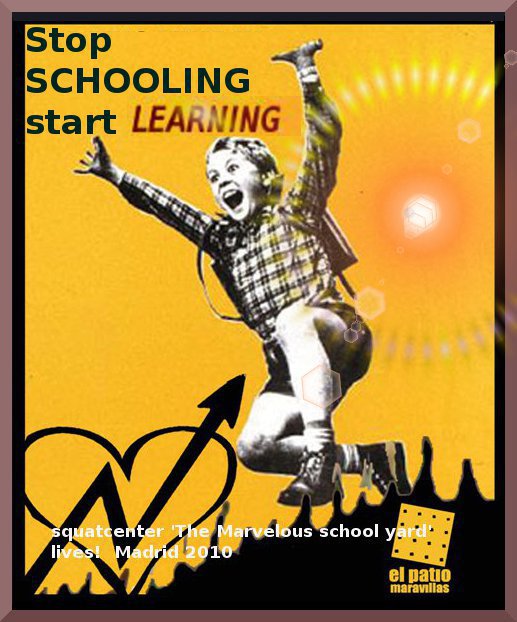 with the rules in his first grade class. But could they entrust a 6-year-old with his education?
“What an enormous risk we were taking with our children’s lives,” Sadofsky said, thinking back. “You’re told to take care of your children and that schools will give them a good education. Suddenly, you’re turning it around.”
But Sadofsky’s kids flourished and are an example of unschooling’s success: one is a mathematician, one is a software coordinator-turned-jam entrepreneur and the third is a geologist.
“They have, and I think this is true of [Sudbury] alumni in general, an incredible sense of who they are and how they work, and confidence in their abilities,” Sadofsky said. “Not that they know everything, but they know how to find what they need.”
Sudbury schools are democratically run, meaning every student and employee has one vote, whatever their age. The only rules are set by the student body and can be changed by a majority. The overlying theme — respect for yourself, others and the property — is taken more seriously, students say, because you’re judged by your peers instead of an authority figure.
Classes are offered but not mandatory — “certifications” are required to use equipment such as sharp cooking utensils. There are no grades. Staff members often do not have a teaching background; they are there simply to guide students in their individual pursuits.
..……….Ben Locke, 21, entered Sudbury Valley as a teen, feeling isolated and unhappy in his public high school.
“It was a radical idea… I’m certain at the time when I made the transition none of us knew exactly what I was getting into.”
Locke spent most of his first year at Sudbury Valley playing video games. Then he discovered the music room across the hall. Eventually he became comfortable enough to spend hours chatting with other students in the common room.
“The conversation in SVS is radically different than in public schools,” Locke said. “There’s no age segregation, no time limit. We would have a wide variety of topics, some of them totally lewd and some of them more deep and philosophical.” Unschooling advocate and former SVS student Freya Sargent said that even seemingly aimless activities like this have a purpose — they lead kids to discover new interests.
“A lot of parents express concern that ‘my kid is going to end up doing nothing,'” Sargent said. “And that may be true for a certain amount of time, but we as a species are very curious and we have this innate need to learn… People may sit around for a while, but then they get bored and they want to be involved.”
Locke is now studying neuroscience at Harvard University — a passion he developed after wondering how music translates across cultures (remember the Mario Bros. theme song?).
Approximately 90% of Sudbury Valley’s graduates go on to college (compared with 69% of graduates from the public education system). Those opposed to unschooling often say students will have trouble adapting to the real world when confronted with grades, tests or working 9 to 5 under an authority figure.
Molly Morningstar isn’t worried. The 19-year-old pre-med student at Hapmshire College in Massachusetts said the freedom she found at SVS didn’t teach her to avoid work — it taught her to work hard at whatever she enjoyed.
“Freedom is a funny word,” she said. “[The] structure of being a doctor is freedom in a sense because it’s what you chose to do with your life. I feel like I’m a very free person right now — but I still work as a barista at a café 30 hours a week. It’s more about taking charge of your time rather than choosing to do nothing.”
READ MORE HERE http://www.cnn.com/2011/US/08/03/unschooling.sudbury.education/index.html?hpt=hp_bn1
DeSchooling for Social Revolution…Read ‘The Free’
This site is hosting 'The Free', a novel set in the coming collapse of Capitalism. In the story schools, along with most State institutions, close down due to lack of funds, but community based free schools take over. Based on self education groups and online OpenUni courses these youth culture gangs are recruited by the Free CoOps as the 'clan militias' which defend the anti capitalist revolution. You can download the amazing 462 page book here for free, or read it online.
for Free Downloads page click https://thefreeonline.wordpress.com/testing-downloads/

 The Free
@Zelenka: I was “completely undisciplined” as an unschooler K-12.
I got a certificate in professional study of photography when I was 17, now run a successful photography business and have begun my master’s level work in Philosophy of Religion after just graduating cum laude with a B.S. in biblical studies. I’m 25.
I never got an HS diploma. I never got a GED. I didn’t learn how to add a fraction until I was 23.
I never had a “normal’ school day. I “worked” my arse off to do everything I’ve done since I was 12.
You decide.
LikeLike
As a teacher in an urban, impoverish school district, I can testify first hand how the system fails children, especially if they have trouble learning in what has come to be know as the conventional setting. And I know that children DO learn best in context, or organically as was stated in the article. My problem with this arrangement is how is classical knowledge passed on? There is some background knowledge that I would not have explored in this setting that would have left me with a shaky foundation upon entering college. Multiplication tables aren’t fun to do. I initially hated anything that had to do with Shakespeare. And I am not sure I would have just picked up a biology book either. Without some direction, children will at best have odd gaps in their learning and at worst flounder and learn very little. Let them learn HOW they want to, but someone, parent or teacher, need to do some guiding
LikeLike
I picked up Shakespeare as a K-12 unschooler because I wanted to and no one told me I had to. My mom said she liked it. I said, “Hey, I’ll give that a look.” Because of Shakespeare, I read Longfellow. Then more Longfellow. Then Emerson and Poe. Then many other classical works. Unlike my peers, who would never pick up a book and HATED classical literature (and continue to see no need for classical literature) I loved them then and love them now.
Children will read if they are not forced to read. They need to be guided to the watering hole and then left alone to drink. If they want to go to a different watering hole: let them.
Also, the article implied that the people at Sudbury are just that: guides.
LikeLike
Sorry. *Unlike my “public schooled peers”*
All of my homeschool friends did the same thing I did 🙂
LikeLike
Cool. Must try that ‘hands off’ on my son
LikeLike
As to the comment preceding the article, many families who unschool don’t send their child to a “private unschool”. They just live and learn together from a life based in their own home. You don’t have to be rich to do that.
LikeLike
Um, so they’re going to be completely undisciplined? People need work. Or they go crazy.
LikeLike
Hi Debbie. I take your point. How nice to have a real comment on this blog!
Hey Zelenka. ‘Discipline’ is a good habit for me, if it comes from inside because I find it helps me enjoy my mind and body. But NOT if its imposed by you to brainwash me.!
LikeLike