La Floresta: Ateneu i Cooperativa desallotjat per Mossos antiavalots


Desallotgen l’antiga seu de Caixa Terrassa a la Floresta

Àgata Guinó
Poble Els Mossos d’Esquadra han desallotjat a primeres hores d’aquest matí el local de la Caixa Terrassa a la Floresta, que estava ocupat des de mitjan novembre. L’espai s’utilitzava com Ateneu i com a seu d’una cooperativa ecològica

L’antiga seu de Caixa Terrassa a la Floresta, ubicada a la plaça Miquel Ros, ha estat desallotjada a primeres hores d’aquesta matí de dimecres pels Mossos d’Esquadra. En el moment de l’entrada dels cossos de seguretat, l’espai no estava ocupat per cap persona. Al matí, els ocupants del local han arribat i han trobat els antiavalots que els hi han permès treure els llibres, materials i altres objectes que tenien dins l’antiga seu bancària.

Els ocupes han lamentat l’actuació policial ja que han explicat que el local donava servei d’Ateneu al barri i que ara cap espai cobrirà aquestes necessitats. També han exposat que abans del desallotjament no havien rebut cap avís judicial. D’altra banda, han afirmat que hi havia una quinzena d’agents antiavalots de la policia catalana, però que no hi ha hagut cap incident i han assegurat que els Mossos s’han portat correctament. Segons fonts dels usuaris del local, els cossos de seguretat han esbotzat la porta principal de l’edifici per entrar. A les nou del matí tres paletes tapiaven la porta d’entrada al local amb rajoles.

Fonts policials han explicat que una dotació d’antiavalots, més tres patrulles de la comissaria dels Mossos d’Esquadra de Sant Cugat s’han desplaçat fins a la plaça Miquel Ros per desallotjar el local ocupat a les set del matí. A més han destacat l’ordre pacífic en què s’ha portat a terme l’actuació.

Ateneu i cooperativa ecològica
El local ocupat donava el servei d’Ateneu del barri. Cada dia es programaven diferents activitats i tallers en els quals podien participar els infants. Per aquest dimecres a la tarda hi havia programat un taller de fang per a la mainada. A més, l’espai s’utilitzava com a seu de la cooperativa ecològica el senglar. Els membres d’aquesta utilitzaven el local per intercanviar productes d’horts ecològics de la zona.

Gay Men Don’t Get Fat ??

I know lots of men who eat salad—straight men, too. At one time, I even knew more male than female vegetarians. However, I also know lots of men who find this hard to believe. Even in New York, there are tons of stereotypes about what kinds of foods are “gay” and which ones are “straight.”

In Gay Men Don’t Get Fat, his nod to the popular French Women Don’t Get Fat, humorist Simon Doonan plays around with these long-held opinions by encouraging straight men to eat more gay food rather than the meaty, fatty “manly” grub he equates with heterosexual eating.

Repsol criminales FUERA de Ecuador YA!

Campaña para la retirada de la subvención a Repsol de los fondos de cooperación española

Contra que con fondos de cooperación al desarrollo se financien actividades que refuerzan la presencia de Repsol en la Amazonía Ecuatoriana

Campaña ciudadana para evitar la subvención, con dinero público, de actividades destinadas a la filantropía e imagen corporativa en el área afectada por el Bloque 16, en Ecuador. Los importantes pasivos ambientales e impactos sociales de la actividad hidrocarburífera obliga a esta compañía a realizar campañas en miras de apaciguar los reclamos y el descontento de la población.

La Agencia Española de Cooperación Internacional para el Desarrollo, AECID, ha concedido recientemente una subvención a la Fundación Repsol YPF del Ecuador por un monto total de 149.932 euros, para la ejecución de un proyecto en zona de influencia de la operación de Repsol YPF en la Amazonía ecuatoriana. (Resolución de 25 de noviembre, CAP 2º procedimiento, línea II.7) Las actividades de Repsol en América Latina y, específicamente, en Ecuador, han sido ampliamente denunciadas por la sociedad civil a ambos lados del Atlántico por daños ambientales, sociales y violaciones de los derechos humanos de las comunidades y pueblos afectados.

En Ecuador, Repsol opera el Bloque 16, ubicado sobre el territorio ancestral del pueblo waorani, afectando también a población kitchwa, gran parte del Parque Nacional Yasuní y el territorio intangible de los pueblos no contactados Tagaeri y Tagomenani. Repsol ejerce soberanía territorial sobre el Bloque 16, controlando la entrada y salida de personas, en clara violación de los derechos territoriales de los publos afectados. A pesar de la falta de información sobre la situación en el interior del Bloque, Repsol se ha visto obligada a reconocer el vertido de 14.000 barriles de crudo en 2008. Existen denuncias recurrentes sobre el aumento de enfermedades relacionadas con la actividad petrolera y daños hídricos y ambientales en la zona.

Se puede firmar la petición a través del formulario del siguiente enlace:

http://actuable.es/peticiones/pide-…

también se puede copiar y enviar el siguiene texto a : centro.informacion@aecid.es

DESTINATARIO: DIRECTOR DE LA AGENCIA ESPAÑOLA DE COOPERACIÓN INTERNACIONAL repsolmemata

scribo para mostrar mi preocupación por la reciente concesión de una subvención a la Fundación Repsol YPF en Ecuador. Repsol incurre en prácticas contrarias a los derechos humanos internacionalmente reconocidos, así como los principios recogidos en la política de la cooperación española, el Plan Director y estrategias sectoriales tales como la Estrategia de la Cooperación Española con los Pueblos Indígenas. Solicitamos que no se utilice el dinero público computado como Ayuda Oficial para el Desarrollo para financiar proyectos de empresas trasnacionales que, además de tener cuantiosos beneficios (más de 4.000 millones de euros en 2010), muestran poco respeto por las normas socio-ambientales y los derechos humanos internacionalmente reconocidos. Confío en que AECID cumplirá con los compromisos asumidos por España internacionalmente.  Atentamente,

Domingo 1ro de enero de 2012, por

http://repsolmata.ourproject.org/spip.php?article212

feminism: Occupying the Occupy Movement

Occupying the Occupy Movement

Robin Morgan   January 3, 2012   Women’s Media Center

An Occupy movement for 2012 could gain strength and staying-power with strategies suggested by an emerging feminist critique.

As women of the Arab Spring are rediscovering, being participants, even leaders, of the uprisings hasn’t led to women’s equality—a depressingly familiar scenario, notoriously reminiscent of the 1960s aftermath of the Algerian revolution. In fact, the phenomenon is historically omnipresent (including the American revolution).

Here in the Global North, for example, women were active early in the Occupy movement. Yet that movement has presented an optic of being  predominantly male (and in the United States, white and young)—as well as indifferent to the fact that capitalism simply cannot be transformed without confronting its foundation: patriarchy, itself reliant on controlling and exploiting women. And women, by the way, comprise 51 percent of the 99 percent (and virtually zero of the 1 percent).

Who then is the real constituency in need of economic justice?

The United Nations acknowledges that the world’s poor are 70 percent female. Women’s unpaid labor is worth $11 trillion globally, accounting for 41 percent of the GDP in, for instance, North America. It could well be argued that, given women’s massive amount of unpaid labor—and since women are the means of reproduction who produce the labor force itself—most women exist more under feudalism than under capitalism.

Join Us!  Subscribe to WAMMToday from our blog website and “Follow” us.  www.wammtoday.wordpress.com.   
WAMMToday is now on Facebook!   Check the WAMMToday page for posts from this blog and more! “Like” our page today.

Equal pay, reproductive rights, maternity leave, childcare—all are economic as well as human-rights issues. So are sweatshop labor/maquilliadores, sex trafficking/slavery/tourism, and war’s impact on women, who with their children comprise some 80 percent of refugees and displaced peoples. Women are the primary caregivers for the ill, the young, the aged, and the dying—so health costs are “women’s issues.”The pornography and prostitution industries each run into the hundreds of billions of dollars annually; China spends $27 billion just on Internet pornography. We only have statistics for a few “developed” countries on the staggering cost of domestic violence. We do know that domestic violence costs $5.8 billion a year in the United States alone.

One would think that such “women’s issues” would make unarguable the centrality to economics of female human beings. Wrong. Too often, the Occupy movement has betrayed its own vision by revealing itself as a sexist microcosm of the society it opposes. Harassment and assaults required women to define safe sleeping areas—immediate necessities yet questionable strategically, since these can become “ghettos,” while the problem, a  male sense of entitlement, goes unchallenged.

Nor does this happen only in the United States, although North American sites got more press attention. Incidents of sexual assault and rape have been reported not only in New York, Cleveland, Dallas, and Baltimore, but in Glasgow, Montreal, London, and more. In some locations, male site monitors were reluctant to call police for fear that negative attention would be deleterious

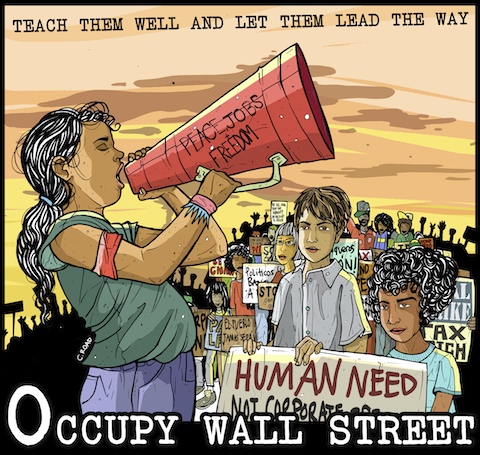
by Christy C. Road

to the Occupy “message.”

Brooklyn, Occupy Imnop, from Occuprint.org

Now, however, women are protesting that kind of protest. In Bristol, England, feminists called for “Carrying Our Safe Space With Us,” aiming to empower women to speak at Occupy general assemblies. On November 25, International Day for the Elimination of Violence Against Women, Feminists Occupy London took to the streets denouncing rape; that same day, Italian women marched in Rome, defining economic austerity measures as a form of violence against women, and citing policies that in effect force women to work multiple jobs, paid and unpaid. In Manila, Occupy was taken over by women, becoming Occupy RH (reproductive health), Filipina-led. Women in Slovenia, New Zealand, and Australia publicly decried the lack of safety for women at Occupy sites.

Such international groups as Code Pink, WomenOccupy, RadFem, the Filipina network Af3IRM/GabNet, and others raised women’s profile, thus challenging men’s hegemony. The Feminist Peace Network established the Occupy Patriarchy website, to  provide a supportive, global space for  feminist analysis, response, organizing, and networking within the global Occupy movement.

Having caught the world’s imagination with an admirable energy, seemingly spontaneous and seemingly grassroots,  the Occupy movement is now poised at a crossroads. It has enormous potential—but lasting change will require consciousness that doesn’t ignore the majority of  humanity. It needs to break free of being “a guy thing” or risk drowning in its own rhetorical generalities.It’s not as if certain models aren’t there. The women of England’s Greenham Common “occupied” turf decades before OWS—they endured, and won. Irish women barred doors to keep men from storming out of Northern Ireland peace talks. Women in Liberia sat singing for months in a soccer field to birth a revolution. Market women in Ghana brought down a government. Gandhi acknowledged copying the concept of  Satyagraha— nonviolent resistance—from India’s 19th century women’s suffrage movement.

These are  different—and long-lasting—techniques of protest, by which at first it seemed the Occupy movement was influenced. (At the risk of offending anarchists, I’ll paraphrase two of the Women’s Media Center slogans: “You have to name it to change it,” and “You have to see it to be it.” As a woman who once agreed “Level everything, then we’ll talk politics,” I recommend examples and clearly articulated demands as pretty good stuff.

It’s not too late. As the Occupy movement in many areas moves away from the tactic of claiming physical space, a change of protest style is in order: more hit-and-run, engage-disengage, morning-long, afternoon-long, or day-long (not open-ended) demonstrations—plus focused, doable demands.

Most women have far too many other responsibilities—including children—to spend months in tents playing drums, even if the tents were safe spaces. The Occupy movement needs women—the numbers, the economic analysis, the different strategic approach—to survive, let alone succeed. Yet women’s engagement with it might well require turning up in numbers massive enough to effect a de facto transformation of leadership and focus;:occupying Occupy in a “women’s style” could make all the difference.At the minimum, it should be possible to demand that men become the change they claim they want to see.  (I mean,really, guys.) If Occupy men can dare be unafraid of that different kind of leadership—can even seek it out and welcome it—everyone wins and the paradigm is transformed.

If not, they will at least have radicalized a whole new generation of feminists.

Women’s Media Center  (reblogged whole article with thanks)