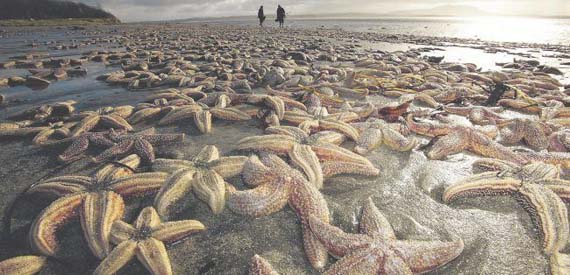
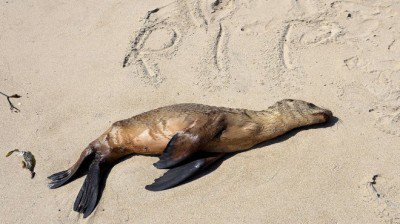
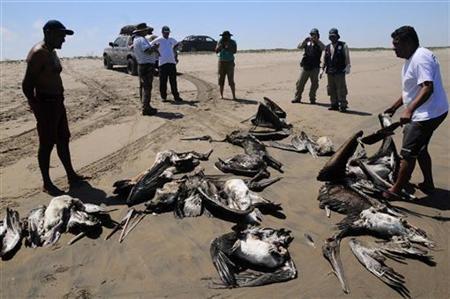
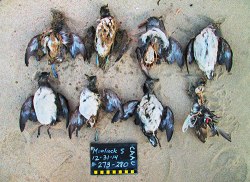
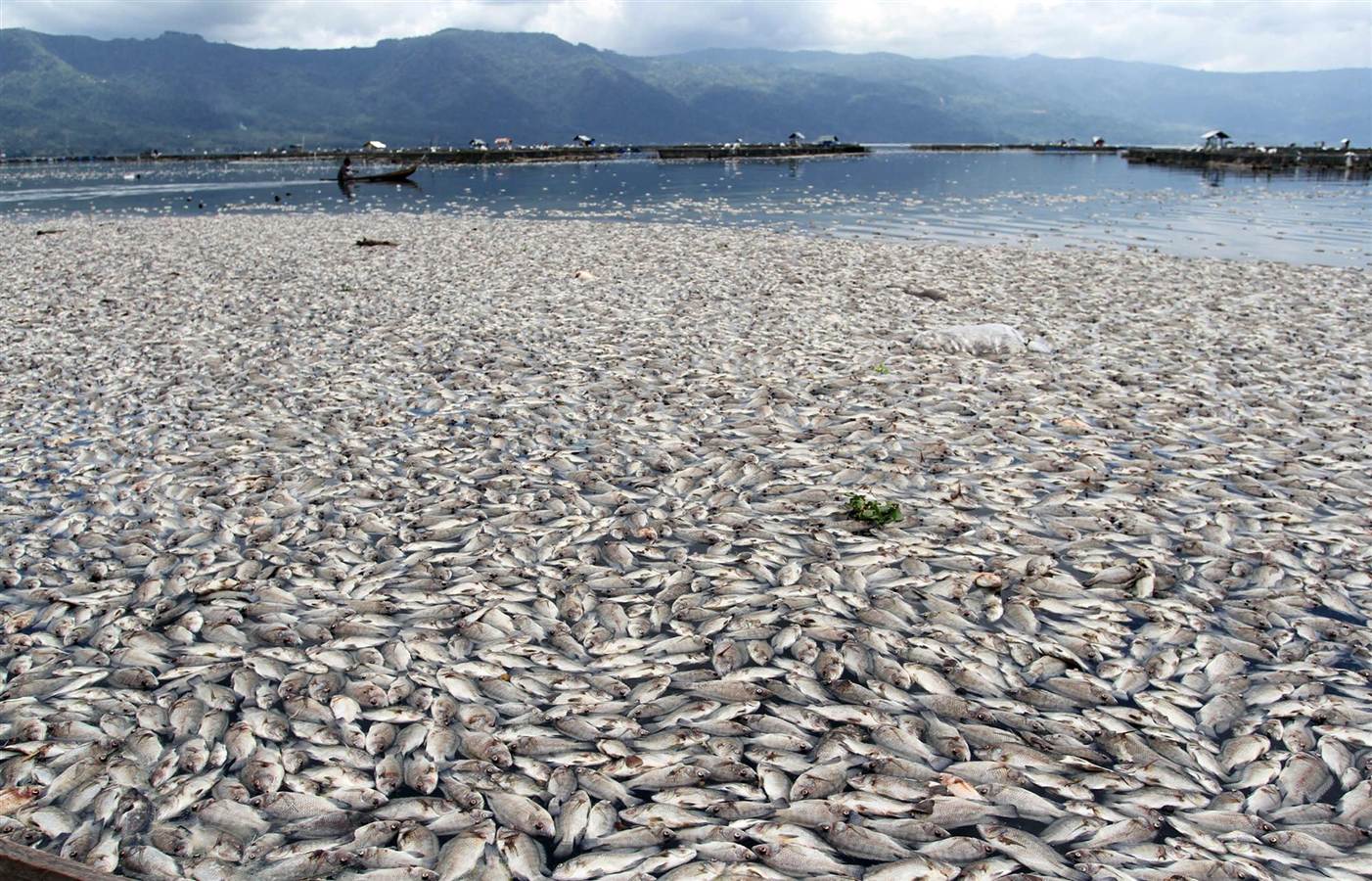
 Due to Global Overheating in the context of predator capitalism the oceans have never been hotter or more contaminated in human history, causing the death of coral reef ecosystems, spreading dead zones, lethal acidification, nuclear radiation damage, etc. In this context it is not surprising that beaches on the US west coast and worldwide are becoming sadly littered with the bodies of our fellow creatures on an unprecedented scale.
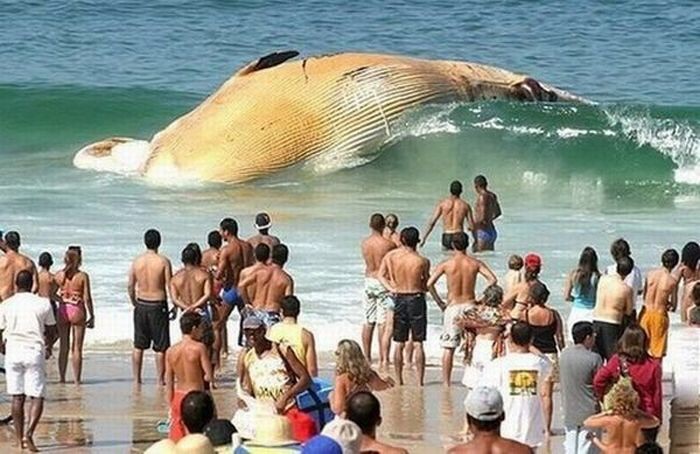 Giant whales found dead on west coast beach — Second largest animals on planet — Official: “It’s never happened… Extremely unusual… Very rare and odd… We want to know why” — Gov’t scientists testing for Fukushima radiation — Backlog at lab due to so many recent deaths ENENews
West Coast devastation continues: seals, oysters, pelicans, fish, squid — all sick, dying or failing to breed by Ethan A. Huff,

Much of the carnage is being reported in California, where baby sea lions in distress have been washing ashore in record numbers. The Wall Street Journal (WSJ) reports that, for the second year in a row, more baby sea lions than ever are having trouble surviving after being abandoned by their mothers, the direct result of a lack of food.According to reports, a record 367 California sea lions were 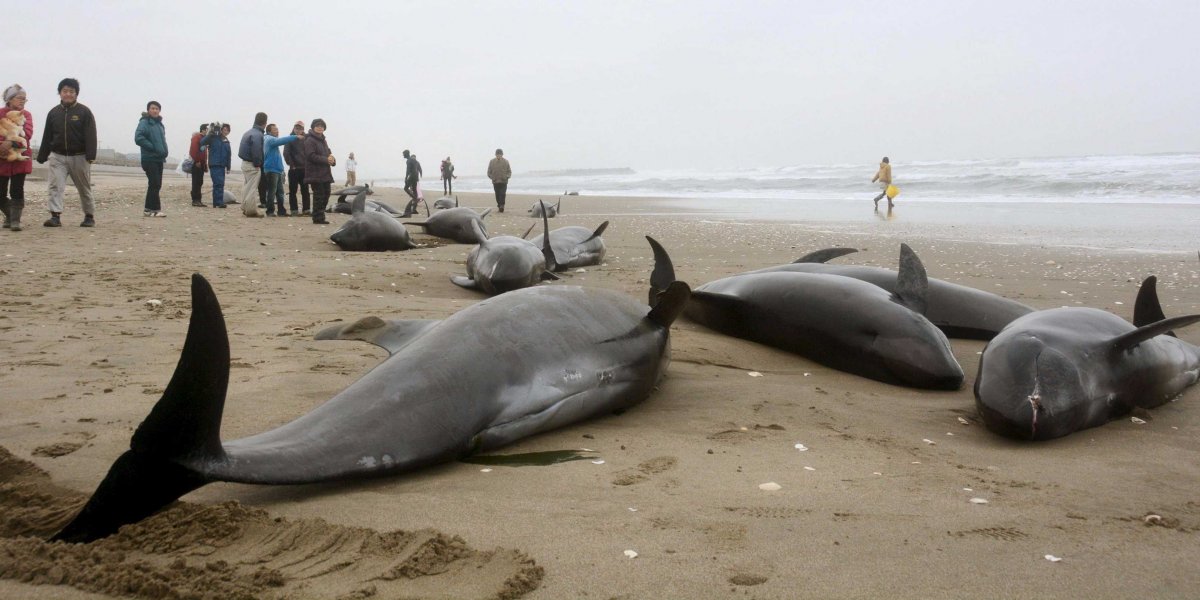 admitted to the Marine Mammal Center near San Francisco between January and May, which is nearly five times the normal average. In Southern California, more than 600 sea lions, or twice the normal average, have been taken in so far this year. This is on top of the 1,600 that were treated last year.
“Sea lions are living and feeding on the same resource[s] as humans are,” stated Shawn Johnson, director of veterinary science at the Marine Mammal Center, to WSJ. “If they are starting to have problems, that shows there could be a problem with the ocean.”

Also suffering along the Alaskan coast are Alaskan ice seals, more than 250 of which have developed a mystery disease that often results in death. Experts have postulated that toxic algal growth along coastal waters may be to blame, and this a result of excess sun exposure due to continued ozone depletion.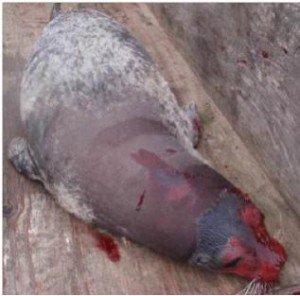
“In all, the federal government has declared 38 ‘unusual mortality events’ involving marine mammal species since 2003,” wrote Jim Carlton for WSJ. “That is nearly twice the number of events recorded from 1991–when the animals were put under greater federal protection–to 2002.”
Over on the other side of the country, hundreds of manatees and about 80 bottlenose dolphins were discovered stranded in Florida’s Indian River Lagoon between 2012 and 2013. And in South Carolina in 2013, as many as 40,000 menhaden fish, which measure between six and eight inches in length, washed up dead between DeBordieu Beach and Pawleys Island, just one week after thousands of the same type of fish washed up along North Carolina’s Masonboro Island.
One year prior, thousands of dead starfish washed up along the same beaches.
Back in California, changing weather patterns that some scientists are attributing to the weather phenomenon known as El Nino are causing fish and whales to appear in unusual places. The first ever yellowfin tuna fish was recently caught in San Diego, as well as the first dorado Mahi Mahi fish. These fish types typically do not appear in San Diego.
MASS MORTALITY EVENT CONFIRMED
“We’ve already started to see very unusual fish catches here,”  stated Tim Barnett, a marine research emeritus with the San Diego-based Scripps Institute of Oceanography, to KPBS. “The first yellowfin tuna was caught in May–that has never happened before to anybody’s recollection.
“And the other thing too is the first dorado (mahi-mahi)–first of June. That has never happened before. They really like the warm water and you normally don’t see them here until September.”
Ocean mortality events mark beginning of possible global extinction
Since these types of fish don’t normally live in the colder waters off the coast of California, their fate is basically already sealed like the rest of the dead animals that have previously been discovered. Add to this the millions upon millions of dead sea stars being identified up and down the Pacific West Coast and the world has a real problem on its hands.
“It’s the largest mortality event for marine diseases we’ve seen,” added Drew Harvell, a marine epidemiologist at Cornell University, to KUOW News about the phenomenon. “It affects over twenty species on our coast and it’s been causing catastrophic mortality. … My expectation is that within the next month all of the stars will die.”
Whether it’s radiation from Fukushima, residual oil and chemical pollution from the BP oil spill in the Gulf, changing weather patterns, or some combination of all three, one thing is for sure — the world’s oceans are sick. And based on the way things are going, a global extinction event of epic proportions seems like less a matter of if, and more a matter ofwhen.
Sources for this article include:
http://enenews.com
http://www.kpbs.org
 http://usnews.nbcnews.com
CKNW News Talk 980, Nov 18, 2015 (emphasis added): The Department of Fisheries and Oceans is looking into the death of three fin whales near Bella Bella on BC’s central coast… Paul Cottrel with the DFO says a multiple death like this is extremely unusual. “We just get one or two a year, and usually never in the same area like this, or on the same beach which iseven more rare. So that’s why it’s definitely a very unique situation.” He says all three whales were juvenile males, two of them likely younger than two-years-old… He says there were no bite marks on the carcasses, or any signs of boat strike either. Cottrel says the DFO conducted a necropsy, but found no obvious cause of death.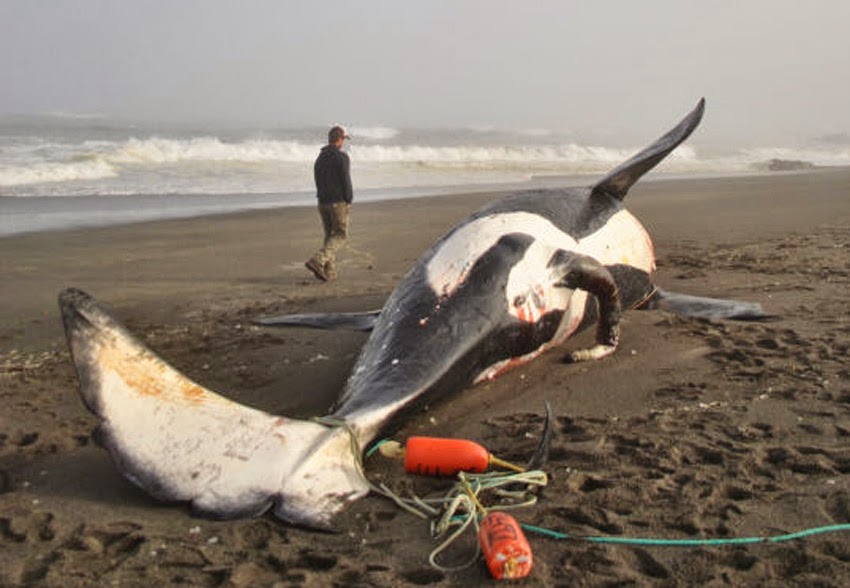
Global News, Nov 19, 2015: Questions raised after carcasses of 3 dead fin whales found near Bella Bella… “It is very rare and odd that you get three large whales together in one small area,” says Cottrell. “We want to know why it happened, whether it is a natural event, killer whale predation or something else.” Cottrell says, to his knowledge, it has never happened in B.C. before, which is a source for concern. The fin whales are listed as threatened under the Species At Risk Act… and are the second-largest animal on the planet  after blue whales. “Any time you get three animals that wash up and die together and it is a threatened species, we are going to work hard to figure out what happened,” he says… “Given the location and where they ended up, all close together, we are thinking that the animals likely live stranded and died there together”…
Vancouver Sun Nov 19, 2015: The recent deaths of three young fin whales near Bella Bella are causing concern after a summer that saw an unusual spike in large whale deaths… “Fin whales are listed as threatened under the Species at Risk Act, so every animal is extremely important to the population. Seeing three together, obviously it’s disturbing and we want to find out what happened,” Cottrell said. He added that it’s very unusual for baleen whales like fins to die in groups… Samples have been taken from the whales’ stomachs and colons… The results of lab tests may take a while, though, because of a backlog caused by a pulse of large whale deaths this summer along the West Coast of North America. “We’re really working everybody pretty hard, and these three fin whales doesn’t lessen the load at all,” Cottrell said. Four humpback whales were found dead in a single week in B.C. waters in August, and as of this week, five fin whale carcasses have been discovered. One sperm whale and one grey whale have also died this year. Meanwhile, more than 30 large whales have died off the coast of Alaska. Scientists have yet to determine why so many whales have died… Scientists are also testing for radionucleotides to see if radioactivity was a factor.
Coastal Guardian Watchmen Network, Oct 27, 2015: Heiltsuk Guardian Watchmen found this large plastic tote and a tire… near Bella Bella yesterday. Tsunami debris is still arriving…
Published: November 20th, 2015 at 4:55 am ET
|

Related Posts
- Giant whales found dead up & down Pacific NW coast, scientists ‘baffled’ over surge — 25+ carcasses reported in past month — Gov’t: “Troubling… Definitely a pulse of deaths” — Experts: “Alarming spike… Exceptionally rare to see a dead humpback” — Concerns about unidentified pathogen (PHOTOS) August 13, 2015
- Skyrocketing deaths on West Coast — Experts: “Extreme Mortality Event… dying in such high numbers… such great numbers… very concerned” — “It’s so mysterious… What is going on here?!” — “Possibilities like fallout from Fukushima” — Only 2 full necropsies on 700 deaths (VIDEOS) September 2, 2015
- ‘Astonishing’: World’s rarest whale spotted near Canada’s Pacific coast — “First confirmed sighting in recent history” — Two seen in last few months after none in 60+ years — Some “migrate to the area around Japan” — “Nasty looking but healed wound” on upper jaw (PHOTOS) November 7, 2013
- Scientists mystified by unusual strandings of large sea creatures on West Coast — TV: “In 3 weeks, 5 dead whales have now beached along the Northern California coast” — “It’s totally something new, something strange”… “This is kind of eerie, what are the odds of two dead whales in same place?” (VIDEO) May 11, 2015
- Scientists present links between unusual Alaska seal deaths and Fukushima fallout — Skin lesions, hair loss, lethargy — ‘Pulsed release’ when built-up radionuclides were set free as ice melted — “Wildlife health implications” due to radiation exposure discussed (PHOTOS & MAP) January 25, 2014

 The Free