

from Hazards of Liquefied Natural Gas (LNG): Ría de Huelva, Ferrol, https://huelvadenuncia.wordpress.com
translation by thefreeonline, illustrations etc. added
The worst danger of ‘natural’ gas is irreversible climate chaos. With the new IPCC report it is seen that gas cannot be a “bridge fuel” to reach renewables, there is no time. Furthermore, it is increasingly accepted that gas is just as dangerous as coal, (and fracking gas at least twice as dangerous), due to the inevitable methane leaks, hidden by the industry. It is way past time to abandon “natural” gas in favor of renewables.

And there is another reason to stop gas, especially LNG, because of its high danger, as we see in the reports below:
Hazards of liquefied natural gas (LNG) summary by Choco Toxico ..
To transport natural gas, it is subjected to a liquefying process, cooling it to -161º C. In this liquid state, the gas volume is reduced 600 times.
Once liquefied, it is transported in so-called methane tankers, capable of loading between 120 and 200 million liters of Liquefied Natural Gas (LNG).
Arrived at its destination, the LNG is transferred to huge tanks, where it will be stored in a liquid state, until it is regasified for sale and distribution, hence these are called regasification plants……….
SEE FULL REPORT TRANSLATION FURTHER BELOW
”Flammability … Almost all cargo vapours are flammable. When ignition occurs, it is not the liquid which burns but the evolved vapour that burns….Vapour cloud explosions and boiling liquid expanding vapor explosions are the most grave flammability hazards on gas carriers”… Wikipedia
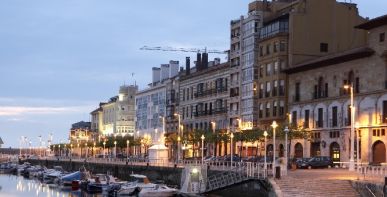
Huelva city
In the vicinity of the city of Huelva there is currently a large regasification plant located at the facilities of the Outer Port, owned by Enagas. LNG is an extremely flammable and explosive substance. One of the most powerful non-nuclear explosives known.
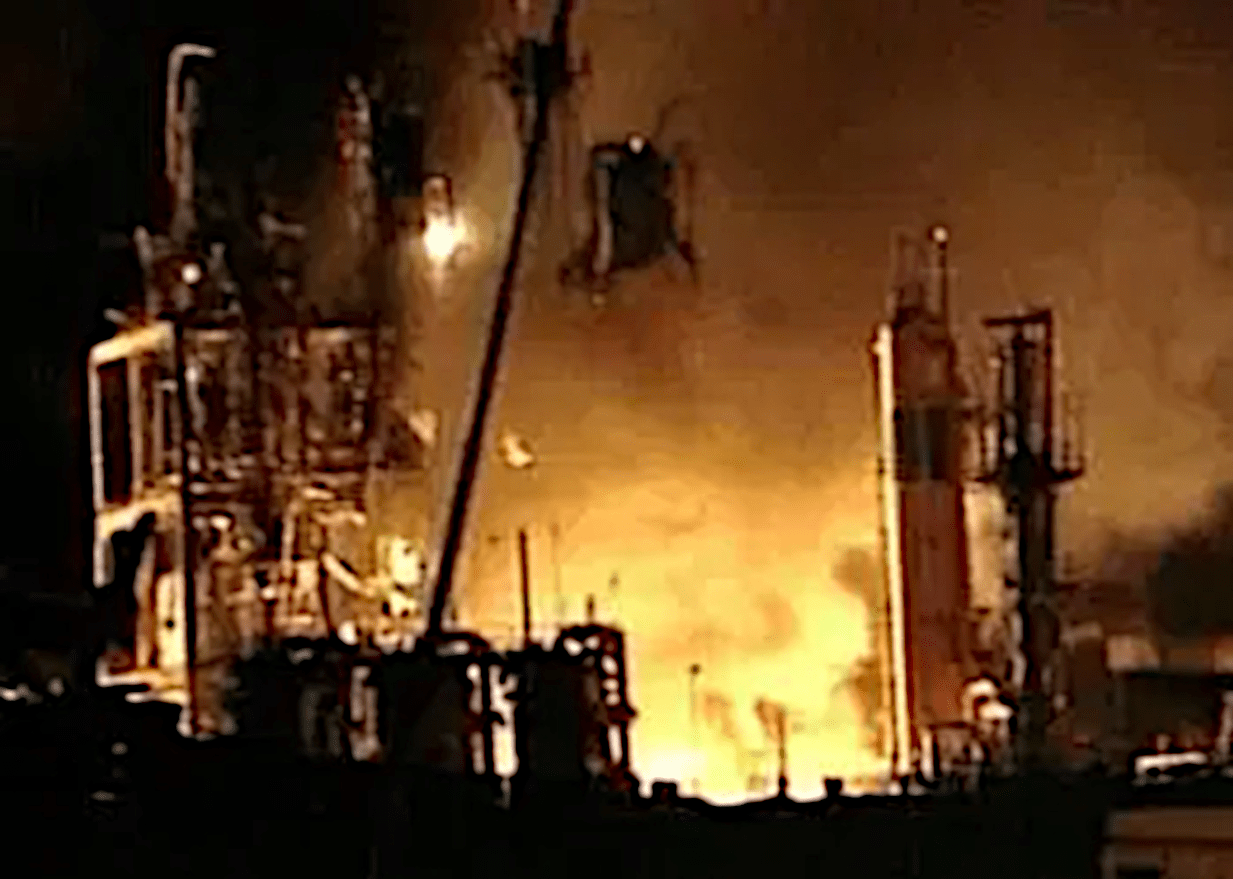
The explosion of a large LNG gas plant in Algeria caused 27 deaths and 74 injuries… El Pais Algerian refinery blast toll reaches 23 – The Irish TimesThe explosion, the worst LNG accident for nearly 30 years, ripped through the vast … last night, caused at least 74 injuries and shut down all activity at the oil and gas … A French and a Turkish worker died in the blast, officials told journalists. … Skikda is Algeria’s largest port and handles the majority of the country’s crude, …
The greatest risk of fire or explosion occurs in the process of loading and unloading LNG carriers. If a spill occurs with ignition of the entire cargo, a cloud of fire would be generated that would devastate some 4,500 hectares around the wrecked ship, equivalent to 20 to 30 nuclear bombs like the one in Hiroshima. Human or technical failures, ship collisions, windstorms or earthquakes could cause a spill to be triggered.
In Huelva, the situation is turning dantesque as the regasification plants and their discharge pontoons have been installed around one of the largest refineries in Europe, Cepsa’s in Palos de la Frontera.
A real madness. In the event of the explosion of one of the LNG ships that enter the Huelva estuary every week, the radius of the devastation could be about 10.5 km, destroying the towns of Palos, Mazagón, Punta Umbría and the city of Huelva.
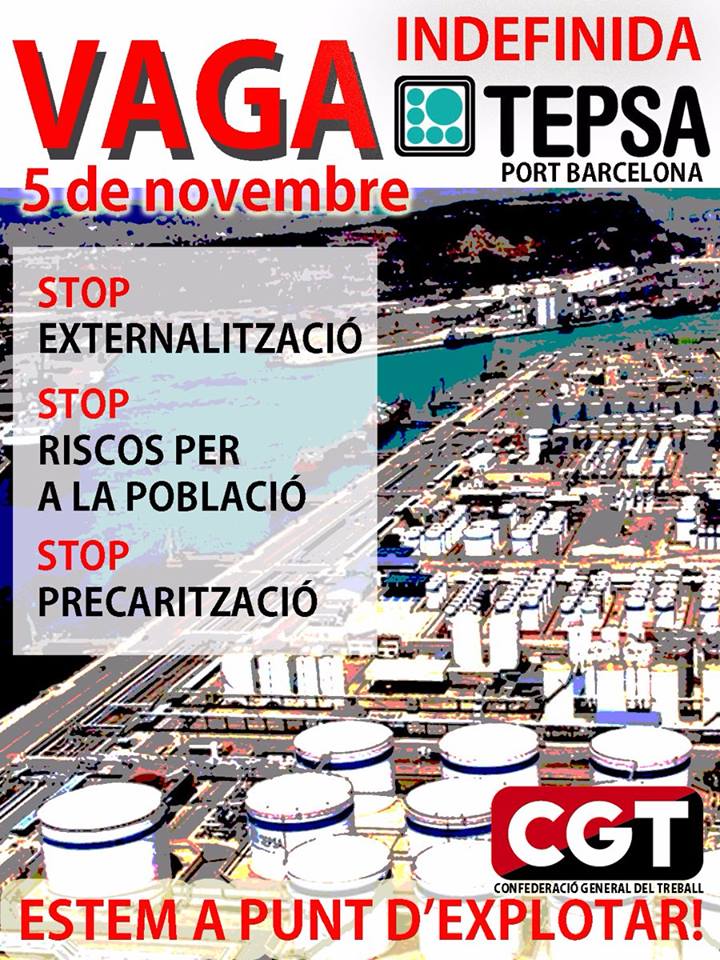
Poster for 2018 port strike against dangers and precarious work … Global Anti Frack Day .. #GasDownFrackDown October 14, 2018..”WE are About To EXPLODE”
Reganosas Fight against LNG in Ferrol
Accidents happen (Bhopal-1984, Senghenydd-1913, Chernobyl-1986, Oppau-1921, Savar-2013, …), thousands and thousands of them, unforeseen, or due to technical and human factors. Prevention is a fundamental part of security, and a gas plant like Reganosa, built with favoritism of those in power, should never have been built.

Located next to a chemical plant (Atlantic Forest) that stores thousands of tons of toxic and highly flammable products, there is a power plant and a glue factory (Imegasa), a few meters from the town center of Meá, 700 meters away. IT IS 1000m from the Military Arsenal of the town of Mugardos, 2000 from the Center of Ferrol, it is not a safe plant, because it does not respect the principle of prevention, with the location of two population centers so few meters away.
After four court sentences against the regasification company of Mugardos, the Spanish government resolved to exempt Reganosa from an environmental impact assessment, so as not to comply with the sentences of the Supreme Court.

Comparison of photos from Beirut explosion and the LNG plant of Reganosa in Galicia, Spain.”This Citizen Emergency Committee addresses a letter to the President of the Xunta de Galicia, Alberto Núñez Feijoo, reminding him of the illegalities that the Administration he chairs, among others, has been protecting for 20 years, in the REGANOSA Gas Plant, of which he is a shareholder with Tojeiro Group”.
Citizen Emergency Committee for the Ría de Ferrol /Comité Cidadán de Emerxencia para a Ría de Ferrol/

History of some accidents in the LNG industry (to 2005)
www.laohamutuk.org › Oil › LNG › app4The resulting explosion and fire killed 128 people. … Jules Verne Spill, Arzew, Algeria. LNG liquid spill caused by overflowing of a cargo tank that resulted in the … This led to the flow of natural gas into the tank while it was being constructed. … and fire destroyed a portion of the LNG plant and caused 27 deaths, 74 injuries, …
Link to Index and Table of Contents
| 1944 | Cleveland, Ohio, USA | At the peak-shaving plant a tank failed and spilled its contents into the street and storm sewer system. The resulting explosion and fire killed 128 people. The tank was built with a steel alloy that had low-nickel content, which made the alloy brittle when exposed to the extreme cold of LNG. |
| 1964 | Arzew, Algeria | During loading operations, lightning struck the forward vent riser of the Methane Progress and ignited vapor which was being routinely vented through the ship venting system. A similar event happened early in 1965 while the vessel was at sea shortly after leaving Arzew. In both cases, the flame was quickly extinguished by purging with nitrogen through a connection to the riser. |
| 1965 | Jules Verne Spill, Arzew, Algeria | LNG liquid spill caused by overflowing of a cargo tank that resulted in the fracture of the cover plating of the tank and adjacent deck plating. |
| 1965 | Methane Princess Spill | LNG discharging arms were disconnected prematurely before the lines had been completely drained, causing LNG liquid to pass through a partially opened valve and onto a stainless steel drip pan placed underneath the arms. This caused a star-shaped fracture to appear in the deck plating in spite of the application of seawater. |
| 1969 | Portland, Oregon, USA | An explosion occurred in an LNG tank under construction. No LNG had ever been introduced into the tank. The cause of the accident was attributed to the accidental removal of blinds from natural gas pipelines which were connected to the tank. This led to the flow of natural gas into the tank while it was being constructed. |
| 1971 | La Spezia, Italy | This accident was caused by “rollover” where two layers of LNG with different densities and heat content form. The sudden mixing of these two layers results in the release of large volumes of vapor. In this case, about 2,000 tons of LNG vapor discharged from the tank safety valves and vents over a period of a few hours, damaging the roof of the tank. |
| 1972 | Montreal, Quebec, Canada | A back flow of natural gas from the compressor to the nitrogen line occurred during defrosting operations at an LNG liquefaction and peak shaving plant in Montreal East. The valves on the nitrogen were not closed after completing the operation. This caused over-pressurization of the compressor and the natural gas entered the control room (where operators were allowed to smoke) through the nitrogen header. An explosion occurred when an operator tried to light a cigarette. |
| 1973 | Staten Island, NY, USA | In February 1973, a fire started while repairing the interior of an empty storage tank at Staten Island. The resulting increase in pressure inside the tank was so fast that the concrete dome on the tank lifted and then collapsed down inside the tank killing the 37 construction workers inside. |
| 1974 | Massachusetts Barge Spill, USA | After a power failure and the automatic closure of the main liquid line valves, 40 gallons of LNG leaked as it was being loaded on a barge. The LNG leaked from a one-inch nitrogen-purge globe valve on the vessel’s liquid header, causing several fractures to the deck plates. |
| 1977 | Aquarius Spill, Bontang, Indonesia | During the filling of a cargo tank, LNG overflowed through the vent mast serving that tank. The incident may have been caused by difficulties in the liquid level gauge system. The high-level alarm had been placed in the override mode to eliminate nuisance alarms. |
| 1978 | Das Island, U.A.E. | An accident occurred due to the failure of a bottom pipe connection of an LNG tank. The tank had a double wall (a 9% nickel steel inner wall and a carbon steel outer wall). Vapor from the outer shell of the tank formed a large heavier-than-air cloud which did not ignite. |
| 1979 | Mostafa Ben Bouliad Spill, USA | While discharging cargo at Cove Point, Maryland, a check valve in the piping system of the vessel failed releasing a small quantity of LNG. This resulted in minor fractures of the deck plating. |
| 1979 | Cove Point, Maryland, USA | In October 1979, a natural gas leak at Cove Point caused an explosion killing one plant employee and seriously injuring another and causing about $3 million in damages. |
| 1983 | Bontang, Indonesia | A rupture in an LNG plant occurred as a result of over-pressurization of the heat exchanger caused by a closed valve on a blow-down line. The exchanger was designed to operate at 25.5 psig. When the gas pressure reached 500 psig, the exchanger failed and the explosion occurred. |
| 1987 | Mercury, Nevada, USA | In August 1987 an accidental ignition of an LNG vapor cloud occurred at the U.S. Department of Energy Nevada Test Site during large-scale tests involving spills of LNG. The cloud was accidentally ignited and damaged and propelled polyurethane pipe insulation outside the fence. |
| 2003 | Bintulu, Malaysia | A major fire occurred in the exhaust system of the propane gas turbine in the first train (Train Number 7) of the MLNG Tiga project at the Petronas’ LNG Complex. |
| 2004 | Skikda, Algeria | A steam boiler that was part of an LNG production plant exploded, triggering a second, more massive vapor-cloud explosion and fire. The explosions and fire destroyed a portion of the LNG plant and caused 27 deaths, 74 injuries, and material damage outside the plant’s boundaries. |
| 2004 | Ghislenghien, Belgium | A pipeline carrying natural gas from the Belgian port of Zeebrugge to northern France exploded, resulting in 23 known fatalities. The cause of the incident is still under investigation but it appears that a contractor accidentally damaged the pipe. |
| 2004 | Trinidad & Tobago | In June 2004, workers were evacuated after a gas turbine at Atlantic LNG’s Train 3 (Trinidad & Tobago) facility exploded. |
| 2005 | District Heights, Maryland, USA | A Washington Gas Company-sponsored study released in July 2005 pointed to subtle molecular differences in the imported liquefied natural gas the utility began using in August 2003 as the cause of a house explosion in March 2003. |
| 2005 | Nigeria | A 28-inch LNG underground pipeline exploded in Nigeria and the resulting fire engulfed an estimated 27 square kilometers. |
·

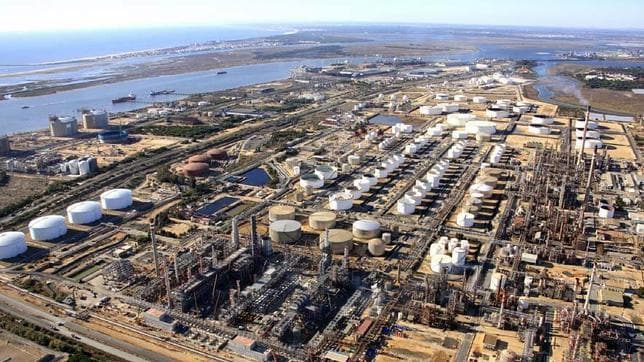
Aerial view of Enagas and Refinery From left to right: Metanero + Enagas Refinery + Cepsa Refinery in the Outer Port, municipality of Palos de la Frontera (Huelva). An unacceptable risk.
Full Report: Hazards of Liquefied Natural Gas (LNG)
Dangers in Huelva:31.01.2012 · from Huelvadenuncia.org ·
To transport natural gas (mainly composed of methane) from the extraction sites to the destination countries, it is subjected to a liquefaction process, for which impurities are previously extracted, basically water and carbon dioxide, after which it is cooled down to -161 Cº, so that the volume that the gas occupies is reduced 600 times.
In this liquid state is how gas is transported in the so-called LNG tankers, which are capable of transporting between 120 and 200 million liters of LNG.
Thus, the volume of gas transported by a LNG carrier is equal to 600 times its size. ….
At the port of destination, the LNG is transferred to huge tanks, where it will be stored in a liquid state, cryogenized at that very low temperature, until it is regasified for sale and distribution, hence these plants are called Regasifiers.

Some ships are now being powered by ”ECO” LNG.. but is LNG really less pollutive and Climate destructive than filthy diesel bunker oil? Gas is less pollutive, but when you add in huge methane leaks, flaring, transport, conversion to LNG, shipping, reconversion to normal gas, etc it may be equally as bad, and if it is made from Frack Gas from the US it may be much worse, even than coal.
In the vicinity of the city of Huelva there is currently a large regasification plant, owned by Enagas, located at the Outer Port facilities. A second regasification plant is being planned in the same location, promoted by the Villar-Mir group, owner of Fertiberia.
More information in:chocotoxico.blogspot.com.es/2012/01/los-riesgos-del-gas-n…
Liquefied natural gas (LNG) is an extremely flammable and explosive substance. LNG is one of the most powerful non-nuclear explosives known.

LNG, in the event of a leak from the tanks of LNG tankers, can, on the one hand, transform into steam, generating a heavy “cloud” that will spread at the mercy of the wind, and that in case of encountering any spark (generated for example in any electrical process, lighting a bulb, switch, starting a motor) or a small flame will ignite generating a cloud of fire that will calcinate everything in its path.
LNG leak Shows Jordan Cove Project too risky for Coos Bay ‘For 35 years I have worked as a firefighter. I know the Jordan Cove liquefied natural gas (LNG) export terminal puts our communities at too high a risk. Last…’ theworldlink.com
Moreover, it is proven by the laboratories of the gas companies themselves, that in certain weather conditions, in conjunction with the amount of leakage, LNG can ignite on its own without the need for external ignition. Under ambient conditions, the air / natural gas mixture is flammable when the natural gas content is between approximately 5% and 15% by volume of the air.
The following video shows the extreme flammability of LNG in an exercise conducted by a fire department. The vapor that expands like a heavy cloud is equivalent to a few liters of LNG, it is easy to imagine how a fire of millions of liters can become, which are those loaded by a LNG carrier or stored in the tanks of the regasification plants.
see BLEVE video above
Another possible risk of LNG ignition is determined by the occurrence of the phenomenon known as BLEVE, which is the acronym in English for “boiling liquid expanding vapor explosion” (explosion of vapors that expand in boiling liquids).
This type of explosion is what can occur in the tanks of methane tankers or regasification plants that store liquefied gases, when they overheat in the event of a fire outside of them.
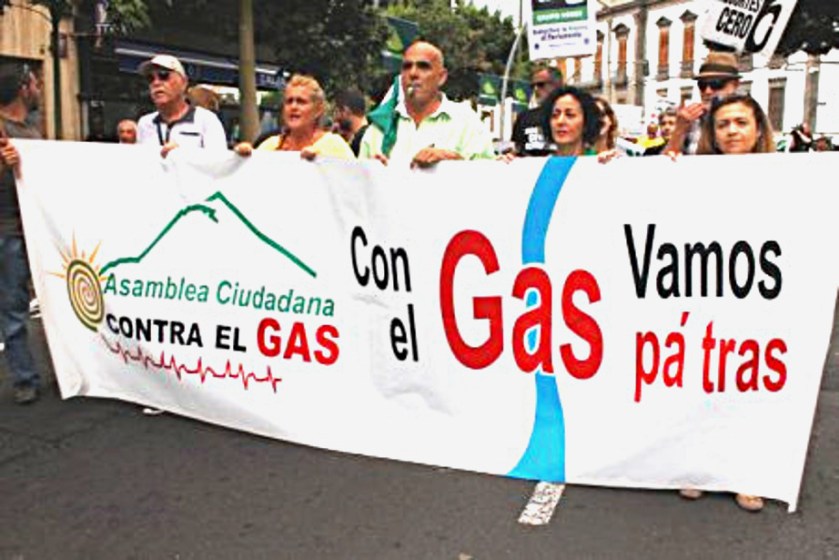
On the other hand, apart from its extreme flammability, when LNG is transported at such a very low temperature, it is subject to a physical process called “accelerated phase transition” in the event of a break in the transport tank. , known by its acronym in English, RPT (Rapid Phase Transition).
LNG at -161º C, in case of spillage, when coming into contact with sea water, would quickly go from liquid to gaseous state. Well, in this quick phase change process, LNG is incredibly explosive.
A small spill of a few hundred liters can cause a strong explosion that in turn can damage the ship’s structure, thus generating a larger spill, and with it a larger deflagration, in a chain process that would also be aggravated by the ignition of gas that would not have exploded. A real hell.
The following video, which collects LNG experiments carried out by the French gas company Gaz de France, shows the explosive capacity of LNG under real environmental conditions.
As can be seen in it, the experiments have been carried out using a few liters of LNG, so it is easy to imagine the size and power of the explosions if they were discharged into the sea of millions of liters that are transported by a LNG carrier.
From the foregoing, it can be deduced that the most dangerous processes in the transport of LNG are undoubtedly the loading and unloading of LNG carriers, since they are the moments in which the most external factors intervene. Human and technical failures, collisions between ships, windstorms, earthquakes, could lead to the loading or unloading process of a significant enough spill of LNG so that the subsequent explosion would cause an uncontrollable tragedy.
If there were a spill with ignition of the entire cargo (between 120 and 200 million liters), a cloud of fire would be produced that would devastate, setting fire to everything in its path, some 4,500 hectares around the wrecked ship.
Assuming that the destructive radius of the Hiroshima bomb was 1.6 km, the deflagration or fire of all the gas transported in a LNG carrier would be equivalent to between 20 to 30 nuclear bombs like the one in Hiroshima, depending on the size of the ship and the amount of cargo spilled.
As is easy to calculate, no prevention equipment could control a LNG fire and / or explosion of such dimensions.

In Huelva, the situation is inconceivable, since the environmental administrations (Ministry and Council) have allowed the installation of the enormous Enagas regasification plant and its tanker discharge pontoons (as well as the future one of Villar Mir) a few meters from one of the largest refineries in Europe, Cepsa “La Rábida” in Palos de la Frontera, in such a way that the regasification plant is surrounded by dozens of hydrocarbon tanks and an industrial activity, that of refining, which constantly requires flammable processes .
LNG carrier + Regasification Plant + Refinery. The town of Palos de la Frontera in the background. A terrible irresponsibility.
In the event of an explosion of one of the LNG tankers that weekly enter the Canal del Padre Santo of the Huelva estuary, the radius of devastation would be about 10.5 kilometers, which would devastate the towns of Palos, Mazagón, Punta Umbría and the city of Huelva itself. To all of which would be added the explosions of the fuel tanks stored in the refinery.

Tanks of the Enagás Regasification Plant in the Outer Port, seen from the Punta Umbría estuary. In the background you can see the tanks of the Cepsa refinery. The proximity to Punta Umbría is obvious.
Neither in the Integrated Environmental Authorization granted on January 29, 2008 by the Ministry of the Environment for the expansion of the Enagas regasification plant, nor in the much more recent Environmental Impact Statement of August 9, 2011, granted to the company Energía and Gas de Huelva (Energas) of the Villar Mir group, are what the risks that the location of the regasification plants next to one of the largest refineries in Europe may entail mentioned or valued at all, not in passing.
It is as if the refinery is not there, and the regasification plants are in the middle of the desert.

But if this omission is already surprising, it is not, however, the only one that suffers from both resolutions, of course favorable to the installation of regasification plants. In this sense, neither of the two mentions the risk of spillage, either in the unloading process or due to rupture of the tanks on land, due to an earthquake.
Such omission is frankly surprising, considering that Huelva is located in an area of medium-high seismic risk, to the point that since 1969 there have been five earthquakes in Huelva that have exceeded 5 on the Richter scale. That of 1969, which reached 7.3, that of 1989, 5.6, that of 2004, 5.5, that of 2007 reached 5.9 and that of 2009, 5.7.
However, this incontestable fact does not deserve the slightest consideration or reference when authorizing the installation of tanks containing more than 150,000 m3 of one of the most flammable and explosive products known.
A geological study confirms the existence of active faults in the Ría de Huelva, a natural space in continuous evolution(PDF) Active Faults in Iberia – ResearchGate
Flammability … Almost all cargo vapours are flammable. When ignition occurs, it is not the liquid which burns but the evolved vapour that burns….Vapour cloud explosions and boiling liquid expanding vapor explosions are the most grave flammability hazards on gas carriers.
But the omission of foreseeable circumstances that may directly affect the LNG discharge is not limited to the previous two, it is aggravated by the fact that neither of the two authorizations makes the slightest mention of the risk that a tsunami occurs on the coast of Huelva, and the consequences that this may cause in the regasification plant facilities and in the process of unloading the LNG carriers.
The risk of a tsunami is by no means negligible, since at present five catastrophic tsunamis are geologically verified on the coast of Huelva, those of the years 1755, 1531, 949, 881 and 395 of our era, all of them historically originated by documented earthquakes..
But thats not all, because as recently as 2007, there was a tsunami that they say generated a wave of half a meter, which is why it went practically unnoticed. But the truth is that another and more powerful one occurred and at any time may occur again.
Are the regasification plant facilities and its discharge dock ready to withstand the effects of a tsunami? Definitely not.
In the case of the regasification plant, if it were flooded by the tsunami, it would be seriously compromised, if not disabled, both the power supply of the plant and its generators.
Without electric fluid, the cryogenization that preserves the LNG in its liquid state could not be maintained, thus raising the temperature inside the tanks, turning the LNG into a gaseous state, with the disastrous effects that, as we have seen, this entails.
Do the administrative authorizations of the plant contemplate this possibility?
No. It would be an accident practically identical in its causation to that of the Fukushima nuclear power plant.
In the event that the tsunami occurs during the process of unloading a LNG carrier on the dock of the regasification plant, all of the above would have to include the effect produced by the violent collision of the ship against the dock, with the leakage of LNG, and the consequent risk of ignition and explosion of the cargo.

Another not inconsiderable risk would be the collision of LNG carriers with other vessels that circulate in their entry or exit maneuvers from the port of Huelva through the Canal del Padre Santo, the natural entrance of the port, and where the jetty of the regasification plant is located.
Enagás andthe future of Villar Mir.
If the risk of collision is already high, given the intense traffic of the Huelva estuary (2000 vessels per year), it will multiply exponentially if the second regasification plant, that of Villar-Mir, is built, as expressly recognized in the Resolution of Related image Environmental Impact granted by the Ministry of the Environment, with the same will produce an increase in maritime traffic and “according to the environmental impact study, after the start-up of the projected complex, an increase in LNG traffic of about 6,000,000 m3.
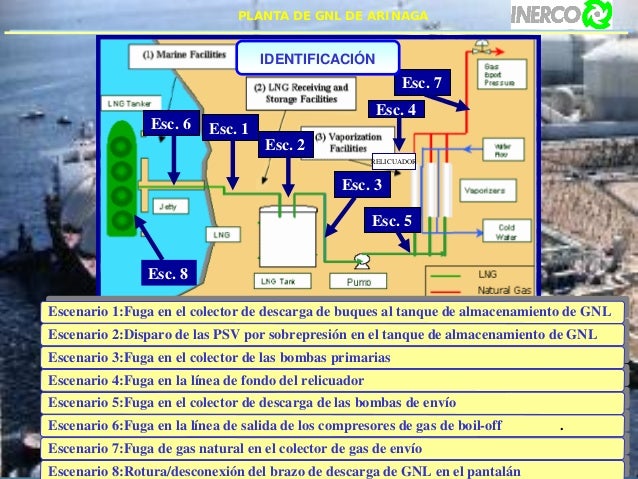
With an average capacity of 130,000 m3 of LNG tankers, the number of this type of ships that the project will involve will be about 46 per year ”.
Finally, regarding the risk of deflagration inherent to LNG, the Junta de Andalucía in its AAI to Enagás, keeps the most absolute silence.
The Ministry, regarding this same risk, in relation to the Villar-Mir regasification plant (which finally was not built), limits itself to stating the following: “the impact on the marine environment of a possible LNG leak in loading and unloading operations or due to an accident Maritime is not considered significant, since unlike other hydrocarbons, such as petroleum, liquefied natural gas vaporizes quickly as it floats on water and leaves no residue ”.
It is enough to see the previous videos and the studies carried out by industrial safety consulting companies specialized in LNG, to determine that the ministry has very lightly dispatched its consideration of “no significant risk” in the event of a spill.
STOP el Gas de Fracking que Gas Natural Fenosa Lleva a España
El Frack Gas de Trump llega a España via Gas Natural Fenoso

Llega un metanero con GAS DEL FRACKING a Barcelona…en un barco Ruso!?
Argelia da luz verde al Fracking Gas con EU Imperialistas TOTAL y CEPSA
Repsol Looting Libya: profits unaffected by Pipeline Sabotage:
Resoluciones administrativas citadas
- Autorización Ambiental Integrada concedida a la Regasificadora de Enagas Palos de la Frontera
- Resolución de Declaración de Impacto Ambiental concedida a Enargas (Villar Mir) el 9 de agosto de 2011
Alegaciones a la AAI
- Alegaciones presentadas por la Mesa de la Ría a la AAI concedida a Enagas para la Regasificadora de Palos de la Frontera.
Noticias Relacionadas
- Huelva Información 27/12/2007: Enagas invertirá 311 millones en su planta de Huelva y un gasoducto
- Huelva Información 26/08/2011: Medio Ambiente da el visto bueno a la planta de regasificación de Villar Mir
- Huelva Informacion 12/03/2011: El mayor riesgo sísmico para Huelva es el maremoto.
Post relacionado:

Bibliografia digital
- Análisis de riesgos y planes de emergencia en plantas de GNL
- Anális HAZOP en plantas de GNL
- Gestión de la seguridad en plantas de GNL
- Explosiones BLEVE: evaluación de la radiación térmica.
- Sistemas de Seguridad y Protección de GNL
- LNG Properties and Hazards. Understand LNG Rapid Phase Transitions (RPT)
- Estudio de los Sistemas de Seguridad en la descarga de GNL
FUENTE: chocotoxico.blogspot.com

 The Free
