


by Anarchist Union of Afghanistan and Iran https://asranarshism.com
آدرس و اسامی صفحات مرتبط با اتحادیه آنارشیستهای ایران و افغانستان shared with thanks. Illustrations added
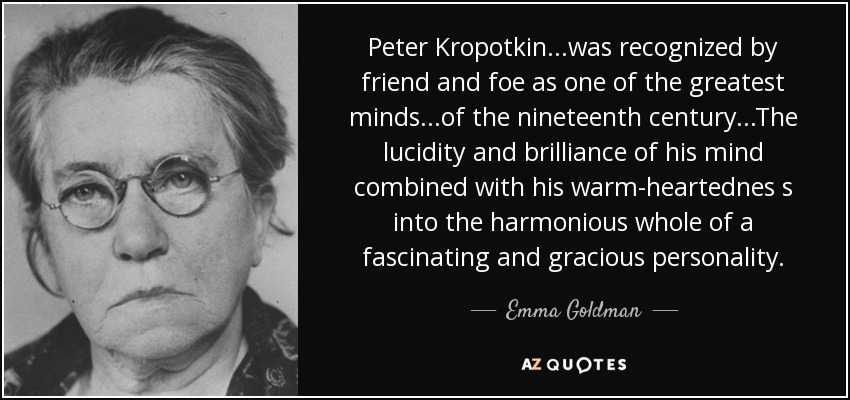
Kropotkin is often heralded as the most important classical anarchist theorist. Bookchin–influenced heavily by Kropotkin– is one of the most seminal theorists in post-classical anarchist period of anarchism. Kropotkin and Bookchin advocate for very similar yet distinct prescriptions of a good society.
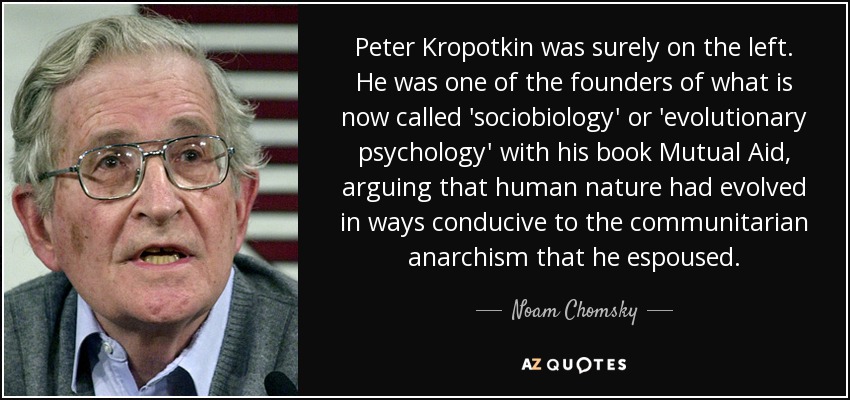
They have similarities of anti-statism, anti-capitalism, anti-hierarchical praxis more broadly, socialization and communalization of land, the means of production, distribution, and consumption, more specifically communist forms of distribution according to ability and need.
They even both emphasize the necessity of communal forms as well as an emphasis on technology and achieving a post scarcity society by organizing finitude in a way to make it so there is more than enough for everyone economically.
28 آگوست مدرسه آنارشیستی
Despite Bookchin’s departure from anarchism towards the end of his life, communalism draws ”from anarchism” a “commitment to antistatism and confederalism, as well as its recognition that hierarchy is a basic problem that can be overcome only by a libertarian socialist society,” (Bookchin 2007).
Many of the most important substantial analyses of problems and solutions are consistent between classical anarcho communism of Kropotkin and the non-anarchist yet libertarian communist communalism of Bookchin–so many that there are more similarities between them than there are between Kropotkin and many neo-anarchists
For Kropotkin, anarchists ought to create anarchist specific organizations, organize federations of affinity groups for direct actions, build revolutionary communes, and participate in radical trade unionism.
Kropotkin prescribes worker internationals and refers to worker internationals as waging a “direct…battle of labor against capital- not through parliament but directly by the means that are generally available to all workers,” (Kropotkin 2014, 466).
Direct action is action that is not mediated by hierarchy, but it is always mediated by various factors– often mediated by organization of some kind or another. Kropotkin prescribes fluid federated affinity group models (Kropotkin 2014, 475), and Kropotkin advocates for what is commonly referred to as a spokescouncil model between them, as well as decision making power at the lowest level.

Kropotkin also calls for a general strike from below which is then transformed–if possible– into mass expropriation and armed struggle (Kropotkin 2014, 477). Kropotkin put communes as relatively central to his political prescriptions and says that “it will be the communes, utterly independent and released from the oversight of the state, which will, alone, be able to provide the requisite context for revolution and the wherewithal for its accomplishment, (Kropotkin 2014, 593).
Kropotkin also prescribes syndicalism as a form of “direct struggle of Labor against Capital on the economic field.” (Kropotkin 2014, 403). Kropotkin also notes the limits of trade unionism while prescribing that anarchists modify trade unions along anarchistic lines through getting involved within trade unions (Kropotkin 2014, 391)
Bookchin’s core strategy involves the creation of horizontalist democratic community assemblies as a means to create the ends of horizontalist democratic community assemblies. Such a strategy is a non hierarchical dual power that

- 1. Meets people’s needs
- 2. Decentralizes and communalizes power and
- 3. Builds the new world in the shell of the old uniting people on horizontalist democratic terms of practice in the community sphere
- 4. Builds committees and other collectives and organizes mutualistically with them
- 5. Participates in sustained direct action
- 6. Participates in sustained mutual aid.
- 7. Participates in political education
- 8. Participates in building quantity of people to add to various projects
- 9. builds capacity quantity wise for people to participate in various qualities of actions and alternative institutions and infrastructure builds that are not otherwise possible with less people and less organization.
- 10. Organizes non ruling class people broadly. Just because Bookchin emphasized communal assembly forms, does not mean that Bookchin reduced the means and ends of society to such forms
One critique leveled against Bookchin is that Bookchin is exclusively for communal forms. Although Bookchin advocates for, and fleshes out, communal forms more so than most anarchists, Bookchin does not reduce a process of revolution to such communal forms.
Even towards the end of his life–as Bookchin started to more fully emphasize the importance of horizontal communal democracy– Bookchin advocated for increased activity and organization in trade union movements. Bookchin even advocated that workers should make trade union internationals to deal with excesses of capitalism and as a way to keep left tendencies around.
Bookchin was instrumental in recovering the affinity group model and spreading it to radicals and environmental direct action groups in the USA and abroad. Despite Bookchin’s (at times overly harsh) critique of syndicalism, Bookchin was a member of the IWW. Bookchin was also a fan of study groups.
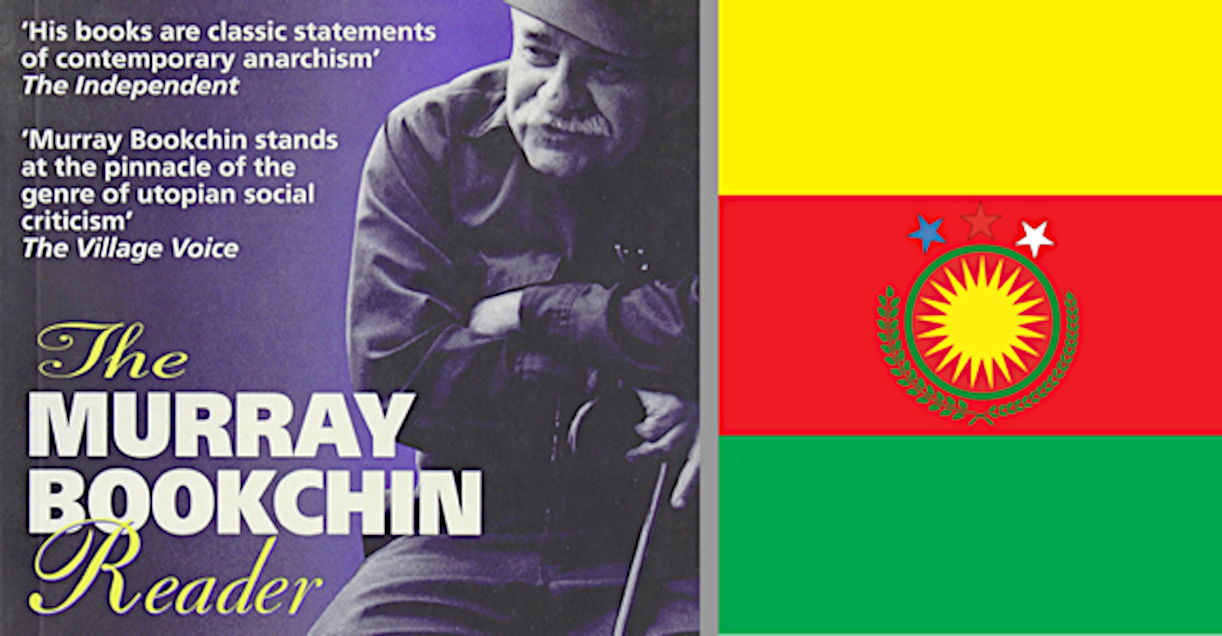
The PKK–which has been influenced by social ecology and Bookchin’s ideas more recently even though it used to be a more Leninist organization– started as a study group and became a revolutionary organization that helped fuel the revolution in Rojava. Bookchin also advocated for creating what Bea Bookchin has called “building blocks” of a revolution which include but are by no means limited to cooperatives.
Bookchin also advocated a kind of anti electoral electoralism through
- 1. Running candidates on a libertarian socialist platform

- 2. In favor of abolishing their own position
- 3. That act as a delegate of popular assemblies bounded by a libertarian socialist platform (that includes a minimum program of non reformist reforms and steps in a good direction)
- 4. Giving popular assemblies binding power
- 6. Hollowing out the state of its military and police power and
- 7. Using the political season for popular education (Bookchin 1992).
Between affinity groups, trade unionism, study groups, community controlled cooperatives (Bookchin 1992), popular education via study groups, dialogue, and writing, and anti electoral electoralism, it is clear that Bookchin does not reduce tactics of a revolution to communal assemblies.
At least a part of Bookchin’s critique of the above forms and strategies is the insufficiency of such strategies–not the lack of necessity/desirability of the above. Bookchin additionally claims that there there are ethical and strategic features of communal assemblies and is in favor of communal assemblies as revolutionary forms in relation to a broader ecosystem of bottom institutions and liberatory social movements.
Furthermore, Bookchin is in favor of horizontalist communal assemblies as the kind of governance structure that should exist post revolution
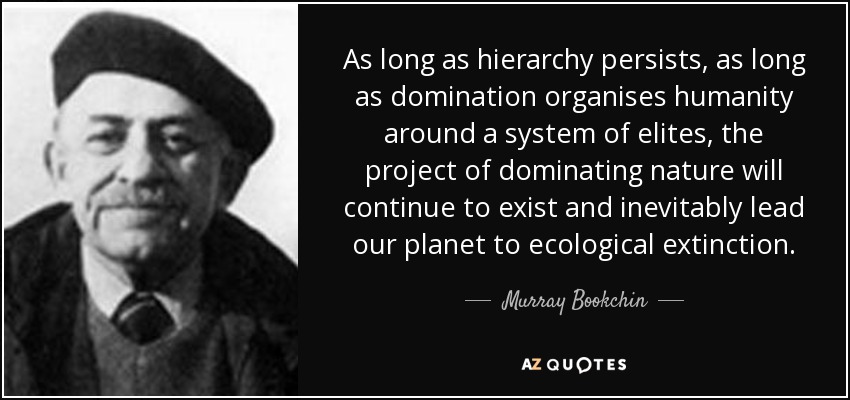
Bookchin and Kropotkin distinguish government and statecraft in different ways. For Bookchin a state is a form of hierarchical political governance rooted in institutionalized top down command.
As Bookchin points out, “every state, although necessarily a form of government, is a force for class repression and control,” (Bookchin 2007). Government for Bookchin–as he defined later on in his life– is some form of governing which is not necessarily hierarchical nor non hierarchical.

As Bookchin states, “Every institutionalized association that constitutes a system for handling public affairs—with or without the presence of a state—is necessarily a government,”(Bookchin 2007). Such governing could take the form of non-hierarchical communal assemblies, or workers’ councils, or take the form of a republic, or a monarchy, etc.
For Kropotkin, government is the decision making body of a state, and the state is the enforcer of such decisions. Kropotkin at times refers to his ideal form of society as self-government, and at other times as the abolition of government. Those two different notions of government are not incompatible if by government Kropotkin means hierarchical government and if by self-government Kropotkin means non-hierarchical government.
Kropotkin wants a revolution that is “not just communalist, but communist,” with the goal of “abolishing government by proxy”. Such prescriptions are consistent with the core ethos and praxis of Bookchin’s communalism
For Bookchin, the communalization of the economy means that the means of production needed for communes at various scales to reproduce themselves are placed under the hands of horizontal democratic community control, with embedded worker’s councils.
As Bookchin says the economy should be placed under “management by the community as part of a politics of public self management,” (Bookchin 2005). The participatory communal assemblies (at different scales linked co-federally) through needs, desires, and deliberation (bounded by non-hierarchical bounds) create policy that embedded participatory committees implement through self management within the bounds of the policy created from below by the communal assemblies.

This is done through communalizing property that could be used to “militate against a publicly controlled economy,” (Bookchin 2005); that is property that if owned non communally would privatize policy over and above the commune privatizing the means of existence, production, and politics instead of placing “the material means of life into communal forms of distribution,” (Bookchin 2005).
Within such bounds–and due to such bounds– of communal self management, all would have the rights to access to the means of existence, the means of artistic expression, the means of science, the means of philosophy, the means of luxury, and a common sphere where the fruits of production are accessed freely by people according to their needs and desires
For Kropotkin, “communalization of social capital must be accomplished everywhere where this becomes possible and as soon as the possibility emerges,” (Kropotkin 2014, 500) and further states that such communalization should happen whether or not people agree with it, that is “without inquiring whether the whole or the greater part of Europe or a particular country is ready to accept the ideas of collectivism” (Kropotkin 2014, 500).
Such a worldview is de facto stating that communalisation ought to be a rule in regards to the minimal standards of relating to one another whether people want it or not. For Kropotkin, Free agreement of collectives and individuals should exist within the boundaries of anarchist communism whether or not people are ready to accept such standards.

This does not mean Kropotkin is not for gaining popular support and as much popular support as possible. In fact he prescribes getting as close to that as possible, as soon as possible, as part of the process of creating ripe conditions to enable communalization of property
Kropotkin states earlier on in the same essay that there would be “expropriation pure and simple of the present holders of the large landed estates, of the instruments of labor, and of capital by the cultivators, the worker’s organizations, and the agricultural and municipal communes.” (Kropotkin 2014, 500).
For Kropotkin, the relations of cultivators, worker’s organizations, agricultural and municipal communes are to exist altogether in relation, and the way they relate should be figured out through free agreement and disagreement of collectives and individuals, in such a way that collectives retain self management–therefore necessitating communal self government.
One can agree with that prior sentence while still preferring Bookchin’s more specific communalization as a more fleshed out form of freedom ensuring that communes are not privatized.
A further argument could be made that communalization, as Bookchin fleshed out, is needed or desirable for communes to retain self management– and for arriving at other developmental ethical criteria
Kropotkin says that “we can take the liberty of pleasing ourselves and of helping others to please themselves in accordance with our ideas of what is proper,” (Kropotkin 2014. 613).
What is evident from all his work is that there should be certain practices through which free initiative ought to flow through– such practices being rooted in libertarian communist principles. Kropotkin also states that “that in all moral teachings and conceptions the obligatory element is based on the recognition of equity by feeling and by reason” (Kropotkin 1968, 175).

Kropotkin is in favor of a moral universalism of a particular kind, and that particular passage is in regards to parsing out of obligatory vs permissible vs. desirable dimensions of moral systems (which includes obligatory vs. supererogatory dimensions of the good).
Kropotkin thinks a good moral system should have both obligatory and non-obligatory aspects. Kropotkin’s conception of anarchist communist principles is that they ought to be obligatory minimal standards through which we relate to one another politically, economically, and socially.
Kropotkin is in favor of anarchist communist moral imperatives rather than no imperatives

It is important to note issues of definitional vs substantial disagreements Kropotkin had with laws with and without adjectives. Laws are often associated with the rule of the state. Kropotkin does have substantial differences with Bookchin about law, but Kropotkin is in favor of non hierarchical obligations as opposed to no rules.
Kropotkin does critique law without adjectives saying that at best governments and laws “give legal sanctions to revolutionary deeds which have already been carried out,” (Kropotkin 2014, 500). Kropotkin correctly points out that such law “would remain a dead letter if it were not freely put into effect in each commune, in each district, by those who are actually involved” (Kropotkin 2014, 500).

Kropotkin claims the written law at best is just stating what already exists de facto, and at worst it is the formalization of statecraft. But the goal of law is to use the written word to formalize principles into that which is or ought to be de jure; that which ought to be minimal standards of treatment of people that are meant to sustain beyond periodic informal associations.
If such anarchist communist principles, which Kropotkin thinks should be minimum standards that particular free initiatives are filtered through, get formalized, then such principles can be explicit rather than just a matter of custom
In contrast to Kropotkin’s view on law, Bookchin prescribes in The Communalist Project, that revolutionaries “should, in effect, demonstrate a serious commitment to their organization—an organization whose structure is laid out explicitly in a formal constitution and appropriate bylaws.
Without a democratically formulated and approved institutional framework whose members and leaders can be held accountable, clearly articulated standards of responsibility cease to exist. Indeed, it is precisely when a membership is no longer responsible to its constitutional and regulatory provisions that authoritarianism develops and eventually leads to the movement’s immolation.
Freedom from authoritarianism can best be assured only by the clear, concise, and detailed allocation of power, not by pretensions that power and leadership are forms of “rule” or by libertarian metaphors that conceal their reality. It has been precisely when an organization fails to articulate these regulatory details that the conditions emerge for its degeneration and decay,” (Bookchin 2007).
For Bookchin, the formalization of libertarian socialist principles into laws acts as a way of minimizing arbitrary power–holding such principles accountable and people accountable to such principles. For Bookchin, the ability to rationally cultivate and formalize explicit non hierarchical minimal standards in society is a way of stopping people from arbitrarily creating unwarranted double standards and authoritarianism
Endnotes
Bookchin, Murray. Urbanization without Cities: The Rise and Decline of Citizenship. Montréal U.a.: Black Rose Books, 1992
Bookchin, Murray. “Municipalization: Community Ownership of the Economy.” Libcom.org. July 2005. https://libcom.org/library/municipalization-murray-bookchin.
Bookchin, Murray. Social Ecology and Communalism. Oakland, CA: AK Press, 2007
Kropotkin, Petr Alekseevich. Ethics ; Origin and Development. Authorized Translation from the Russian by Louis S. Friedland and Joseph R. Piroshnikoff. New York: B. Blom, 1968
Kropotkin, Pëtr Alekseevič, and Iain McKay. Direct Struggle against Capital: A Peter Kropotkin Anthology. Oakland, CA: AK Press, 2014
———————————————————————————————–
آدرس و اسامی صفحات مرتبط با اتحادیه آنارشیستهای ایران و افغانستان
Anarchist Union of Afghanistan and Iran, May 24, 2018

 The Free