

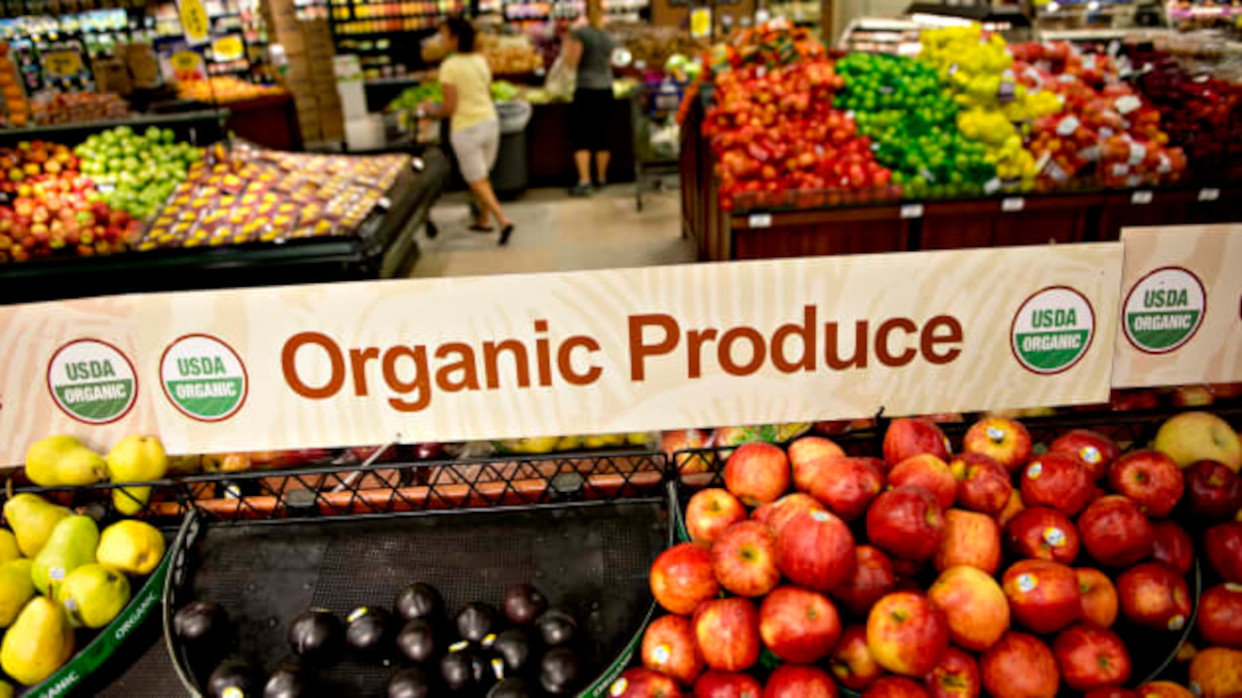
Now you can enjoy ecological vegetables from supermarkets all over Europe, but you may be eating a healthier and tastier tomato that still costs too much in fuel consumption, plastic pollution and worker exploitation.
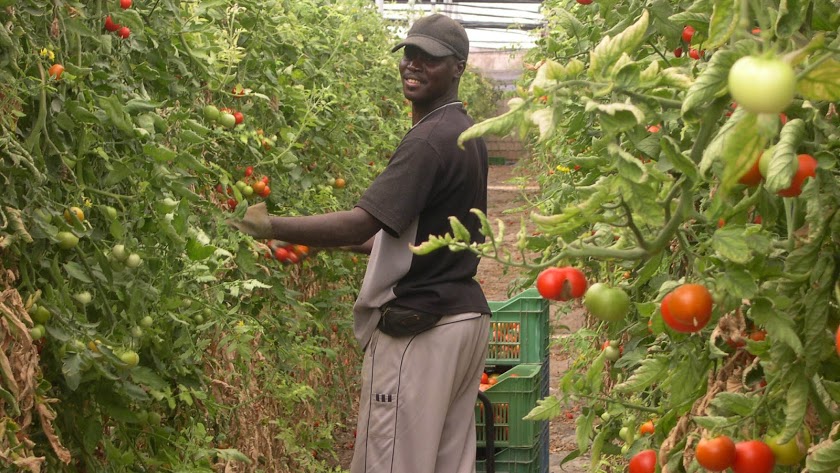
Almeria is a semi arid province in the SE of Andalucia, Spanish State, which is famous for its sea of plastic greenhouses producing vegetables year round for the European market, using mainly immigrant labour working in terrible conditions for low pay.
Little by little things are improving, due to fierce competition from Morocco and other countries many farmers are turning to organic ecological production.
It seems like a contradiction to talk of sustainability. The plastic is made from oil products. It doesn’t last more than 4 years and ends up polluting everything, though much more controlled than before.
Water is still a huge problem, competing with the locals, the tourist industry, and the now decimated local ecology for scarce resources. Also your eco tomato may be grown with desalinated water, again produced with a lot of fossil fuels.
Climate Change is another huge threat, with desertification spreading north from the gigantic man made climate disaster of the Sahara. Almeria may not have the perfect climate for long, mini hurricanes now form in the Mediterranean, and the melting Arctic could plunge all Europe into deep freeze winters by cutting ocean currents.
Once the Almerian pioneer farmers have perfected the techniques they will be bought up by Big Agriculture who will transfer production across the channel to North Africa, where the authoritarian muslim regimes can escape the EU controls of the waning authoritarian catholic Spain.
Despite all these problems the change is happening, and fast, and the below Foco Sur article and interview details how its being done, without discussing the big sustainability threats. The Eco greenhouse boom has taken off, ferrying fresh healthy vegetables by motorway to Paris in just 24 hours
To placate the Nth European customers while qualifying for the ECO label the mainly migrant workers may be treated a little better and learn new skills, as well as escaping exposure to toxic and carcinogenic herbicides and pesticides.

Organic farming ‘supersized’: An imperfect solution for the planet?
by Down to Earth, shared with thanks
This week Down to Earth is in southern Spain, amidst the world’s largest greenhouse complex. In just a few years, Spain has become the undisputed leader of organic farming in Europe. But is intensive organic farming a real solution for the planet? We find out more.
The Almeria province is the heart of the continent’s intensive agriculture and has seen the proportion of organic farming explode over the last decade from 1.4 percent to 10.3 percent.
Tomatoes, cucumbers and sweet peppers have become staples of organic farming in Almeria. Around 80 percent of this organic produce is exported elsewhere in Europe, where consumers hail the label as a symbol of sustainability.
But is organic farming produced intensively a real solution for the planet? We take a closer look.
Jan van der Blom, Coexphal, Association of Horticultural Producers and Exporters in Almeria
The final conclusion of the report concerning ecological horticulture in Almeria was that it is far from sustainable, since a lot of plastic waste ends up in the environment.
The organisation of horticultural companies APROA has protested against this negative image.
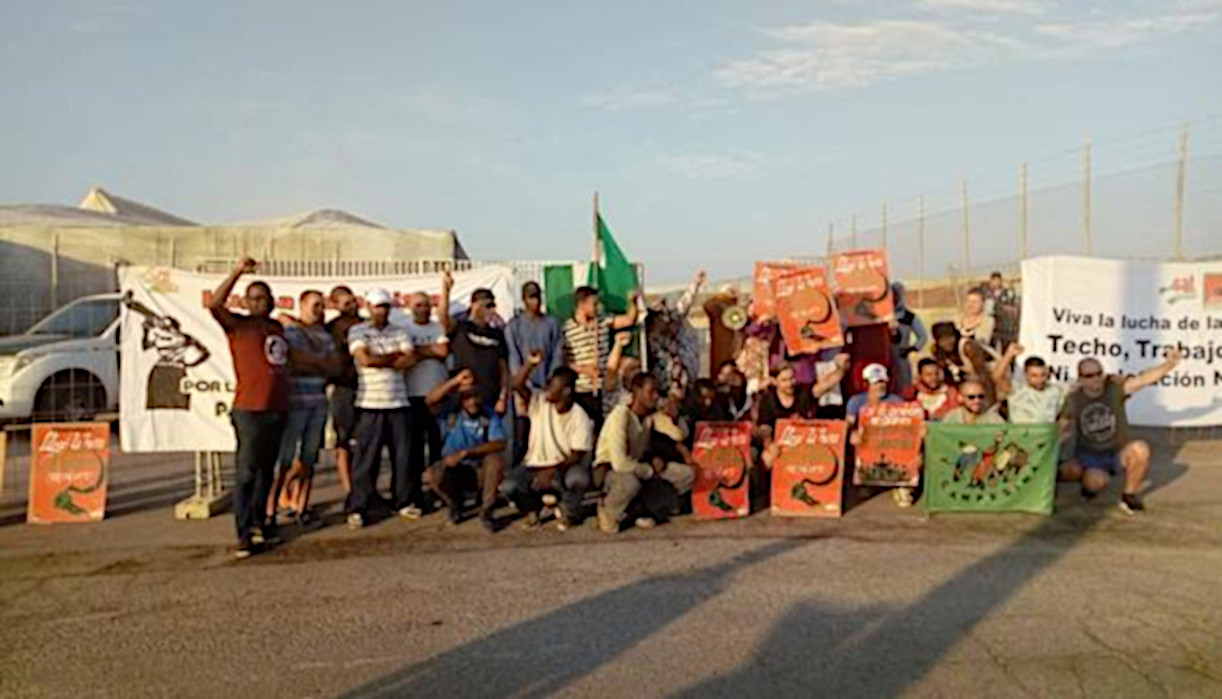
Almeria agriculture workers strike for better conditions
FRANCE 24 showed dramatic pictures of a landscape full of plastic debris. APROA claims that these images are totally misleading. Manager Luis Fernández: “This was recorded at Rambla Morales on September 27. Two weeks earlier, on September 12, several dozen hectares of greenhouses, as well as an entire camping site, were destroyed and washed away by an exceptional flood exactly at this spot. Presenting this to illustrate plastic dumping is a mistake, it’s a natural disaster.”
APROA has quantified the volume of plastic waste. Most of it comes from the greenhouse covers that are replaced every four years. This is a high volume of homogeneous residue, very useful for recycling purposes. Growers receive 10 cents per kg for this old plastic.
Other types of plastic are more difficult to recycle. These are usually processed together with municipal residues, generating energy through incineration. It’s estimated that between 70 and 80 percent of the total plastic residues are recycled, serving as raw material for the production of new plastic products.
The sector in Almeria is fully aware of the need to recycle in order to survive. ”Enormous progress” has been made, although it still must improve. APROA works closely with the administration to avoid and penalise the dumping of waste. They operate a special telephone number (+34 687 500 400) where people can report illegal dumping.
Fernández: “With our concentration of greenhouses, we are in a perfect position to reach 100 percent recycling. Nevertheless, as long as only a tiny fraction of the plastic is blown away by the wind or washed away by the river, the entire sector will have a severe image problem.
*********
Eco-greenhouses: ”the sustainable future of agriculture”?
by revista Foco Sur …octubre de 2020
”In the future, all Almeria greenhouse fruit and vegetable production will be organic. ”

This will be the case to differentiate from the competition and offer added value in the face of the growing exports from neighboring countries, which either cannot compete in this sector of growing demand, the organic one, by not meeting the required characteristics, or because they are committed to mass production far from quality criteria.
In addition, Almería has been positioning itself in recent years as the spearhead of organic production in Andalusia and Spain.
The autonomous community (Almeria) is already established as the main producer and exporter of the agricultural sector, and it faces the new challenge of promoting organic production. It is the main producer in the country, with 46% of the total, and the reference figures continue to grow year by year.
Thus, 1,065,260 hectares are dedicated to this type of cultivation in the region, which represents 19% of the total area devoted to agriculture.
The province of Almería leads figures in this sector such as operators, with 3,677. And although it is at the rear in total area dedicated to organic production, it leads the number of hectares under plastic that grow this type of product, which is in strong demand in Europe, with 3,212 compared to 631.5 in the next, Huelva.
And it is so thanks to the strong growth of recent years. In 2010, there were just 891 hectares of organic greenhouses in the province.
Reimagining Almeria’s Plastic Sea of Greenhouses

Rubén Nieto had already spent five years cultivating cherry tomatoes and watermelons under the criteria of organic production. Son and grandson of farmers, when at 18 he chose to continue the tradition, he was left with a family farm; two greenhouses of two hectares in total that they had been dedicating to the cultivation of grains for pasture, between Campohermoso and San Isidro, and opted for a type of cultivation that few saw having a future then.
He was clear about it. If the decrease in production of an ecological greenhouse compared to a traditional one is around 30%, the higher prices and, above all, its greater stability compensated.
see also: EcoWatch…. Europe’s Dirty Little Secret: Moroccan Slaves and a ‘Sea of Plastic’
At that time, between 100 and 200 hectares were dedicated in Almería to what its farmers still consider the future production in our province, with associations such as Bioindalo advising and encouraging the leap to products that from countries such as Switzerland or Germany were in high demand, although here it was difficult to see them on the supermarket shelves.
“Those years were complicated because the supply letter was very small,” recalls Nieto, who says that currently the quantity of approved products has already been equated with that of traditional cultivation.
His is “a modernized organic production,” explains this young farmer, who adds that “we implemented biological control from the beginning, we need to have bugs because, if not, we don’t have many weapons” to combat the pests.
To certify a greenhouse as ecological, a series of requirements must be met in the treatment of the soil and the products that are used for fertilizers and prevention and elimination of pests and diseases. To certify that all the criteria are met, auditors such as Agrocolor, COEXPHAL based in Almería, and CAAE are in charge.
Regenerated land without synthetic products
To obtain the ecological certificate, “the greenhouse has to be isolated four or eight meters from farms that are not,” explains Rubén Nieto. Otherwise, “in the areas that are closer to that distance they force you to do several analyzes a year and to have that band closed so that it is not contaminated with the neighbor’s treatments.” Julián Giner, technical coordinator of Koppert in Almería, points out as keys to considering a greenhouse crop as organic to “regenerate the land and not use a synthetic, industrial or chemical product”.
see also… Phys.Org…Insects replace pesticides in Spain’s ‘Sea of Plastic’ reducing Consumption of insecticides in Almeria—where agriculture employs some 120,000 … by Encarnacion Samblas of environmental group Ecologists in Action …Jul 24, 2019

The first step forces those who want to make the leap from transforming a traditional production greenhouse into an organic one to wait a until they can grow with a certificate. It is a necessary to stop for 2 years for the earth to cleanse itself of the ‘prohibited’ products in organic production.
If you decide to take that leap, “the farmer does not have to invest anything,” says Andrés Góngora, provincial secretary of COAG Almería. But it does “have to open a training process, the farmer has to change many concepts that they have assimilated in terms of phytosanitary treatments or crop rotation.” Likewise, “technicians who are experts in organic farming are needed, because you have to have specific advice on this matter,” adds Góngora. All this makes it take a few years since the change of model in a greenhouse begins until it is ready to go.
When you do have to make a larger outlay is during the harvest, “because there are certain ecological inputs that are very expensive”, clarifies the provincial secretary of COAG.
Other added expenses are in maintenance: it is not the same to work with fertilizers to which substances are added to facilitate their solubility than to do it with those approved for ecological farming. “We have tanks and filters more clogged than traditional greenhouses,” acknowledges Nieto, who says that “we have to change the drip systems every two or three years because they get dirty with impurities.”
The control of pests and diseases is another key in this type of crops, as it is not possible to use certain chemicals that are common in traditional production. Thus, Giner explains that Koppert works with plants and insects for this biological control.
For example, we plant some “tall grains, such as corn or sorghum, to avoid certain predators in the greenhouse. At the same time we plant lobularia, which is a plant that blooms throughout the year, to serve as a reservoir for the Hymenopterans ”used to eliminate pests.
In the event that an attack is detected, Giner emphasizes that they have “a wide range of products” to solve it. Among them, “we can work with bacilli, if we have problems with a dipteran in the root, and also with a virus that is authorized to control worms.”
see also: Ecologists horrified by videos showing rivers of plastic Watch (1:24)
Technology for the eco-greenhouse
Technology is another differential element in this type of greenhouse, although not exclusive to them. By not being able to count on traditional solutions to treat the soil and plants, the possibility of having control of the parameters that facilitate the healthy growth of the crop, such as light, humidity or temperature, is of great help for the task of farmer.
Spain: Desalinated water to irrigate Almería greenhouses
This is the case of Rubén Nieto, who with a group of colleagues has assembled in his two greenhouses a system of sensors linked to an Arduino board with which he can know, just by looking on his mobile, if the conditions both outside and in the Indoor are suitable for your plants, nowadays peppers, which replaced the cherry a couple of years ago, and watermelons.
With this system, which they have called LIBO, they control “temperature, humidity, soil temperature, solar radiation, CO2, condensation and a series of parameters that help us make decisions,” explains Nieto. The values may indicate, for example, “not to water for a while or to ventilate the farm.” Likewise, thanks to LIBO “we can assess the probabilities of a pest attacking us, because the more stressed the plant is, the easier it is. Seeing the history of certain parameters, we can enter to deal with one insect or another ”.
Far from the image of the “old-fashioned” farmer, digging trenches and planting by hand, which could have organic farming, now greenhouses “have to have Wi-Fi yes or yes” to be able to implement systems like LIBO. “The pick and the hoe are still there, but we have to evolve by leaps and bounds,” says Nieto.
Giant steps like those that the organic agriculture sector under plastic has taken in our province in just half a decade. Attracted by the higher average prices and with fewer swings, many have taken the step in recent years. “There has been a certain ‘demeanor’ of people who have switched to organic due to the economic issue, but the decline in production, pest problems, pressure, etc., has made many people return to conventional,” acknowledges Rubén Nieto.
And although the growth in demand is constant, the penetration of these products in our country is still slow. Among other reasons, points out this farmer, “due to the difference in price between the organic product and the conventional one.” A difference “in the supermarket, at the time of sale”, qualifies. “They pay us a little more but then the price is multiplied by two on the shelf, and that is unaffordable for many,” he acknowledges.
Coots among a plastic lake after a heavy rainstorm in Almeria
Keys to converting a conventional greenhouse into an eco-greenhouse
- Leave two years without cultivation to regenerate the soil, that the remains of synthetic chemical products used in the traditional greenhouse are eliminated.
- Prepare the soil with microorganisms, thermal blankets and / or hedges to improve the soil conditions for both fertilization and structure and to eliminate previous pathogens.
- Prepare tanks, hedges and reservoir plants that serve to reproduce the ‘bugs’ for pest control.
- Plant flower reservoirs to maintain optimal conditions for pest predators.
- In addition to insects, use licensed viruses, fungi and bacteria to help control pests in greenhouses.
- Improve the irrigation system so as not to lose water and so that the plant does not have excess moisture and is not affected by fungi.
- Use non-synthetic products and authorized microorganisms to prevent diseases.
- Implement a sensor system to monitor variables such as temperature, humidity, radiation or condensation to keep the eco-greenhouse in optimal conditions.
Luis Miguel Fernández, manager of COEXPHAL: “The prospects for organic production in our province are positive and with notable growth rates”
‘Consumers are not aware we are slaves‘
The ecological surface under greenhouse in COEXPHAL for the 2019/20 campaign reached 1,578 hectares, which increases to 2,012 hectares if we add the spring crops. Production was almost 147,000 tons. Adding only the crops under plastic, these figures represent 58% of the total officially recognized area in Almería. This province accounts for 75% of the wintering ecological area of Andalusia.
In recent seasons, the growth rate of this type of production has been high: the surface has tripled in the last 5 years. However, in the last year the pace has slowed down: in 2019, only 50 new hectares of organic greenhouse were added. Even so, we can say that the prospects for this type of production in our province are positive and with notable growth rates for the future.
What are the main characteristics of this type of greenhouses and of organic production in our province?
In Almería, organic tomatoes, peppers, cucumbers, courgettes, aubergines, melons and watermelons are grown under greenhouse, tomato being the most representative vegetable both in terms of surface area and production.

Apart from what has already been achieved, how could this type of crop be improved and promoted?
At present, all policies, both in Europe and in the rest of the world, are geared towards the fight against climate change and environmental degradation and pursue an economy based on sustainability. From the European Green Deal, which includes the Farm to Table strategy, to the Sustainable Development Goals with the
Agenda 2030 proposed by the United Nations (UN), pursue an efficient use of resources and this is fully in line with the values on which ecological agriculture is based, with a productive system that reduces environmental degradation to through the reduction of inputs.
On the other hand, the fruit and vegetable sector is immersed in a price crisis and a continuous loss of profitability at a general level and in conventional agriculture in particular. One way to deal with this situation is through differentiation and this can come from the hand of organic production with more possibilities to sell your product and obtain added value.
What advantages and disadvantages does an Almeria farmer have when it comes to opting for organic farming?
The advantages are all as I have pointed out previously, you are differentiating yourself by producing a healthy, quality and sustainable product. In addition, our customers increasingly demand this type of product from us, so we must continue to offer it to them.
Another very important advantage for agriculture in general is that most farmers, in the fight against conventional pests, are following ecological guidelines, focusing on improving biodiversity to facilitate the installation of auxiliaries, with which both production systems They are betting on an increasingly environmentally sustainable model.
It may have drawbacks like any other production method, but they do not go beyond adapting to existing regulations.
Should the agricultural industry of Almeria bet heavily on this type of production?
Of course, this expansion towards the natural and ecological should continue, since it is in line, as I explained before, with the fight against climate change and the sustainability of our planet.
(Report published in the October 2020 issue of Foco Sur magazine)
see full original of Foco Sur article in Spanish HERE.. Ecoinvernaderos: el futuro sostenible de la agricultura
(Reportaje publicado en el número de octubre de 2020 de la revista Foco Sur).

 The Free