#COVID19 #Madrid: The neighborhoods of #Villaverde, #Usera, #Vallecas and #Carabanchel rise up against selective confinements

Madrid. Spain. The neighborhood associations of Carabanchel, Villaverde, Usera, Puente and Villa de Vallecas categorically rejected the proposal of selective confinement of their neighborhoods to stop the advance of Covid-19. About thirty of these groups, together with the FRAVM, made the “Manifesto for the Dignity of the South in the face of the second wave”…

#COVID19 #Madrid: The neighborhood associations of #Villaverde, #Usera, #Vallecas and #Carabanchel rise up against the proposal of selective confinements — Enough 14 –

About thirty of these groups, together with the FRAVM, made the “Manifesto for the Dignity of the South in the face of the second wave” public, a forceful writing that reviews a good part of the endemic problems and the abandonme

Image

nt of the Administration that these districts have suffered for decades and serves to confront the “stigmatization, exclusion and territorial discrimination”. We do not share everything in the following statement, even reject some parts (like the part about sharing a police station in Usera and Villaverde). Still we think its an important read about the growing resistance in Madrid against classist cofinement measures in the framework of COVID-19.

Originally published by Asociaciones Vecinales Madrid. Translated by Enough 14. Image above by @DRYmadrid.

“This is my neighbourhood, not a ghetto”. Concentrations in popular neighbourhoods of Madrid, againts the proposal for segregating poor neighbourhoods for controlling #COVID19

Continue reading “#COVID19 #Madrid: The neighborhoods of #Villaverde, #Usera, #Vallecas and #Carabanchel rise up against selective confinements”

How the world’s richest destroyed the climate to fly more and drive bigger cars.

As longer term readers will be aware, the original title of this blog was Make Wealth History. I chose the name to highlight the fact that a fair and sustainable world is impossible if all the attention is on lifting the poorest out of poverty.

How the world’s richest destroyed the climate — The Earthbound Report

There isn’t the ecological space for everyone on earth to enjoy a Western consumer lifestyle. Those in the richest countries have to shrink their consumption in order to make room.

The role of the richest in environmental destruction has rarely been presented as graphically as it is in Oxfam’s latest report. Confronting Carbon Inequality investigates the last 25 years of accumulating carbon emissions and maps it onto income brackets.

The headline finding is that the top 1% are responsible for double the emissions of the poorest 50% of humanity. The climate was not destroyed to lift people out of poverty, or because people in Africa had too many babies. It was destroyed so that the world’s richest could fly more and drive bigger cars.

This is why it is vital to understand climate change as a justice issue.

Since the majority of that poorest 50% are people of colour, and the majority of that 1% are white, it has to be understood as a matter of race as well.

Graphs like this make a mockery of the idea that responsibility for solving the climate crisis lies predominantly with developing countries. Middle income countries make up 40% of the world’s population, and 41% of the cumulative emissions. While there is an obvious need for those countries to peak and reduce their emissions, their share of the overall total is proportional. The wealthiest 10%, on the other hand, have 52% of the total.

For my generation, climate change is the front line of global justice. This is the civil rights movement, Apartheid, the struggle to end slavery. It is on this question that future generations will judge us.

Oxfam’s report can be downloaded here.

Lideresa indígena es asesinada en Nariño, Colombia — Alma Cubanita

Telesur El hecho ocurrió este fin de semana, en el que, paralelamente, el país también llegó a 61 masacres en lo que va de 2020. El gobernador del Cabildo Indígena El Gran Mallama, enclavado en el Departamento de Nariño, Colombia, Álvaro Gerly Molina Cuestas, rechazó el homicidio de la líder indígena y comunera, Alba Alexandra […]

Lideresa indígena es asesinada en Nariño, Colombia — Alma Cubanita

The US is using the Guardian to justify jailing Assange for life. Why is the paper so silent?

Julian Assange is not on trial simply for his liberty and his life. He is fighting for the right of every journalist to do hard-hitting investigative journalism without fear of arrest and extradition to the United States. Assange faces 175 years in a US super-max prison on the basis of claims by Donald Trump’s administration that his exposure of US war crimes in Iraq and Afghanistan amounts to “espionage”.

The US is using the Guardian to justify jailing Assange for life. Why is the paper so silent? — The New Dark Age

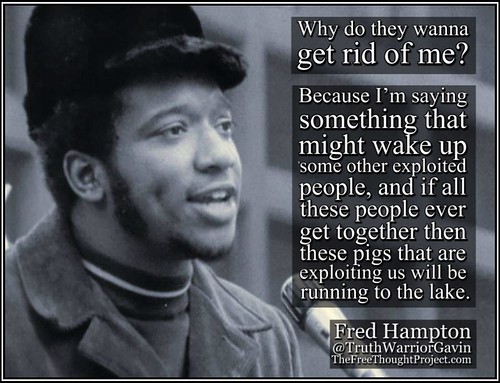
Fred Hampton: Before being Assassinated This Black Panther United All Races Against The ‘Elite’

panther

by Gavin Nascimento Spread the love at The Free Thought Project

At the young age of just 21 years old, this Black Panther leader managed to pull off what many at the time considered to be impossible — uniting different races and seemingly opposed political groups in common cause against the ruling class.

Some say this is the true reason why he was assassinated.

Fred Hampton Quote

Quote Source

Sadly, very few people today know who Fred Hampton really was, what he truly stood for, and how he was brutally assassinated. In this blog I will not be exploring the complexity and exceptional integrity of this man’s character in detail, since I believe he is deserving of a much more meticulous write up than I can offer at this time.

Nonetheless, I would like to share his transcendent message of unity and solidarity to help remind everyone who the real enemy is. Please feel free to take and share any of these quotes from this article. His message is extremely important.

Quote Source

Continue reading “Fred Hampton: Before being Assassinated This Black Panther United All Races Against The ‘Elite’”

What Frogs Can Teach Us about the State of the World

by The Walrus shared with thanks

By tracking amphibian songs, citizen scientists are helping us understand what’s happening to our environment by Caitlin Stall-Paquet
Photography by Jeremie Stall-Paquet Updated 16:32, Sep. 17, 2020 | Published 15:19, Sep. 16, 2020

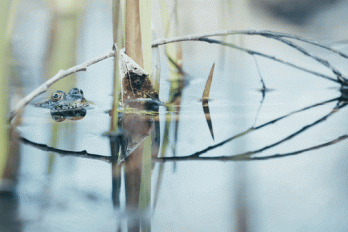
It’s an hour after sunset, one night in early April, and I’m standing on the side of a dirt road in my hometown of Frelighsburg, Quebec, with my hands cupped around my ears. I’m listening for the calls of anurans—amphibians without a tail, so frogs and toads. I am here, more specifically, to hear the croaks of wood frogs, which are one of the first species to peek their little brown heads out after a long winter of hibernation.

🎧 TURN ON YOUR SOUND TO HEAR THE FROG SONGS: 🎧

Jeremie Stall-Paquet Photographer / Videographer instagram.com/jeremiestall | https://vimeo.com/jeremiestall

This isn’t just recreational listening, mind you—this is also for science. I am a volunteer observer, one of several who are gathering data about dwindling amphibian populations in this region.

For the parcours d’écoute (“listening pathways”) project I am on, participants each choose a quiet eight-kilometre stretch of road and go out listening along it, noting the frog and toad species they hear and the volume of their calls, returning to record these observations in the same spots once more, later in the season, ideally year after year.

North American Amphibian Monitoring Program

It’s called the Amphibian Population Monitoring Program, a long-term citizen-research project created in the 1990s by the Saint Lawrence Valley Natural History Society—part of a provincial-government push that came about when the International Union for Conservation of Nature highlighted worldwide declines of amphibian populations.

Continue reading “What Frogs Can Teach Us about the State of the World”

Anarchist Communist Political Economy and the Spanish Revolution

Posted on by enough14Originally published by Red & Black Notes. Written by Percy Hill.

Image above: A tram in CNT colours, Barcelona, 1936. In an anarchist system the trams ran on time without bosses.

Political economy is the study of production and distribution of the material means necessary for society to function [1].

Anarchist communism specifically advocates for a stateless, classless society featuring democratic control of the means of production, where goods are distributed by the principle “from each according to ability to each according to need” [2].

Business unionism vs revolutionary unionism - Dave Neal

The key organisational structures are community controlled industries and communes with decentralised planning of production and distribution. Furthermore, when larger scale coordination is required these organisations form federations. Federations are controlled from below with democratically elected, recallable delegates. 

Continue reading “Anarchist Communist Political Economy and the Spanish Revolution”