My dad used to give a simple explanation for why he brought beavers back to Scotland. “What right do we have to criticise Brazilians for chopping down their tropical rainforest if we refuse to restore our temperate rainforests?”.
Image, Dave Maric.
Beavers were killed off in Britain in the 1600s, trapped for their thick and fashionable fur. Since then, the wetlands, fens and marshes that they maintained have been ditched, drained and ploughed over. Landscapes rich in bugs and fish and mammals, with abundant coppicing undergrowth, meandering streams and cascades of ponds have become regimented monocultures where the rainwater rushes off, stripping topsoil and flooding cities downstream.
Beavers are nature’s engineers. Our plants, animals and fungi evolved alongside the extraordinary dams they build, coming to rely on them to filter streams, prune trees, and maintain a steady water table.
Last night I stood by a pond they’ve created. Where once there was a dead agricultural ditch, now, bugs rippled the water. Trout rose and bats dipped to catch them. Life is returning.
Humanity has a choice. Either we allow the planet’s sixth great extinction to continue, until, probably, our civilisation goes with it. Or we choose to change.
And the power to make that decision isn’t evenly distributed. It is those of us in the wealthy west who have done most to drive the mass extinction. And it is we who must do most to bring back life. It is no coincidence that Britain was the birthplace of the industrial revolution and is one of the most nature-depleted countries on earth.
The current nuclear risk workforce is aging out, with few interested in replacing them.
At the Bulletin of the Atomic Scientists, innovation advocate Sara Z. Kutchesfahani says the vast majority of U.S. students don’t learn about nuclear weapons in high school, or even in most relevant college coursework. Kutchesfahani says that low level of knowledge, combined with industry factors, means the nuclear workforce itself is about to hit a critical state.
A serving British soldier was arrested by the Royal Military Police on Monday after protesting in uniform against Britain’s support for Saudi Arabia in the Yemen war. Yemen-born Lance Corporal Ahmed Al-Babati was filmed in Whitehall outside the Ministry of Defence before being taken away by three military police officers.
Al-Babati joined the British Army in 2017. He described the British government as having “blood on its hands” with lucrative arms sales to Saudi Arabia. According to a report in the Telegraph, he is a member of the Royal Signals and vowed to blow a whistle every ten minutes to represent how often a child is said to be killed in the conflict.
Published: 12:26 27 August 2020 Updated: 15:32 27 August 2020
I haven’t seen him at his job for a month, he’s in charge of placing carrots, mushrooms, okra, on that long shelf in the supermarket where there are always two workers placing vegetables on the shelves.
Has he gotten sick? Did he get the virus? I wonder while I look carefully at the other shelves to see if I can find him, but no, he’s not there, there are only young people doing the work.
The new litter, those coming from internet scams, those who have all the strength to work , the recently emigrated: their little faces say it all. The recently undocumented immigrants are as if they were carrying a large poster announcing that they have just arrived and that they do not have papers, the fear of the circumstances emerges twice over them.
Those looks, those ways of walking, the clothes, their accents, so from their places of origin that it is as if they are spotlighted.
All that fades over the years like a tempera painting that receives the sun every day and pales until its tones become haggard, that is what time does to undocumented migrants who go crazy in the frenzy of wanting to run away towards freedom and then enormous wall of exclusion they encounter, which is devouring them physically and emotionally.
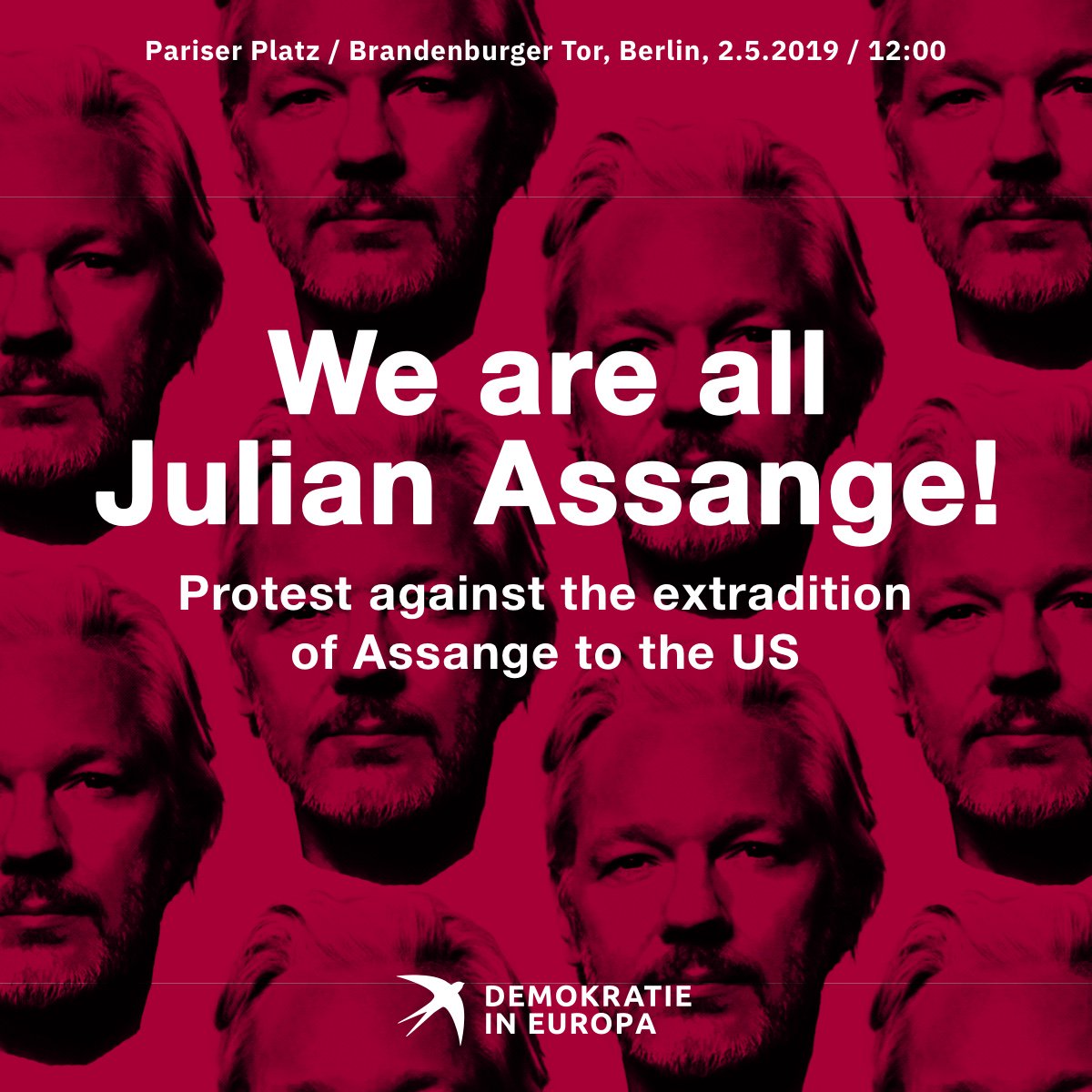
Court hearings in Britain over the US administration’s extradition case against Julian Assange begin in earnest next week. The decade-long saga that brought us to this point should appall anyone who cares about our increasingly fragile freedoms.
A journalist and publisher has been deprived of his liberty for 10 years. According to UN experts, he has been arbitrarily detained and tortured for much of that time through intense physical confinement and endless psychological pressure.
He has been bugged and spied on by the CIA during his time in political asylum, in Ecuador’s London embassy, in ways that violated his most fundamental legal rights.
The judge overseeing his hearings has a serious conflict of interest – with her family embedded in the UK security services – that she did not declare and which should have required her to recuse herself from the case.
All indications are that Assange will be extradited to the US to face a rigged grand jury trial meant to ensure he sees out his days in a maximum-security prison, serving a sentence of up to 175 years.
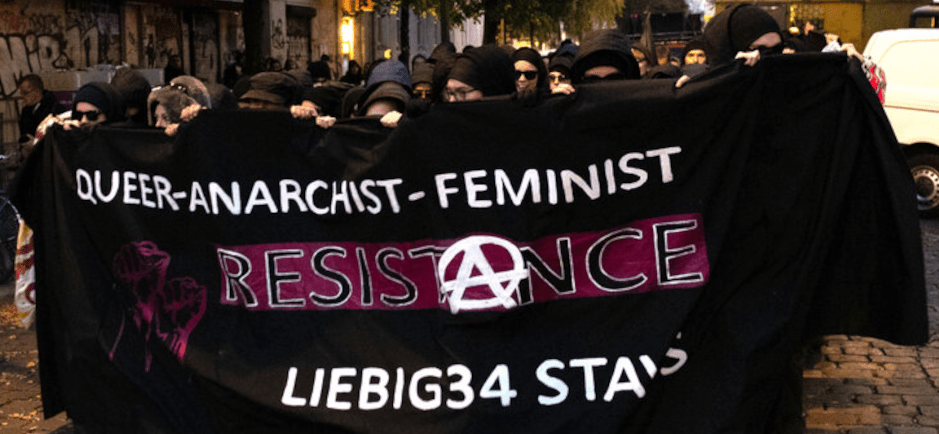
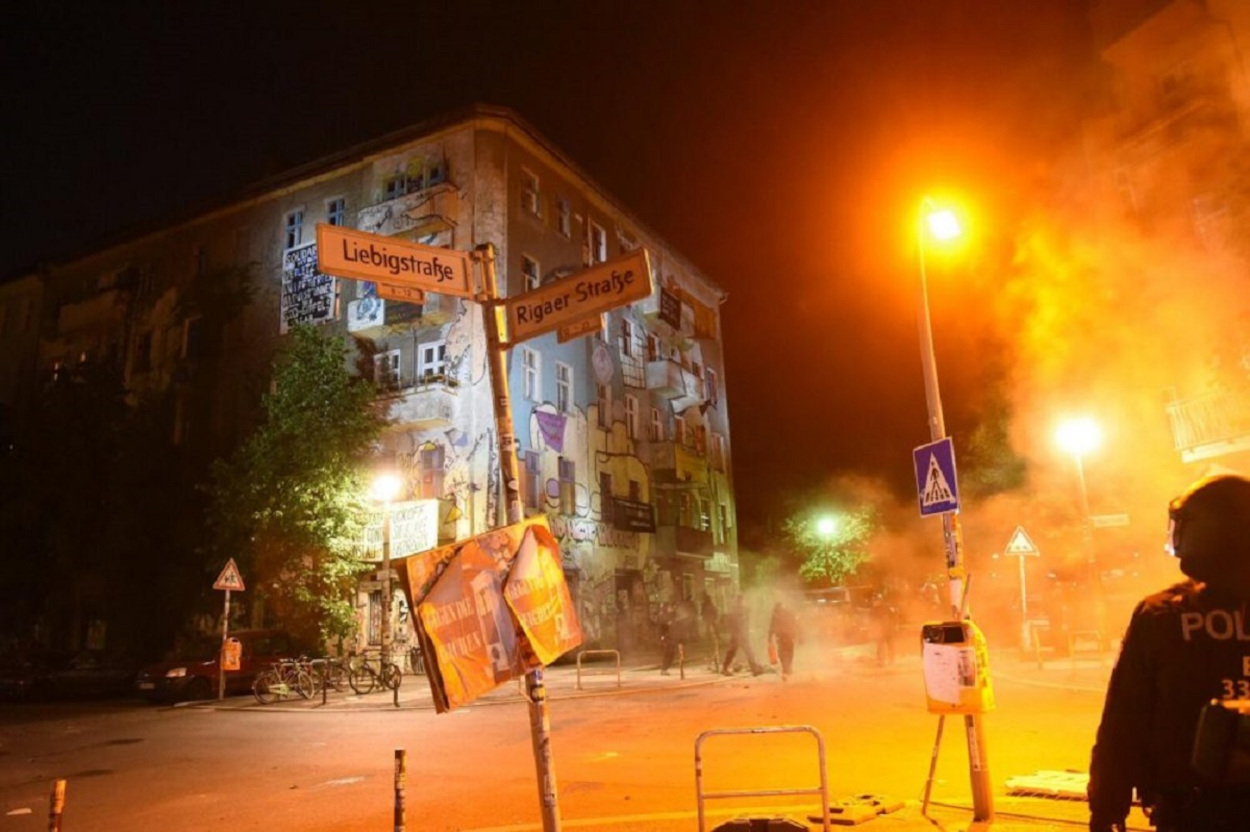
Berlin. Update of the international call for the defence of Liebig 34. Originally published by Defend Liebig 34.
Liebig 34 is being threatend by eviction. When state, cops and the owner want to evict, they will only have a desaster on their hands.
As an anarcha-queer-feminist selforganized house-project without cis-men, directly at the square „Dorfplatz“ in Friedrichshain, Liebig 34 is a place where resistive actions and collective moments are decided and organized.
A place where self-organization becomes a dangerous word, where a project is becoming a starting point of struggles and not just a space of self-reference and alternative entertainment.
Today, we mourn the passing of our friend and comrade, David Graeber, a tireless, insightful, and wide-ranging thinker. In his honor, we present his essay, “The Shock of Victory,” which he composed for the fifth issue of our journal, Rolling Thunder, exploring how anarchists can set long-term goals so as not to be caught off guard by our victories.
David’s unexpected passing takes us by surprise. Only days ago, we were corresponding with him about Facebook’s decision to ban anarchist pages to placate the Trump administration. David was among the first to respond with a support statement, charging that “Nothing could conceivably be more violent than to tell us—and particularly our young people—we are forbidden to even dream of a peaceful, caring, world.”
This was in character for David. He was not just an intellectual—he was always eager to take a stand, putting himself in the thick of things. He participated in the Direct Action Network in New York City leading up to the massive demonstrations against the Free Trade Area of the Americas ministerial in Quebec City in April 2001 at the high point of the so-called “anti-globalization” movement. He was an instrumental participant in the founding of Occupy Wall Street and engaged in the debates about “violence” that followed, confronting the same self-righteous pundits that other anarchists did. He was one of the first to direct international attention to the revolutionary experiment in Rojava when it was threatened by the Islamic State, and joined us a year ago in calling for solidarity when Turkey invaded.
He put his body on the line along with his reputation, braving tear gas as well as academic retaliation. After Yale forced him out for his political beliefs, David was compelled to move overseas to find a university position commensurate with his abilities. He got a corporate publishing deal, yes, but he got it by refusing to compromise, not by watering down his politics.
David wrote—and thought, and said, and did—more than we could possibly summarize here. We hope that others will compose a proper eulogy to him, recounting all of his activities and contributions across a wide range of fields. Even when we disagreed—our analysis of democracy is in part a response to David’s account of democracy in essays such as “There Never Was a West“—we always learned from him. He was a stalwart friend and a worthy adversary.
In Graeber’s most transcendent work, such as the essay “What’s the Point If We Can’t Have Fun?”, he grapples with the basic ontological questions about freedom and the cosmos. This is how we remember him, weaving together different threads to present a vision of self-determination that extends from subatomic particles to entire societies and ecosystems:
“Is it meaningful to say an electron ‘chooses’ to jump the way it does? Obviously, there’s no way to prove it. The only evidence we could have (that we can’t predict what it’s going to do), we do have. But it’s hardly decisive. Still, if one wants a consistently materialist explanation of the world—that is, if one does not wish to treat the mind as some supernatural entity imposed on the material world, but rather as simply a more complex organization of processes that are already going on, at every level of material reality—then it makes sense that something at least a little like intentionality, something at least a little like experience, something at least a little like freedom, would have to exist on every level of physical reality as well.”
He passed away at the young age of 59. Our hearts go out to everyone who survives him. We mourn his passing and grieve for all the things that David had yet to share with us.
David Graeber, rest in peace.
The essay we share here emerged from a discussion about the legacy of anti-capitalist struggles at the turn of the century, during the protests against the World Trade Organization, the World Bank, and proposed “free” trade initiatives such as the Free Trade Area of the Americas. Anarchists and other anti-capitalist protesters played a major role in delegitimizing the WTO and World Bank and even succeeded in blocking the passing of the FTAA agreement—yet afterwards, many of the participants in the movement were dejected, dismayed that we had not succeeded in abolishing capitalism entirely.
Following this discussion, we invited David to expand his thoughts in an essay for Rolling Thunder, and the result was the following essay, “The Shock of Victory.”







/cdn.vox-cdn.com/uploads/chorus_image/image/64846422/0a848e4111.7.jpeg)



 The Free