Bill Laurance, James Cook University Campaigns and boycotts get the attention of large corporations, because they hit them where it hurts: their reputation and market share.
#Boycottpalmoil #Boycott4Wildlife Tweet In October 2000, I was […]
In October 2000, I was driving through downtown Boise, Idaho, and nearly careered off the road. Just in front of me was a giant inflatable Godzilla-like dinosaur, well over 30m tall. It was towering over the headquarters of Boise Cascade, one of North America’s biggest wood products corporations. For years, the firm had been tangling with environmental groups who blamed the company’s logging practices for declines in the extent of old-growth forests across the globe.
Brands aren’t your friends- Subverting London
The huge inflatable reptile was the inspired idea of the Rainforest Action Network, who used it to label Boise Cascade a dinosaur of the timber industry. The blow-up dinosaur was headline news across the United States and the label stuck. Although Boise Cascade tried to deny it was yielding to environmental pressure, it ultimately agreed to phase out all of its old-growth wood products.
Environmental campaigns such as this one have become an increasingly important arrow in the quiver of conservation groups, for a very good reason. The world has become hyper-corporatised and globalised, with the result that, as I reported in 2008, deforestation is now substantially driven by major industries rather than by the exploits of poor people trying to make a living off the land.
Ferrero and Nutella responsible for palm oil deforestation despite supposedly using “sustainable” palm oil. Image: Charlie Hebdo
Last-ditch tactics
Boycotts are typically a last resort. The Rainforest Action Network tried for years to nudge, cajole and finally pressure Boise Cascade to phase out old-growth products, without success. Its gentler tactics worked fine with other big corporations such as Home Depot and Lowe’s, but it took a gigantic dinosaur to get Boise Cascade’s attention.
It is of great importance to resort to female genealogies to find lines of action that allow us to study the processes of change from the perspective of women. These genealogies help to clarify social phenomena that have transformed our lives at the present time and help to reconstruct the milestones and the women who contributed to that change.
It is essential to name women, build the genealogy in ways of doing and being among the founding texts of the feminist movement, to recover the historical voices of women and transmit them in formal and informal education.
The socio-cultural performance of women is not always the product of exceptionality, but rather stems from a trajectory that should be highlighted. We intend to reconstruct a part of the genealogy of anarchist feminism through three women: Louise Michel, Teresa Claramunt and Emma Goldman.
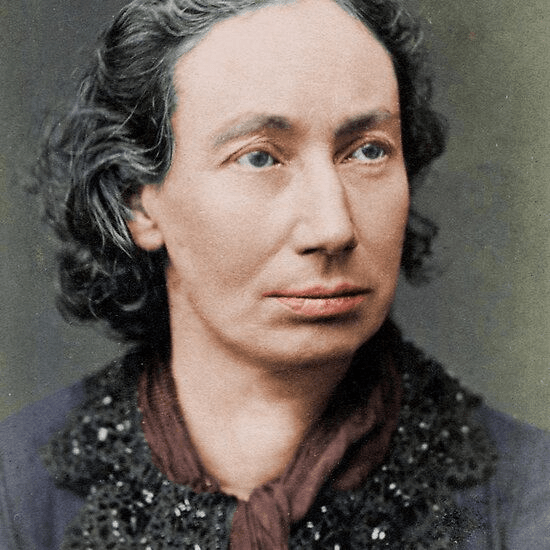
Louise Michel (1830-1905) belonged to a generation older than Teresa Claramunt (1862-1931) and Emma Goldman (1869-1940). The three met, although they never spent long together.
Teresa met Louise in 1897, both had been tried by separate Military Courts and deported. Louise, the ‘Paris Commune’ woman had returned to France after her deportation in 1880 and, finally, she went into exile in England in 1890. Claramunt along with twenty-seven other people, despite being declared innocent in the Montjuïc Trial, were deported to England in 1897.
When they arrived in London, after disembarking in Liverpool, Louise Michel[1], Fernando Tarrida and the Committee for the Protection of Victims of Spanish Atrocities[2] were waiting for them.
Teresa must have known of Louise because her great friend Teresa Mañé (who met with the deportees shortly after) was one of the promoters of Michel’s work in Spain. Perhaps for this reason, her daughter Federica Montseny met and was interested in the Commune and in Louise Michel [3].
Federica Montseny
Both were excellent communicators both at rallies and through articles in the labor press. Both carried out multiple propaganda tours spreading The Idea and were linked to newspapers such as El Productor in the case of Claramunt and Le Libertaire in the case of Michel. Their personal lives were difficult, especially when they stopped being young, due to the little income they had.
The parallelism of the stories of these two women we can assume must have linked them, despite the brevity of their meeting, in a feeling of empathy and solidarity, in addition to explaining why Teresa was called the ‘Spanish Louise Michel’.
Emma and Louise also met in England in 1895. Emma traveled to Europe to study in Vienna and her first stop from the United States was in London where she met various anarchist personalities including Louise (indeed that was her goal in visiting England as she says herself).
It was also a brief meeting since Emma went on to Vienna where she studied a midwifery course and another on childhood illnesses.
Emma’s impressions in her autobiography [4] make clear the great admiration she felt for her and for her intervention in the Paris Commune: «Louise Michel had stood out for her love of humanity, for her great fervor and courage» [ 5].
Her physical description made it clear that Michel was a woman aged by all the hardships she had experienced (she was sixty-five years old and not sixty-two as Goldman wrote): “She was bony, emaciated and looked older than she really was (…) ; but her eyes were full of youth and spirit, and her smile was so tender that she won my heart immediately »[6].
When Emma met Louise she wondered: «how could there be someone who did not see her charm» despite the fact that she did not care about her appearance and showed great disinterest in herself: «her dress was threadbare , the hat was very old. Everything she wore of hers did not fit her »[7].
Let us not forget that Emma was a young woman of twenty-six who looked admiringly at Louise but that she must have seen her as an older woman. It was her admiration for the old ‘Comunera’ (woman Commune member) that transformed the realistic impression of her into a completely different, almost mystical feeling [8]:
«(…) Her whole being was illuminated by an inner light. I was quickly succumbing to the charm of her radiant personality, so irresistible in her force, so touching in her childlike simplicity. The afternoon I spent with Louise was an experience unlike anything that had ever happened to me before in my life. Her hand in mine, the tender touch of her hand on my head, her words of affection from her and intimate camaraderie from her made my soul expand, ascend towards the spheres of beauty where she dwelled » .
Emma and Teresa met in Spain during a brief visit that Emma made between December 1928 and January 1929, to gather information.
It was the Austrian historian Max Nettlau (1865-1944), an anarchist intellectual with an encyclopedic culture, devoted to the study of the history of anarchism and the life of Bakunin, who encouraged his friend Emma, with whom he had been in constant correspondence since they met in London in 1900, to visit a country that had captivated him.
Spain was not an unknown country for her. Her anarchist internationalism had led her from a very young age to want to know the situation of her comrades from the rest of the world.
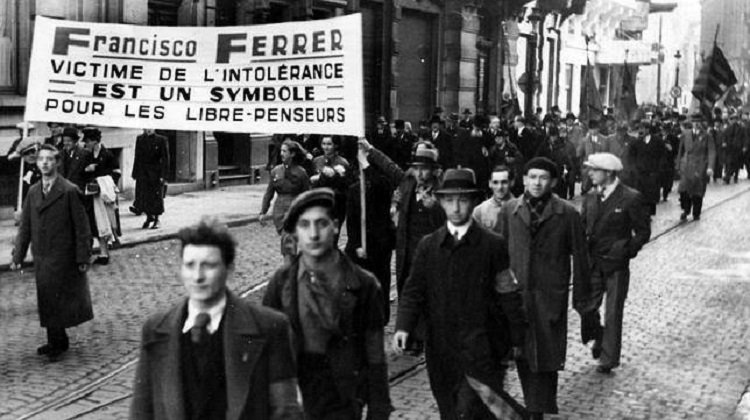
In the United States he participated in various campaigns against the repressive policy of the governments of the monarchy of Alfonso XIII, specifically as a result of the brutal torture of the prisoners of Montjuic (she probably knew Claramunt as a result of this campaign), and as a result of the execution of the pedagogue Ferrer y Guardia after the Tragic Week in Barcelona in 1909.
Russia on 24 February launched a “special operation” in Donbass aimed at protecting Donetsk and Lugansk People’s Republics (DPR and LPR), which were recognised as independent entities by Moscow on 21 February. The Western media called the operation “an invasion” they have long warned about.
The “Russia invasion” narrative wasn’t the West’s “prophecy” but rather a cover-up for a new attempt to return the breakaway Donetsk and Lugansk republics by force to Ukraine, according to George Eliason, an American investigative journalist who lives and works in Donbass. Bringing back Donbass would have paved the way for Ukraine’s NATO membership: in accordance with the alliance’s rules, a country having territorial disputes cannot be admitted to the bloc.
“First of all, Zelensky ordered the attack during a speech a few weeks ago,” Eliason says. “He made it very clear Ukraine’s buildup was for that purpose.”
By December 2021, the Kiev government had amassed up to 125,000 troops along the contact line with the Donbass republics. At the same time, OSCE reported more frequent use of heavy weapons, prohibited under the Minsk Agreements, by the Ukrainian Armed Forces against the breakaway regions.
The Western smoke-and-mirrors media campaign speculating about Russia’s “imminent invasion” began in spring 2021, according to the investigative journalist. The mainstream press claimed that Russia was about to invade Ukraine.
“This is a huge breach in what constitutes a fact in the media. Published satellite images of Russian army positions accompanying these news reports showed the Russian army on bases over a day’s travel away.
In real terms this translated into 160 miles to 460 miles from the border,” says Eliason, stressing that the Russian army could hardly launch a surprise land attack from these positions.
Ukrainian service members are seen on the front line near the village of Zaitseve in the Donetsk region, Ukraine February 19, 2022
Another battle won. Let’s keep marching and pushing to get our stolen rights and freedoms back
Good news, we have a date for revocation: 15TH MARCH
Really good response to the consultation– approx 90,000 responded, 96% participants responded to revoke the mandate with 84% HCPs supporting to revoke the mandate.
Further details of the analysis is in the official government website below. Good work team, we are on the way there!
In good news of this, those in the care sector who lost their jobs due to these mandates will be able to reapply to their jobs with the government supporting continuation of employement conditions, as well as compensation for any pensions lost during that time. (https://t.me/NHS100kChat/33009)
Statement by the following Australian and New Zealand anarchist groups: Anarchist Communists Meanjin, Black Flag Sydney, Geelong Anarchist Communists, Melbourne Anarchist Communist Group and RedBlackNotes.
Russia’s recent invasion of Ukraine is an extension of the human disaster that began many years ago – a product of years of political dictatorship, capitalist terror and geopolitical rivalries. It will predictably result in the deaths of many civilians, and the displacement of even more.
Putin has taken this expansionist course in order to prevent Ukraine from becoming further integrated into the economic bloc of the European Union. His Eurasian Economic Union, comprising Russia and its close allies like Belarus and Kazakhstan, is set up as an expression of the interests of the bourgeoisie of his own country, which prefers to be a big fish in a small pond than to negotiate with the EU as a regular partner.
In some sense, this is a clash between two kinds of capitalist economy: the paternalistic, oligarchic, often state-driven economies of Russia and its neighbours, and the modern, market-driven, hyper-competitive economies of the “advanced” EU states.
The integration of the states around Russia threatens the current Russian bourgeoisie, because it threatens their own existence.
We do not believe this is as simple as a clash between western liberalism and eastern dictatorship, as some would suggest. Our opposition to the Russian bourgeoisie does not entail support for the western European one; as cases like Poland and Hungary show, countries can develop “democratically” towards authoritarianism under the aegis of the EU and NATO.
The growth of “fortress Europe”, greatly inspired by Australia, that brutalises migrants with increasing severity, also demonstrates that liberal democracy and authoritarianism are not opposites, but joint partners.
The war in Ukraine will have global repercussions. Not only will it affect the EU and Eurasian states, but also the USA, which serves as Europe’s main military power through NATO.
Ukraine is also a major agricultural exporter, with many countries reliant on the wheat produced by its fertile soil. Lebanon, for instance, already in the throes of an economic crisis, imports 50% of its wheat from Ukraine. Libya imports 43%. By value, 86% of Egypt’s wheat imports come from Ukraine and Russia.
Destabilisations in this market will undoubtedly trigger the kind of “bread riots” we have seen before in many of these countries.
Despite their differences, both the Western European and Russian bourgeoisies share one essential thing in common: defence of their own existence against their own working classes.
Accordingly, the main response to this warmongering should not be either apologia for Russia imperialism or support for NATO, or even “national defence” within Ukraine.
Rather, we support a renewed effort to bring together workers across national boundaries, supporting all forms of revolt that challenge their respective systems: mutinies, desertions, strikes, sabotage, demonstrations.
For those of us in Australia, we have some basic tasks:
To fight against the warmongering of our own side, and against the hypocritical condemnations of Russia by the same politicians who drove the invasions of Iraq and Afghanistan – in particular, we should do all that is possible to prevent even more nations from intervening, which would risk the possibility of the war spiralling into a larger, even more disastrous global conflict;
To undertake meaningful acts of solidarity with the working classes of Ukraine and Russia, who are the primary victims of the war, and with protestors against it in both countries;
To spread information among workers here regarding the working conditions of those in Russia and Ukraine, and the ways they fight back against the war economy and the restrictions on liberties that inevitably come from it;
To support the free, safe flow of migrants from the conflict, demanding that Australia end its brutal border policies and grant refugees permanent protection, regardless of how they arrived;
To work, as always, for the union of workers across national boundaries, fighting for the only thing that can put an end to all wars: the social revolution.
The war is truly horrendous, but like all other capitalist crises, it contains the potential to trigger the kinds of social uprisings that overthrow entire regimes.
A century ago Russia participated in a disastrous, bloody war. It ended with a working-class revolution that sent shockwaves across the entire world.
It is up to the international working class to make sure that this current war will end in the same way.[1]
Signed by the following anarchist groups of Australia and New Zealand:
Anarchist Communists Meanjin Black Flag Sydney Geelong Anarchist Communists Melbourne Anarchist Communist Group RedBlackNotes
NO WAR BUT THE CLASS WAR!
Notes
(1) We know how this sentence was meant, nevertheless we want to emphasize that we do not support a revolution like the Bolshevik Russian revolution one hundred years ago. We support an anarchist revolution: against all authority. Enough 14.
According to a reputable Syrian pro-opposition Telegram news channel, al-Jasim older brother, Sa’ad, is a security commander in al-Qaeda-affiliated Hay’at Tahrir al-Sham (HTS) that controls the northwestern Syrian region of Greater Idlib.
Tariq al-Jasim in the middle of his armed as seen in a video he released on February 26.
Syrian pro-opposition activists have revealed disturbing facts about a Ukraine-based Syrian businessman who vowed to fight Russian forces currently conducting a special military operation in the country.
The businessman, Tariq al-Jasim, appeared in a video announcing the formation of an armed group to fight Russian forces on February 26.
Not only that, al-Jasim, who has been reportedly living in Odesa city for more than year now, is also the cousin of HTS Emir Mohamad al-Abd. Emir is an Arabic term usually used by radicals to describe senior leaders.
The Telegram channel, known as Muzamjer al-Thawra al-Suriyah, also revealed that the so-called businessman is in fact a drug dealer who used to work as a trafficker in Russia.
According to the Abkhazian Network News Agency, al-Jasim is currently preparing to funnel militants from Syria to Ukraine, where they will be thrown against Russian forces. Al-Jasim is working on this with the Turkish-backed Syrian National Army (SNA).
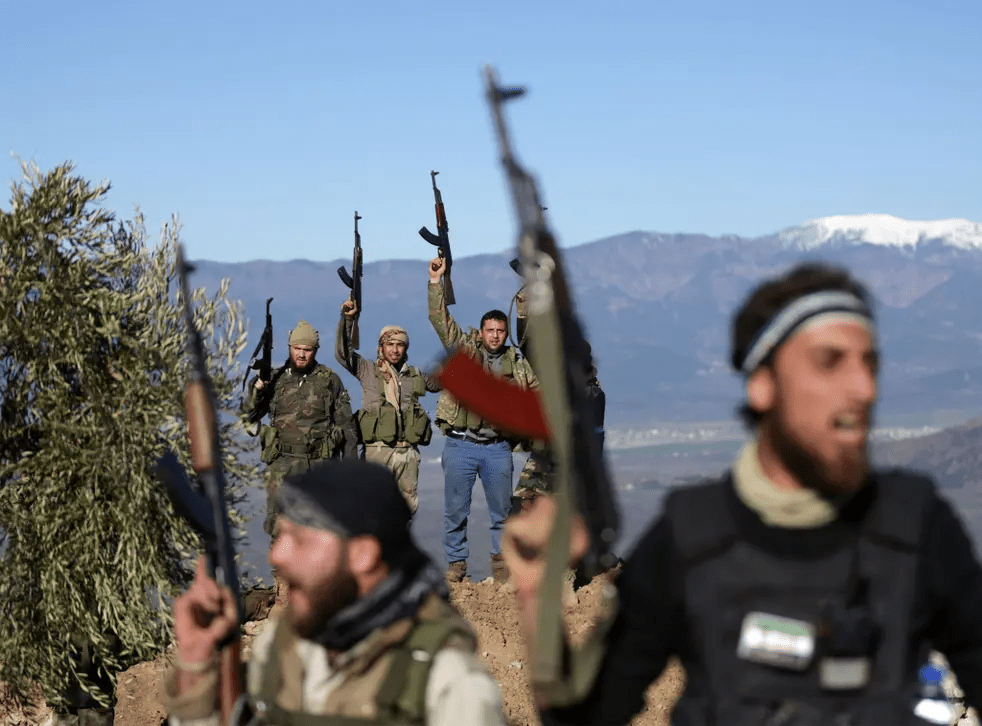
Around 200 militants from the Sultan Morad Division and the al-Shamiya Front have already signed up. They are reportedly amassing now in the Turkish-occupied northern Syrian area of Afrin.
The Russian military kicked off a large-scale special operation to “demilitarize” and “denazify” Ukraine on February 24 following Kiev failure to implement the 2014 Minsk agreement.
Syria: ‘Unlawful’ civilian deaths in Afrin”
Kiev is apparently planning to use al-Jasim to funnel Syrian militants from SNA factions and even HTS to Ukraine. This can’t happen without help from Turkey who controls and commands these militants. Russia, who maintains a large force in Syria, will not likely tolerate this.
ANNA-NEWS|News|Syria|Donbass|Nagorno-Karabakh forwarded from Rybar ⚡️🇸🇾🇺🇦 In Syrian Afrin, in the territories controlled by Turkish formations, a selection point has been set up for those who wish to be sent to Ukraine as part of the detachment of the Syrian-Ukrainian businessman and local crime boss Tariq al-Jasim.
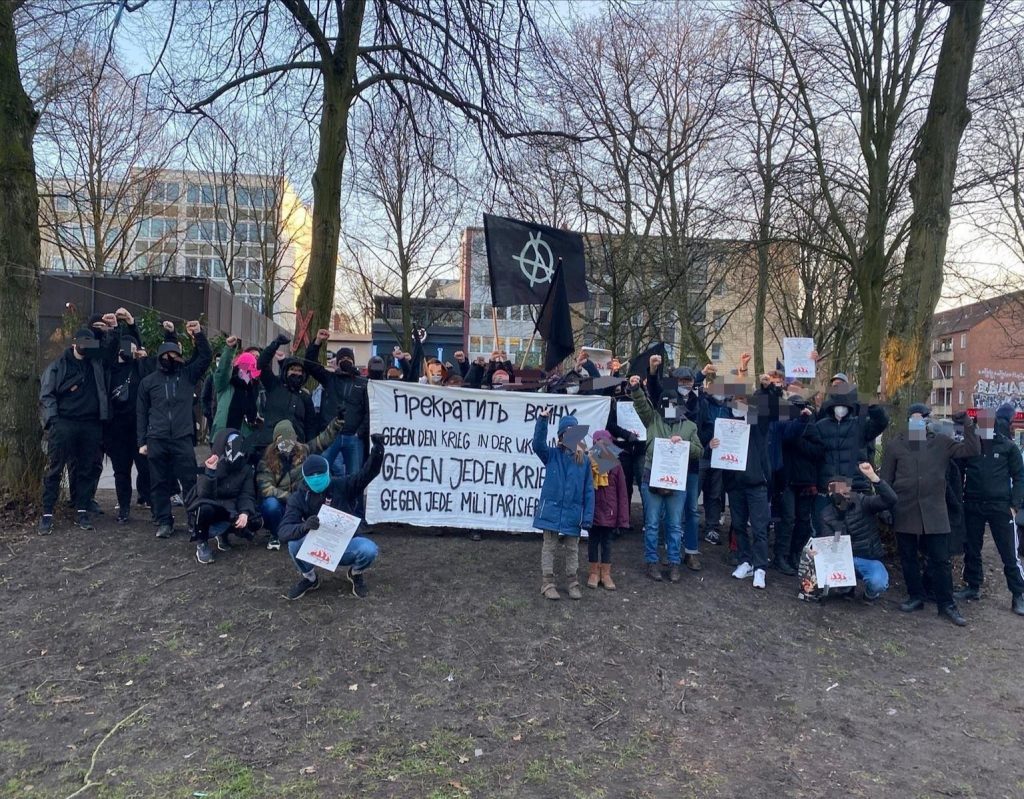
On Sunday 27.02.2022 about 60 people met for an anarchist rally in Arivati Park/Neuer Pferdemarkt Hamburg to take to the streets againstthe war in Ukraine and all militarism.
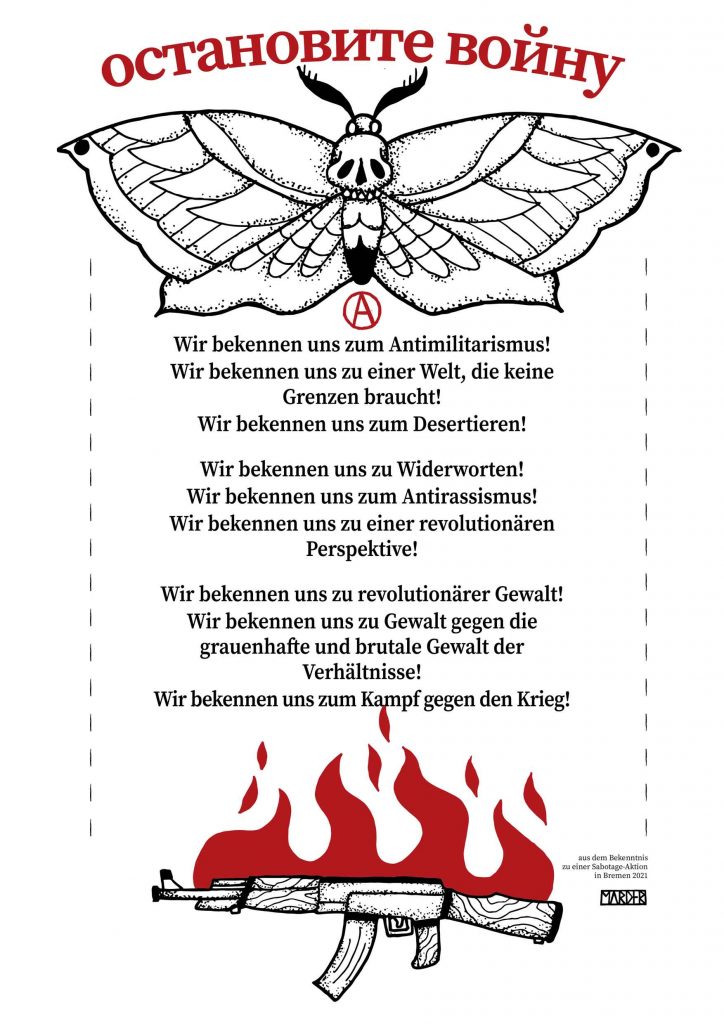
Banners (“Stop war!( in Russian) -Against the war in Ukraine! Against any war! Against any militarization!) were hung up and a speech was given. An anarchist anti-militarist poster was distributed and a solidarity photo was taken for the anarchist comrades in Ukraine.
Afterwards there was a spontaneous demonstration in the direction of Sternschanze, which was stopped by the arriving cops and then registered.
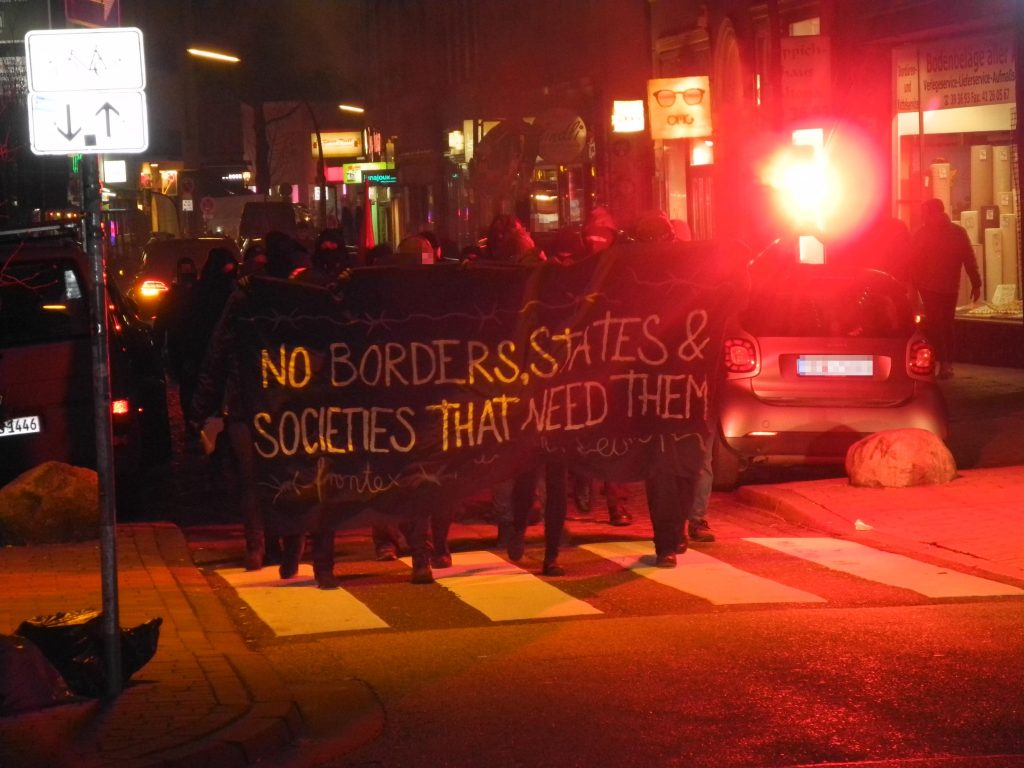
Already on the evening of 26th February, an unannounced demonstration against Fortress Europe took place in Hamburg-Ottensen. About 30 people took their anger about the current situation at the Polish-Belarusian border to the streets.
Flyers flew over the Alma-Wartenburg-square and in front of the Haspa (local Bank) a barricade caught fire. With a lot of pyro as well as slogans against borders and nations, the street was confidently taken.
On the Flyers under the slogan “Against states and their wars” reference was made to the war in Ukraine, other leaflets criticized above all the situation at the Polish-Belarusian border and positioned themselves against borders and Fortress Europe.
Before the cops arrived, the participants were already scattered to the winds.
It is important in these days to make anti-authoritarian and anti-militarist positions visible to oppose the militaristic and nationalistic hegemony that is spreading.







 The Free