The incident comes a day after Russian hackers threatened European banks
“Several” US government agencies have been targeted in an ongoing global hacking spree, CNN reported on Thursday.
While Wasington is not commenting on who is to blame, Russian-speaking groups have taken responsibility for similar intrusions in recent weeks.
The US Cybersecurity and Infrastructure Security Agency “is providing support to several federal agencies that have experienced intrusions,” an agency official told the American broadcaster. “We are working urgently to understand impacts and ensure timely remediation.”
It is unclear who carried out the attack, and how many agencies were affected.
The attack is the latest in a slew of hacks targeting Western corporations, universities, and governments in the last two weeks.
State governments in Minnesota and Illinois have been hit, as have the BBC, British Airways, and oil giant Shell.
A Russian-speaking group known as Cl0p has taken responsibility for most of the breaches, promising to start publishing data obtained from the affected targets if its ransom demands are not met.
According to CNN, the group exploited a vulnerability in a popular file-transfer program called MOVEit to gain access to its targets.
In a video released on Wednesday, the Russian-speaking hacktivist groups Killnet and REvil, as well as another group calling itself Anonymous Sudan, said that they would launch a campaign targeting European banks and financial institutions “without mercy.”
These organizations have allegedly targeted US and other Western governments in the past, although it is unclear whether they took part in any recent attacks..
By Robert Kogon The Daily Sceptic Citing microbiologist Kevin McKernan, the Epoch Times reports that green monkey DNA has been found in mRNA-based COVID-19 vaccines. This has led D.D. Denslow to note in a viral tweet that green monkeys were the source of the infamous 1967 Marburg virus outbreak. Well, as so happens, the production […]
Hoy es 15 de junio de 2023, 15J: Día contra los Centros de Internamiento de Extranjeros (CIE). Un año más, desde la sociedad civil reiteramos nuestro rechazo permanente a la privación de libertad de personas extranjeras por no encontrarse en situación administrativa regular en el territorio español. Lejos de ser una fecha conmemorativa, es una […]
By Rudi Maxwell, June 14 2023 https://www.canberratimes.com.au/story/8232976/survivors-want-pm-to-sign-treaty-to-ban-nuclear-weapons/ Karina Lester (above) and June Lennon are still affected by the fallout from British nuclear tests on their country 70 years later. The two First Nations women are part of a delegation of atomic survivors and relatives, which includes veterans, visiting Canberra to call on the government to sign an […]
Power Mad Maniacs now controlling the USA are guilty of the worst crime in History, by a long shot.. Provoking the Nuclear Holocaust.. Guilty and proud of it.. of conspiracy for profit.. to cause Genocide, Ecocide, Omnicide . . killing you and me, our friends and families.. burned alive , or in a radioactive abbatoir, or just starved to a lingering horror worse than death…
‘At every step of the escalation the US has pretended reluctance while ramping up tens of billions of arms gifts to its proxy Ukraine regime. Now they say the F16s are ‘not really nuclear bombers’, but they can be easily adapted to carry the dirty nuclear bombs Russia realistically claims Ukraine now possesses and plans to use in a desperate new false flag slaughter, just as the British Storm Shadow missiles were easily adapted to Ukrainian jets from Day 1.
Here we are seconds from The Holocaust, when US Nuclear jets “reluctantly” attack Russian forces in areas that are PART OF RUSSIA in Russian law and confirmed by overwhelming votes by their besieged ethnic Russian population, forcing Russia to legally and morally, in their terms , react with Nuclear Weapons. As Putin himself remarked..”without Russia we don’t need a planet”.
As a result, NATO’s European members were given the legal basis to deliver these old fighter jets to the Neo-Nazi junta. The troubled Biden administration has been mulling the move for months, while Ukrainian pilots have been conducting training in several NATO countries, including the US itself. Last week, Russian Foreign Minister Sergei Lavrov issued a stark warning to the political West regarding the delivery of nuclear-capable US-made F-16 fighter jets to the Kiev regime.
“We can expect anything from the leaders of the United States and other Western countries whom Washington has brought to its heel. They are proving the truth of this statement now that following the supplies of modern long-range artillery and tanks, they are getting ready, in earnest, to supply the F-16 jets. Some say they will make two squadrons available, others say eight. They are gearing up to continue the escalation of the war against us,” Lavrov stated and then added a stark warning: “We must keep in mind that one version of the F-16 can carry nuclear weapons.
“M242 gun mounted on Bradley Fighting Vehicles now being destroyed in the Ukrainian Offensive fires the Depleted Uranium rounds”.
The Russian Foreign Minister made these comments mere days after troops from NATO took part in incursions into Russia proper, accompanied by escalating drone strikes against targets as far as Moscow itself. However, the mainstream propaganda machine was quick to decry Lavrov’s warnings as supposed “disinformation” and “baseless fearmongering”. The Business Insider claims, citing Hans Kristensen, the director of the Nuclear Information Project at the Federation of American Scientists, that “Lavrov’s comments were misinformation, perhaps even disinformation”.
“It’s misinformation because he’s saying things that are not real and using it in a way to, I assume, create public concern or fearmongering about Western intentions,” Kristensen told the Business Insider, adding that “Lavrov is using the nominal capability of the F-16 aircraft to say that the ones that might be sent to Ukraine could also be converted to nuclear, but that’s not the case. The F-16s that Ukraine is going to get — if and when it gets them — they’re not from the units that have the nuclear mission. There’s no way at all that any nuclear state in the West would give nuclear weapons, or nuclear weapons capability, to Ukraine. It’s completely out of the question.”
The F-16 is designed to be capable of launching nuclear strikes, usually with B61 thermonuclear bombs. The units deployed by NATO members such as Belgium and the Netherlands operate F-16 fighter jets capable of delivering nuclear weapons, specifically as part of their nuclear sharing agreements with the US.
And it’s precisely these countries (in addition to Denmark and others) that still operate F-16s and could very well be the first to send them to the Kiev regime. On the other hand, members such as Poland and Romania are extremely unlikely to do so, as the move would undermine their own security. This further reinforces the idea that the jets destined for the Neo-Nazi junta will be capable of delivering nuclear weapons.
Although the US is by far the largest operator of F-16 fighter jets, it still hasn’t announced plans to deliver them to the Neo-Nazi junta forces. Washington DC’s propaganda machine insists that this is supposedly because “the US is reluctant to do so to avoid escalation with Moscow”.
However, this is a moot point, as the belligerent thalassocracy has so far done everything in its power to antagonize Russia through a series of moves that have pushed the world dangerously close to a world-ending thermonuclear conflict. Still, this doesn’t seem to stop the US from going ahead with such plans, at the very least covertly. National Security Council coordinator John Kirby recently admitted this, stating that “the US has been forward-looking about future capabilities and needs”.
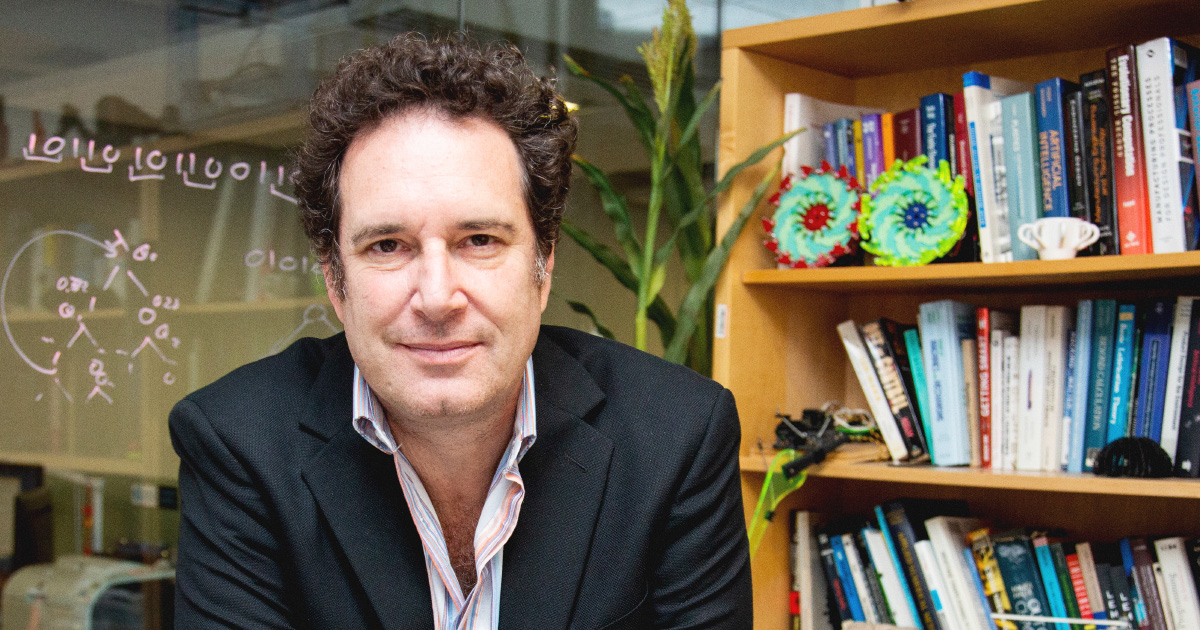
Consciousness, our experience of being in the world, is one of our mind’s greatest mysteries, but as the neuroscientist Anil Seth explains to Steven Strogatz, research is making progress in understanding this elusive phenomenon.
Neuroscience has made progress in deciphering how our brains think and perceive our surroundings, but a central feature of cognition is still deeply mysterious: namely, that many of our perceptions and thoughts are accompanied by the subjective experience of having them. Consciousness, the name we give to that experience, can’t yet be explained — but science is at least beginning to understand it.
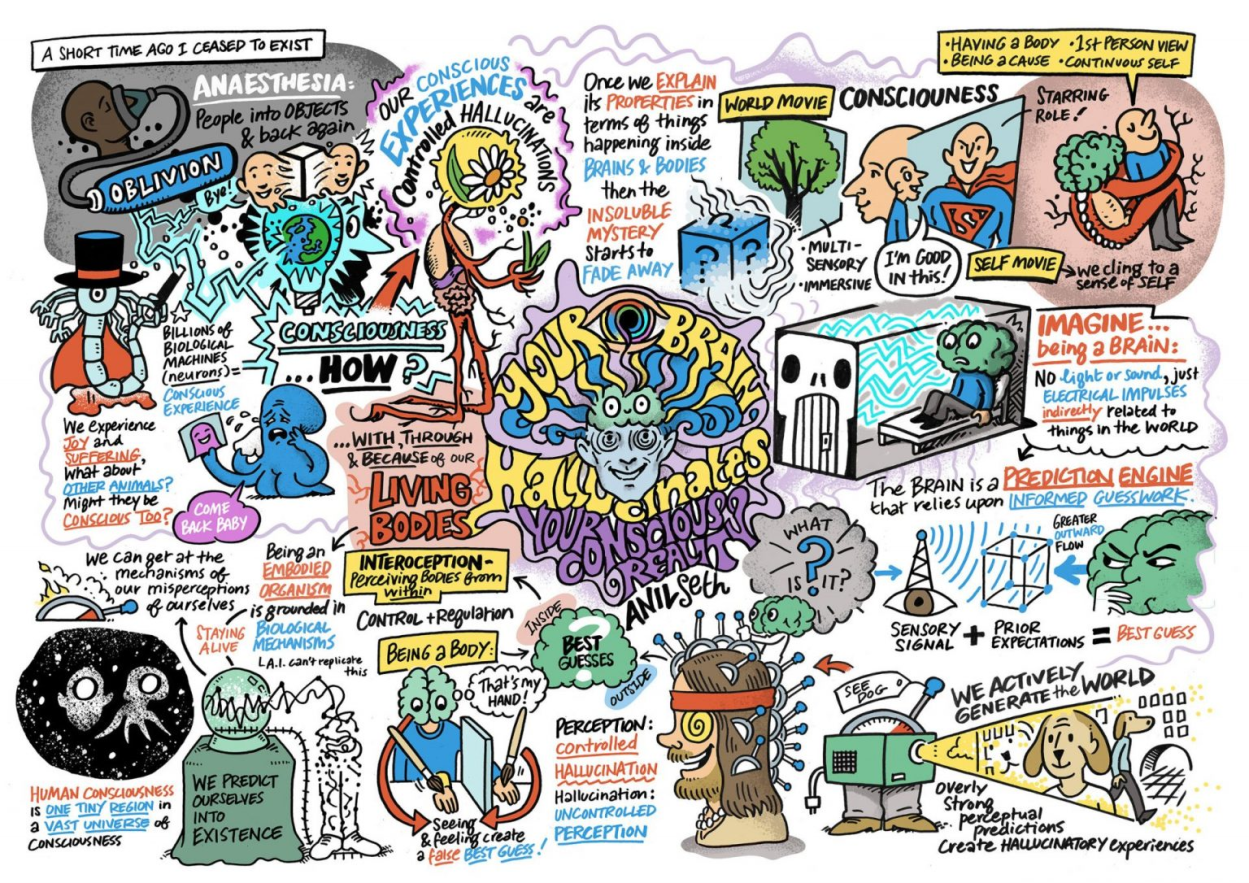
In this episode, the consciousness researcher Anil Seth and host Steven Strogatz discuss why our perceptions can be described as a “controlled hallucination,” how consciousness played into the internet sensation known as “the dress,” and how at home we can participate in helping researchers catalog the full range of ways that we experience the world.
Transcript
Steven Strogatz (00:03): I’m Steve Strogatz, and this is The Joy of Why, a podcast from Quanta Magazine that takes you into some of the biggest unanswered questions in math and science today. In this episode, we’re going to be discussing the mystery of consciousness.
The mystery being that when your brain cells fire in certain patterns, it actually feels like something. It might feel like jealousy, or a toothache, or the memory of your mother’s face, or the scent of her favorite perfume.
But other patterns of brain activity don’t really feel like anything at all. Right now, for instance, I’m probably forming some memories somewhere deep in my brain. But the process of that memory formation is imperceptible to me.
I can’t feel it. It doesn’t give rise to any sort of internal subjective experience at all. In other words, I’m not conscious of it.
(00:54) So how does consciousness happen? How is it related to physics and biology? Are animals conscious? What about plants? Or computers, could they ever be conscious? And what is consciousness exactly? My guest today, Dr. Anil Seth, studies consciousness in his role as the co-director of the Sussex Center for Consciousness Science at the University of Sussex, near Brighton, England. The Center brings together all sorts of disciplinary specialists, from neuroscientists to mathematicians to experts in virtual reality, to study the conscious experience. Dr. Seth is also the author of the book Being You: A New Science of Consciousness. He joins us from studios in Brighton, England. Anil, thanks for being here.
Anil Seth
Anil Seth (01:42): Thanks for having me. It’s a pleasure to be on with you.
Strogatz (01:44): Well, this is, I have to say, one of my favorite and most perplexing things to think about. I don’t really know where to start with it. I mean, consciousness is so mysterious. I sometimes have this uncanny sensation, maybe like once or twice a year. I’ll be looking in the bathroom mirror, shaving. And then I get this creepy feeling like: What is this lump of matter looking back at me in the mirror? Like, who’s in there?
Seth (02:11): Yeah, welcome to my world. This sounds like a description of my every day. Now, in one sense, you leave the mystery behind when you go and make dinner and leave your normal life. But it does have this habit of going everywhere with you. And most days, I’ll have a moment like that. And I will try and train myself also just to continually reflect and meditate on this everyday miracle that we have this electrified pâté inside our skull. And that somehow, in conjunction with the body and its interaction with the world, there isn’t just complicated biological machinery chugging away: There is subjective experience. It feels like something to be me, and it feels like something to be you — to use a definition that comes from the philosopher Thomas Nagel.
(02:58) And that is really still quite astounding. It doesn’t feel like anything to be a table or a chair. But this is the fundamental mystery of consciousness. And it’s both a deep scientific and philosophical mystery, but also a very personal mystery. Because part of the “feeling like” is the feeling of being a particular person. Being the individual that you are. Being you or being me.
Strogatz (03:22): You have just introduced the word “self.” You can be conscious of various things; you can also be conscious of having a self. Should we start to try to tease apart the different concepts related to consciousness? What is consciousness? How is it different from self-consciousness?
Seth (03:39): I think that’s a good idea. There’s always this problem with definition when it comes to a poorly understood phenomenon. Looking back at the history of science, I think we both know that definitions aren’t sort of written in stone and you settle on one and then you just try and figure out what the underlying science is. The definitions always evolve along with our understanding.
(04:00) And so for consciousness, the place I start is with this definition from philosopher Thomas Nagel, who simply said, for a conscious organism, there is something it is like to be that organism. It feels like something to be. Yeah, that’s fairly circular. But I like it because it hits the bullseye that it’s just talking about experience, and it’s useful for what it leaves out. It’s often tempting — and this has happened before in many other examples — of associating consciousness implicitly with something else, whether that’s intelligence, or having language or behaving in a particular way. Or knowing who I am in an explicit, reflective sense of self.
(04:40) All of these things may be aspects of human consciousness. But consciousness in general is not the same as any of these other things. It’s just the raw fact of that experiencing. But then within that, there are indeed further divisions that you can make. And I think this is heuristically useful in dividing up the problem so we can get at consciousness from a kind of divide-and-conquer strategy.
(05:03) And there are three ways that I like to do it. There’s the level of being conscious at all. You lose it when you’re under general anesthesia or in dreamless sleep. Then you are conscious of what’s around you, the world. And then within that, there’s the experience of being yourself, of being the person that you are.
Strogatz (05:20): I thought that was a terrific aspect of your book, as far as helpfulness to me as a reader, to be able to think about chopping up the problem in various ways. You mentioned four levels: the level of consciousness; the issue of what you call the content or contents of consciousness — what we’re conscious of or what we perceive; consciousness of self; and then the fourth one, you say, is this really profound mystery of being you?
Seth (05:47): Well, I actually think the third and the fourth are rather the same.
Strogatz: OK, fine.
Seth (05:49): But there are many ways of experiencing being yourself. So we can have experiences of self without knowing that we’re having these experiences. I can experience being associated with this object that’s my body, and I can have emotions and moods. And all of that can in principle unfold without attaching a name and a set of memories to it.
(06:13) So there are, within each of these areas of content and level and self, there are of course more fine-grained distinctions that we can make. And we can ask whether these finer-grained distinctions have any traction in the laboratory or the clinic — do they pick out joins in nature? Or do they not? Are they things we just sort of make up? And that’s part of, I think, the game of consciousness research. We can figure out which of our distinctions have traction in the real world.
Strogatz (06:20): Great, I do appreciate that, because on this podcast, we try to talk about science, especially big mysteries in science. But I would want to underline the word science. That there are things we can ponder that are outside the realm of science, not even testable or refutable in principle. And I take it that you really are focused on the scientific side of consciousness — I’m sure your philosophical side likes pondering the unanswerables as well.
Seth (06:41): Well, I don’t think philosophy is just pondering the unanswerables. I think science and philosophy really work together in understanding something for which it’s not clear what a satisfactory understanding would look like. Now, we don’t necessarily need philosophy if we are at the stage of the Human Genome Project, where we know exactly what we’re doing and it’s just a sort of engineering problem of how we do it. But when it comes to consciousness, there’s still a mystery not only about how it happens, but about what a successful answer would even look like.
Strogatz (07:08): I appreciate your use of the word “explain” here because I’d like to get into the question of what you have sometimes called the “real problem” of consciousness as opposed to the “easy problem.” So what is the real problem?
Seth (07:39): So science and philosophy really still need each other. You know, with the one, science without philosophy is a bit blind, and philosophy without science is a bit lame. So I’ve never formally studied philosophy, but it’s always been in my environment. And I’ve benefited enormously from talking to and collaborating with philosophers and even trying out some philosophy ideas myself. I think we need it. It keeps science honest, and it helps guide it to the right kinds of questions.
(08:16) But I think there’s still approaches to consciousness which I find less appealing, which are those that are in principle non-testable, which may be purely philosophical positions. There’s a position that’s becoming quite popular these days called panpsychism, which is this idea that consciousness isn’t something that brains generate, or that is identical to particular kinds of brain processes or biological processes, but that it’s fundamental and ubiquitous. That it’s somehow everywhere and in everything like charge or mass-energy. This is maybe superficially an appealing idea, because if you just say consciousness is there from the get-go, then you don’t have to explain how it comes about in certain places and not others.
(08:16) But it doesn’t really explain anything. And it’s not only that it’s not testable; it doesn’t lead to anything that could be testable. And it’s that that I find off-putting. I think philosophical perspectives, they’re rarely themselves testable. Like materialism — the view that I sort of work with, the idea that consciousness is a natural phenomenon and is somehow a property of material things like brains and bodies. That itself is probably not testable. But what it does do is it leads to things that are testable, and over time allows us to explain things about consciousness that we would otherwise not be able to explain.
(09:47) The real problem is how to explain, predict and maybe even control properties of consciousness in terms of their underlying mechanisms in the brain and the body. And that sounds like sort of an obvious thing that we should be trying to do, right? But it’s actually not so much, because these properties of consciousness that I’m talking about that we should try to explain, they are primarily experiential, or what we would call phenomenological properties. Which is an incredibly long word, but what it really just means is the way in which conscious experiences appear as experiences — not what they allow us to do so much, or what functions they might have in terms of the cognitive architecture of the brain.
(10:30) Like, why is a visual experience the way it is and different from an emotional experience? Visual experiences, they have spatial character, they have objects, and things move. An emotional experience doesn’t have these sorts of things, right? It has valence: Things are good or bad. So the real problem is about connecting mechanisms in the brain to these kinds of properties of phenomenology.
(10:54) The reason I called it the “real problem” was as a bit of a bit of a pushback — a kindly, friendly pushback against this “hard/easy problem” distinction from David Chalmers that has really dominated a lot of the contemporary science and philosophy of consciousness. And the reason it’s different is because the hard problem of consciousness is this big, scary mystery. It’s the problem that we mentioned at the start of this conversation. How is it that consciousness happens at all? What is it about matter arranged in a particular way that makes experience happen? I mean, Chalmers puts it like this himself, he said: “It is widely agreed that experience arises from a physical basis, but we have no good explanation of why and how it so arises. Why should physical processing give rise to a rich inner life at all? It seems objectively unreasonable that it should, and yet it does.” And that’s a hard problem. It’s not just like, difficult. It’s hard in this conceptual sense of nobody even really knows what a good answer would look like.
(11:59) And then Chalmers separates that from the easy problems. And by the easy problems, basically, these are all the problems about how brains work, for which you don’t really need to bring consciousness into the picture at all. You know, how the brain transforms sensory signals into actions and making decisions and so on.





















 The Free