
from thefreeonline on By Malik Miah at Red Ant Admin

What’s being called the “summer of strikes” (more accurately an upsurge of labor agitation) is inspiring more workers to fight back.
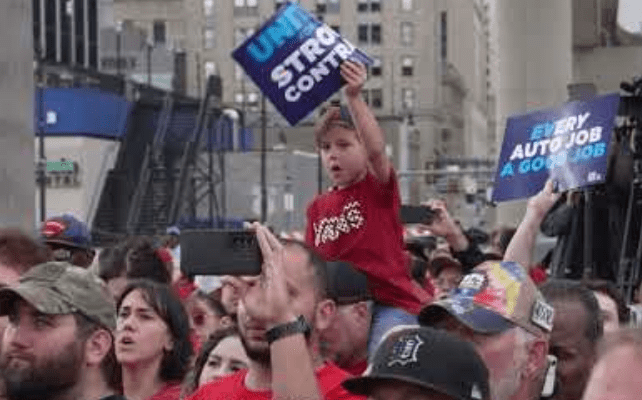
“We build those cars!” chanted striking auto workers.
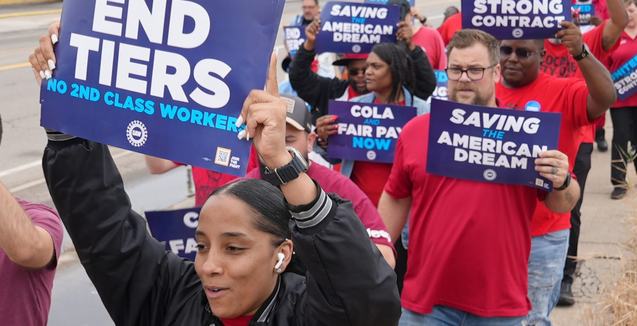
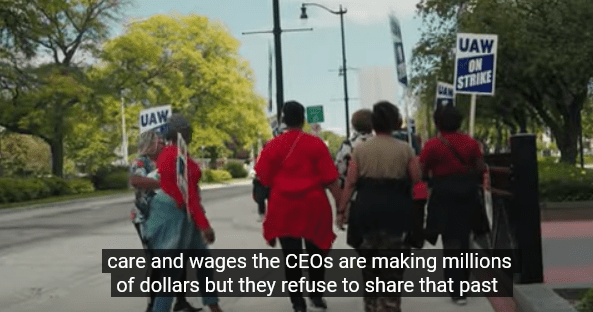
On September 15, at midnight, the United Automobile Workers (UAW) President Shawn Fain said rolling strikes against major US-owned auto companies were launched. Some 12,700 assembly line workers at three plants in Michigan (Ford), Ohio (Stellantis) and Missouri (GM) hit the picket line. The UAW represents 150,000 workers.
This is the first time the union has launched a strike hitting each of the big three manufacturers at the same time.
Fain was elected president in March against long dominant incumbent opposition. He said the strike was class warfare between the working class and the billionaire class.
Fain laid out the stakes days before the strike began:
“Living paycheck to paycheck, scraping to get by? That’s hell. Choosing between medicine and rent is hell. Working seven days a week for twelve hours a day for months on end is hell. Having your plant close down and your family scattered across the country is hell. Being made to work during a pandemic and not knowing whether you might get sick and die or spread the disease to your family is hell.
“Enough is enough. It’s time to decide what kind of world we want to live in and it’s time to decide what we are willing to do to get it.”
A Struggle for the Industry’s Future
“Enough is enough. It’s time to decide what kind of world we want to live in and it’s time to decide what we are willing to do to get it.”
The strike takes place as the traditional automakers invest billions to develop electric vehicles (EVs) while still making most of their money from gasoline-driven cars. The negotiations will determine the balance of power between workers and management, possibly for years to come. That makes the strike as much a struggle for the industry’s future as it is about wages, benefits and working conditions.
The established US carmakers — General Motors, Ford Motor and Stellantis (which owns Chrysler, Jeep, and Ram) — are trying to defend their massive profits and their place in the market in the face of stiff competition from non-union Tesla, owned by the world’s richest man Elon Musk who hates unions, and foreign automakers from Europe and Asia (including Mercedes Benz, Volkswagen, Toyota, Honda, Kia and Hyundai) that are non-union.
Executives and business analysts have characterized what is happening in the industry as the biggest technological transformation since Henry Ford’s moving assembly line started up at the beginning of the 20th century.
They don’t mention that the auto workers in the 1930s organized sit-ins and pitched battles to build their independent unions. Their strike actions along with those of workers in many other industries forced the Federal Government to pass labor legislation favorable to most workers. At that time, the US ruling class feared a workers’ revolution against capitalism.
That’s not the situation today where organized labor is still reeling from decades of bad contract agreements and take-backs (i.e. losses in entitlements). Non-union labor has increased in manufacturing and through the introduction of new productive technologies.
During the Great Recession of 2007-2009, the UAW lost 45 percent of its members. Today non-union auto companies build more cars than union labor.
The UAW has failed to organize any of these manufacturers, which mainly operate in the largely non-union Southern states. Tesla’s main assembly plant is in Fremont, California, which was once owned by GM. Tesla bought the property, but the UAW failed to sign up the new workforce.
Auto workers are trying to defend jobs as manufacturing shifts from internal combustion engines to batteries. Because they have fewer parts, electric cars can be made with fewer workers than gasoline vehicles. A favorable outcome for the UAW would give the union a strong bargaining card if, as some expect, it then tries to organize employees at Tesla and other non-union carmakers like Hyundai, which is planning to manufacture electric vehicles at a massive new factory in Georgia.
The bosses of the “big three” auto manufacturers understand the stakes. They have attacked the union’s strike as threatening the existence of their businesses, as competition from electric vehicles become more prevalent.
However, according to Madeline Janis of Jobs to Move America, “if you look at the breakdown at what it costs to build an EV, labor is an exceedingly small part of the equation. Batteries are the most”… “This idea that the UAW is going to price Ford, GM and Stellantis out of the market is not true.”
The union demands are not only reasonable. They do not even make up for decades of wage and benefit concessions.

The union demands are not only reasonable. They do not even make up for decades of wage and benefit concessions.
CEO pay versus a wage increase
The big business media continues to present the big lie that the union’s demand for a 40 percent wage increase over four years is too much. Yet the salaries and benefits of the CEOs dwarf what a typical production worker makes, which averages $28 an hour at the top of the wage scale.
Last year, the CEOs of the Big Three automakers received staggering pay packages, fueling workers’ ongoing push for better wages and benefits.
Ford’s Jim Farley took home around $21 million, Stellantis’ Carlos Tavares pocketed nearly $25 million and General Motors’ Mary Barra brought in roughly $29 million.
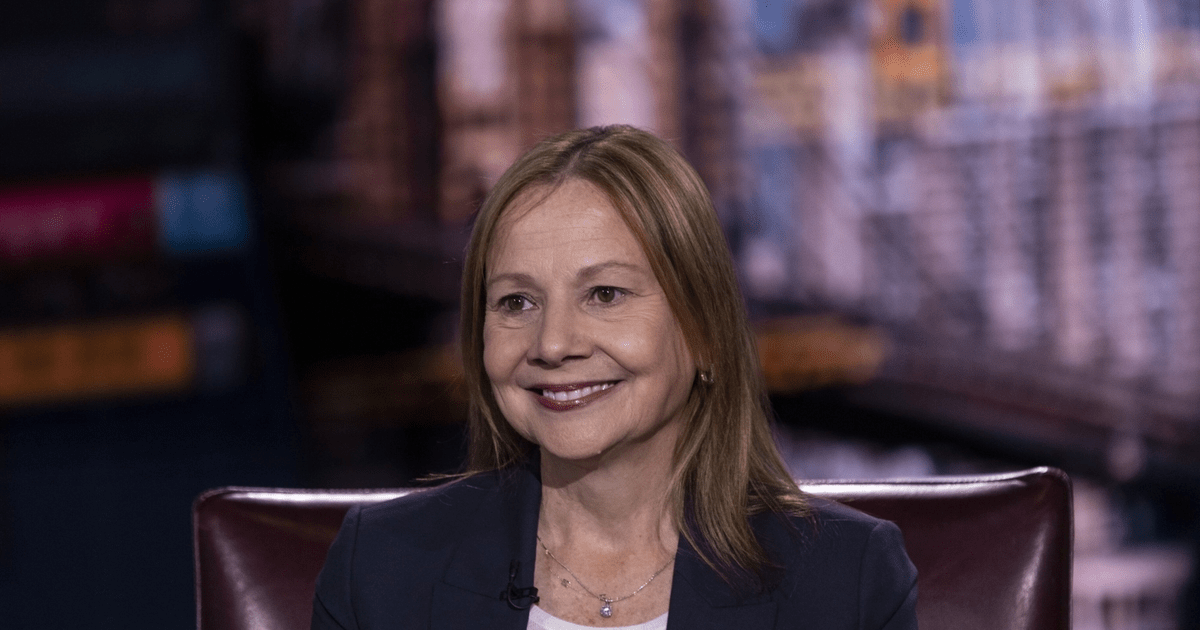
Barra has received more than $200 million in total salary plus other benefits since becoming GM’s CEO in 2014.
Ford’s chief executive made 281 times as much as the company’s median worker last year.
“We’ve went backwards in the last 16 years — backwards — while the CEOs gave themselves 40 percent pay increases in the last four years alone,” Fain said from a picket line in Michigan. “And they want to call us greedy.”
Robert Reich, the former U.S. labor secretary, argued in a blog post the day before the strike began that the combination of “humongous executive pay packages,” massive automaker profits, low wages for hourly employees, and tiered pay systems that harm newer workers have increased “the likelihood of a long strike.”
Two tier wage system
The other issue concerns the two-tier wage structure first brought in at a Big Three auto supplier in 2003 and then introduced into vehicle assembly plants. While the union opposed the system at first, including the use of temporary employees, it became standard in contracts. Currently it takes up to eight years for new hires to reach parity wages.
The effect is keeping all wages down and causing growing bitterness between workers doing the same jobs.
The Big Three are offering to reduce the pay progression from eight to four or six years. The union wants it reduced to 90 days after completion of probation.
The Biden administration, which constantly calls itself the most “pro-union” presidency ever, seeks a “compromise” on these issues, using the rhetoric that the companies and workers have common interests.
Striking workers on the picket lines have expressed little faith in the government. A year ago, Biden stepped in to prevent rail workers from striking and recently placed pressure on the Teamsters leadership at UPS to settle without a strike even though members wanted to strike for maximum gains from the package delivery company.
The UAW’s ‘Stand-Up’ Strategy
Rather than an all-out strike, the UAW is engaging in what it is calling a “stand-up strike” in reference to the 1937 “sit-down strikes” that built the UAW and, in doing so, ignited the twentieth-century US labor movement.
Specific UAW locals will be called out on strike with little warning, a means of destabilizing operations at the automakers, while other locals will continue working. Fain has said if the employers refuse to budge, more factories will strike. If there is no progress by September 22, Fain said more plants will be shut down.
“We are maintaining maximum flexibility,” Fain reckons. “We can call on multiple locals to go out at once or one at a time. We can do this multiple times a week or only once a week. This will provide national negotiators with leverage at the table. And we can keep escalating and keep taking plants out.”
The downside of this rolling strike tactic rather than an all-out strike is that such a method reduces the immediate economic impact on the companies and could isolate strikers, failing to foster the unity so critical to pulling off a strike against some of the country’s most powerful companies.
Striking workers are getting $500 per week strike pay — raised last year from $275 — paid from the union’s $825 million strike fund. The union will pay strikers’ health insurance premiums.
Solidarity
Teamster car haulers who deliver vehicles for the Big Three have vowed to refuse to deliver to dealerships during the strike.
Teamster car haulers who deliver vehicles for the Big Three have vowed to refuse to deliver to dealerships during the strike. “We are 100 percent supportive of UAW workers and Shawn Fain’s positions,” Kevin Moore, president of Teamsters Local 299 in Detroit, told the Detroit Free Press. “Our Teamsters will not cross strike lines.”
It is urgent that the strikers are supported not only by the labor movement but students who will be entering the labor market, and others. The stakes for the working class and its allies are high.
The UAW strike is existential. If it fails, the non-union sectors will grow, and it will take a radical change in strategy by the labor movement to organize the unorganized.
A victory for the UAW would inspire workers at non-union auto plants and in other industries. The bosses and investors of Wall Street understand this very well.
A victory would also help the six-month long Hollywood writers and actors strike. It would also help to create greater worker confidence at other companies like Amazon and Starbucks that have won union votes but face the challenging task of forcing bosses to agree to decent contracts.
What’s being called the “summer of strikes” (more accurately an upsurge of labor agitation) is inspiring more workers to fight back.
“An all-out strike is still a possibility,” said UAW President Shawn Fain.
For strike updates go to uaw.org
Related
Tram Refurbishment Grinds to a Halt as Workers StrikeJuly 25, 2022In “Australia”
Horticultural Workers Strike a Big WinJune 30, 2023In “Australia”
Solidarity with Striking USYD WorkersMay 9, 2022In “Australia”

Published by Red Ant Admin
View all posts by Red Ant Admin

 The Free