
The Biden Regime destroyed gas supplies of its European dependencies and forced them to buy US LNG frack gas at many time the price – a boom for the powerful corporate energy lobby. Next move was to “pause” new LNG exports to keep the price high and placate Climate activists. But the Texas cowboys want unlimited expansion and new pipelines to ensure it.

The Federal Energy Regulatory Commission approved a controversial pipeline on Thursday despite opposition from local and Indigenous communities and without considering its climate impacts

from thefreeonline by Olivia Rosane on 18 Feb 2024 at Common Dreams
‘Alarming’: FERC Ignores Climate Impacts and Rubber-Stamps Texas Pipeline
“The world does not need more LNG, and FERC is out of step with the reality of the climate crisis and communities impacted by these projects,” one advocate said.
The commission limited its review of the Saguaro Connector Pipeline to a 1,000-foot stretch of the project on the Texas and Mexican border.

The final aim is a LNG plant in the north of the narrow Gulf of California, home 0f the last few 50 VAQUITA porpoises The Vaquita: The World’s Cutest and Most Endangered Sea Mammal
If built, the pipeline could transport as many as 2.8 billion cubic feet of fracked gas per day to an export facility in Mexico, where it would be shipped to Asia and Latin America.
The decision comes weeks after the Biden administration paused Department of Energy (DOE) approvals of new liquefied natural gas (LNG) exports while it updates its assessment criteria.

“It’s alarming that FERC would approve the Saguaro Connector Pipeline based on a narrow environmental assessment that ignores the vast majority of the project and its impacts,” Doug Hayes, senior attorney for Sierra Club’s Environmental Law Program, said in a statement.
“Rubber-stamping this project means vulnerable communities along the route will be at risk so oil and gas companies can pad their pockets by sending U.S. gas cheaper to Asia via Mexico.”

“FERC is responsible for sending gas out of the country and that is exactly what this pipeline is doing. Why do they not have purview over the whole pipeline?”
Friends of the Earth Action argued that the approval was inconsistent with the administration’s LNG approval pause.
“The decision to approve the Saguaro connector represents a colossal failure to consider the public interest,” the group posted on social media. “If LNG approvals are on pause, FERC shouldn’t be rubber-stamping this pipeline!”
The pipeline will be 155 miles long and four feet in diameter and is intended to carry gas from the Permian Basin in Texas to the border.
Once there, another pipeline still in the works will carry the gas 500 more miles to a proposed LNG export facility on Mexico’s Pacific coast.
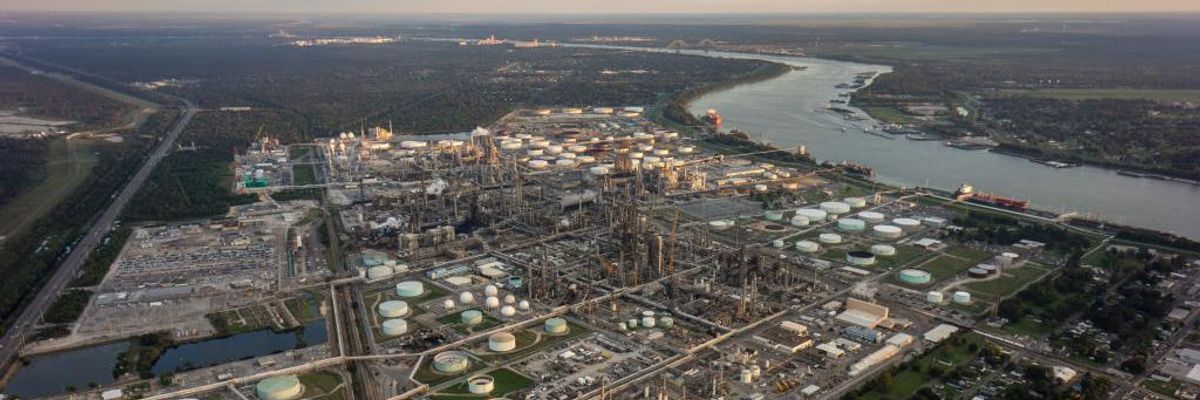
An aerial shot of the chemical plants and factories that line the roads and suburbs of the area known as “Cancer Alley”
‘Death Sentence’: Reports Call for End to Big Oil’s US Sacrifice Zones
“People’s lives and the environment are being devastated at the hands of big business,” one human rights researcher said.
Amnesty International and Human Rights Watch both published reports on Thursday detailing how the fossil fuel industry has harmed the health and environment of communities in Texas and Louisiana, and how state and federal regulators have failed to protect them.

- The Amnesty report, The Cost of Doing Business? The Petrochemical Industry’s Toxic Pollution in the USA,
- The HRW report, “We’re Dying Here”: The Fight for Life in a Louisiana Fossil Fuel Sacrifice Zone,
The amount of gas that would pass through the Texas portion of the pipeline every day is twice the amount used by the state of Vermont in a 24-hour period, according toInside Climate News.
West Texas communities along the pipeline’s route are worried about what could happen if the pipeline were to explode, since many have limited medical facilities.
For example, the pipeline passes within one mile of Van Horn, a low-income, majority Hispanic community.
“Having a pipeline so close to town, carrying extremely flammable gas at high pressure, places an unnecessary risk on a good portion of Van Horn’s citizens,” resident Tomas Mansfield said in a statement.

An industrial plant in Louisiana’s Cancer Alley, October 17, 2023. © 2023 Eli Reed for Human Rights Watch
“While our emergency services work very hard at keeping us safe, a major disaster would overwhelm what services we do have, and additional help is at least 80 miles away. Trauma centers are over 100 miles away—our hospital is only a Level IV trauma center, and major traumas are usually flown to El Paso.”
Typically, FERC will sign off on an entire pipeline route if it crosses state lines.

Because this part pr the pipeline only passes through the state of Texas, the commission says it is only responsible for the portion of the pipeline near the border.
However, the Texas Railroad Commission, which approves pipelines in the state, does not have any authority over a pipeline’s route.
It also signed off on the pipeline before the residents of Van Horn were even aware of it, according to Inside Climate News.
Frontline communities and environmental groups argue that FERC should consider the entire pipeline route because it will carry gas destined for overseas export.

Culberson County Hospital (left) and Van Horn Rural Health Clinic (right) are shown in Van Horn, Texas, where residents are concerned about the local health system’s ability to cope with a major pipeline explosion.(Photo: Texas.pics/Wikipedia/
“The people of West Texas are looking to FERC since the Texas Railroad Commission has disclaimed any responsibility for the siting and routing of this pipeline,”Deborah Pendleton, who owns land near the pipeline’s route, said in a statement. “FERC is responsible for sending gas out of the country and that is exactly what this pipeline is doing. Why do they not have purview over the whole pipeline?”
“It’s common knowledge FERC works for big oil and gas, not the people. This was a predetermined decision.”
Indigenous communities, meanwhile, are worried that the pipeline will damage local ecosystems and sacred spaces, such as geothermal hot springs located close to the border.

“Our concern is that the pipeline is going to go through the hot springs,” Christa Mancias-Zapata, the executive director of the Carrizo/Comecrudo Tribe of Texas, told DeSmog. “Anywhere you go in that area is a sacred site to our people.”
The fight against the pipeline connects to the broader Gulf Coast struggle against oil and gas infrastructure that has sacrificed the health of communities and ecosystems in the region.
“In South Texas, we’re fighting to save the last pristine part of the Gulf Coast from extractive industry,” Mancias-Zapata said at an anti-LNG protest in New Orleans. “We’re trying to stop it from taking our sacred lands, our sacred sites, and destroying the natural infrastructure that Mother Earth created for us.”

There is also a growing movement to stop the LNG buildout for the sake of the global climate. The Biden administration’s approach to the pipeline illustrates contradictions within its climate policy, as it at once approves controversial developments like the Willow oil drilling project in Alaska and pauses LNG export approvals to further consider their emissions, among other factors.
Petrochemical plants also produce plastics, a major environmental pollutant and health hazard. Yet their production is set to double by 2040, Amnesty said, with a spiderweb of pipelines bringing, the liquid gas (not LNG) from the new western Permian fields to giant billion dollar new plastics complexes on the Gulf Coast with the aim to corner the World Plastics Market.
In early November 2023, the State Department asked FERC to perform an analysis of the project’s entire lifecycle greenhouse gas emissions, rather than just those of the border stretch, in line with administration policy.

Advocacy group Public Citizen, which is a legal intervenor in the pipeline’s FERC hearing, requested that the department account for its recommendation, and has now promised to ask for a rehearing of FERC’s decision.
“The commission’s decision ignores the harm record methane gas exports have on raising US Americans’ energy bills and exacerbating climate change, all to prioritize feeding more gas to China,” Tyson Slocum, director of Public Citizen’s Energy Program, said in a statement.
“The Saguaro export pipeline’s only purpose is to bypass the log-jammed Panama Canal to send U.S. produced gas to planned LNG export terminals on Mexico’s Pacific Coast.”
Residents also say they will continue to battle the pipeline.
“This approval was expected by all of us watching,” frontine rancher Bill Addington who works with the West Texas Legal Defense Fund said in a statement. “It’s common knowledge FERC works for big oil and gas, not the people. This was a predetermined decision. We will defeat the Saguaro LNG export project.”
RELATED
US appeals court rejects renewed challenge to Mountain Valley pipeline …5 days ago
US panel approves pipeline, natural gas terminal in Oregon…
Federal commission approves expansion of Northwest pipeline over ……

 The Free
One thought on “Green Light given for Texas mega frack-gas pipeline via poor areas despite LNG expansion “pause”.”