
de thefreeonline por Patricia Reguero Ríos, Gessamí Forner, Sara Plaza Casares , Ester Fayos, Meritxell Rigol a El Salto y directa.cat/
“Patriarchy, Genocides, Privileges” is this year’s motto. /article in English further down)

Consultar el Mapa AQUÍ /mapa-todas-manifestaciones-convocatorias-8-marzo-2024
MANIFESTACIÓN 8M en Madrid La Comisión 8M convoca de Atocha a Colón para decir se acabó a los genocidios en una marcha para todas

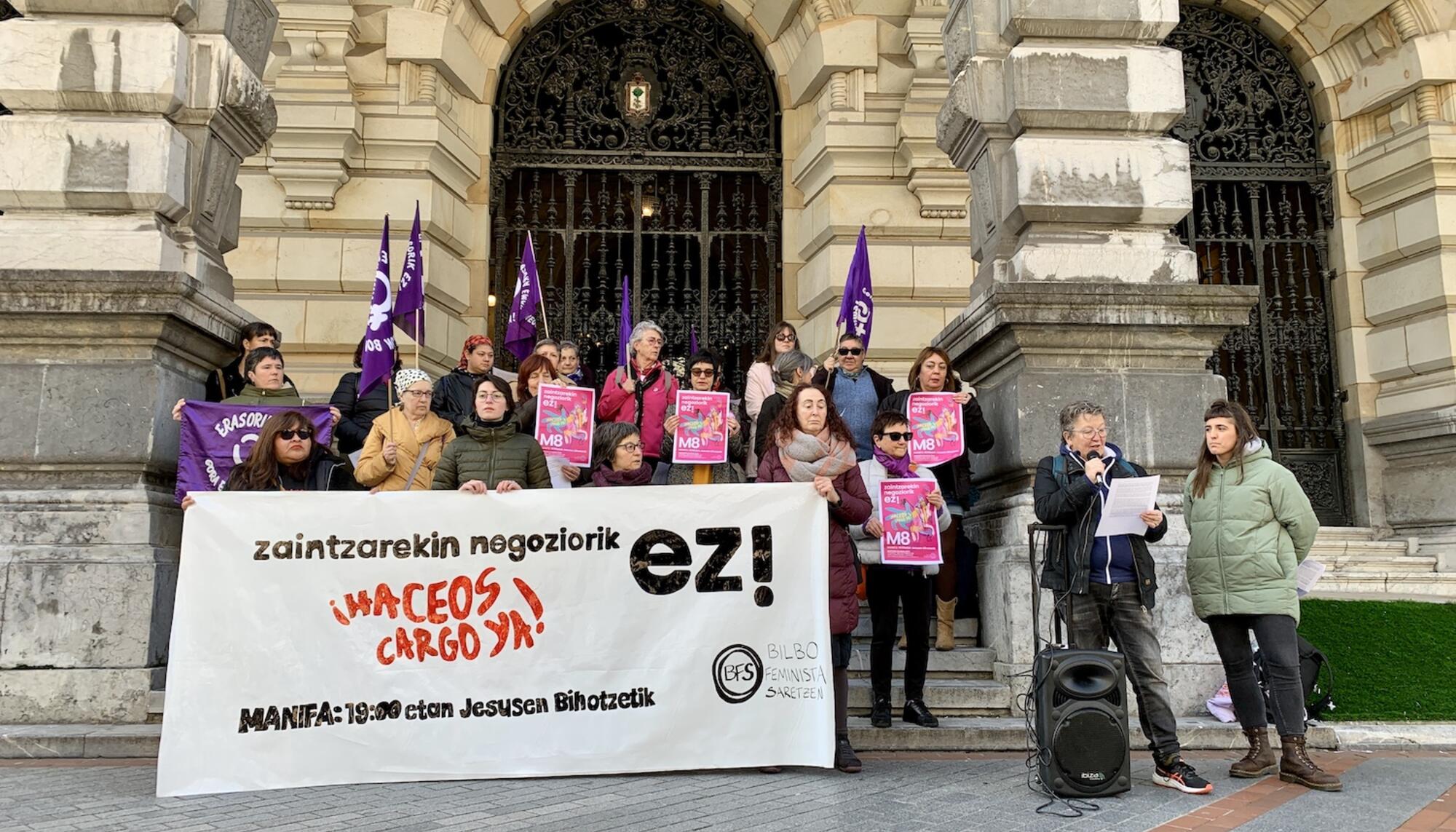
Euskal Herria ‘Zaintzarekin, negoziorik ez! y ¡Haceos cargo ya!’ serán los lemas que recorrerán las capitales vascas el 8M
Las manifestaciones en Bilbao (19h), Gasteiz (18h), Donostia (18.30h), Pamplona (19h) y Baiona (18h) realizarán los recorridos habituales…..
Una de cada cuatro trabajadoras de hogar ha sufrido algún tipo de violencia en el trabajo
El 83% de las empleadas de hogar ha padecido consecuencias en su salud a raíz de su trabajo. Las violencias a las que están expuestas estas mujeres se producen en la oscuridad de la inviolabilidad de los hogares……

Los hombres cobran al mes 465 euros más de pensión que las mujeres
El movimiento pensionista demanda más medidas para acabar con una brecha de género superior al 32% causada por el desigual reparto del trabajo de cuidados, realizado mayoritariamente por mujeres.

Violencia machista En Madrid ciudad solo hay 15 plazas para mujeres maltratadas que necesitan refugio
Las trabajadoras de la Red de Atención a Mujeres Víctimas de Violencia de Género del Ayuntamiento convocan paros porque no quieren “ser cómplices” del “abandono” del consistorio……

Unanimous cry against precariousness and institutional racism in an 8M that opts for various formulas
The CGT, the anarcha syndicalist union is convening the labor strike
original above with links in Catalan
With or without a strike call, the feminist organizations are planning a day of actions to make visible the condemnation of the inequalities and violence that affect women, both in paid work and in the rest of life.
Reverse the policies that expose migrants to serious rights violations and stop the massacre in Gaza, among the central demands of the mobilizations in the Catalan Countries

The pulse of Working Women’s Day as the main day of feminist mobilization has remained constant, well alive, since the first feminist strike in the territories of the State, on March 8, 2018. It does so by pointing out, 8M after 8M, the foundations of an ordered world to the detriment of women’s provision of time, money, health and freedom to decide.
And it does so by demonstrating in the public space that a majority of this part of the systemically abused population does not resign itself to it, but aspires to change it fundamentally. The organizers of the 8M hope to make it visible again tomorrow in a massive way.
Among the central axes of the mobilizations, this year there are precariousness: precariousness in working conditions, accentuated in highly feminized sectors linked to care. And also the precariousness of the conditions to attend to the care needs of children and adults. The most essential work to support us and the most despised and unprotected. It is still mostly undertaken by women, who bear the costs.
"The feminist strike is about health care, labor and consumption, and those who can't do it can join the mobilizations", explains Victoria Columba, Regularización about how the 8M has been proposed in Catalonia
To denounce this, in Catalonia, the 8M Assembly is calling a new day of feminist strike —care, consumption, student and labor—, with the coverage of the CGT and IAC unions, which have registered the call for a general strike. Natàlia Camàra, spokesperson for the 8M Assembly, claims that the feminist strike formula, “beyond the traditional one used by the labor movement”, is a useful tool to “make visible and talk about how patriarchy and capitalism are reconfigure”. “We believe it is important to do it in a context in which, in addition, we see how it costs a lot to mobilize, and feminism can act as an engine”, he adds among the reasons for betting on it.

Cada cop més dones joves sense llar Claudia Frontino Imatges | Claudia Frontino
The student strike is being called by the Students’ Union of the Catalan Countries, to denounce “gender inequalities and sexist violence”. At the gates of 8M, an action has been taken at the University of Barcelona to demand answers to the cases of professors accused of sexist attacks.
“The strike we are calling is in all areas, and those who cannot do it, can join the mobilizations”, says Victoria Columba, Regularization Ja activist, on how the protest day in Catalonia has been planned.
"It may be strategic to offer spaces for action without a strike on 8M and not to institutionalize this tool, but we give it more strength when we consider it," suggests Marta Maicas, part of the Feminist Assembly of Valencia
However, the strike is no longer a formula that is activated unanimously everywhere on 8M. Despite agreeing on the denunciation of precariousness and abuses in paid and unpaid work, the organization of feminist mobilizations in the Valencian Country and the Balearic Islands do not bet on it.
Marta Maicas, spokesperson for the Feminist Assembly of Valencia, explains that they consider the strike call “a very useful tool for the working class”, but that it should not be taken “by default”. “We find it legitimate to use it, but it can also be strategic to offer spaces for action without a strike on 8M, not to institutionalize this tool, but to give it more strength when we consider”, he explains about the decision.
In the same direction, Rosa Fiteni, vice president of the Kellys in the Balearic Islands, part of the 8M organization in the territory, also explains the decision not to go on strike as she finds it “unstrategic” at this time. Likewise, there will be mobilizations during a day that Fiteni values for the ability to “bring out of invisibility” the workers in their sector.
Among the main demands, the collective of hotel cleaners highlights achieving early retirement -given the pathologies they often develop as a result of years doing cleaning work in hotels-, regulating the overload they usually suffer in hotel establishments and that the occupational diseases they develop are recognized.
In the Balearic Islands, there will be mobilizations during a day that, despite not being a strike, the Kellys, part of the 8M organization, value the ability to "bring out of invisibility" the workers in the sector
With or without a strike call, the day of action that will take place throughout the Catalan Countries on 8M aims to make visible women workers in feminized sectors who are usually left in invisible positions. This is the case, in addition to cleaners, to domestic and care workers, sex workers and day laborers. Also, of “those who have disabilities and all those who see their rights diminished because they are women, lesbians and trans”, raise from the 8M Assembly of Catalonia.
The Kellys, Sindillar and Anarchist Whores of the Raval, part of this assembly, have demanded that both care work and sex work be fully recognized as work. Likewise, they state that without “justice” for workers in these highly precarious, feminized sectors with a large presence of workers of migrant origin, “feminist justice” cannot be achieved.
Report the borders that open violence towards women
This is the third year that Sindillar has called on domestic and care workers to go on strike, and it is doing so with specific demands: to obtain the retroactivity of unemployment benefits – from which they were excluded until a year and a half ago – and to have the protection of the law of occupational risks.
This, of course, would be possible for those who have been able to access a contract, which the law on foreigners has made difficult for years. Domestic work is a gateway to the main subsistence labor market for many of the migrant women who arrive in the State and, while being exposed to multiple abuses, they become a fundamental part of the care provision system to people in a situation of dependency.
The CGT, the anarcha syndicalist union convening the labor strike alongside the IAC, places at the core of the call the demand for care as a "fundamental right, without precariousness and remunerated"
The CGT places the demand for care as a “fundamental right, without precarization and remunerated” at the center of the feminist strike call. In addition to the care and social health sector, the union is also calling for a strike to denounce the conditions in underpaid feminized sectors, such as commerce and telemarketing. Among the demands raised by the CGT, there is an end to the wage and pension gap, eradicating gender bias in occupational health, establishing a basic income, the 30-hour working day, having co-education policies and regularizing people in an irregular administrative situation.
“These days, with the protests in the countryside, we don’t find protests by day laborers, because many are without papers, which means they can’t report violence, and there are women who can’t report sexist violence because they can open an expulsion order , that is why it is necessary to see that the immigration law is a sexist law as well as a racist one”, explains Columba.
The activist also highlights the lack of protection in which sex workers find themselves, many in an irregular administrative situation. “The criminalization of sex work is also against women who do not have papers”, he criticizes. In fact, as social organizations warn, women who perform sex work are highly represented among the women locked up in CIE.
The 8M is presented this year as a day to continue pointing out companies "complicit" in the policies of apartheid and massacre against the Palestinian population
“The fact that there are prisons for people without documentation is a symbol of the situation, which perpetuates violence that feminism cannot ignore, because without other struggles such as anti-racism and the rights of sex workers, you cannot understand the feminism”, poses Silvana Cabrera, activist of Regularization Already in Valencia. Precisely, the Sapadors CIE will be the starting point of the 8M demonstration in the city.
In addition to the immigration law, the 8M will have among the main complaints the new migration and asylum pact of the European Union. From Regularización Ja, they point out that it is a migration policy framework that “legitimates violence against women and girls and exacerbates helplessness at the borders”. “Returning women to a third country could pose a risk to their lives and may also make it impossible to request asylum, among others, due to gender violence”, details Columba.
Stopping “the genocides” is also one of the demands that, in the face of the massacre of the population in the Gaza Strip, will be central to the day of actions.
In the Catalan case, Columba points out that the strike they are calling includes consumption, and that, therefore, the day is an opportunity to continue pointing out companies “complicit” in the policies of apartheid and massacre against the Palestinian population of the State of Israel

 The Free