
thefreeonline on 17th April ’24 by Jodi Dean at Verso Blog
In defence of the Radical Universal Emancipation Embodied in the Palestinian Cause.
The images from October 7 of paragliders evading Israeli air defenses were for many of us exhilarating. Here were moments of freedom, that defeated Zionist expectations of submission to occupation and siege.
In them, we witnessed seemingly impossible acts of bravery and defiance in the face of the certain knowledge of the devastation that would follow (that Israel practices asymmetric warfare and responds with disproportionate force is no secret).
Who could not feel energized seeing oppressed people bulldozing the fences enclosing them, taking to the skies in escape, and flying freely through the air? The shattering of the collective sense of the possible made it seem as if anyone could be free, as if imperialism, occupation, and oppression can and will be overthrown.
As the Palestinian militant Leila Khaled wrote of a successful hijacking in her memoir, My People Shall Live, “it seemed the more spectacular the action the better the morale of our people.” Such actions puncture expectations and create a new sense of possibility, liberating people from hopelessness and despair.
When we witness such actions many of us also feel this sense of openness. Our response is indicative of the subject effect the actions unleash: something in the world has changed because a subject has inscribed a gap in the given.
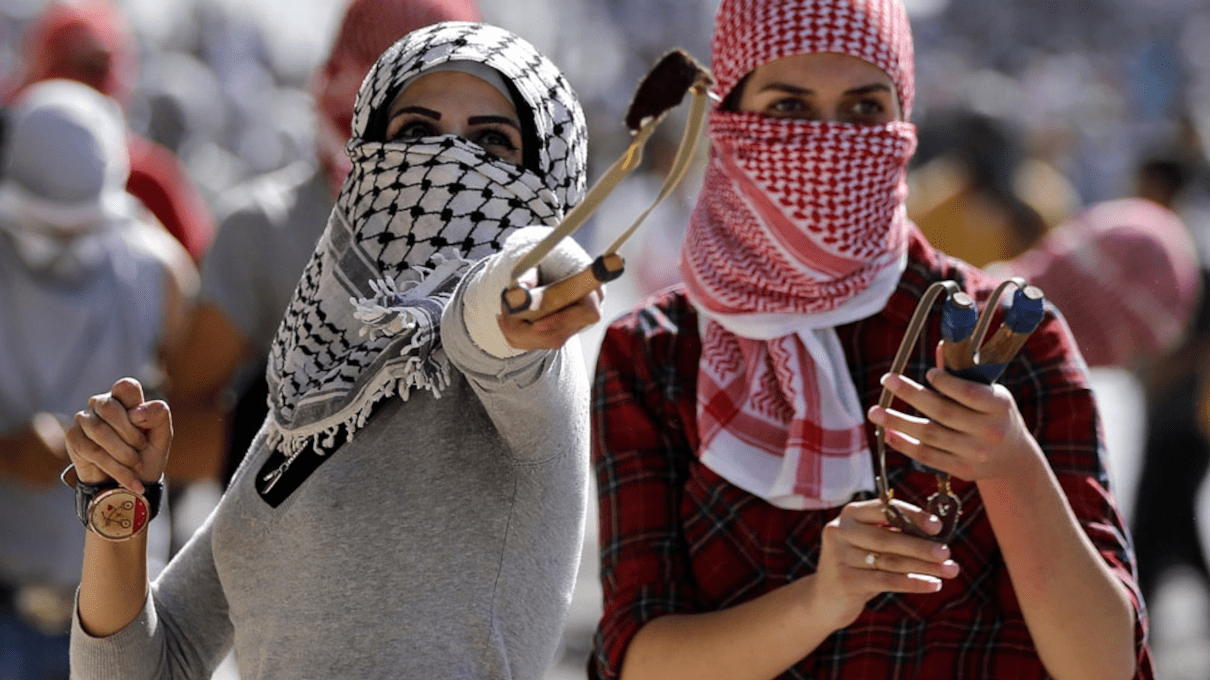
Intifada or not, something powerful is going on | Palestine | Al Jazeera
To use an idea from Alain Badiou, we see that the action was caused by a subject, thus producing that subject as a retroactive effect of the action that caused it. Imperialism tries to shut these feelings down before they spread too far. It condemns them and declares them off limits.
The images of Palestinians that see we in our imperialist settings are usually pictures of depictions of devastation, bereavement and death. The humanity of the Palestinians is made conditional on their suffering, on what they’ve have lost, and what they endure. Palestinians get sympathy but not emancipation; emancipation would eat away at sympathy.
This image of the victim produces the “good” Palestinian as a civilian, even better as a child, woman, or elder. Those who fight back, especially as part of organized groups are bad: the monstrous enemy that must be eliminated.
But everyone’s a target. The fault for the targeting of the “good” Palestinians is thus placed on the “bad “ones, further justification for their eradication: every inch of Gaza provides a hiding place for terrorists. The policing of affect squeezes out the possibility of a free Palestinian.
Policing affect is part of the political struggle. Anything that ignites the feeling that the oppressed will break free, that occupations and blockades will end, must be extinguished. Imperialists and Zionists reduce October 7 to a list of horrors not simply to block from view the history and reality of colonialism, occupation, and siege. They do it to prevent the gap of the disruption from producing the subject that caused it.
The first intifada, in 1987, began with the “Night of the Gliders“. On November 25 and 26, two Palestinian guerrilla fighters from the PFLP – GC (Popular Front for the Liberation of Palestine – General Command) landed in Israeli occupied territory. Both were killed. One of them killed six Israeli soldiers and injured seven more before he died.
Afterwards, the guerrilla became a national hero, and Gazans wrote “6:1” on their walls to taunt the IDF troops. Even PLO Chairman Yasser Arafat praised the fighters: “The attack demonstrated that there could be no barriers or obstacles to prevent a guerrilla who has decided to become a martyr” Nothing could hold them down or block them in if they had the will to fly.
The Night of the Gliders reignited the affective energies of the Palestinian revolution that followed in the wake of Arab defeat in June 1967 and stimulated the growth of the guerrilla movement after the battle of Karama in March 1968.
After the Night of the Gliders and into the first intifada, to be Palestinian again meant rebellion and resistance rather than acquiescence to second-class citizenship and refugee status.
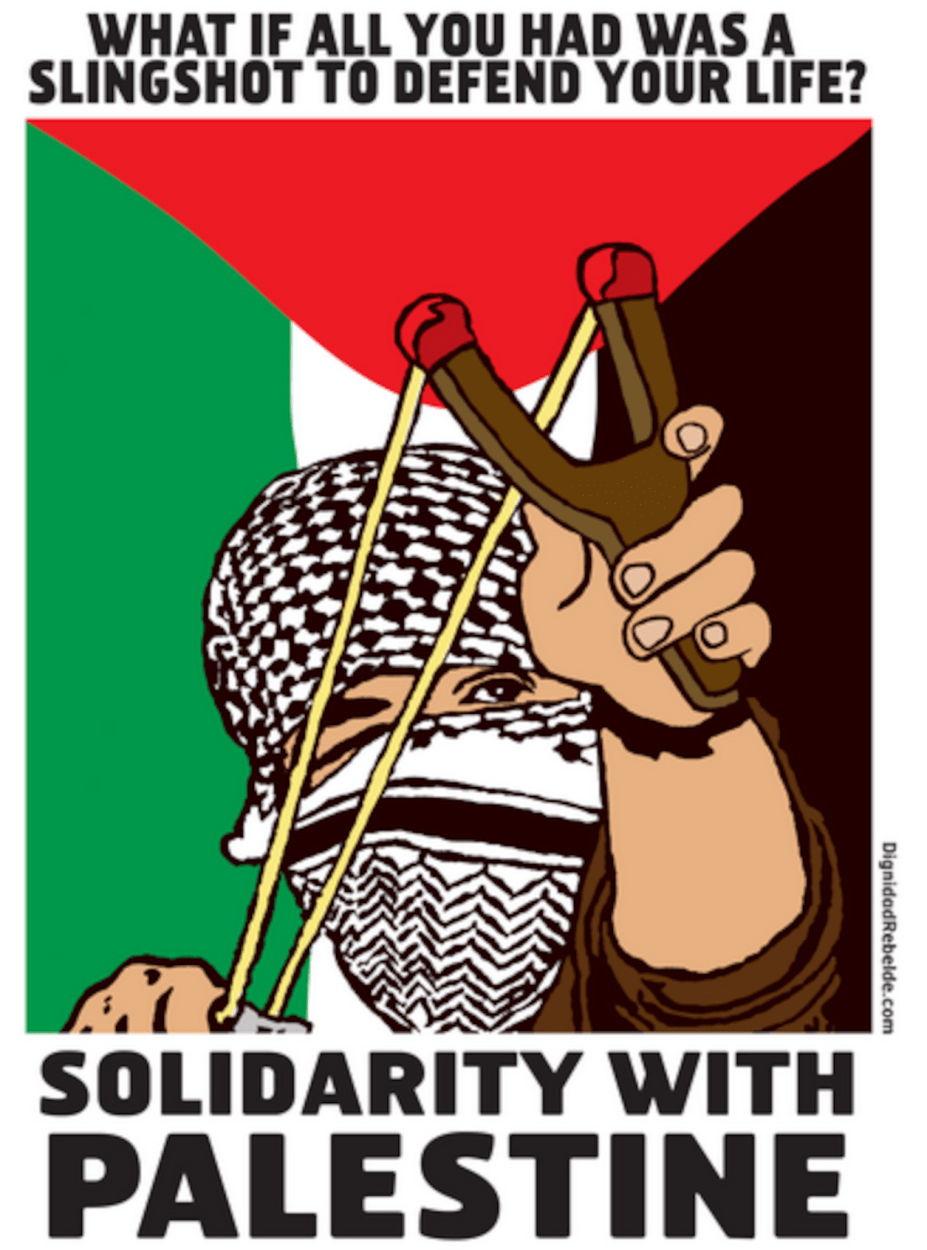
Justseeds | Solidarity with Palestine
In 2018, during Gaza’s Great March of Return, Gazans used kites and balloons to evade Israeli air defenses and start fires in Israeli territory. It seems as if it was Palestinian youth that first started sending the fire kites.
Later, Hamas got involved, creating the al-Zouari unit that specialized in making and launching incendiary kites and balloons.
The kites and balloons boosted morale in Gaza, while damaging the Israeli economy and irritating Israelis living near the Gazan border. In response to an Italian journalist’s remarks about the “iconic new weapon” that was “driving Israel crazy,” Hamas leader Yahya Sinwar explained, “Kites are not a weapon. At most, they set on fire some stubble. An extinguisher, and it’s over.
They are not a weapon, they are a message. Because they are just twine and paper and an oil-soaked rag, while each battery of the Iron Dome costs $100 million. Those kites say: you are immensely more powerful. But you will never win. Really. Never.”
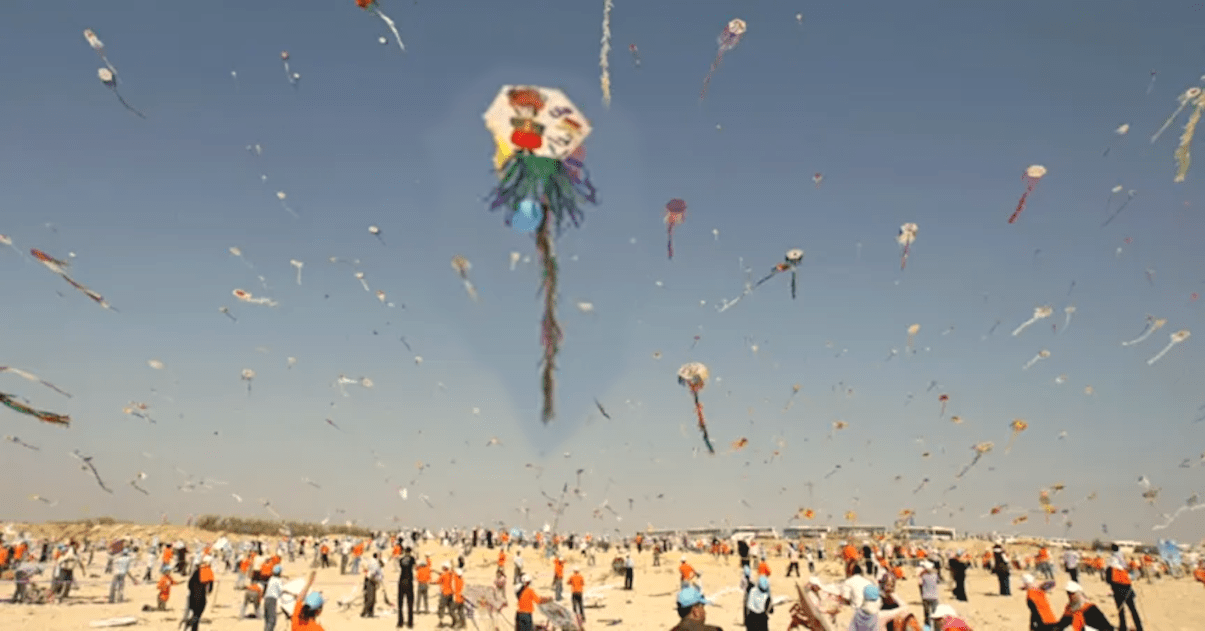
There’s further context for reading kites in Gaza as messages from a people that refuses to submit. In 2011, 15 thousand Palestinian children on a Gazan beach broke the world record for the most kites flown at the same time. Many of the kites featured Palestinian flags and symbols, as well as wishes for peace and hope. An eleven-year-old, Rawia, who made her kite the colors of the Palestinian flag, said, “When I fly it, I feel like I’m raising my country and my flag up, up in the sky.”
The 2013 documentary “Flying Paper,” directed by Nitin Sawhney and Roger Hill, tells the story of some of the young kite fliers. “When we fly kites, we feel like we are the ones flying in the sky. We feel that we have freedom.
That there is no siege on Gaza. When we fly the kite, we know that freedom exists.” Earlier this year, kites were flown at solidarity demonstrations that took place around the world, expressing and amplifying a hope and a will for Palestinian freedom.

In Memoriam of Dr. Refaat Alareer – “If I Must Die”
Refaat Alareer’s last poem, “If I Must Die,” draws on the association of kites and hope. A video of Brian Cox reading the poem circulated online after the IDF killed Alareer in an airstrike that demolished his building.
If I must die,
you must live
to tell my story
to sell my things
to buy a piece of cloth
and some strings,
(make it white with a long tail)
so that a child, somewhere in Gaza
while looking heaven in the eye
awaiting his dad who left in a blaze —
and bid no one farewell
not even to his flesh
not even to himself —
sees the kite, my kite you made, flying up above,
and thinks for a moment an angel is there
bringing back love.
If I must die
let it bring hope,
let it be a story.
The kite is a message of love. It is made to fly, and in flying it creates hope. Alareer’s words attend to the making of the kite, its crafting out of cloth and strings, as well as its flight. Making the kite is more than mourning; it’s an engagement in practical optimism, an element of the subjective process that establishes the subject of a politics, the “you” instructed to make the kite and tell his story.
In 1998, Palestinians built Yasser Arafat International Airport. In 2001, during the second intifada, Israeli bulldozers demolished it. As Hind Khoudary explained, the airport was deeply interconnected with the dream of Palestinian statehood.
She interviewed workers who built the runway that was reduced to rubble and sand. As Khoudary writes, “Gaza airport was more than a project. It was a symbol of freedom for Palestinians. Flying the Palestinian flag in the sky was the dream of every Palestinian.”
The paragliders who flew into Israel on October 7 continue the revolutionary association of liberation and flight. Although imperialist and Zionist forces try to condense the action into a singular figure of Hamas terrorism, insisting against all evidence that with the extermination of Hamas Palestinian resistance will disappear, the will to fight for Palestinian freedom precedes and exceeds it.
Hamas wasn’t the subject of the October 7 action; it was an agent hoping that the subject would emerge as an effect of its action, the latest instantiation of the Palestinian revolution.
Words used by Leila Khaled to defend the justness of the PFLP’s hijacking tactic apply equally to October 7. Khaled writes: “As a comrade has said:
We act heroically in a cowardly world to prove that the enemy is not invincible. We act “violently” in order to blow the wax out of the ears of the deaf Western liberals and to remove the straws that block their vision. We act as revolutionaries to inspire the masses and to trigger off the revolutionary upheaval in an era of counter-revolution.”
How can an oppressed people believe that change is possible? How can movements that have experienced decades of defeat ever feel like they are capable of winning?
Sara Roy documented the despair that pervaded Gaza and the West bank before October 7. Factionalism, and the sense that not just Fatah but Hamas was cooperating too much with Israel, had unraveled confidence in a nationally unifying project.
A friend told Roy, “Our past demands have become meaningless. No one speaks of Jerusalem or the right-of-return. We just want food security and open crossings.”
Al Aqsa flood attacked that despair. The coalition of resistance fighters led by Hamas and PIJ (Palestinian Islamic Jihad) refused to accept defeat and submit to the indignity of slow death. Their action was designed so that the revolutionary subject would appear as its effect.
******
In the six months since the beginning of Israel’s genocidal war on Palestine, there has been a surge in global solidarity with Palestine, one reminiscent of the previous wave of the 1970s and 1980s. As Edward Said told us, by the end of the seventies “there was not a progressive political cause that did not identify with the Palestinian movement.”
Solidarity with Palestine united the left, knitting liberation struggles together in a global anti-imperialist front. As historian Robin D.G. Kelly says, “We radicals regarded the PLO as a vanguard in a global Third World struggle for self-determination traveling along a “non-capitalist road” to development.”
The militancy and dedication of the Palestinian struggle made its revolutionary combatants models for the left.
The struggle for Palestinian liberation today is led by the Islamic Resistance Movement — Hamas. Hamas is supported by the entirety of the organized Palestinian left. One might have expected that the left in the imperial core would follow the leadership of the Palestinian left in supporting Hamas.
More often than not, though, left intellectuals echo the condemnations that imperialist states make the condition for speaking about Palestine. In so doing, they take a side against the Palestinian revolution, giving a progressive face to the repression of the Palestinian political project, and betraying the anti-imperialist aspirations of a previous generation.
Jodi Dean teaches political, feminist, and media theory in Geneva, New York. She has written or edited thirteen books, including The Communist Horizon and Crowds and Party. Posted on by CP(M)Posted in OPINIONTagged Gaza, Israel, Jodi Dean, Palestine.
******
Night of the Gliders – PFLP | PPPA
Justseeds | Solidarity with Palestine
In Memoriam of Dr. Refaat Alareer – “If I Must Die”
Intifada or not, something powerful is going on | Palestine | Al Jazeera

 The Free
One thought on “Palestine speaks for everyone /Radical Universal Emancipation”