Black Bearded Saki Chiropotes satanas Brazil Endangered The greatest risks for the future survival of the Black Bearded Saki, also known as the Black Cuxiú are the loss and fragmentation of their habitat and hunting pressure. IUCN Red list Black Bearded #Sakis are #endangered large monkeys endemic to #Brazil #SouthAmerica they are #endangered by #timber […] — Palm Oil Detectives
Conservation Status and Threats
The black bearded saki is classified as Endangered by the International Union for Conservation of Nature (IUCN, 2020), appearing on the IUCN Red List of Threatened Species. This species is already considered extinct in much of its original range, and current populations are trending downward at alarming rates. The number of mature individuals may be fewer than 2,500.
Like many endangered primates throughout the world, the greatest threat to black bearded sakis is the loss of their natural habitat driven by human development. Large infrastructural projects like highways and the Tucurúi Dam have sacrificed large swaths of habitable land to human interests while smaller projects, like logging and agriculture, continue to fragment the scant pieces of habitat left over.
For primates like the black bearded saki who stay high in the canopy but who are not especially skilled leapers and climbers, forest fragmentation creates a host of problems. Climbing down out of the canopy, for instance, requires extra time and energy that these primates would otherwise spend performing more natural behaviors.
Additionally, leaving the canopy makes them easier targets for predators, including human hunters. In fact, forest fragmentation likely increases the rate at which black bearded sakis are hunted by humans since preferred game animals also decrease in number due to loss of their own habitats.
Furthermore, isolation caused by fragmentation creates genetic bottlenecks. The harmful defects and increased vulnerability to diseases that these cause can gradually render each new generation less viable.
Limited Conservation Efforts
Without significant efforts to save the black bearded saki from extinction, this species will soon become extinct. Fortunately, there are efforts currently under way to turn this trend around.
The Pitheciine Action Group (PAG) is an organization directly involved in black bearded saki conservation efforts. With help from an international committee established by one of Brazil’s top federal environmental agencies, PAG are developing a Conservation Action Plan for the black bearded saki.
A number of areas, both protected and unprotected, exist where the presence of black bearded sakis is possible but not confirmed. Therefore, surveys and research into the effects of fragmentation on isolated black bearded saki populations are needed for any future conservation efforts to have meaningful effects.
Black bearded sakis have found an ally in Projeto Kaapori (Project Kaapori). The Ka’apori capuchin (Cebus kaapori) is another Critically Endangered primate species with essentially the same range as the black bearded saki. Projeto Kaapori’s primary mission is Ka’apori capuchin conservation. However, in doing their work, they have simultaneously collected data on all other primate species living in the Ka’apori capuchin’s range, including black bearded sakis. In so doing, they are contributing information that is crucial to the PAG’s Conservation Action Plan. Additionally, they are showing how research and conservation projects can be planned in the future to benefit these species jointly.
Hope for black bearded saki conservation lies in the future of the Gurupi Biological Reserve. This reserve is the last significant patch of forest where black bearded sakis are known to be living. It, plus the many Amerindian reservations that border it, currently offers wildlife an estimated one million hectares of relatively unfragmented and untouched forest. Founded in 1988, Gurupi falls under the IUCN protection category as a “strict reserve.” It is one of the last remnants of the Belém Center of Endemism and, as such, its preservation is significant for a number of flora and fauna endemic to this area. Human activity is, therefore, heavily restricted within this reserve.
Deforestation pressures from illegal activities continue to plague the Gurupi Biological Reserve, however. A third of the reserve’s forest has been lost to local ranchers, timber companies, and illegal land settlers since its founding. Today, federal agencies like the Primate Protection Center (Centro de Protectão de Primatas Brasileiros) and the Chico Mendes Institute for Biodiversity Conservation (Instituto Chico Mendes de Conservação da Biodiversidade) are working to solve these and other pressures that face Gurupi with mixed results so far.
In addition to these federal protections, Gurupi is also supported by the Amazon Region Protected Areas Program, a collaboration between governmental and non-governmental agencies working to expand protections for the Amazon rainforest in Brazil. Furthermore, a proposition to create a South Amazon Ecological Corridor would connect the Gurupi Biological Reserve to other protected areas in the country. If initiated, the ecological corridor would eventually link more than 30,000,000 hectares (78,000,000 acres) of rainforest.
No doubt, the protection of their habitat will have mounting positive effects for black bearded sakis living within the Gurupi Biological Reserve. In tandem with the PAG’s developing Conservation Action Plan, the future of the black bearded saki does not seem as bleak as it once did.
Pricing power in criminal Gold market dominated by West’s institutional money moving East and implications are profound
The gold price has risen to a series of new all-time highs of late, a development that has received only cursory attention in the mainstream financial media. But as is the case with so much else these days, there is much more going on than meets the eye. In fact, the rise in the dollar price of gold is almost the least interesting aspect to this story.
For thousands of years, gold was the ultimate store of value and was synonymous with the concept of ‘money’. Trade was often settled either in gold itself or in bank notes backed by gold and directly exchangeable for it. Currencies backed by nothing but government decree – called ‘fiat’ currencies – have tended to eventually fail.
However, in 1971, gold found itself cast out of this ancient role when the US unilaterally suspended dollar convertibility into gold as enshrined in the Bretton Woods agreement that established the framework for the post-war economy. Shortly thereafter, in an act that medieval alchemists only dreamed of, gold was created out of thin air in the form of futures contracts, meaning bullion could be bought and sold without any metal changing hands – or even existing.
Besides the obvious ramification of all of this – the removal of gold backing to the dollar and thus implicitly to nearly all currencies – there are two important features of how the gold market has subsequently functioned: first, gold has essentially been reduced to trading like any other cyclical financial asset; second, the price of gold has largely been determined by Western institutional investors.
Both of these longstanding trends are now breaking down. As we will see, the importance of this development is hard to overstate. But let’s begin with a very quick examination of how gold went from being the ultimate source of value to just another ticker moving in predictable patterns in the constellation of financial instruments.
How paper replaced metal
The collapse of Bretton Woods in the late ‘60s and early ‘70s – culminating in the gold window being shut in 1971 – was a messy period of transition, uncertainty, and instability. The dollar devalued and a fixed-rate system was negotiated and soon thereafter abandoned. But what was clear was that the US was steering the world away from gold and toward a dollar standard.
Jelle Zijlstra, president of the Dutch central bank, chairman of the Bank of International Settlements from 1967 until 1981, and a prominent figure at the time, recalled in his memoirs how “gold disappeared as the anchor of monetary stability” and that “the road… through endless vicissitudes to a new dollar hegemony was paved with many conferences, with faithful, shrewd, and sometimes misleading stories, with idealistic visions of the future and impressive professorial speeches.” But, he concluded, the ultimate political reality was that the “Americans supported or fought any change, depending on whether they saw the dollar’s position strengthened or threatened.”
Nevertheless, gold was lurking in the shadows like a deposed but still-living monarch and thus represented an implicit guard against the abuse of what had become fiat currencies. If nothing else, as dollars continued to be printed, the price of gold would surge and signal a debasement of the greenback. And this is more or less what happened in the 1970s after the gold window was shuttered. After breaking the $35 per-ounce peg in 1971, gold rocketed all the way up to $850 by 1980.
Hunger for gold in the Global North is fueling a living hell for Indigenous people in the Global South. Here’s reasons why you should #BoycottGold4Yanomami @barbaranavarroTweet
So the US government had a strong interest in managing the perception of the dollar through gold. Most importantly, it didn’t want to see gold recreate a pseudo reserve currency by strengthening substantially. Legendary Fed chairman Paul Volcker once said “gold is my enemy.” And indeed it traditionally had been the enemy of central banks: it forced them to tighten rates when they didn’t want to and imposed on them a certain discipline.
This framework helps make sense of the rise of the unallocated – i.e. ‘paper’ – gold market in the 1980s and the countless gold derivatives that emerged. This actually started in 1974 with the launch of gold futures trading but exploded in the next decade. What happened is that bullion banks began selling paper claims on gold for which there was no actual gold attached. And buyers were not actually required to pay upfront but could simply leave a cash margin.
The setup is reminiscent of the old communist joke that went “we pretend to work and you pretend to pay us.” In this case, the investor pretends to pay for the gold and the seller pretends to own it. This is about as close as you can get to pure speculation.
Thus was born the fractional-reserve paper gold scheme that persists to this day. And indeed, there is now vastly more paper gold than physical, some $200-300 trillion compared to $11 trillion, according an estimate by Forbes magazine. Others put the discrepancy even higher. Nobody really knows. Comex, the primary futures and options market for gold, has also become more paper-driven. According to analyst Luke Gromen, whereas 25 years ago some 20% of the gold volume on Comex was related to a physical ounce, that number has fallen to around 2%.
Gold as just another cyclical asset
What is important to understand here is that the creation of a derivative market satisfies demand for gold that would otherwise go to the physical market. Only a limited amount of gold exists and can be mined but an unlimited amount of gold derivatives can be underwritten. As Gromen explains, when monetary expansion drives demand for gold (due to the inflation this brings), there are two ways this demand can be dealt with: let the price of gold rise as more dollars chase the same amount of gold; or permit more paper claims to be created on the same amount of gold, which allows the pace of gold’s rise to be managed.
There are several important implications of this. The rise of the paper market has clearly played an important role in defanging gold in its role as exerting a hard limit on expansionary policy, thus implicitly reinforcing the credibility of the dollar. But it has also meant that the gold price has largely been determined by investment flows rather than physical demand. And when we’re talking about investment flows, we mean first and foremost Western institutional investors.
Given that gold trades essentially as a cyclical asset, institutional investors have primarily traded gold based on movements in real US interest rates – meaning interest rates adjusted for inflation. Gold is bought when real rates fall and vice versa. The logic is that when interest rates rise, money managers can earn more by switching to bonds or cash, thus increasing the opportunity cost of holding non-interest-bearing assets such as gold. By the same token, lower rates make gold – seen as a hedge against inflation – more attractive. This correlation has been particularly strong over the last 15 years or so and many analysts date it back further than that.
So let’s go a step further and pose the following question: If Western institutional money has been driving the price, who has been on the other side of the trade when actual gold does change hands?
To oversimplify a bit, the model worked roughly as follows, as has been explained by gold analyst Jan Nieuwenhuijs: Western institutions essentially controlled the price of gold and bought from the East in bull markets and sold to the East in bear markets. This makes sense, because the Western side of this trade essentially consisted of investors who in any asset class tend to chase the price higher. The East, meanwhile, was characterized more by consumer demand. Because consumers are price-sensitive, they tend to buy when the price is low and are happy to sell into a rising market.
So gold flowed from East to West in bull markets and from West to East in bear markets. But, as we mentioned above, it was the Western institutional investors who were in the driver’s seat in this trade.
This was the well-established state of affairs up until 2022, which happens to be when the Ukraine proxy war began and the US took the bold step of freezing some $300 billion in Russian central bank assets.
The end of a longstanding correlation
A coincidence or not, what happened that year was that the correlation between US real rates and gold broke down and has not been restored. The first sign of an impending shift was that, in first few months after the Fed embarked on a sharp rate-hike cycle in March 2022, gold did drop but proved much more resilient to the rising rates than correlation models would have suggested. But the real breakdown in the correlation started around September of that year, when gold prices actually started climbing even as real rates remained flat. In fact, from late October 2022 through June 2023, the gold price rose 17%.
Meanwhile, over 2023, US real yields rose (despite quite a bit of volatility), which, according to the old correlation, should have meant a decline in gold prices as higher yields elsewhere would make non-yielding gold less attractive. However, gold rose 15% for the year.
Another notable aspect of this is that Western institutional investors have been net sellers of gold, as evidenced by declining inventory held by Western exchange-traded funds (ETFs) and falling open interest on Comex during the October 2022-June 2023 period mentioned above (when the correlation broke down). In 2023, gold ETFs posted net outflows for the year despite the rising gold price. Meanwhile, so far this year through February, the ETF outflow figure amounted to $5.7 billion, $4.7 billion of which came from North America – all while gold prices have surged to all-time highs.
So coming into focus is a picture of Western institutional investors responding like Pavlov’s dogs to rising interest rates and ditching gold in favor of higher yielding assets such as bonds, stocks, money market funds – you name it. And normally, like clockwork, this would have driven the price down.
Musk-US’s NATO promise to Kiev like start of ‘Nuclear Apocalypse’ –Watch Movie Here
A pledge by US Secretary of State Antony Blinken that Ukraine will become a member of NATO looks like a scene from a movie about a nuclear apocalypse, entrepreneur Elon Musk believes.
The top US diplomat reiterated the “rock solid” determination of his country and other members to eventually include Ukraine in the military bloc at a NATO summit in Brussels this week. Speaking alongside Ukrainian Foreign Minister Dmitry Kuleba, he said the purpose of the event was to “help build a bridge to membership.”
“This is literally how the nuclear apocalypse movie starts,” Musk responded on X (formerly Twitter). He shared a video from the 1983 American television film ‘The Day After’, which depicts a fictional nuclear war between the US and the USSR. The movie was shown to Soviet audiences in 1987, when the two superpowers were negotiating a key nuclear arms control treaty.
In a post on social media, former president Dimitry Medvedev lashed out at Kiev’s Western backers, arguing that they are “taking the world for fools” if they believe that sending foreign forces to Ukraine would not lead to a dangerous escalation. If NATO soldiers do end up in Ukraine, they will not be limited to non-combat roles, he claimed.“They will become part of the regular forces that are fighting against us. That is why they will have to be treated only as the enemy,” Medvedev, who currently serves as deputy chairman of Russia’s Security Council, wrote. “We should take no prisoners! The highest rewards must be given out for every killed NATO soldier.”
Musk has previously spoken out about the risks to Ukraine and the world of further escalation. Continued hostilities could result in Kiev losing access to the Black Sea, he said last week.
The billionaire has urged Kiev to offer concessions to Moscow in exchange for a peace treaty. He has also backed the argument that US attempts to weaken Russia by arming and funding Ukraine have backfired.
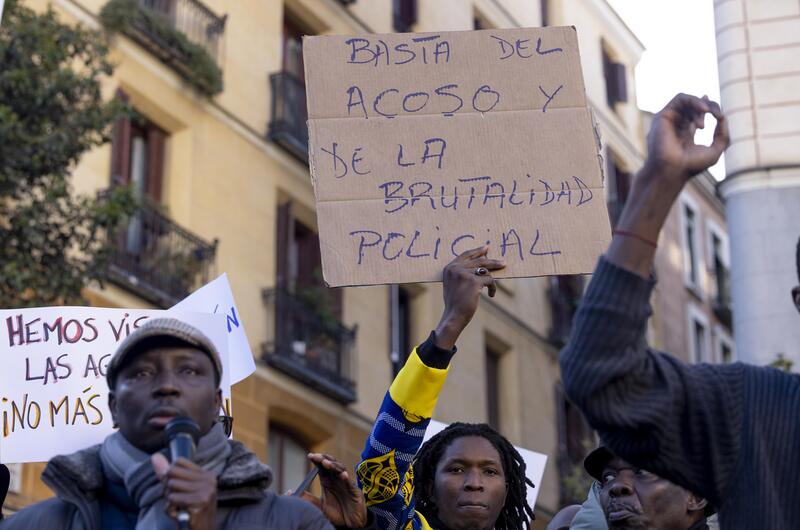
Un número desproporcionado de represores persiguió, apaleó, requisó el material e identificó a vendedores, mientras la gente denunciaba la actuación policial
Decenas de agentes de la Policía Municipal y de la Ertzaintza cargaron ayer por la tarde contra personas que estaban ejerciendo la venta ambulante en las inmediaciones de la Gran Vía de Bilbo.
Como se aprecia en los vídeos que han circulado en redes sociales, los vendedores, asustados, salieron huyendo —alguno incluso cayó en una fuente—, pero los policías les persiguieron, les requisaron el material e identificaron a cuatro de ellos.
En las imágenes se ve un claro empleo de la violencia por parte del operativo policial, con el uso de las porras, de la unidad canina y con agentes encapuchados, generando una situación de mucha tensión en pleno centro de la ciudad que llegó a provocar cortes en el tráfico y que suscitó un gran rechazo por parte de las personas viandantes que asistieron a los hechos.
Algunos de ellos, grabaron los vídeos que hoy dejan constancia de la desproporcionalidad de la actuación policial.
Al menos 57.000 millones de euros de gasto militar en 2024 –
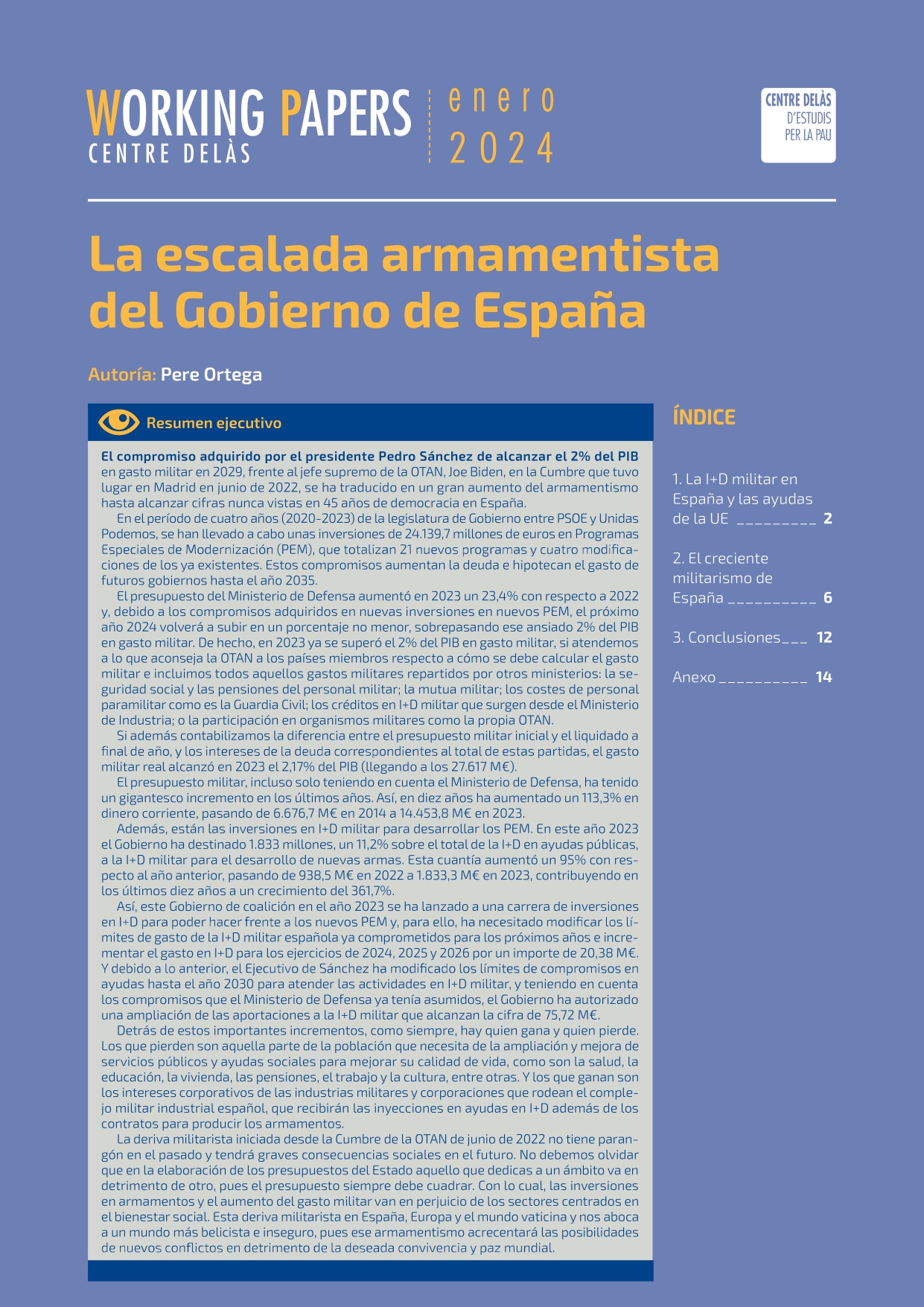
El compromiso adquirido por el presidente Pedro Sánchez de alcanzar el 2% del PIB en gasto militar en 2029 en la Cumbre que tuvo lugar en Madrid en junio de 2022, se ha traducido en un gran aumento del armamentismo hasta alcanzar cifras nunca vistas en 45 años de democracia en España.
En el período de cuatro años (2020-2023) de la legislatura de Gobierno entre PSOE y Unidas Podemos, se han llevado a cabo unas inversiones de 24.139,7 millones de euros en Programas Especiales de Modernización (PEM, antes llamados PEA), que totalizan 21 nuevos programas y cuatro modificaciones de los ya existentes. Estos compromisos hipotecan el gasto de futuros gobiernos hasta el año 2035 y previsiblemente aumentarán la deuda
El presupuesto del Ministerio de Defensa aumentó en 2023 un 23,4% con respecto a 2022 y, debido a los compromisos adquiridos en inversiones de nuevos PEM, el próximo año 2024 volverá a subir en un porcentaje no menor, sobrepasando de nuevo el tan manido 2% del PIB en gasto militar que exige la OTAN.
Por otro lado, están las inversiones en I+D militar para desarrollar los PEM. En este año 2023 el Gobierno ha destinado 1.833 millones, un 11,2% sobre el total de la I+D en ayudas públicas a la I+D militar para el desarrollo de nuevas armas. Esta cuantía aumentó un 95% con respecto al año anterior, pasando de 938,5 M€ en 2022 a 1.833,3 M€ en 2023, contribuyendo en los últimos diez años a un crecimiento del 361,7%.
El pasado 13 de marzo se anunció que no se presentará para su aprobación en el parlamento del proyecto de ley de presupuestos generales del estado que estaba en negociación y que, por tanto, continuará la vigencia de la prórroga de los presupuestos aprobados en 2023.
En lo que respecta al gasto militar la prórroga es engañosa y no supone, en modo alguno, que el gasto militar de 2024 sea el mismo que el previsto en 2023 y, mucho menos, que el efectivamente ejecutado (muy superior al aprobado) para dicho año.
En el presente informe intentaremos acercarnos a una estimación del que podría ser (dado que la falta de presupuesto lo que hace es convertir en más opaco si cabe nuestro gasto militar) el gasto militar 2024.
También propondremos algunos puntos sobre los que habrá que estar vigilantes a lo largo del año para detectar las partidas y autorizaciones de gasto militar que se irán haciendo para provocar el aumento del gasto militar por encima del prorrogado.
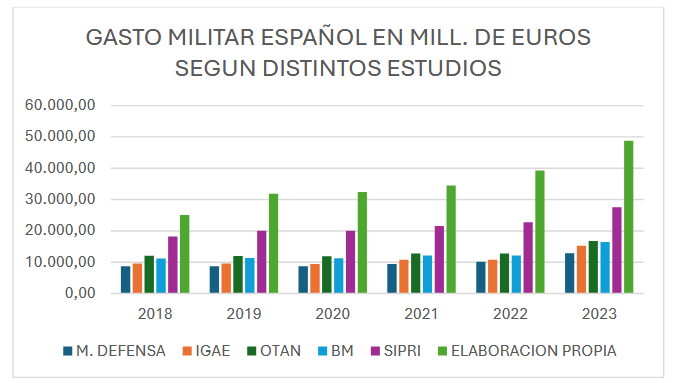
Para ello, en un primer momento, recordaremos la cifra de gasto militar que en 2023 se presupuestó y los componentes ocultos en los que se distribuía. También veremos en un momento el crecimiento extrapresupuestario de este gasto militar “reconocido” según la intervención general de la Administración del Estado (IGAE), órgano público de fiscalización del gasto público.
La IGAE, sin embargo, no controla específicamente el gasto militar, ni desagrega el gasto por los distintos programas y partidas que disfrazan gasto militar en otros ministerios ajenos a Defensa, por lo que los datos obtenidos sólo nos darán una aproximación al gasto efectivamente ejecutado durante 2023 y a la cifra total de gasto militar español.
En un segundo momento analizaremos diversos parámetros que nos permiten estimar el crecimiento del gasto militar español para 2024 y ofrecer una cifra aproximada que sirva de referencia.
También analizaremos, desde una perspectiva antimilitarista, las principales tendencias y objetivos que dicho gasto pretende cubrir y algunos de los movimientos políticos a los que habremos de estar vigilantes para denunciar el crecimiento de dicho gasto.
A little more than a month that has passed since the release of the “Assembly” winter interview and this info fully confirms its thesis about the approaching revolutionary situation in the country.
This yellow Niva has become in Ukraine a truly popular meme of resistance to state terror
The people vote against the state, which wants to see them as dumb cannon fodder, not only with their legs but also with their wallets.
The Ukrainian parliament is on the verge of a crisis: few deputies want to take political responsibility for the bill on strengthening mobilization, the adoption of which has been postponed to April.
Parliamentarians promise that the bill will not include online summonses or blocking of bank cards for evasion. From the calculations of the National Bank of Ukraine, in January 2024 alone, the population withdrew 27.4 billion hryvnias from Ukrainian banks.
Why is this not a nationwide spontaneous strike? Moreover, according to a NBU report published on March 11, the volume of foreign remittances from people to the country has been falling for the second year in a row. Over the past year, the amount decreased by 7.8%, in 2022 – by 10.5% (that is, from $14 billion in 2021 to $12.5 in 2022 and $11.6 billion in 2023).
Obviously, those who left the “country of dreams” before the full-scale invasion take their families with them instead of returning to them even after the war.
At the same time, according to the deputy chairman of the same NBU, Sergiy Nikolaychuk, the expenses of Ukrainians abroad are much greater than the transfer of funds to Ukraine: the outflow from the cards of the population in the “travel” category amounted to $20 billion in 2022 and $18 billion in 2023.
The people vote against the state, which wants to see them as dumb cannon fodder, not only with their legs but also with their wallets.
Another example of how unannounced quiet sabotage can force the state to unclench its jaws may be the plans voiced by the new commander-in-chief Oleksandr Syrskyi to dismiss those who refuse to fight from the Armed Forces of Ukraine, and using the money saved to double combat payments, to 200 thousand hryvnias per month.
The only question is, why then are they going to mobilize hundreds of thousands of recruits if they are preparing to purge the army of unmotivated personnel?
One way or another, no one knows what will be in the final voted version of the bill. All we can say with certainty is that even if they manage to bend the people by adapting the initial draconian version, the critical mass of those who are not going to die for the money of the IMF, BlackRock and Ukrainian respected citizens will not disappear anywhere – moreover, this public can only become more dangerous.
Europe: soldiers and young people flee armies By Pierre Duval – Continental Observer – 26.03.2024 The populations from immigration are not interested in the military uniform to lead the wars of the Occident, nor are the other young people of these countries. Most migrants support Russia. Calls by NATO leaders to recruit soldiers in a crusade against Russia are shunned by recruits […]
Lieutenant General Oleksandr Pavliuk, the new commander of the AFU Land Forces, posted on March 24 the follow alarm about his subordinates:
«”How will I surrender without a fight”: why the enemy can defeat us with the help of the Ukrainians themselves
The highest pilotage of the art of war is to destroy the plans of the enemy and defeat him without using his troops in battle. And judging by the last months, the Russians are very skillful in using ancient Chinese stratagems of warfare. And some of our fellow citizens, unfortunately, have lost the understanding that their acts and public statements have turned into a powerful weapon in the hands of the enemy. Who did not leave, does not leave and will never leave his desire to destroy Ukraine. Let’s recall what was written and distributed in our social networks two years ago and compare it with what is happening now. From queues to the enlistment centers and memes “if to serve – everyone is sick, but if to fight – everyone is healthy”, we reached the harassment of the military from the enlistment centers and moral support for evading the defense of Ukraine. Two years ago (not having even a tenth of today’s air defense equipment, weapons and experience of a full-scale war!) we, with all that, perfectly understood how important it was to disrupt the mobilization in Russia. They rejoiced at every military commissariat set on fire there, rejoiced at the queues of their evaders, who fled in panic to Georgia and Kazakhstan. From the unity and cohesion of that time, our space of news and discussion has slipped (or rather, ossified!) not without the help of our wonderful bloggers and free media. In the news channels, there are many reports about “unfortunate drowning people in the Tisa” or “combat Hutsul” squads. But there are almost no materials related to the work of the enlistment centers, the specifics of military service, the need to perform military duty. Publications are not interested in such topics. Appeals from the media for clarification of these issues are individual. Can’t make a flashy headline? Will the target audience hide their eyes? A separate topic is the attitude towards military personnel of the enlistment centers Today, the enlistment centers and their guard companies are mostly staffed by servicemen who lost their health in the war and were deemed unfit to serve in combat units. How did it become acceptable to treat these people who went through hell as enemies and call them “man hunters”? Why is it that in all the materials about “illegal acts of the enlistment centers” the most important emphasis is deliberately omitted: first of all, illegal is the refusal of men from their constitutional duty to defend Ukraine? Not to mention the fact that all shots like “packing into a bus” fundamentally (!) do not contain what exactly led to such consequences in the behavior of the heroes of the material.
Call for an Online Assembly against the War and its Logic (24-02-2024)An internationalist statement received by our editorial team yesterday. Despite disagreeing with some details (like confusing draft avoidance with desertion), we are glad to share this invitation with everyone!
In various social networks: YouTube, Facebook or TikTok, there are many videos with content taken out of context. We are often reproached: “it’s your own fault, you don’t change!” It does not. We change, we see our shortcomings and work every day to become better, more understandable! There is a lot of work ahead, and it will be much more difficult without your help! After all, only together we will be able to withstand this influx and ultimately Victory! Break the alliances of the enemy, divide his battle formations – the ancient Chinese war strategy teaches. Contrasting the army with civilians is one of its points. So before sharing the “flagrant story of rights violations” and the plight of the “poor evaders”, it’s worth asking yourself: who is this really helping to win the war? Definitely not to Ukraine»
There have been so many examples of passers-by fighting off people kidnapped by camouflage catchers in recent months that there is no point in listing them here. Let’s limit ourselves to more vivid stories.
In particular, on February 6, enlistment agents visited the Hutsul village of Kosmach in the Ivano-Frankivsk region (the birthplace of the legendary rebel leader Oleksa Dovbush). The residents did not greet them very friendly. They were surrounded by a female group exclaiming that “war has not been declared in the country” and that the visitors “will be beaten.”
Subsequently, the women went out to an improvised protest in the center of this village. Rumors began to spread throughout the settlement that a raid of the enlistment office was planned, so women came out to stop it and also demand “fair mobilization.”
When states are preparing for confrontation with the enemy outside their borders, they begin to mobilize their populations: it has been reported in recent months that Denmark has extended military conscription to women as well, France wants to raise the age limit for reservists from 65 to 72 years, and Germany, after investing €100 billion in rearmament, is considering reintroducing compulsory military service.
In the center of the village they began to stop cars, including the car of Ivanna Grepinyak, who was traveling with her 6-year-old daughter. Protesters said the woman was filming their gathering on her phone.
They started pulling her out of the car, tearing out her hair, taking away the car keys, and hitting the child. Ivanna claims that the protesters accused her of being an “information leaker” and coming to “hand over” local men to the military commissars.
The protesters moved away from Ivanna’s car only after someone exclaimed that this was not the vehicle they were waiting for. Most of the protesters ran to the car that had approached from behind, at which time Ivanna was able to leave Kosmach.
The woman went to the hospital complaining of injuries inflicted on her and her daughter by protesters. Doctors diagnosed the girl with a contusion of the soft tissues of the nose, and the 24 y/o with a probable closed head injury. She was hospitalized.
In turn, women in Kosmach say that communication with the driver was polite. From their point of view, it was Grepinyak who began to insult the residents, swore obscenely, provoked, and subsequently ran over one of the protesters’ feet. The next day, a village meeting was held in Kosmach, where enlistment officers tried to explain why and how the mobilization was taking place. However, people reacted emotionally to these arguments, demanding to know from whom Ukraine needs to be defended.
After fruitless discussions, people began chanting “Shame!” It was barely possible to avoid a physical clash between the military and the community – but that was only the first bell. (Meanwhile, the regional enlistment center of Ivano-Frankivsk this week reported that 39 thousand people are wanted in the region for ignoring summonses.)
On March 7, in the village of Ploska (about 5 km from the Romanian border in the Chernivtsi region), Hutsul cavalerists attacked them with the axes.
According to the cops, those mentioned in the post of Pavliuk came to the enlistment checkpoint and provoked the conflict. The viral video shows two persons in camouflage talking to a man sitting on a horse and holding an ax. Then, a SUV appears in the frame and hits one of the servicemen.
Then, getting out of the car, the driver stopped and hit him in the forearm with the butt of an ax. Another attacker also struck a serviceman in the shoulder with the butt of his ax. The men damaged the windows of the enlistment car and fled. It was 28 y/o and 43 y/o local residents. Both were taken into custody under Part 4 of Art. 296 of the Criminal Code (hooliganism with particularly aggravating circumstances) without right of bail. The article provides up to 7 years of imprisonment. An ax is the Hutsul weapon, including in the fight against mobilization. Like it had Dovbush and his insurgents (in fact, the Western Ukrainian analogue of Robin Hood)
These are two brothers, their sister said that one of them lost a son during the war. He went to the enlistment office, but there he got beaten and threatened. And when they met again, the man decided to take revenge. The second brother served in Donbass from 2015 to 2018. According to the lawyer, he was shell-shocked.
According to the police and the prosecutor’s office, on the evening of the same March 7, in the village of Mala Rogan near Kharkov, a drunken 25-year-old local resident took an RGD-5 grenade from the balcony and, in the presence of people on the street, threw it under the car of some 31-year-old female military living in that village. So he decided to take revenge on her because of a long hostile relationship. Her blue Kia Sorento parked near the house was damaged by the explosion. The woman was at home and there were no injuries.
Based on archives of social networks, we found out that this woman is Maryana Malykhina, she earlier terrorized the community, beating neighbors and locking them in the basement. “This is a generally creepy person, causing a stir throughout Rogan. She’s always yelling that she’s the navel of the Earth because she’s a warrior. She threatens everyone, even children, even her family is afraid of her,” locals characterize her. The guy was detained, he was informed of suspicion on the same Part 4 of Art. 296 of the Criminal Code.
On March 21, in Novovolynsk of the Volyn region, two enlistment employees visited the dormitory of a 50-year-old man due to failure to appear on a summons to dispatch.
He stabbed the visitor twice – the first hit was blocked, and the second hit him in the stomach. After this, he allegedly tried to cut his wrists; an ambulance was called to the scene. The cops opened a criminal case under Part 1 of Art. 121 of the Criminal Code of Ukraine (inflicting grievous bodily harm), the desperate man faces imprisonment for a term of 5 to 8 years. “Rambo: First Blood” in the Ukrainian way…
The revolutionary process in Rojava, based on the pillars of grassroots democracy, women’s liberation and social-ecology, is progressing while at the same time is threaten by the continuous war carried on by the Turkish state. The Turkish army is not responsible only for killing civilians and political representatives but for a planned ecocide and attacks […]




























 An ax is the Hutsul weapon, including in the fight against mobilization. Like it had Dovbush and his insurgents (in fact, the Western Ukrainian analogue of Robin Hood)

 The Free