
These were K2-3 d and Kepler-186 f, two Earth-sized exoplanets 144 and 579 light-years from Earth (respectively).
from thefreeonline on by Matt Williams at Universe Today (on Telegram: t.me/thefreeonline)

Earth’s magnetosphere is the region defined by our planet’s magnetic field. Image Credit: NASA
Planetary Habitability Depends on its distance from its Star’s Magnetic Field
The extrasolar planet census recently passed a major milestone, with 5500 confirmed candidates in 4,243 solar systems. With so many exoplanets available for study, astronomers have learned a great deal about the types of planets that exist in our galaxy and have been rethinking several preconceived notions.
These include the notion of “habitability” and whether Earth is the standard by which this should be measured – i.e., could there be “super habitable” exoplanets out there? – and the very concept of the circumsolar habitable zone (CHZ).

In a recent study, a team from Rice University extended the definition of a CHZ Habitable Zone of a planet to include its star’s magnetic field.
Traditionally, astronomers have defined habitable zones based on the type of star and the orbital distance where a planet would be warm enough to maintain liquid water on its surface. But in recent years, other factors have been considered, including the presence of planetary magnetic fields and whether they get enough ultraviolet light.
In a recent study, a team from Rice University extended the definition of a CHZ to include a star’s magnetic field.
Their findings could have devastating implications in the search for life on other planets (aka. astrobiology).
The paper describing their findings, “Exploring the Effects of Stellar Magnetism on the Potential Habitability of Exoplanets,” appeared on July 9th in The Astrophysical Journal.

On Earth, the presence of an intrinsic magnetic field has been vital to the emergence and evolution of life as we know it. Without it, our atmosphere would have been stripped away long ago by energetic particles emanating from the Sun – which was the case with Mars. In addition to Earth’s atmosphere, our planet’s magnetic field ensures that a limited amount of solar radiation and cosmic rays reach the surface.
For this reason, astrobiologists consider a planetary magnetic field essential for determining whether or not an exoplanet is habitable.
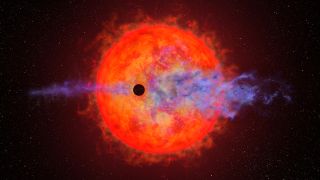
An illustration shows the atmosphere of a planet being blown away by its star, destroying the conditions needed for life. (Image credit: NASA, ESA, Joseph Olmsted (STScI))
Another factor is how the strength of a planet’s magnetic field and its interaction with its parent star’s magnetic field affect habitability.
Not only does an exoplanet require a strong field to shield it against stellar activity (solar flares, etc.), but it must also orbit far enough to avoid a direct magnetic connection with its star.
The magnetic field of a planet must be strong enough to shield it from the bombardment of charged particles coming from its star, yes, but it must also be far enough away from this stellar magnetic field to avoid direct contact and prevent a powerful event called “magnetic reconnection” from occurring.
The magnetic interactions between planets and their parent stars are known as “space weather.” For their study, the team examined 1,546 exoplanets to determine if they orbited inside or outside their host star’s Alfvén radius – the distance where stellar wind decouples from the star.
This consisted of characterizing the stars’ activity known using their Rossby number (Ro) – the ratio between a star’s rotational period to their convective turnover time.
Planets orbiting within this radius would directly interact magnetically with the star’s corona, leading to significant atmospheric stripping, ruling them out as viable candidates for habitability. This phenomenon has been observed with TRAPPIST-1 and its system of seven exoplanets.
After examining all the exoplanets in their study, they found that only two planets met all the conditions for potential habitability.
*Note that the 1546 planets in the study could only be chosen because their rotation details (Convective Turnover Time) are known – not due to their distance from Earth- So suitable planets for life may still be found comparatively nearby. There are an estimated 100 billion planets in the Milky Way Galaxy.
However many exoplanets more easily found are with red dwarf stars, which could mean that they must be close to their stars to be warm enough for life, but therefore likely inside the atmosphere stripping Alfvén radius?. * ..(Blogger)
These only 2 definitely suitable planets were K2-3 d and Kepler-186 f, two Earth-sized exoplanets 144 and 579 light-years from Earth (respectively).
At 13km/s, it would take about 12 million years to get to Kepler-186 f .
K2-3 d is a super Earth exoplanet that orbits an M-type star. Its mass is 2.2 Earths, it takes 44.6 days to complete one orbit of its star, and is 0.2014 AU from its star. Its discovery was announced in 2015.

Kepler-186f is inside the CHZ habitable Zone and outside its star’s Alfvén radius thus avoiding atmosphere stripping.
It is believed to be slightly larger than Earth and to have a similar composition to it. It is not known whether the planet has an atmosphere, but if it does, its position in its star system’s habitable zone means that it could potentially have oxygen and liquid water and thus be able to support life .
Both planets orbit within their stars’ CHZ, and lie outside their Alfvén radius, and have strong enough magnetic fields to protect them from stellar activity.
“While these conditions are necessary for a planet to host life, they do not guarantee it,” said Atkinson. “Our work highlights the importance of considering a wide range of factors when searching for habitable planets.”

These findings highlight the need for continuous observation when studying exoplanet systems and considering what factors have led to the emergence of life here on Earth. They are also indicative of current efforts among astronomers and astrobiologists to refine the definition of “Habitable Zone” and create a more nuanced understanding. In so doing, this research could help refine the search for extraterrestrial life by allowing scientists to further constrain where they should be looking.
Further Reading: Rice University, The Astrophysical Journal
The team’s research was published on July 9 in The Astrophysical Journal.
*********************************************
Newly Discovered Planet In Pisces Constellation By UK Scientists Claim It Can Support Human Life
by: True Activist Posted on July 25, 2024 https://trueactivist.com/newly-discovered-planet-in-pisces-constellation-by-uk-scientists-claim-it-can-support-human-life-t1/
***************************************************

 The Free