— In the sparse, sandy grasslands of Jarud Banner in north China’s Inner Mongolia Autonomous Region, machinery is filling wind-eroded pits and laying sand barriers while workers are busy supporting the comprehensive management of Horqin Sandy Land.
“Our independently developed sand-fixing machine processes raw materials like sand and straw into grass mats for sand barrier installation,” said Yu Dongjiang from M-Grass Ecological Environment (Group) Co., Ltd.
The sand-fixing machine is simple in structure, easy to operate, and highly adaptable to various terrains. It improves raw material utilization efficiency, enabling the installation of nearly 30,000 meters of sand barriers daily, according to Yu, who is also the project manager for the comprehensive management of the northern central Horqin Sandy Land.
Previously, the manual weaving of grass mats required significant labor and time.
Yu’s project shows China’s wider push to advance ecological restoration. In the arid landscapes of northern China, cutting-edge technology is transforming the fight against desertification into a story of hope and renewal.
From satellite monitoring systems to innovative tree-planting tools, the integration of advanced equipment has elevated traditional reforestation efforts.
In Inner Mongolia’s Kubuqi Desert, for example, drones have been employed to plant seeds across vast stretches of barren land, significantly improving efficiency and survival rates. These seeds, combined with specially developed nutrient packs, ensure saplings thrive in challenging environments.
While in northwest China’s Gansu Province, solar energy projects are being combined with afforestation programs at the southern edge of the Tengger Desert, creating a synergy that not only restores ecosystems but also boosts local economic development.
Local villagers are also finding employment in these initiatives, blending green technology with grassroots participation.
“I never would have imagined that as a farmer, I could find work in the sand dunes,” said Qin Zhaoping, a resident of Hengliang Township in Gansu’s Gulang County. His job involves adjusting the sprinkler irrigation systems beneath photovoltaic panels and tending to the thriving sand plants.
For Qin, photovoltaic-based desert control is a meaningful effort that benefits future generations. “It generates electricity, combats desertification, and provides me with an income from working here,” he said.
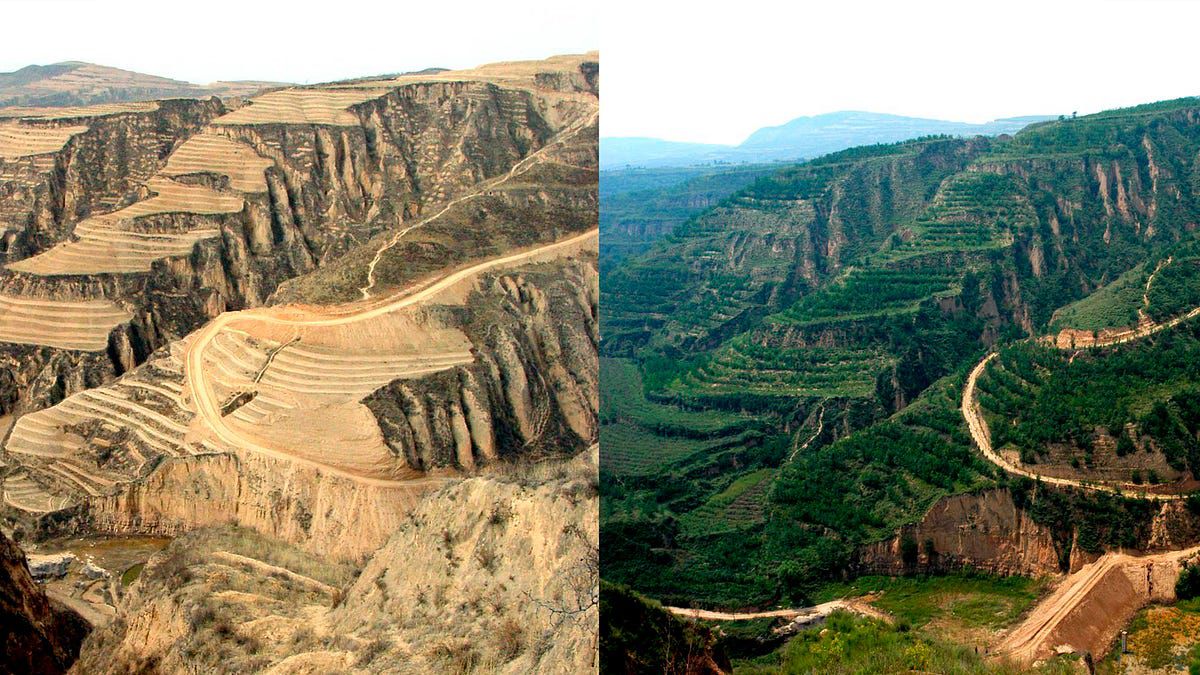
According to official data, 53 percent of China’s treatable desertified land has been restored, leading to a net reduction of approximately 4.33 million hectares of degraded land.
One of the country’s landmark ecological projects is the Three-North Shelterbelt Forest Program. Since 1978, China has expanded its afforestation area by 32 million hectares under the program.
Meanwhile, China’s desertification control technologies and equipment are making their way onto the global stage, sharing ecological restoration expertise with other countries and regions.
To join the efforts of the Global South, China has launched desertification control centers with Arab states and Mongolia, created demonstration sites in Central Asia and Africa, and provided satellite technology and big data support for Africa’s Great Green Wall initiative.
In December, Yu’s company signed a memorandum of understanding with the municipal government of Ulaanbaatar in Mongolia to enhance the country’s ecological environment and promote practical cooperation
The Free is a book and a blog. Download free E/book ...”the most detailed fictional treatment of the movement from a world recognizably like our own to an anarchist society that I have read...
View all posts by thefreeonline



 The Free