Illegal Logging Spreading in Madagascar

Illegal Logging Spreading in Madagascar
By Lovasoa Rabary-Rakotondravony

ANTANANARIVO, May 19, 2011 (IPS) By Lovasoa Rabary-Rakotondravony

– The transitional authorities in Madagascar are struggling to overcome the problem of illegal logging of precious wood. In spite of an April 2010 decree that prohibits the logging, transporting, trading and export of precious woods, felling in the forests is still continuing.

In mid-April, the heads of the police force of Antalaha, a town on the northeastern coast of Madagascar – the area most affected by the phenomenon – seized 30 tonnes of rosewood being transported in two trucks.

But this is far from the only place where trafficking in illegal timber is taking place on this island, which has the biggest rosewood reserves in the world. A few days earlier, three other trucks transporting 115 rosewood logs, were intercepted in Tolagnaro, in the southeast. Before the raid, more than 1,000 pieces of another kind of precious rosewood found in Malagasy forests, were seized in the same region.

In Mahajanga in the northwest, more than 250 containers full of rosewood destined for export have been held at the port since December 2010. Most of this wood comes from Mampikony, an area situated about 250 kilometres southeast of Mahajanga, Ndranto Razakamanarina, a forestry engineer and president of the Voahary Gasy alliance, an umbrella body of civil society organisations working for the protection of the environment, told IPS.

Deforestation Devours Rich Ecosystems

Deforestation Devours Rich Ecosystems
By Franz Chávez.LA PAZ, May 19, 2011 (IPS) – Occupations of land for agriculture over the last four decades in Bolivia, whether by individuals or in organised collective initiatives, have led to severe ecological damages and low levels of productivity because of the intensive use of machinery and the failure to take into account the limitations of the soil, said environmentalist Marco Ribera.

“To this aggressive approach towards ecosystems is added the irregularity of many processes of obtaining land, in murky periods in which the phenomenon flourished under dictatorships or in a context of political favours,” Ribera, research coordinator for the Environmental Defence League (LIDEMA), a local environmental group, told IPS.
Ribera is an interdisciplinary biologist who, after reviewing statistics, land occupation records, and studies on environmental damages, concluded that misguided state management and land occupations carried out without adequate planning continue to occur today in the process of colonisation of the Amazon jungle in the northern province of Pando.

Of Bolivia’s total area of nearly 1.1 million square kilometres, 25 percent is Andean highlands, 15 percent is made up of valleys, and the rest is lowland plains and rainforest. Since the second half of the 1980s, the Bolivian economy has been driven by intensive agribusiness in the lowlands, where soy has become the star crop.
Soy exports brought the country 554 million dollars in export earnings in 2010, making the crop the third-biggest foreign exchange earner after natural gas and minerals. Bolivia’s total exports in 2010 amounted to 6.96 billion dollars, just over one-third of GDP.  CONTINUED

http://www.rainforestportal.org/shared/reader/welcome.aspx?linkid=223719

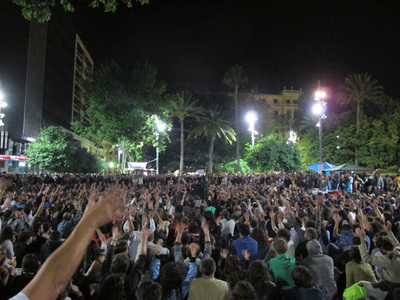
Spanish Revolution camps.. the details

Spain’s Tahrir Square


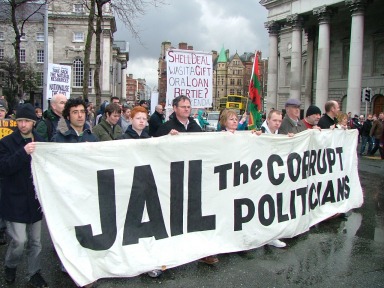
Pablo Ouziel’s ZSpace PagSpain’s people’s movement seems to be finally awakening as la Puerta del Sol in Madrid begins to look like it may become the country’s Tahrir Square, and the ‘Arab Spring’ may be joined by what is now bracing to become a long ‘European Summer’. As people across the Arab world continue their popular struggle for justice, peace and democracy, Spain’s disillusioned citizens have finally begun to catch on as well. Slow at first, hopeful that Spain’s dire economic conditions would magically correct themselves, the Spanish street has finally begun to understand that democratic and economic justice and peace will not come from the pulpits of the country’s corrupt political elite.

Amidst local and regional election campaigns, with the banners of the different political parties plastered across the country’s streets, people are saying ‘enough!’ Disillusioned youth, unemployed, pensioners, students, immigrants and other disenfranchised groups have been inspired by the Arab world and are now also demanding a voice – demanding an opportunity to live with dignity.  

As the country continues to implode economically, unemployment grows incessantly leaving one in two young people unemployed across many of the country’s regions. With many in the crumbling middle class on the verge of losing their homes while bankers profit from their loss and the government uses citizen taxes to expand the military industrial complex by going off to war; the people have begun to grasp that they only have each other if they are to rise from the debris of the militarized political and economic nightmare in which they have found themselves. Will thousands in protest become tens and hundreds of thousands? It is beginning to look like they might.  

And in this way, Spain is finally, one hopes, re-embracing its radical past, its popular movements, its anarcho-syndicalist traditions and its republican dreams. Crushed by Generalissimo Francisco Franco seventy years ago, it seemed that Spanish popular culture would never recover from the void left by a rightwing dictatorship, which exterminated anyone with a dissenting voice; but the 15th of May 2011, is the reminder to those in power that Spanish direct democracy is still alive and has finally begun to awaken.

In the 1970s a transition through pact, transformed Spain’s totalitarian structures into a representative democracy in which all the economic structures remained intact. For the highly illiterate generations of the time, suffering in the reality of a poverty-stricken country, the concessions made by the country’s elite seemed something worth celebrating. Nevertheless, as the decades passed, the state-owned corporations were privatized robbing the nation of its collective wealth, and the political scene crystallized into a pseudo-democracy in which two large parties — PP and PSOE — marginalized truly democratic alternatives. As this neoliberal political project materialized, the discontent began to resurface, but the fear mongers — Spain’s baby-boomers who had once fought for democracy — were quick to remind the youth of the dangers of rebellion. For many decades in Spain the mantra was, ‘it is better to live as we are than to go back to the totalitarianism of the past, and if you shake the system too much, it will take away our hard-earned rights’. So the youth remained silent, fearful of what could happen if they spoke, and the baby-boomers in their compromise blamed the youth for their indifference. According to them, it was the youth — who were unwilling to work — which were bringing the country to its knees. But the youth have stopped this blame game, and aware of the true risks to their future are finally enticing the whole country to mobilize.

A failed European project, with its borders quickly being reinstated, a collapsing Euro currency, and the examples of Greece, Portugal and Ireland are the reminders to those on the streets of what it is they are fighting to disassociate themselves from, and of the freedoms they are working towards. The economic and political project of the country’s elite has destroyed the economic dreams of whole generations of naïve and apathetic Spaniards.  It has left the country in the hands of bond speculators and central bankers, and Spaniards will have to pay that price. Nevertheless, the debt accumulated by the Spanish family, has also earned it the education with which it can understand what is going on, and through it Spanish people appear to be ready to liberate themselves from the tyranny of their government.

What has begun in Madrid’s Puerta del Sol and has been echoed in fifty-two cities across the country is the birth of a popular movement for freedom, which has no intention of fading away. The people have no choice, either they take city squares as symbols of their struggle, or their message is never heard. The government knows this and that is why it has quickly responded by trying to disperse the crowds with its repressive police force. But following some arrests, the people are back with more strength.

A silent revolution has begun in Spain, a nonviolent revolution which seeks democracy through democratic means, justice through just means, and peace through peaceful means has finally captivated the imagination of the Spanish people, and now there is no turning back. The challenge ahead will be in keeping the collective spirit nonviolent as the police force does everything in its power to disintegrate the movement into a violent chaos that can justify its repression. The popular movement will also have to be alert as the bond speculators threaten the country with economic sanctions in order to scare the population into submission, and a constructive program will have to be articulated so that the movement can continue to function whilst providing sustainable alternatives for a different Spain.

Hopefully an articulate steering committee will flourish soon from amongst the crowds, which is capable of making clear and viable demands that grab the imagination of the country and force the political elite to comply. These are delicate times in Spain, if this spontaneous nonviolent movement succeeds, Spain may welcome a brighter future. If it fails, I fear violence will become the only option for those in pain. What those outside of the country can do for Spain is to echo the shouts of indignation coming from the country’s streets. So far both mainstream and progressive international media channels have opted for silence. Let us hope this silence breaks. 

http://www.zcommunications.org/spain-s-tahrir-square-by-pablo-ouziel

Take The Streets movement going worldwide!

As the Spanish authorities fail to evict the dozens of new street camps the movement is now leaping borders.

The #spanishrevolution spreads worldwide

There convened concentrations in Italy and sitting in London, Paris, Berlin, Brussels and Copenhagen. Mexico City and Buenos Aires prepare Camping

The # spanishrevolution has ceased to be a movement in Spain and has just started to cross borders, especially in Europe

Juan Cobo, # acampadasol spokesman, told Público.es who are overwhelmed by the number of calls they are getting from other countries. “We call on Colombia, Costa Rica, Mexico, Venezuela, Argentina … want to interview and learn the movement, ” ha

ñalado. For the moment, I know that already preparing camped in Mexico City and Buenos Aires    México DF y en Buenos Aires..

In Europe, calls for focus have multiplied throughout the morning and in countries like Italy #italianrevolution)), UK(#ukrevolution France(#frenchrevolution) , Germany#germanrevolution

, Belgium, Denmark and Portugal is already a reality.The voice began to run yesterday through two Facebook groups:Italian Revolution – Democrazia Reale Ora  I Pray and Real Democracy – Roma, who have managed to call protests in 13 cities, including Rome, Turin, Milan, Bologna and Florence.

The rallies are being organized for Erasmus students but young people have joined Italian

The movement is also transmitted through Twitter with hashtag # italianrevolution and got the attention of Viola Popolo and Italian  grupo Anonymous Anonymous group.

The initiative is divided into two groups. On one side are the Spanish Erasmus students and workers who decided to move following the example of the Puerta del Sol and on the other, the Italians themselves who have taken the sign of real democracy and have already placed in the middle of the phrase “The Italy of our discontent. ” In any case, it is certain that both groups will gather in each of those cities

Both Twitter and Facebook have querdio convey the ideas that are inspiring 15M movement and has been called to respect certain rules that all demonstrations have the greatest credibility. It asks people to go without flags of any party or trade union and to develop “personal signs of the group, you can think of who can best represent us.”

As in Madrid, is recommended to take “any device with which we can connect to social networks Twitter or Facebook” to “deliver what we do in all media.”

Organizers warn that “you may not legally be covered: we have not warned about sitting still for all this has been arranged this evening in a matter of hours. Tomorrow [by now] attempt to contact the authorities […] It is important that this Friday’s all conducted with the utmost respect. ”

Finally, remember that there are no “no type of alcoholic beverage. There is a bottle […] It is important that the image that we show has credibility abroad. ”
London, Paris, Copenhagen, Amsterdam …

In other countries, concentrations are held in the respective Spanish embassies: in London at 19.30 at the Embassy of Spain, in France from the Facebook profile vrai Pour une démocratie Pour une vrai démocratie, called to demonstrate in Paris at 20.00 also before the Spanish Embassy. In Germany have called for demonstrations in Berlin, always facing the Spanish embassy this afternoon and tomorrow, reports Patricia Baelo.

“It is recommended to bring any device connect to Twitter or Facebook” In Denmark, the concentration will be on Saturday 21 at 18.00 at the Spanish Embassy in Copenhagen, and in Belgium, will take place in BrusselsBruselas tomorrow Friday at 18.30. The call is also being followed from Amsterdam, the Netherlands, with a concentration convened this afternoon for 20.00 hours, and in LisbonLisboa,, the event will take place at 19.00 pm today.(19th)

La #spanishrevolution va a todo el mundo. Going worldwide!

La #spanishrevolution se extiende a todo el mundo

Hay convocadas concentraciones en Italia y sentadas en Londres, París, Berlín, Bruselas y Copenhague. México DF y Buenos Aires preparan acampadas

La #spanishrevolution ha dejado de ser un movimiento sólo de España y ha empezado a traspasar fronteras, sobre todo en Europa

Juan Cobo, portavoz de #acampadasol, ha declarado a Público.es que están sobrepasados por la cantidad de llamadas que están recibiendo de otros países del mundo. “Nos llaman de Colombia, Costa Rica, México, Venezuela, Argentina… Quieren entrevistarnos e informarse del movimiento”, ha se

ñalado. Por el momento, les consta que ya se están preparando acampadas en México DF y en Buenos Aires.

En Europa, las convocatorias para concentrarse se han ido multiplicando a lo largo de la mañana y en países como Italia (#italianrevolution), Reino Unido (#ukrevolution), Francia (#frenchrevolution), Alemania (#germanrevolution), Bélgica, Dinamarca y Portugal ya son toda una realidad.

Fuerte apoyo en Italia

Italia ha sido el país que más se ha movilizado. La voz empezó a correr ayer a través de dos grupos en Facebook: Italian Revolution – Democrazia Reale Ora y Democracia Real Ya – Roma, que han conseguido convocar protestas en 13 ciudades, incluidas Roma, Turín, Milán Bolonia o Florencia.

Las concentraciones están siendo organizadas por los estudiantes erasmus pero se han adherido los jóvenes italianos

El movimiento se transmitió también gracias a Twitter con el hashtag #italianrevolution y consiguió llamar la atención del Popolo Viola y del grupo Anonymous italiano.

La iniciativa se divide en dos grupos. Por una parte están los estudiantes erasmus y trabajadores españoles que decidieron movilizarse siguiendo el ejemplo de la Puerta del Sol y por otro, los propios italianos que han adoptado el cartel de Democracia Real Ya y le han colocado en medio la frase “La Italia de nuestro descontento”. En cualquier caso, es seguro que ambos grupos se van a juntar en cada una de esas ciudades

Tanto en Twitter como en Facebook se han querdio transmitir las ideas que están inspirando al movimiento 15M y se ha llamado a respetar unas normas para que todas las manifestaciones tengán la máxima credibilidad. Se pide que la gente acuda sin banderas de ningún partido ni de sindicatos y que elaboren “carteles personales, de grupo, lo que se os ocurra que mejor pueda representarnos”.

Como sucede en Madrid, se recomienda llevar “cualquier dispositivo con el que nos podamos conectar con las redes sociales de Twitter o Facebook” para “difundir lo que vamos a hacer en todos los medios”.

Los organizadores advierten de que “es posible que legalmente no estaremos amparados: no hemos avisado de la sentada aún porque todo esto se ha organizado esta tarde en cuestión de horas. Mañana [por hoy] intentaremos comunicarnos con las autoridades […] Es importante que este viernes todo se lleve a cabo con  el mayor de los respetos”.

Por último, recuerdan que no se lleve “ningún tipo de  bebida alcoholica. No se trata de un botellón […] Es importante que la imagen que mostremos al exterior tenga credibilidad”.

Londres, París, Copenhague, Amsterdam…

En el resto de países, las concentraciones se realizarán en las respectivas embajadas españolas: en Londres a las 19.30 horas ante la embajada de España; en Francia desde el perfil de Facebook Pour une vrai démocratie, se llama a manifestarse en París a las 20.00 horas también delante de la embajada española. En Alemania se han convocado manifestaciones en Berlín, siempre frente a la embajada española, para esta tarde y mañana, informa Patricia Baelo.

“Se recomienda llevar cualquier dispositivo con el conectarse a Twitter o Facebook” En Dinamarca, la concentración será el próximo sábado 21 a las 18.00 horas en la embajada española en Copenhague; y en Bélgica, tendrá lugar en Bruselas mañana viernes a las 18.30 horas. La convocatoria también está siendo seguida desde Amsterdam, Holanda, con una concentración convocada esta tarde para las 20.00 horas; y en Lisboa, la manifestación tendrá lugar a las 19.00 horas de hoy.

sigue la Acampada Sol ..Rain fails to stop ‘Egypt’ camp

sigue la Acampada Sol 08:45h | lainformacion.com Cuarto día de concentración en la Puerta del Sol de Madrid y en otras plazas de España en protesta por el actual modelo social, político y económico.

La lluvia no pudo con la Acampada SolNo piensan moverse de allí, al menos durante esta semana. Los seguidores del movimiento ciudadano que ha “tomado” la Puerta del Sol para pedir un sistema “más democrático” llevan cuatro noches durmiendo al raso. La ocupación de la plaza madrileña -que tiene réplicas en muchos otros lugares públicos de España- comenzó de manera espontánea el domingo, cuando un grupo de los que habían participado esa tarde en la marcha convocada por Democracia Real Ya decidió quedarse a pasar la noche en la calle para mostrar el alcance de su descontento.

10.30 La Junta Electoral Provincial de Madrid se reunirá a lo largo de esta mañana para analizar la acampada, después de que ayer se incumpliera su resolución en la que no se autorizaba la concentración. Fuentes cercanas a este organismo han explicado que la decisión es “vinculante” y de “obligado cumplimiento”, por lo que ahora tendrán que analizar qué medidas tomar ante la comprobación de que se ha pasado por alto.

9.30 Un grupo de internautas promueve una petición popular para que la Junta Electoral Central revoque hoy la decisión de la Junta madrileña y de otras jurisdicciones que ayer desautorizaron las concentraciones del movimiento nacido el 15M. La iniciativa tiene hasta el momento unas 39.000 adhesiones. La Junta Electoral Central tiene previsto estudiar este jueves la incidencia de las movilizaciones en la campaña electoral y en la jornada de reflexión del sábado.

8.30 Los manifestantes recogen, una vez más, tiendas, cartones y lonas y se ocupan de limpiar la plaza, mientras ajustan el calendario de asambleas y reuniones de comités para este jueves.

8.00 Alrededor de dos centenares de personas han dormido la noche de este miércoles en la madrileña Puerta del Sol, a pesar de la intensa lluvia, y orgullosos del seguimiento que ha conseguido el movimiento 15M desde el pasado domingo. “Llueve y llueve y la plaza no se mueve”, han coreado los participantes en la cuarta noche de acampada, que ha transcurrido sin incidentes después de una nueva concentración multitudinaria durante la tarde.

2.10 Se celebran comités para organizar la acampada, que se ocupan de buscar provisiones, mantas y tiendas para pasar la noche. También hay grupos que limpian la plaza y que intentan controlar que no se beba. “La gente está respondiendo muy bien”, ha dicho un portavoz del movimiento identificado como Charly, que ha explicado que los bares de la zona les facilitan alimentos y les permiten usar los baños. Asimismo, varias personas se ofrecen voluntarias para traducir a distintos idiomas el manifiesto del movimiento 15M. Los manifestantes debatieron en una asamblea las propuestas para construir “una democracia real desde la base, desde las personas”, en palabras del portavoz.

Amenaza de desalojo acampada BCN. Eviction threat Barcelona

per copypaste 19 mai 2011
Més carrer i menys ordenata i tuisters, facebocs i joguines similars, merdes del sistema, amics de les nuclears, germans del petroli.
noticia copiada del diariot feixista del mundo:

La protesta contra la clase política y la banca que cientos de personas vienen protagonizando en plena Plaza Catalunya de Barcelona desde el lunes ha afectado de lleno a la campaña electoral en Cataluña y, específicamente, en la propia Barcelona.

Los dos principales candidatos a la alcaldía de la capital catalana, Jordi Hereu (PSC) y Xavier Trias (CiU), se han visto obligados a modificar su rutina discursiva para dejar a un lado sus promeses electorales y dar su opinión sobre una movilización con cuna en las redes sociales de internet.

Ambos contendientes han coincidido en mostrar su “respeto” por una movilización que, en parte, les tiene a ellos y a sus partidos en el punto de mira. No obstante, han dejado también meridianamente clara su intención de que la protesta no enturbie la cita con las urnas el domingo 22 de mayo.

Hereu, tras intentar solidarizarse con quienes “no ven un horizonte claro, sino un muro”, ha recordado que él es el alcalde y está ahí para hacer cumplir las normas. Así, ante la intención de los organizadores de permanecer en la emblemática plaza hasta el domingo, Hereu ha advertido de que “una acampada indefinida en el espacio público con elementos estables” está radicalmente prohibida.

Su papel como primer edil, no obstante, no le ha apartado de la oportunidad de intentar rascar apoyos entre los concentrados, admitiendo que “me adhiero a la indignación” ya que “me ha tocado como alcalde vivir con el resto de ciudadanos los efectos de esos tejemanejes financieros” que han conducido a la crisis.