Africa: GMO seeds introduced despite public rejection

By David Njagi

NAIROBI, May 16, 2011 (IPS) – Farming with genetically modified organisms (GMOs) is becoming more widespread in Kenya due the promotion of biotechnology through clever schemes,  and the lack of a legal framework for these controversial products.

”Because Africans are strongly against GM foods the companies are using their economic muscle and criminal disregard for local opinion to gain  a foothold and get the farmers ‘hooked’.

Africa: policy on genetically modified organisms (GMO) and genetically engineered (GE) foods (map/graphic/illustration)

Click here, or on the graphic, for full resolution.

Africa: policy on genetically modified organisms (GMO) and genetically engineered (GE) foods. The Cartagena protocol on biosafety, a supplement to the convention on biological diversity, has strong support in Africa, with a majority of the countries as signatories. In addition, several countries have, in the past, rejected aid (especially unmilled grains) in food imports with concerns for national biosafety. South Africa is so far the only country that is seeing wide-spread use of genetically modified crops.

In Kenya The Sygenta Foundation has triumphed with a novel scheme to insure farmers crops. The Syngenta Foundation is a not-for-profit organisation attached to the Syngenta Company that researches and produces GM seeds. The foundation is involved in the “Safe Biotechnology Management” (SABIMA) project aimed at promoting GM technology among small-scale farmers in Ghana, Nigeria, Burkina Faso, Kenya, Uganda and Malawi.

The Kenya Biodiversity Coalition (KBioC) regards the scheme as part of seed-manufacturing multinational companies’ renewed appetite to use Kenya as a testing ground for GMOs by offering seeds to farmers.
“We suspected that a lot of GM seed, particularly for maize, was being imported from South Africa either as contaminated maize or plain GMOs,” recalls Kamau of KBioC. “We went to the key maize-growing regions and did random sampling. We bought the seed and found it was laced with GM strains.”Controls on seed imports are often slack or lacking.”So even if Kenya has not commercialised GMOs, it is likely that farmers are planting GM seed without their knowledge,” says Kamau.

Despite rejection everywhere but South Africa, Dr. Margaret Karembu, of a pro GMO company, predicts that 10 African countries will have adopted the technology before 2015

read more…http://ipsnews.net/news.asp?idnews=55648
Peru: Indigenous anti mine protestors hold Puno city

Customs warehouse in Puno on fire after it was attacked overnight

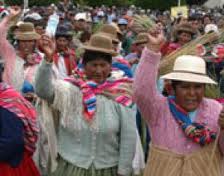
20,000 Aymaras occupy Puno

Thousands of angry indigenous protesters have taken over the city centre of Puno in south-eastern Peru.

Looters have taken advantage of the unrest and ransacked offices and shops as the police retreated.

Cars and buildings were torched on Thursday night when protesters went on the rampage, demanding an end to a Canadian silver mining project.

The indigenous Aymara activists say the mining company will pollute their ancestral lands.

The protesters have blocked the main roads into the city.


Border crossing still closed

A customs office was set ablaze on Friday and several other buildings are still smouldering after being torched in the night.

The demonstrators have threatened to continue the disruption until the government revokes the mining concessions for the Canadian Bear Creek mining company.

The activists say the mining corporation will contaminate nearby Lake Titicaca, decimating the fish stocks.

However, the firm denies it will harm the environment and wants to begin production next year.

The unrest in Puno comes two weeks before the 5 June presidential run-off election.

The indigenous activists say they will try to stop the polls from going ahead in Puno if their demands have not been met.

Chile:Dictator Laws used against anarchists, Mapuches…

 
By Pamela Sepúlveda

SANTIAGO, May 25, 2011 (IPS) – “What is happening in Chile isn’t justice; it’s a pantomime, because under the anti-terrorism law, there is absolutely no way justice can be done,” José Venturelli, spokesman for the European Secretariat of the Ethics Commission against Torture, said on a recent visit to this South American country.

The controversial law that Venturelli was referring to has been used to try members of Chile’s Mapuche indigenous community involved in the long-running struggle for their right to land.

Ramón Llanquileo, José Huenuche and Jonathan Huillical, sentenced to 20 years in prison, and Héctor Llaitul, sentenced to 25 years, began a hunger strike on Mar. 15 in a prison in southern Chile, demanding a fair and impartial retrial.
The four Mapuche activists were not actually tried under the counter-terrorism law, which dates back to the 1973-1990 dictatorship of General Augusto Pinochet and has been widely condemned by the international community. But although they were tried under ordinary criminal law, the case against them was built on the investigation carried out under the anti-terrorism legislation, and their recent conviction was based on the testimony of police officers and anonymous witnesses.

The four were found guilty of theft of lumber and attempted murder for allegedly attacking a prosecutor riding in a motorcade in 2008 in the southern town of Tirúa, 700 km south of the capital.

Ten activists arrested is the so-called “caso bombas” (bombs case) ended a 65-day hunger strike in April, held to protest an alleged frame-up and their trial under the anti-terrorism law. They were arrested for allegedly setting off 29 bombs in Santiago in incidents dating back to 2005. But most of the supposed evidence against them was thrown out by the judge.

URGENT AMAZON FOREST ALERT

URGENT AMAZON FOREST ALERT

slaughtering-the-amazon-cover

[UPDATE 20 May 2011: The Guardian UK reports, “Brazil forms ‘crisis cabinet’ following unexpected deforestation surge”.]

Events are moving quickly in Brazil’s epic battle over a new national Forest Code. The struggle has has reached a critical stage full of both danger and opportunity. Please take action.

EMERGENCY — BRAZIL’S NATIONAL MONITORING AGENCY JUST CONFIRMED THAT RECENT DEFORESTATION HAS JUMPED 473 PERCENT. THE SITUATION IS CRITICAL.

[Reuters reportagem em Português]

Sign the international petition to defend Brazil’s forests.

If you would rather sign a petition in Portuguese, here is one from avaaz.

The recent monitoring reports of both the government and the environmental NGOs showed prelimary data of a huge surge in deforestation as agribusiness and the ruralist coalition push to deforest and create a new code of amnesty for the forest destroyers. Today’s release of frightening new data shows how aggressive the large farmers and agribusiness are. PLEASE ACT NOW.

The Dilma government has been caught between its desire for for rapid economic development and its desire to maintain its green image to the international community where it has pledged to reduce emissions from deforestation and to maintain biodiversity. Additionally, it wants to showcase its “greenness” at the upcoming 2012 “Rio+20” world environment conference. Indeed, on the advice of its Foreign Ministry, the Dilma leadership delayed the recent Forest Code debate (google translation from Portuguese) in Congress in order to revise its position.

The good news it that IBAMA (the national environment protection agency) has just announced a new policy of zero deforestation. The future of the forest hangs between this positive initiative and the reckless campaign of ruralista deforestation. This is the defining moment!

[Update: Here are the latest reports on deforestation and the new IBAMA policy.]

ACT NOW. Sign the petition in English or in Portuguese to defend Brazil’s forests.

with thanks via:

http://lougold.blogspot.com/2011/05/urgent-amazon-forest-alert-events-are.html

Monsanto en Chile..compra de politicos

A new law gives Monsanto and others freedom to act in Chile and restricts the right to reuse seeds.

Con 13 votos a favor (de la derecha y uno de la Concertación), 5 en contra y 6 abstenciones, el Senado de Chile aprobó el 11 de mayo el Convenio Upov 91 que impedirá a los campesinos guardar la semilla y extenderá el tiempo de vigencia de los derechos y garantías de las transnacionales que vendan semillas híbridas y transgénicas en el país.

INDIGNACIÓN CAMPESINA E INDÍGENA

La Asociación Nacional de Mujeres Rurales e Indígenas (Anamuri) y Terram, invitadas a expresar su opinión ante el Senado, habían mostrado ante la Comisión de Agricultura su repudio a esta iniciativa…..

VIOLACIÓN DE UN DERECHO HUMANO

La selección, mejoramiento e intercambio de semilla –trafkintu en mapudungun– es un derecho humano de los agricultores y pueblos indígenas del mundo, reconocido incluso en el Tratado de Recursos Fitogenéticos de la FAO y reivindicado por Vía Campesina y por la Cloc, la Coordinadora Latinoamericana de Organizaciones del Campo. De esta manera, las mujeres campesinas e indígenas y las comunidades campesinas son las verdaderas gestoras de la diversidad y riqueza genética que …..

UPOV Y LOBBY EMPRESARIAL

La Unión Internacional para la Protección de las Obtenciones Vegetales, Upov, es una organización propiciada por las transnacionales comercializadoras de semillas y respaldada por los gobiernos, de la que Chile es parte. En los primeros años producían híbridos y hoy también transgénicos. Entre ellas están las empresas Monsanto –que controla más del 90% del mercado de la semilla transgénica- Syngenta, Bayer, y Dupont/Pioneer. Las ventas de semillas y plaguicidas les reportan enormes ganancias a costa de la destrucción de la agricultura campesina, remplazada por la agroindustria y los monocultivos de semillas transgénicas. El precio de los alimentos, según FAO, se encuentra actualmente en los niveles más altos de la historia.

El Convenio Internacional para la Protección de las Obtenciones Vegetales (Convenio Upov) ha sido modificado en tres oportunidades: 1972, 1978 y 1991. En Chile el exitoso lobby empresarial para que Chile, firmante de Upov 78, adhiriese a Upov 91 fue encabezado por Monsanto a través de ChileBio con el apoyo de Anpros (la asociación gremial de productores de semilla transgénica de exportación) y del Diario Financiero, virtual vocero del negocio de exportación de semilla transgénica. El Gobierno y senado chileno finalmente se rindieron a la presión adicional del Presidente Obama, cercano a Monsanto, quien traía en su agenda de visita a Chile, el tema del respeto a la propiedad intelectual………

LEER Más…..via InSURgenciA Hip Hop.

This blog promotes ‘The Free’, an adventure novel set in the collapse of Capitalism.  free DOWNLOAD page, click HERE 

1st victory:ConocoPhillips deja b.39 en favor de Indigenas

MILAGRO EN LA SELVA: ConocoPhillips se retiró del Bloque 39 por AMOR a NO CONTACTADOS

“es crucial que los operadores restantes en la región, Perenco y Repsol, sigan el liderazgo de ConocoPhillips y que se retiren de estos bloques petroleros polémicos.” declaró Amazon Watch.

Petrolera estadounidense abandona proyecto de extracción que atenta contra indígenas en aislamiento voluntario

13 May 2011 – http://www.actualidadambiental.pe/?p=10528&cpage=1#comment-5025

.

La petrolera estadounidense ConocoPhillips se retiró de proyecto que junto a Repsol-YPF pretendía explotar el crudo del Bloque 39, adyacente al Bloque 67. Según informó Amazon Watch, estos trabajos extractivos desplazarían a indígenas en aislamiento voluntario ubicados en la selva norte del país.

Para Amazon Watch, las operaciones petroleras en las regiones donde habitan los indígenas en aislamiento representan una gran amenaza a su sobrevivencia, debido a la posible propagación de enfermedades foráneas y al desplazamiento forzado.

Ambos bloques petroleros están ubicados en la frontera con Perú y Ecuador, entre los ríos Napo y Tigre, y limitan con una reserva para personas indígenas aisladas, ubicada al otro lado de la frontera en Ecuador.

Asimismo, Amazon Watch indicó que “es crucial que los o

via MILAGRO EN LA SELVA: ConocoPhillips se retiró del Bloque 39 por AMOR a NO CONTACTADOS – cinabrio blog.

No Justice, No Peace: Mining in Ecuador

No Justice, No Peace: Canadian Mining in Ecuador and Impunity | 

Lawsuits against the blatant atrocities of mining corporations have been thrown out, one in Canada and the other in Ecuador, where projects are pushing ahead despite passionate united local, cultural  and environmental opposition.

‘Water is worth more than Gold!’ is the popular warcry.

No Justice No Peace

”…Therefore, many communities could read into the defeat of the lawsuit that their only practical (and affordable) solution to the threats that mining and other extractive industries pose on their rights, land and cultures lies in physically standing up to these projects – even at the risk of being labeled terrorists or saboteurs….

This, at a time when special laws are being enacted in countries rich in natural resources, such as Ecuador, to judicially categorize acts of civil disobedience as terrorism.

As of today, there are nearly 300 activists in Ecuador facing terrorism and sabotage charges for standing up to mining and other extractive activities that threaten the livelihood, or well-being of communities and the environment….

Over half of these targeted activists are indigenous, including the leaders of the most important indigenous groups in the country…..

Ironically enough, this happens in the context of Ecuador’s progressive Constitution, which recognizes that nature has rights, and that Ecuadorians have the right to a good life (Sumak Kawsay)….

Take away the only effective tool that communities and indigenous people have to protect these rights from transnational corporations and you have the making of a major, and sustained, human rights nightmare supported by the State….”

Continued…

No Justice, No Peace: Canadian Mining in Ecuador and Impunity | 

This blog promotes ‘The Free’, an adventure novel set in the collapse of Capitalism.  free DOWNLOAD page, click HERE