“Disillusionment, confusion, shock, panic — this is how one must describe the West’s reaction to the first days of the long-awaited Ukrainian counteroffensive…”Pundit Vladimir Kornilov goes on to point out that the Ukrainians did exactly what they were told to do, and performed exactly as they were trained: A blitzkrieg consisting of a de-miner followed by Western tanks. With this technology, they were assured that they could punch their way to Crimea within a week.
Weeks before the “blitzkrieg”, this was exactly how media talking heads such as David Petraeus described the upcoming victory. “Everything will be decided in the course of 72-96 hours,” Petraeus assured those American philistines who still watch TV. But then, when the blitzkrieg failed miserably and left literally billions of dollars of Western technology burning on the plains of Zaporozhie, Western pundits made a swift turn and blamed the clueless Ukrainians: “Why…
American corporate propaganda and schools teach that Richard Nixon was a corrupt, horrible President. This is because he was popular with the American people and took actions to benefit them, at the expense of the Deep State. During his five years in the White House Americans saw a reduction of involvement in the Vietnam War, détente with the Soviet Union, deep cuts in military spending and the establishment of the Environmental Protection Agency and Occupational Safety and Health Administration. In 1969, Nixon upset the Pentagon by ordering bio-weapon labs closed and all stockpiles destroyed. Nixon ended American involvement in Vietnam combat in 1973 and the military draft that same year. His visit to China in 1972 eventually led to diplomatic relations.
Nixon engaged in intense negotiations with Soviet premier Leonid Brezhnev that led to agreements for increased trade and two landmark arms control treaties: SALT I, the first…
By Craig Murray Source: CraigMurray.org.uk Three British journalists I know personally – Johanna Ross, Vanessa Beeley and Kit Klarenberg – have each in the last two years been detained at immigration for hours on re-entering their own country, and questioned by police under anti-terrorist legislation. This is plainly an abuse of the power to detain […]
A statement on the incident from US Indo-Pacific Command says the Chinese ship “executed maneuvers in an unsafe manner” in the presence of US and Canadian warships during a “routine south to north Taiwan Strait transit” by the naval forces of those nations, coming as close as 150 yards from the American vessel.
The reader may well ask: what is a Chinese navy vessel doing in the Taiwan Strait, right where US and Canadian warships are peacefully conducting routine navigation exercises? Exercises they cannot conduct off the coast of British Columbia or the state of Washington?
It seems that China has somehow brilliantly managed to place its country immediately adjacent to the Taiwan Strait, and is now only 100 miles from Taiwan itself. This narrow channel of water was the only space the US and Canadian navies were given practice and to travel through, placing them dangerously…
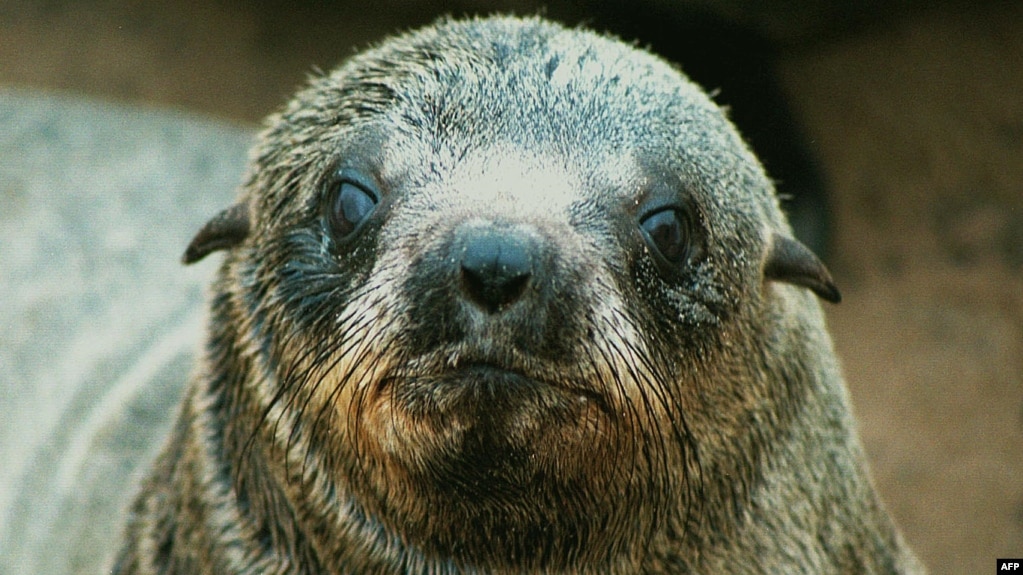
FILE – A Namibian Cape fur seal pup is pictured at a seal reserve 430 kilometers west of Windhoek. Namibia’s Ministry of Fisheries has issued a quota for the harvesting of 80,000 pups and 6,000 bulls in the harvesting season that begins July 1, 2023.
Share
Print
WINDHOEK, NAMIBIA —
This year’s Cape fur seal culling along Namibia’s coastline is set to begin July 1 – a harvest that’s done onshore for population control.
The seal population, according to the country’s Ministry of Fisheries and Marine Resources, stands at 1.6 million and is made up of 26 colonies. The ministry has issued a quota for the harvesting of 80,000 pups and 6,000 bulls this year.
The annual harvest is usually met with controversy because of the methods used in the culling of seals. Pups are clubbed over the head, while the bigger…
On the title photo – action in memory of murdered antifascists in Moscow, 2015.
The antifascist movement emerged in Russia in the late 1990s – early 2000s as a response to neo-Nazis’ violence: back then, the far-right was attacking migrants, homeless people, punks and anyone they didn’t like almost daily.
Over the past couple of decades, the movement has changed significantly, having gone through murders of its participants, numerous criminal cases and now a split due to the war. Radio Svoboda (RS) recountsthe story of Russian antifa. Author: Yana Sakhipova.
“Glory to Russia” – says a man in military uniform and raises a bottle of beer, while the band Klowns performs on stage under the flags of the so-called “DPR” and “LPR”. The musicians came to Donetsk in January of 2023 – as they claim, to do “a good deed” for the people that “have lived in cultural isolation” for the past nine years.
A significant part of the visitors are military men.
Klowns was one of the first and most popular antifascist bands in Russia. Now, only Sergei is left from the original lineup. And he doesn’t count himself as a member of antifa anymore. “I want Russia to be integral, so that Maidan wouldn’t be repeated here” – he says.
In three months and a hundred kilometers from Donetsk, in Bakhmut, the Russian antifascist and anarchist Dmitri Petrov will die while fighting on the Ukrainian side. “As an anarchist, revolutionary and Russian, I felt it necessary to take part in the armed resistance of Ukrainians against Putin’s occupants” – Petrov wrote in a letter he commanded to be published after his death. “I did it for the sake of justice, protection of Ukrainian society and of liberation of my own country – Russia- from oppression. For the sake of all the people, whom a heinous, totalitarian system, formed in Russia and Belarus, deprives of dignity and opportunity to breath freely”. .
Even before February 2022, it would be difficult to call the Russian antifascist movement unitary. The full-scale war in Ukraine though literally scattered antifascists on different sides of the front. But it started very differently.
The 2000s
In 2002, the 13-year-old Inessa Dymnich went to a concert for the first time – the band was “Tarakany!”. At that time, Inessa was not interested in politics – she just liked punk rock. Before one of the following concerts, bottles flew against Inessa and people walking next to her, smashing against a wall above their heads. Back then this was becoming commonplace: concerts were regularly attacked by fascists.
Under the threat of an attack were performances of bands of various genres – from punk and hardcore to reggae and rap. An antifascist movement as such didn’t exist yet and the concerts often didn’t have a political orientation: the far-right simply didn’t like punks and representatives of other subcultures. Attacks were occurring not only in the clubs but also on the way to them.
“While on the bus, heading to the concert, you had to be constantly on the watch for what’s going on, if there are any individuals dressed like the far-right. You could be attacked on your way out of the bus, at any passage.
You were going out with a feeling that you’re waking into a fighting pit. You never knew what could be thrown at you on the way – a bottle, a stone, a fist. A part of people found themselves in antifascism because they were simply fed up constantly getting jumped on at concerts” – recounts Inessa.
People had to walk from the metro in groups, while we were learning about the concerts by word of mouth: public announcements were too dangerous.
This was not saving us from regular attacks and concert goers had to defend themselves by engaging in clashes with the Nazis – that way, gradually, a subcultural antifascist movement started to form.
With time, antifascists started organizing the security of events.
“We used to gather people near the metro station with our security group. Those who had traumatic pistols were surrounding this crowd and were leading them to the club. If someone walked away alone to the bathroom or to a shop, he could be killed” – says Shura, an antifascist who was involved in the security of concerts.
“Back then, when someone was coming to a concert without a gun everyone was looking at him in bewilderment: are you immortal?”
After a while Inessa also got involved in the security of concerts. She started getting interested in the ideological component of antifascism, as well – she found unacceptable the fact that some distinguish people on the basis of their nationality and looks, while the attacks on migrants and homeless were happening almost daily.
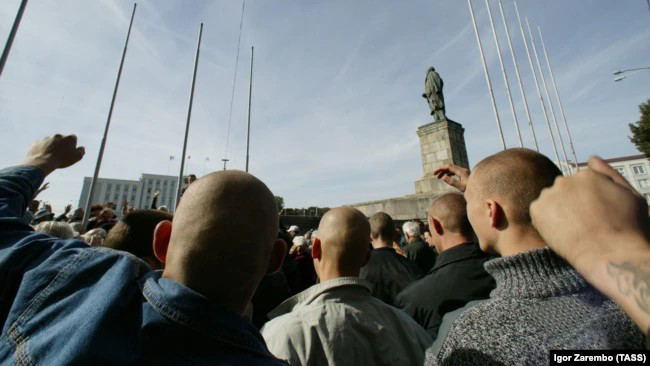
ç (Photo) Neo-Nazis at the rally “in defense of Russians rights”, 2004
The concept of antifascist resistance emerged at the beginning of 20th century in Italy and Germany, that back then were rapidly moving towards fascism and Nazism.
In 1970-1980s, when in the post-war world the far-right started gaining power again, the antifascist movement was also reborn. Similarly, to the far-right, the new antifascist were not only a political movement but also a subculture, closely related to music and style – yet based on certain ideological principles.
In that form the antifascist movement, or antifa, arrived in Russia about 30 years later.
In high school Inessa was writing slogans of the sort “Liberty, equality and fraternity”, “Against sexism and homophobia”, “Animal rights” on the margins of her notebook.





 The Free