Ceasefire Negotiations-rushing out a bunch of ad hoc goose-eggs to score quick media points.
They are literally not listening to any of Russia’s conditions or demands. Russia has stated repeatedly that no land can possibly be given to Ukraine, because it is now enshrined in the Russian constitution. How deluded does Trump have to be to actually even remotely believe that Russia would hand over the largest nuclear power plant in Europe to Ukraine?
The charade also continues to highlight the incredible hypocrisy of the ‘Rules Based Order’. On the very same day that Trump and the West attempted to guilt-trip Russia into an unfavorable ceasefire, Trump himself threatened to forcibly annex a fellow NATO member’s territory—in front of the Reichsmarschall of NATO himself, no less:
TRUMP ON GREENLAND: “Denmark’s very far away & really has nothing to do…What happened? A boat landed there 200 years ago or something and they say they have rights to it. I don’t know if that’s true. I don’t think it is, actually.”
Events again accelerate, as geopolitical inevitabilities come to a head on the stage.
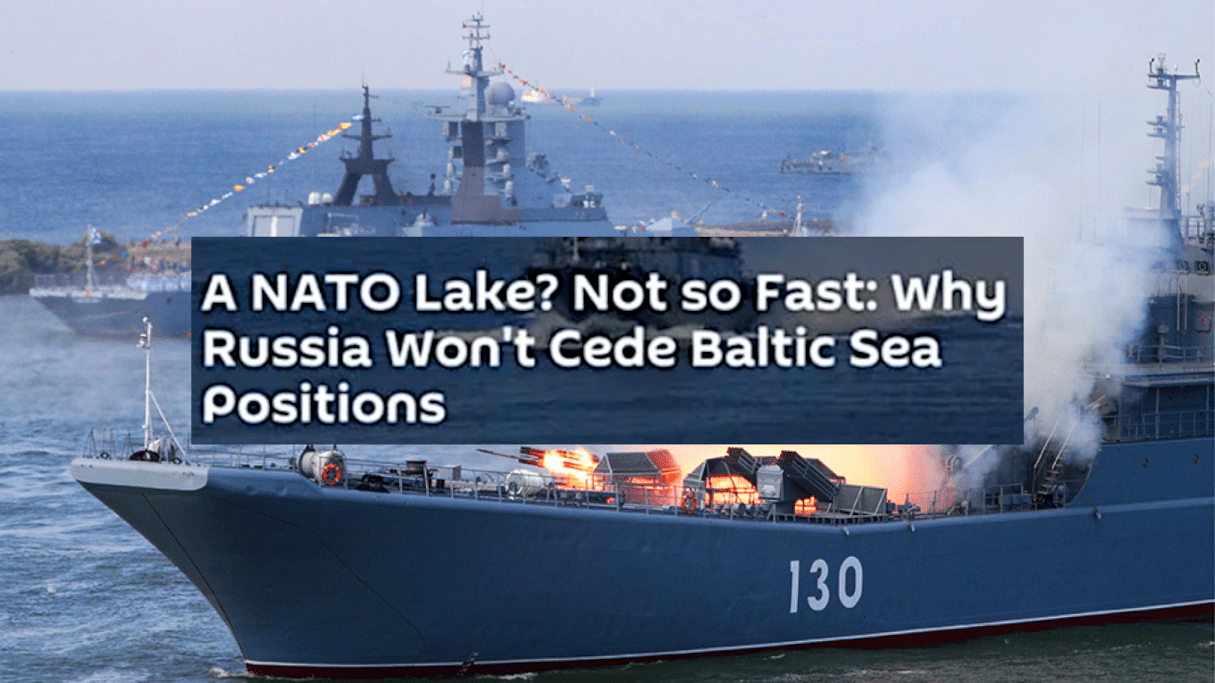
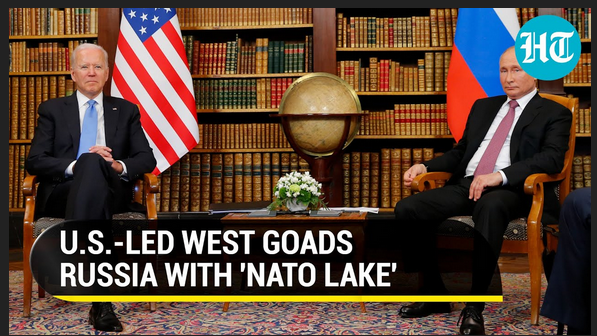
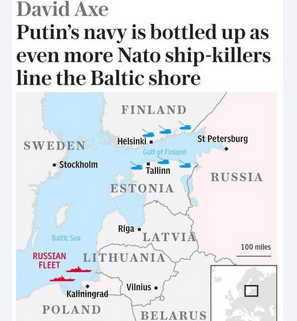
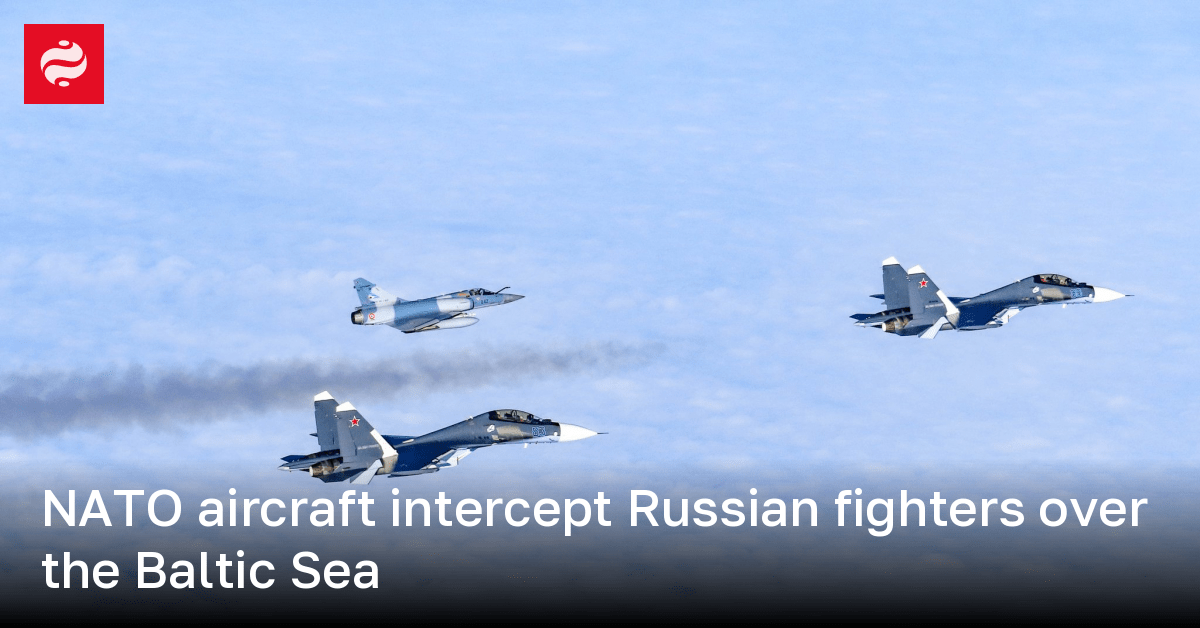
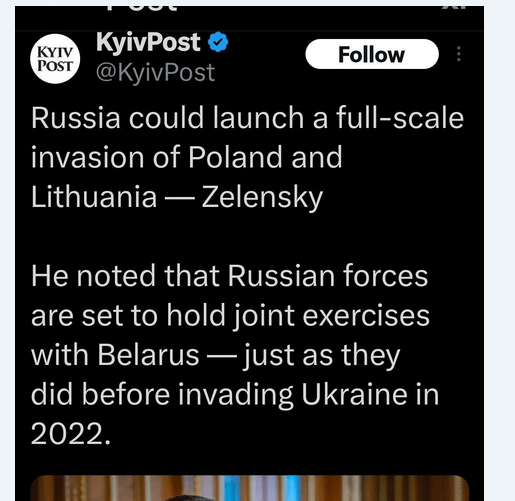
We’ll get to the ostensibly biggest storylines revolving around the crescendoing Ukrainian peace talks, but the biggest story slipping under the surface revolves around the escalating threats from the Baltics and their masters toward Russia as a new vector of provocation from the West.
In light of Ukraine’s proceeding collapse, the Empire badly needs to find a way to ‘self-fulfill’ the prophecy of Russia attacking Europe, in order to sell its own fraudulent historiography of the war, which underpins all the malice carried out against Russia to this point.
Thus lies the need to ramp up provocations to force Russia into making some militarily aggressive action or attack on another neighboring country, to sell the whole narrative. This would serve two purposes: if the war in Ukraine ends, the West needs some way to keep Russia busy and pressured to slow its development, particularly now that its economy is rapidly distancing itself from decaying Europe.
But the second purpose lies in—even if the Ukraine war goes on—forcing Russia to respond aggressively to a neighboring country to galvanize European, and even global, solidarity, allowing the fulfillment of all the military rearmament dreams NATO’s magpies have been twittering about.
Now that Ukraine teeters on the edge, the plan is ramping up. Several major concerted ‘events’ occurred this week, by no coincidence of their own:
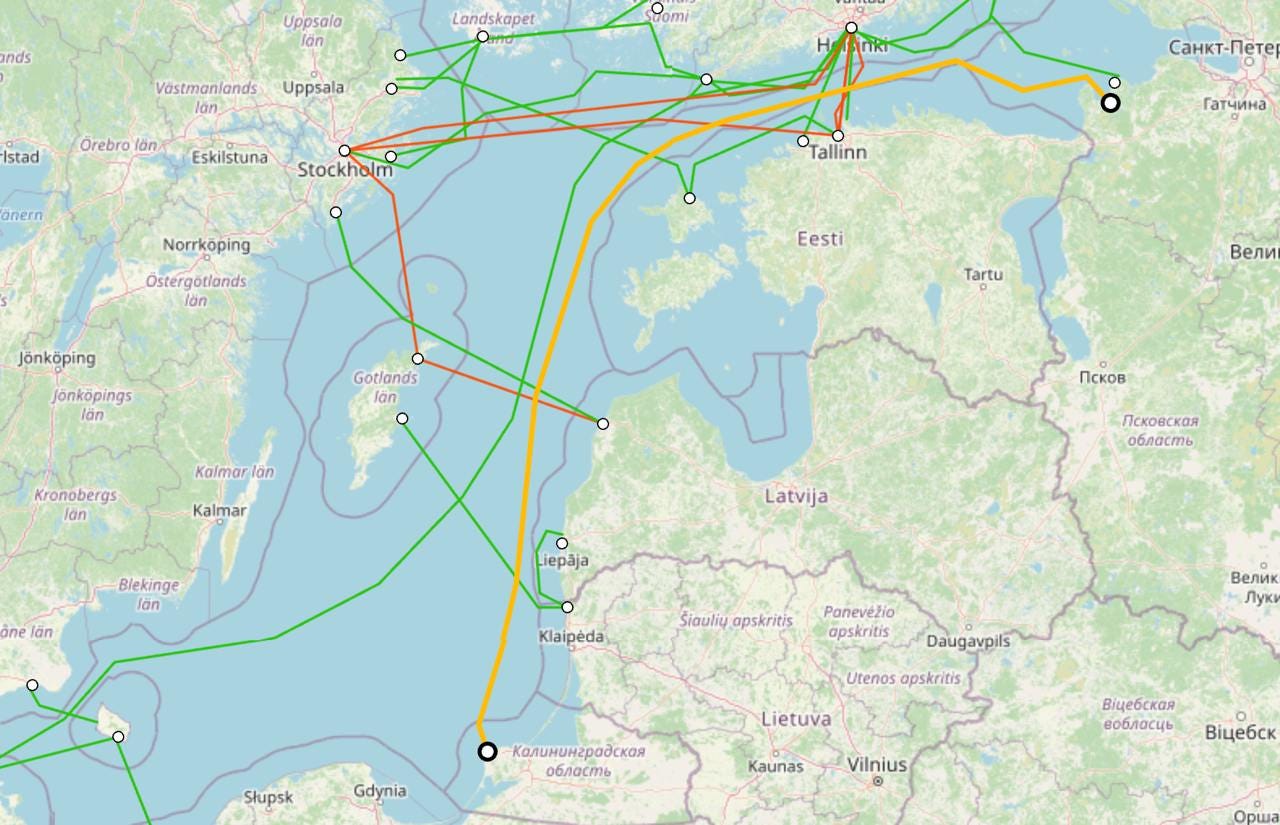
Firstly, Russian Rostelecom’s underwater Baltika cable in the Gulf of Finland was “damaged”, i.e. severed, clearly not by ‘accidental action’:
In the Gulf of Finland, the Rostelecom cable connecting Kingisepp with Kaliningrad was damaged again. What other incidents with underwater communication infrastructure occurred in the Baltic Sea-in the RBC
On February 8, Rostelecom reported damage to its underwater telecommunications cable Baltika. It connects the Leningrad Region with Kaliningrad and partly passes through the economic zones of Finland and Sweden. The previous accident on the Baltika occurred on October 7, 2023.
The length of the underwater cable, which was apparently damaged, is 1,115 km. It connects Kaliningrad and Kingisepp in the Leningrad region.
The severing of this cable potentially cuts Kaliningrad’s communications from the Russian mainland.
Zerohedge details the pile-up of Baltic sea cable incidents of late:
Around the same time a Russian oil tanker suffered an ‘explosion’ in its port of Ust-Luga, which sits on the Gulf of Finland mere miles from the Estonian border:
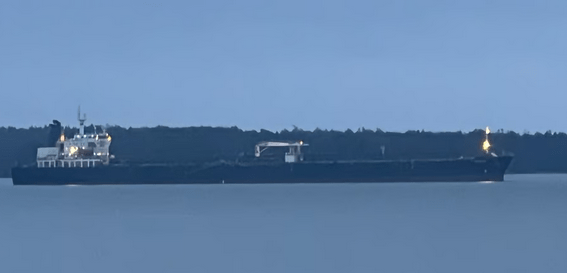
Enemy saboteurs probably worked in Ust-Luga. The recent explosion in the engine room of the Koala tanker (164,500 tons), according to sources of Ambrey Analytics (a company in the field of marine risk management), was associated with the installation of underwater mines on the outer part of the hull. Three explosions resulted in three holes: one 100 cm by 80 cm, and two large 4 by 2 meters.
Yesterday, the Russian Foreign Intelligence Service warned about upcoming terrorist attacks and incidents that Ukrainian intelligence plans to carry out in order to ban Russian cargo and ships from passing through the Baltic Sea. We are seeing the first such incident.
And as the above alludes to, Russian SVR suddenly announced that Ukraine is in the process of finalizing major provocations in the Baltic Sea area. The plan specifically includes blowing up a foreign ship to blame Russia, presumably as a putative Russian “response” to the Russian assets now being targeted in the region:
The SVR says that the special services of Ukraine, with the support of the West, are planning a series of high-profile anti-Russian provocations. The main task is to close Russia’s access to the Baltic Sea under the pretext of Moscow’s aggressive actions. The first terrorist attack may be the detonation of Russian/Soviet-made mines on a foreign ship in the Baltic waters. They are looking for people from Asia and the Middle East to carry out the terrorist attack, the salary is 20 thousand dollars, there are no contract details. The attacks will begin as soon as possible in order to weaken the Kremlin’s negotiating position as soon as possible.
Lo and behold, on the heels of the above, major press outlets like Politico announce a renewed initiative to target and “seize” Russia’s shadow fleet:
EU Pirates of the 21st Century: Baltic States Seek New Opportunities to Capture Russia’s Shadow Fleet — Politico
▪️Finland, Estonia, Lithuania and Latvia are looking for loopholes in international law to seize Russian ships.
▪️The European Union is holding “behind-the-scenes talks” on a large-scale seizure of Russian oil export tankers, Politico writes.
▪️European countries bordering the Baltic Sea are developing new legislation to make it possible to seize ships on “environmental or piracy grounds.”
▪️The new proposals come amid widespread frustration that Western sanctions against Russia are not working, as Moscow continues to ship its oil and evade sanctions.
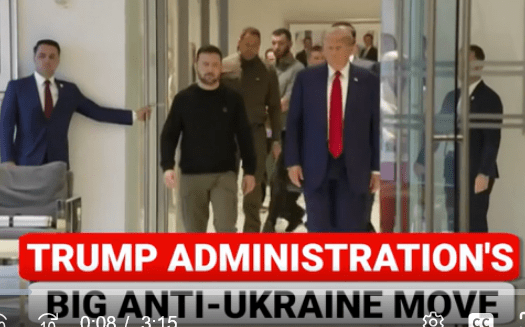
Game Over For Ukraine War? Trump Stops All U.S. Aid To Kyiv Amid War With Russia After publicly threatening Russia Trump has tacitly included Ukraine in the 90 day suspension of foreign aid.
The administration of President Donald Trump has reportedly frozen assistance grants as part of a broader foreign policy audit
Without US Finance the Ukraine war against Russia has zero future, despite the last minute Billions gifted by Biden. Suspending Aid gives Biden the obvious leverage to force the Ukraine Regimen to make a deal and allow Russia to keep the 4 ethnic Russian oblasts in Donetsk.
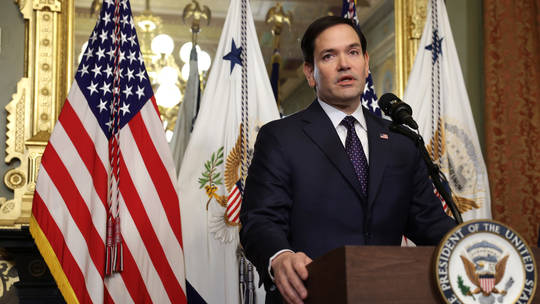
Newly confirmed US Secretary of State Marco Rubio, Washington, DC, January 21, 2025.
US Secretary of State Marco Rubio has frozen nearly all new aid grants to Ukraine for 90 days, Politico reported on Friday. The move comes after President Donald Trump ordered a full review of all foreign assistance.
Rubio instructed diplomatic and consular posts to issue “stop-work orders” on nearly all “existing foreign assistance awards,” Politico said, citing an internal document.
According to Politico, the order “shocked” State Department officials and appears to apply to funding for military assistance to Ukraine.
15 years ago, antifascist lawyer Stanislav Markelov and journalist Anastasia Baburova was murdered in Moscow. Their legacy tells us why anti-fascism remains vitally important in Russia today.
On January 20, we remember the Antifascists Stanislav Markelov and Anastasia Baburova, murdered in 2009 by Russian neo-Nazis in the center of Moscow. Today, St. Petersburg, Krasnoyarsk, Riga and Izhevsk, among many others, have woken up with improvised altars in their memory. To remember is to fight! No forgetting, no forgiveness!
19 de January del 2025 De parte de Sare Antifaxista 10 puntos de vista Los 19 de enero se recuerda a lxs Antifascistas Stanislav Markélov y Anastasia Babúrova asesinados en 2009 por neonazis rusos en el centro de Moscú. Hoy San Petersburgo, Krasnoyarsk, Riga o Ízhevsk entre otros muchos, han amanecido con improvisados altares en su memoria.¡ Recordar es luchar ! ¡ Ni olvido ni perdón !
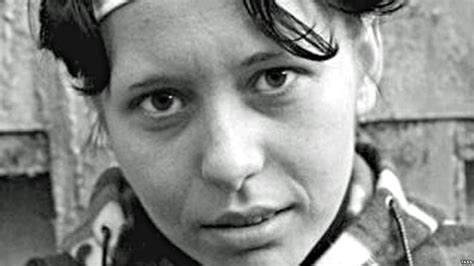
Anastasia Baburova
Baburova was active in the anarchist in environmentalist movement until her murder by nazis . She participated in the activities of ecological camps, in social fora, including the Fifth European Social Forum in Malmö 2008, organised the ‘Anti-capitalism 2008’ festival, demonstrated widely, and was involved in anti-fascist activities more generally.
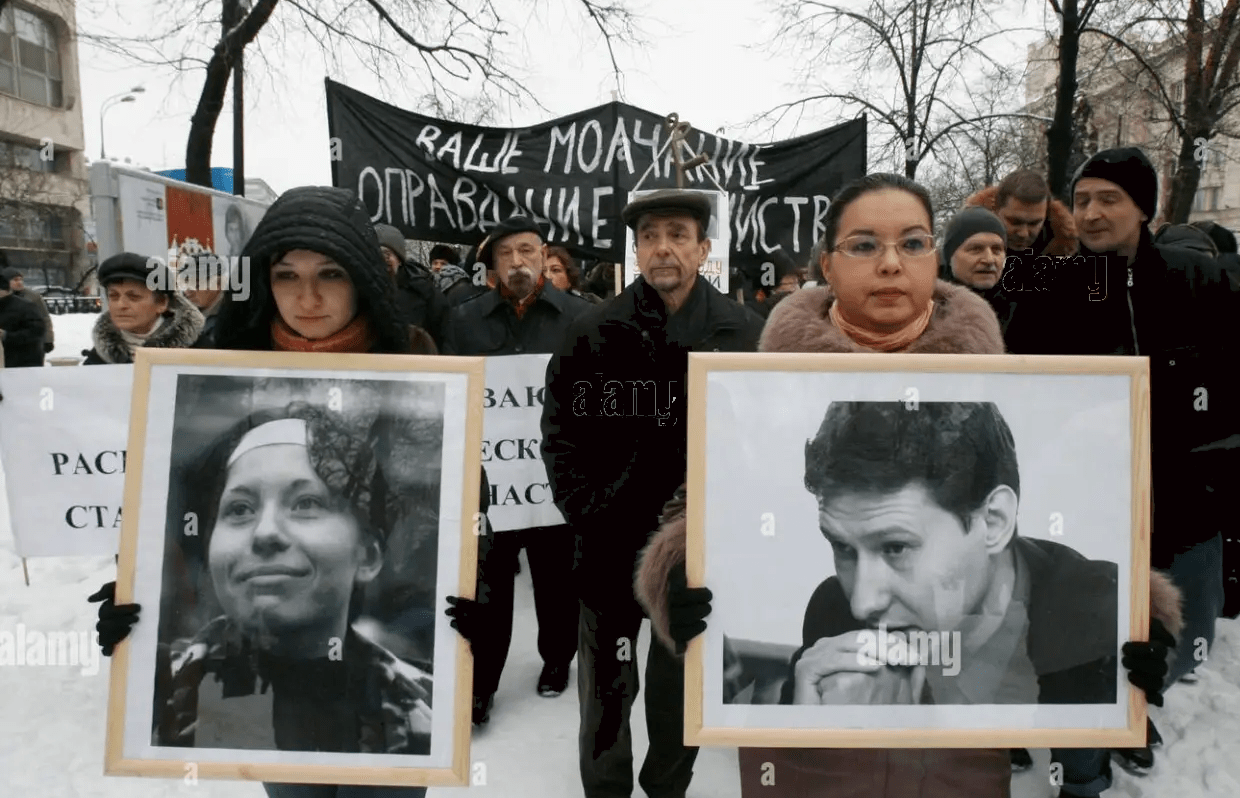
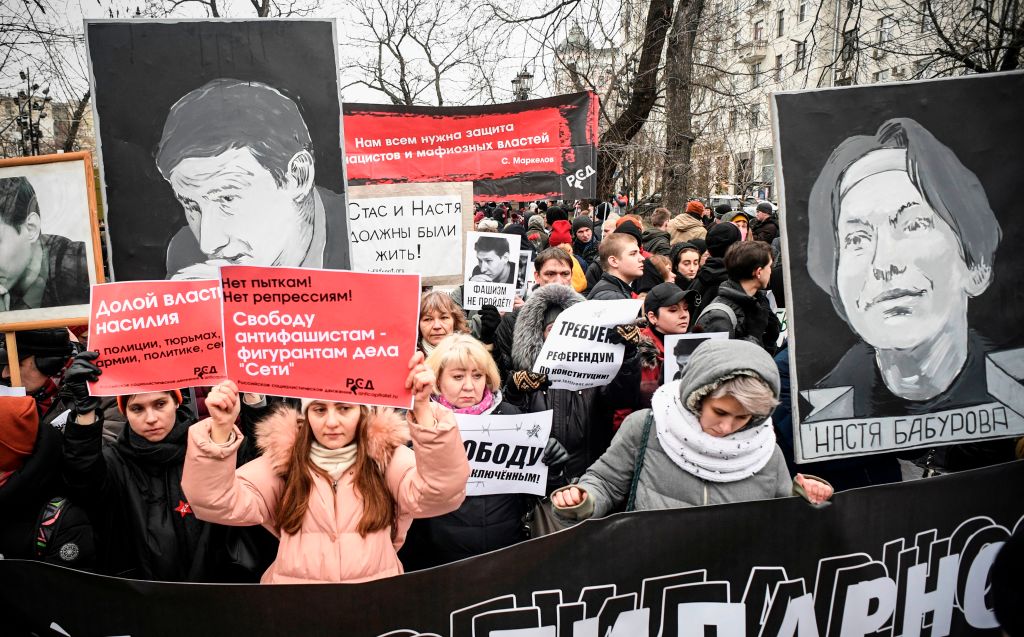
Russian opposition protestors march in central Moscow on January 19, 2020, carrying portraits of lawyer Stanislav Markelov and journalist Anastasia Baburova. – More than a thousand opposition activists of various stripes marched in central Moscow after President Vladimir Putin proposed re-drafting the constitution and unleashed a political upheaval. Protesters — mostly young anti-fascist activists — chanted “Revolution” and “No to dictatorship” and some carried copies of the constitution. The annual march was called to commemorate the memory of lawyer Stanislav Markelov and journalist Anastasia Baburova were gunned down in Moscow in 2009 by ultranationalists. (Photo by Alexander NEMENOV / AFP) (Photo by ALEXANDER NEMENOV/AFP via Getty Images)
In 2003, she married a fellow journalism student, Alexander Frolov, whom she met in 2000 during her studies in Sevastopol, they divorced in 2007.
In July 2008, Baburova participated in a demonstration against the felling of the Khimki Forest. Besides Russian and Ukrainian, which she considered her native languages, she also spoke English and French.[12]
The day before her murder, Anastasia appeared at the anarcho-communist unity event ‘Autonomous Action’.
Throughout 2008, Anastasia Baburova worked on the editorial team of the Russian newspaper, Izvestia, and had had dozens of articles published by both Izvestia and Financial News, particularly on finance.
Beginning in October 2008, she investigated (as a freelance-journalist) Russian neo-Nazi groups for Novaya Gazeta.[16][17] In December 2008, she resigned from this post over the political course of the newspaper.
At first it was reported that Baburova had been wounded in an attempt to detain Markelov’s killer, but later Russian law enforcement authorities declared that Baburova was shot in the back of the head. Baburova died a few hours after the attack at a Moscow hospital.[18
The Living Front of Stanislav Markelov
Ten years ago, activist lawyer Stanislav Markelov was murdered in Moscow. His legacy tells us why anti-fascism remains vitally important in Russia today.
On 19 January 2009, Stanislav Markelov and Anastasia Baburova were murdered. Every year since, Russian anti-fascists hold a march in their memory. Source: anatrrra / Livejournal.
Ten years ago, Stanislav Markelov was murdered in Moscow. He defended anti-fascists and ecologists, mothers trying to defend their sons serving in the army and citizens of Blagoveshchensk brutalised at the hands of the riot police, the relatives of Elza Kungayeva (murdered by a Russian soldier in Chechnya) and journalist Mikhail Beketov, who was brutally assaulted for covering the construction of a new highway near Moscow.
That day in January, the Neo-Nazis also killed his companion Anastasia Baburova, a like-minded journalist. The killers were eventually sentenced to long prison terms. Some of their friends and sympathisers are now working for government bodies or pro-regime mass media, whereas others have fought and still fight on both sides of the conflict in Ukraine. As a figure, Markelov feels so necessary in Russia today, yet so hard to imagine.
Starting in the hippie subculture of the perestroika era, Markelov went on to join the Student Defence trade union and Defenders of the Rainbow eco-movement. Later, he was a legal representative in some of the country’s most dangerous and high-profile cases — and a proponent of Russia’s new anti-fascism.
In the 1990s, Markelov was among those who appealed to the non-Bolshevik traditions of the Left, caught between aggressive free marketeers and Soviet revanchists. During the Constitutional Crisis in October 1993, he joined the Voloshin Medical Brigade, who helped everyone in need of medical assistance, no matter what side they took amidst the bloody conflict.
Looking back, this healing of wounds and applying of stitches on the streets of Moscow in 1993 feels like an attempt to symbolically unite two parts of a broken society. On the one hand, the enthusiasts of 1991, the people who, in 1993, still believed in the imminent triumph of liberal democracy. On the other, the people who believed that the near future would bring nothing good, but had no counter-agenda except a fanatical anti-liberalism and their memories of the USSR.
This rupture is yet to close, and Markelov — who mixed liberal human rights work with left-wing values — was the living embodiment of the attempt to overcome it. This combination is something very unusual in Russia. Ever since Soviet times, the majority of Russian liberals who have believed in human rights have shown skepticism towards any discussion of social justice and equality.
Leftists, on the contrary, often interpret the rhetoric of human rights as a cover for the economic aggression of neoliberalism. However, the fact remains that liberals in Russia cannot survive without a serious shift to the left (a truth that Alexey Navalny has understood all too well), while leftists, who easily turn to liberal human rights organisation for free assistance, and then brand them as enemies of the working class, look simply ridiculous in this instance.
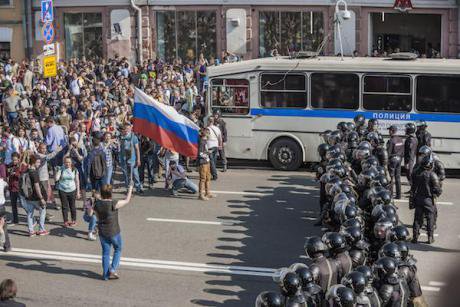
Riot police surround people during a demonstration against Vladimir Putin in Moscow, on 5 May 2018. Photo: NurPhoto / SIPA USA / PA Images. All rights reserved.
Laughing bitterly at this absurd situation, the unique nature of Markelov’s experience is clear. Markelov came to work as a lawyer through his political activism, and then, for the sake of defending the most vulnerable and powerless people in society, disdained both a steady professional career and every stereotype on why the personal, political and professional should not be mixed in legal work.
‘Stealing sovereign reserves by the West in response to political disputes, as in Russia, Libya, Venezuela.. is eroding faith in US dollar hegemony and US ability to indulge in infinite borrowing‘.
EU mulls mobilizing Belgian king’s 81 year old Decree to continue thousands more illegal anti Russia sanctions – FT
The renewal of the restrictions, set to expire at the end of January, has been in limbo due to Hungary’s veto threats
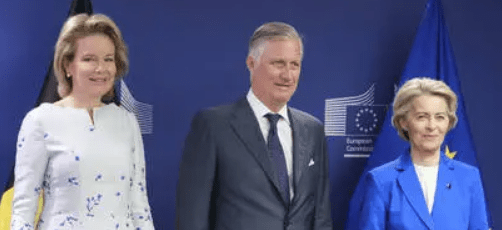
Queen Mathilde d’Udekem d’Acoz ), and King Philippe of Belgium by the President of the EU , Ursula von der Leyen
EU officials are desperately developing backup plans to secure sanctions against Russia, including potentially invoking an 81-year-old law that involves the Belgian king, after Hungary threatened to veto their renewal, the Financial Times reported on Friday.
The bloc is seeking to hold on to the $213,000,000,000 of Russia’s frozen foreign assets seized in the Brussels-based clearinghouse Euroclear and continue diverting billions in interest payments to the Ukraine regime
Hungarian Prime Minister Viktor Orban warned the EU in December that his government could veto the sanctions, which require unanimous approval to be extended.
Ukraine would never have dreamed of going to war against mighty Russia over giving autonomy to a few ethnic Russian oblasts on the border, were it not for long established control and massive cash support from the USA.
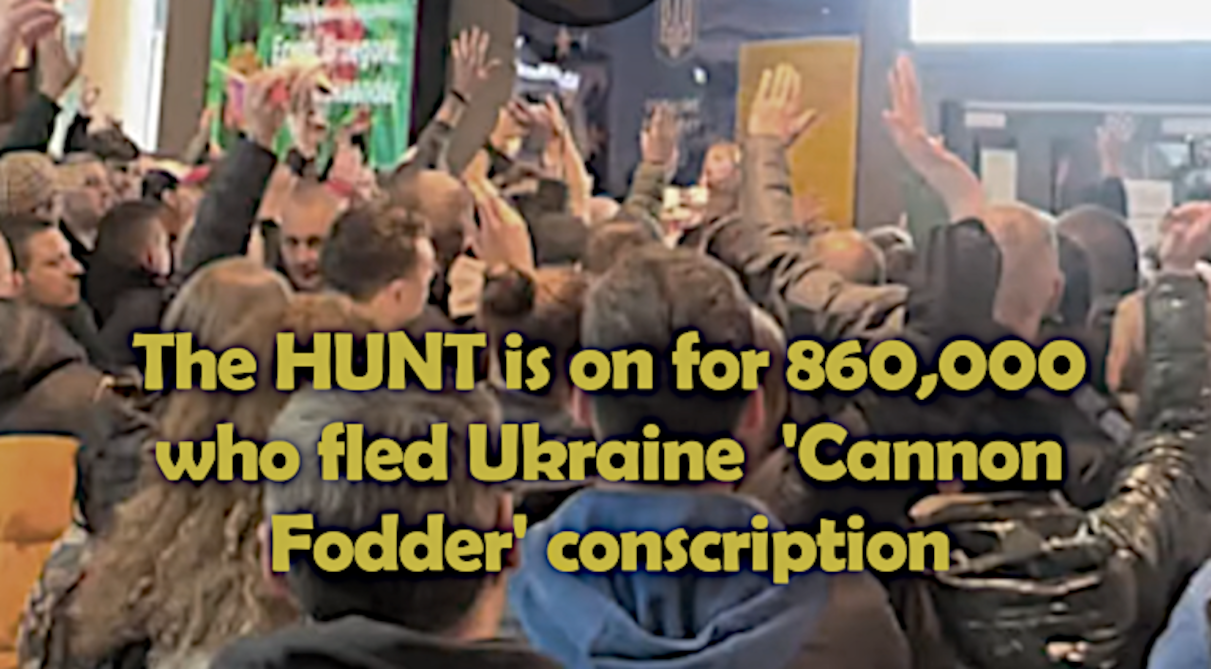
Conscription officers kidnap with snatch squads to send more cannon fodder to the front line, according to multiple videos
Even with gifted arms, training and logistics from the US and 32 NATO States they could finally never have enough soldiers to win.
Barring mutual suicide in a western triggered Nuclear Armageddon Ukraine was always bound to lose. By now a third have fled the country, the economy is dead, only surviving on Western donations to the corrupt and nazi infested State apparatus.
It’s now impossible to fill conscription quotas, and sending untrained old men straight to the front lines is nothing but a death sentence. Those who cannot flee have to live in hiding and are ruthlessly hunted down by conscription police thugs.
Ukrainian authorities are pushing their mobilization campaign to the limit, with many encounters between target recruits and conscription officers descending into violence, according to videos shared on social media over the past week
A video from the scene shows a Ukrainian service member cocking his gun to disperse the crowd. According to media reports, and judging by the clip, the man was able to walk away from the conscription officers.
According to a clip published by several media outlets on Tuesday, one of the most brutal incidents occurred in Lviv, in western Ukraine. Three conscription officers in uniform can be seen trying to force a middle-aged man into a minibus as he fiercely resists.
One soldier is seen kicking the man multiple times in the knee. After a severe beating, the draftee ends up in the vehicle, and his further fate is unknown.
Responding to a public outcry, the local recruitment office claimed the man was eligible for mobilization but did not have any ID documents. The military said it tried to take the would-be conscript to the local recruitment office, but he refused and lashed out at the officers, leading to a clash. The office also said those involved in the encounter have been suspended.
Another clip released on Sunday shows the moment Ukrainian recruiters attempted to arrest a man in Kamenets-Podolsky, in western Ukraine, reportedly breaking his arm in the process.
anarcomuk.uk/2025/The following interview was carried out by comrades from the Československé anarchistické sdružení – CAS a Czech Internationalist Anarchist Group.
1)Please introduce yourself briefly to the readers of our magazine. Are you from Ukraine, where you were born and spent your youth? Hi. My name is Vadym Yakovlev, I’m Ukrainian queer writer and journalist and […]
The following interview was carried out by comrades from the Československé anarchistické sdružení – CAS a Czech Internationalist Anarchist Group.
1)Please introduce yourself briefly to the readers of our magazine. Are you from Ukraine, where you were born and spent your youth?
I was born in Odesa, the largest southern multicultural city in Ukraine, a few months before the collapse of the USSR.
My mother is Ukrainian and my father is Russian.
Their fathers were military. My father worked in a factory. With the collapse of the USSR, the factory was closed, and my father lost his job. It affected my family and my childhood.
At home my relatives spoke Russian and Ukrainian, so I never focused on issues such as national identity. My family was an unhappy international family that lost a lot with the collapse of state communism in Ukraine.
I guess all of that influenced me a lot in my search of my true political views and my desire to do something that can have influence on society.
2)You left Ukraine, what led you to this decision?
On the one hand, I could no longer work in Ukraine because of my political beliefs.
The Ukrainian intelligentsia, journalists and artists as a community with the beginning of the war decided to become privileged elite propagandists in the service of the state.
I didn’t want to be a propagandist, so I lost the opportunity to publish my articles. And if you publicly express in Ukraine the views I have, authorities can put you in the jail.






 The Free