
 Recently I discovered that a CO2 -free fuel for internal combustion engines already exists and would be cheaper and less dangerous than petroleum products.
 -
your page (Promote CO2 free fuel) http://www.facebook.com/pages/Promote-CO2free-fuel-NH3-exists-NOW/195655647150736?sk=wall
-
i have visited your page, also followed the links that i could find, now need to research the claims before i can like or share, as i could not find a simple to understand explanation of
 how this technology works… as time is of the essence, doubling up my time when such a simple explanation probably already exists to enable understanding by everyday people (who do not hold chemical/mechanical engineering degrees) would see your page, and this technology, greater general public awareness.
Warm regards
Anne - REPLY….. TheFree Mikegilli
-
thanks ANNE FOR YOUR SUGGESTION.. I didn’t realize this was an issue and will try to find such an explanation. however I fear that no matter how it is explained, nobody will listen to me, when lots of credible scientists have been ignored for so many years. One angle I thought of was appealing to people suffering respiratory illnesses linked to pollution from oil based motors.
All I can do here is reprint the Wikipedia article.
Ammonia was used during World War II to power buses in Belgium, and in engine and solar energy applications prior to 1900. Liquid ammonia was used as the fuel of the rocket airplane, the X-15. Although not as powerful as other fuels, it left no soot in the reusable rocket engine and its density approximately matches the density of the oxidizer, liquid oxygen, which simplified the aircraft’s design.
Ammonia has been proposed as a practical alternative to fossil fuel for internal combustion engines.[39] The calorific value of ammonia is 22.5 MJ/kg (9690 BTU/lb) which is about half that of diesel. In a normal engine, in which the water vapour is not condensed, the calorific value of ammonia will be about 21% less than this figure. It can be used in existing engines with only minor modifications to carburettors/injectors.
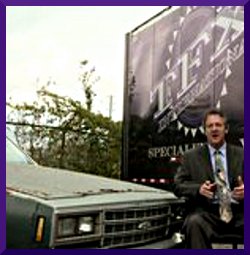
To meet these demands, significant capital would be required to increase present production levels. Although the second most produced chemical, the scale of ammonia production is a small fraction of world petroleum usage. It could be manufactured from renewable energy sources, as well as coal or nuclear power. It is however significantly less efficient than batteries.[citation needed] The 60 MW Rjukan dam in Telemark, Norway produced ammonia via electrolysis of water for many years from 1913 producing fertilizer for much of Europe. If produced from coal, the CO2 can be readily sequestered [39][40] (the combustion products are nitrogen and water). In 1981 a Canadian company converted a 1981 Chevrolet Impala to operate using ammonia as fuel.[41][42]
Ammonia engines or ammonia motors, using ammonia as a working fluid, have been proposed and occasionally used.[43] The principle is similar to that used in a fireless locomotive, but with ammonia as the working fluid, instead of steam or compressed air. Ammonia engines were used experimentally in the 19th century by Goldsworthy Gurney in the UK and in streetcars in New Orleans in the USA.
safety
NH3 Fuel risk analysis report carried out by Quest Consultant see Here http://www.iowaenergycenter.org/wp-content/uploads/2012/03/NH3_RiskAnalysis_final.pdf

 The Free
Reblogged this on Demand CO2-free gasoline..it exists now (NH3)..
LikeLike