
en castellano más abajo
Series of big anti-nazi demos against fascist squatters… Anti- fascists seize ‘white Spanish only’ food stall and distribute to all.. Fascist squatters may have owners permission… Squatters movement disowns fascist squat… Police turn blind eye to nazi ”okupas” in Tetuan barrio…. Fascist thugs from MSR squat injure local youths.. Media equates nazi’ Social Home’ with long existing popular and anti racist Squat center ‘La Enrededera’ to demand its eviction.
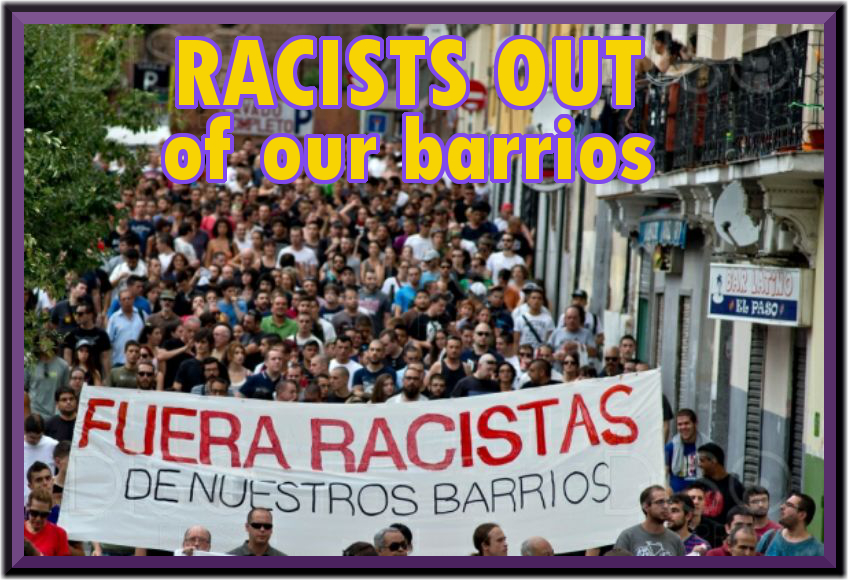
They are not squatters: they are Nazis
alternative Housing Office Madrid
On 18 August, the neo-Nazi group Social Republican Movement (MSR) announced on social media their entry into an abandoned building in Madrid’s Tetuan barrio and fheir intention to turn it into a social center for ‘those in need’ provided they were white and of Spanish nationality. .
Opening a such center in the district with the largest migrant population of Madrid and the opposition it generated among neighbors attracted media attention, especially after the massive demonstration against held the same day as opening of the center, on August 30.
Since then, it has been common to see the press referred to the center as a “squatted building” and members of the neo-Nazi group as “squatters” in an error which is then repeated in social networks. The center is equated with the squatting movement, which has always had among its main objectives the recovery of abandoned homes to become social centers and buildings.
This assimilation was false, but the reality mattered little. Saying the MSR is part of the squatter movement pursued a very specific goal: to reduce the problem to a confrontation between gangs. A center that promotes discrimination and racial hatred was reduced to a fight between “ultras of different directions,” in the headline on a story from ABC in September . It mattered little that the center of the MSR had nothing to do with the squatting movement or their ideas, or their goals, or how they work: the important thing was to convey the idea that all squatters are violent and cause problems . However, they overlooked the most important thing: they are not squatters.
We wont prop up your ruins: the squatting movement
The squatting movement as we know it today emerged in the Spanish State in the late eighties. That’s when the first self-managed social centers, recovering abandoned buildings to give them a collective use appeared. Abandoned factories, empty warehouses and disused public buildings began to be used as places where neighborhood residents and members of different groups come together to do all kinds of activities from watching a movie to participating in a workshop. Buildings destined to become a heap of ruins become places of the neighborhood and for the neighborhood. Instead of the rubble, life.
But squatting is not only a response to a specific need. Self-managed social centers, not only aim to combat the abandonment of neighborhoods by the institutions. At an abandoned building the squat is questioning a model city in which it is only speculation or debris, but not only that. Through the restoration of buildings, squatting also questions two pillars of capitalism: private property and the laws that protect it. From childhood we are taught to value private property and considere it a basic right from work: the more you work, the more properties can have.
However, we soon realize that this relationship is fictional, that the days of eight or ten hours a day just let us make ends meet and that after forty years of work, the only property we have is a floor sixty square meters in the suburbs, that’s if we were lucky and we managed to finish paying the mortgage. And if that relationship is fictional, we can also think that raising the basic right to private property is equally false. Indeed, it almost seems more propaganda of those who do have properties, not only those who have a mortgage-that is to say, a debt-or sometimes not even that. Maintaining a closed property excluding others from use when the owner is not using it or needing it is not legitimate or respectable.
Allowing abandoned buildings to fall apart while neighborhoods need property is cruel and unjust. The squat recognizes and respects the possession (this is mine because I use it), but not the property (this is mine to smash, hoard it or turn it into a pile of rubble). Thus, the question of property relations, the squatting movement also challenges the dominant relations that allow one to have many properties and others not to have anything, you have homeless people and houses without people. When fighting against domination, we struggle for a more equal and just society.

Racism and exclusion: the MSR
However, none of this is found in the center of the MSR. The neo-Nazi members not only do not want to end the domination relationsbased on property and money, but also promote another based on race. Not just believing that people should be excluded based on their social class, but also according to their skin color. Using the strategy of the occupation of a building is not based on an attempt to end domination, but on making it stronger. For a neo-Nazi group like the MSR, the occupation is just a way to sell a racist ideology, masking what is really just hatred and exclusion. Copying the appearance of a self-managed social center but endowing it with completely opposite content: where there should be no exclusion and equality and solidarity where there should be no hierarchy, where there should be mutual support welfare, freedom and where there should be no domination.
To the extent that it excludes many of its neighbors, a center of neo-Nazi ideology can never be something in the neighborhood and for the neighborhood. It can only be a place of dissemination of racist ideas in which, hopefully, if you’re lucky they may some day distribute snacks to those they consider worthy of it. When not so lucky its members will be beating up neighbors who are object of their hatred, as indeed has already happened in Tetuan. In addition, a center like this not only does not question the existing city model, it helps strengthen it. Allowing a source of conflict in a neighborhood is a strategy in order to deteriorate gentrification.
When this deterioration is consolidated for example because there are frequent beatings of the migrant-population, residents leave the neighborhood. Thus, speculators can acquire their homes at a very low price, tear them down and build more expensive homes. In a neighborhood like Tetuan, located five minutes walk from the most expensive area of Madrid, the center of the MSR is a perfect opportunity to disrupt a neighborhood that until now has not had problems of coexistence. This does not mean that the city or speculators have necessarily given the keys to the MSR neo-Nazis, but they do fulfill a role that they find useful.
This complicity with the interests of domination, coupled with the spread of neo-Nazi ideology and practice of racism and exclusion mean the center of the MSR must be considered something completely opposite to self-managed social centers belonging to the squatting movement. Discriminatory and xenophobic ideas that they promote have no place in Tetuan or any other district of Madrid. The neighbors have already demonstrated their opposition to the opening of this center and will not stop opposing it until it closes permanently.
MSR members have occupied a building, but are not squatters: they are Nazis.
Out of our neighborhoods racists!
**************

Press Release from Occupied Social Center ”The Climbing Plant”(La
Enredadera CSOA, Tetuan barrio,Madrid).
note: this is a very rough translation, original below, which gives an inside view of the revolutionary occupy movement in Spain
The Enrededera (‘Climbing Plant’) is a project born in early 2009 in Tetouan, one of the most culturally diverse districts of the city of Madrid. The people started this from the squatting movement and other neighborhood-based experiences. On that day, like today, taking an abandoned living space and filling it with all kinds of activities is something beautiful and hopeful; a sample of the work and collective joy in solidarity that can rebuild a ruined building for the use and enjoyment of residents and neighbors. Since its inception, The Enre is open to the whole neighborhood, whatever their origin. We are aware of the cultural wealth that exists in Tetuan, and also how often prejudice and the frenetic pace of life we are forced to take virtually segregated routines, as if we did not live so close, as if we really were not so neighbors .
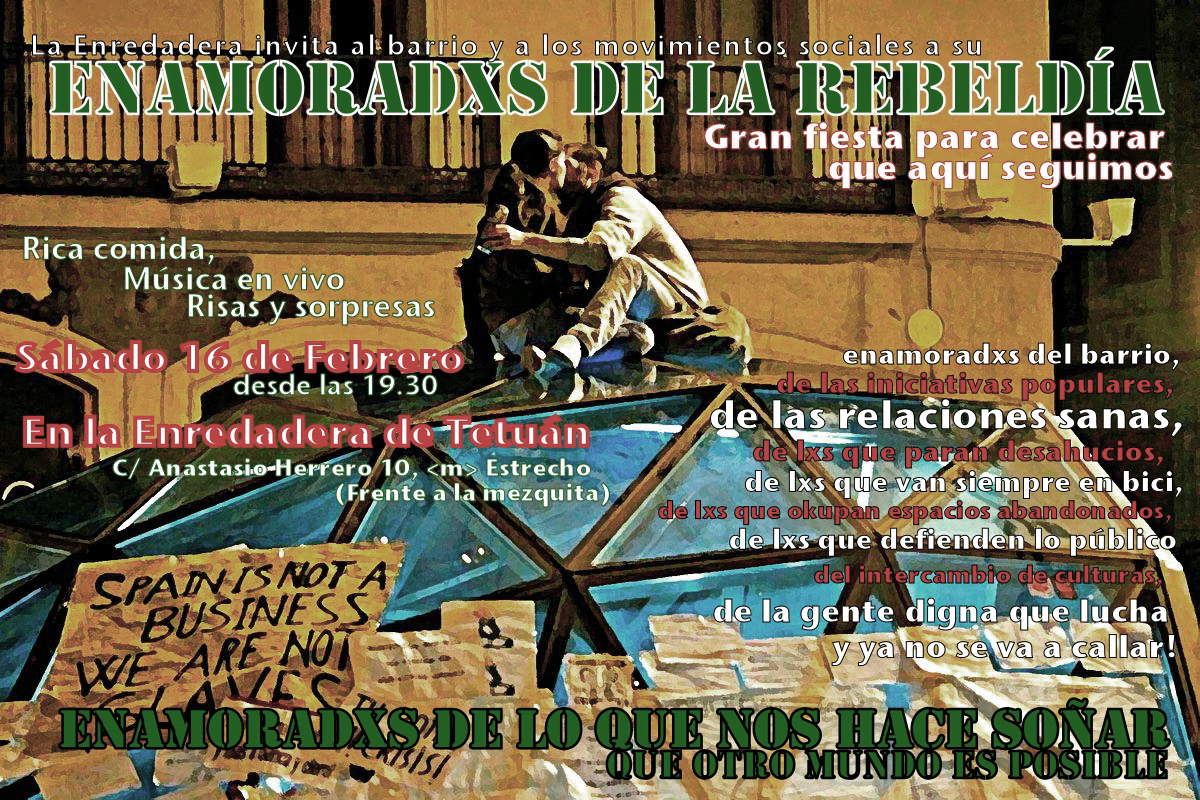
The Enredadera has always endeavored to be a social center for the neighborhood meeting, because we appreciate the value of community ties, cooperation between neighbors; as a network of people who, while remaining anonymous to each other, support each other and become invincible against boredom versus pessimism, facing the crisis. With this philosophy, the Enre has been made, over the past five years, many activities, workshops, lectures and meetings. Today, there Enre in a teahouse, a library, workshops kenpo, yoga and self-repair of bicycles; a photography school a fanzine, rehearsal space, a music school, a group of English conversation, a workshop building with pallets, etc.
It is also the place where many neighborhood groups meet, like the group stopdesahucios (stop evictions) 15M Tetuan, the Food Bank of 15M Tetuan, Tetuan Invisibles, the Reflection Group, the Assembly of 15M of Tetuan (in cold weather and rain ) and so on. In all these activities, it is continuous participation of people from different backgrounds and cultures; because it would be impossible to consider a neighborhood without the richness and diversity that brings

In this context, after five years of exciting community service with an impeccable relationship with our neighbors and very supportive of them, knew for weeks the news that a far-right group, linked to the Social Republican (MSR) Movement had installed at nearby Olias street, with the intention of creating a space “only Spanish“, under the name Home Social Ramiro Ledesma (Hogar Social). For us who work daily in a mestizo and supportive neighborhood, this is very bad news, because we know for a fact that, despite its calculated speech, this group performs xenophobic and discriminatory practices, besides acting recognized as appealing to neo-Nazis, racist and violent, who take refuge in acronyms and social projects for camouflage. The fact that they have illegally occupied the building seems not so relevant, but their presence in the neighborhood, which endangers the safety of many residents of other nationalities. This concern would be the same if it were rented or owned.
Like us, many groups, neighborhood associations and individuals share the concern to have as close to an organization that openly promotes rejection and hatred of immigrants. However, in recent weeks we have been presented in the media as if it were a battle between two social centers of opposite ideology, and we want to emphasize that this is absolutely false.
There is a conflict between two buildings, but a neighborhood that rejects the arrival of this ”Social Home” for a backwards step in building a healthy cultural coexistence to Tetuan. While our philosophy in the Enre rejects Home Social Ramiro Ledesma, the idea of a war between two social centers – in the neighborhood we would be in the middle of the dispute – is completely wrong. Anyone living in Tetouan knows the neighbors do not condone discrimination by origin, only Spanish, as a positive practice for a diverse neighborhood, in the XXI century.
 Urgent support also needed for La Traba squatted A center in Madrid now threatened!!
The equation between the Enre and the so-called Social Home has led many media to present them overnight on a par with a facility that has been working with the neighborhood from the base for over five years – without receiving any complaints from the neighborhood – as the other side of the ultra violence. The same TV a few months ago praised original and transformative initiatives organized from La Ende like Invisibles Tetuan, the Food Bank or 15M Tetuan struggle and Ofelia Nieto 29, now we are branded as bigots and violent and they are asking for our immediate eviction on prime time.
For all this, we denounce the slander campaign that exists against La Enre, based on an unrealistic bias, obvious facts and the widespread rejection of the neighborhood to the so-called Social Home. La Enre is not a magazine, and we do not accept that we equate with this opportunist, racist movement at all.
Finally, we transmit our suspicion that this campaign is no coincidence, and that equating the two initiatives, the government might be trying to kill two birds with one stone and get rid of a powerful project over five years, rooted and very well appreciated by the community
We are convinced that La Enrededera is good for the neighborhood, because it is part of the neighborhood. It is a meeting place for neighbors that are organized from the base, practicing solidarity and mutual support. Self-managing our leisure, stopping evictions together, supporting between families, sparking true solidarity.
La Enredadera is the neighborhood, and will stay in Tetuan
There aren’t two opposing Social Centers: It is an anti racist neighborhood
**********
original of 1st article above
Hoy domingo participamos de la concentración antifascista en Tetuán
contra el edificio ocupado por neonazis
Escrito por Kaos. Antifascismo
Concentración antifascista en Tetuán.
Fuera racistas de nuestros barrios. Contra el centro neonazi ocupa en la calle Juan de Olías 11.
En la Plaza de las Palomas (oficialmente Plaza del Canal de Isabel II).
Domingo 14 de Septiembre a las 18:00. Metro Tetuán o Estrecho (L1).
Convocan: Vecinas y vecinos de Tetuán.
No son okupas: son nazis Oficina de Vivienda de Madrid
El día 18 de agosto, el grupo neonazi Movimiento Social Republicano (MSR) publicaba en las redes sociales la entrada en un edificio abandonado del barrio madrileño de Tetuán y su intención de convertirlo en un centro social que atendiese a personas necesitadas.
Eso sí, siempre que fuesen de raza blanca y nacionalidad española. La apertura de un centro de esas características en el distrito con más población migrante de Madrid y la oposición que generó entre los vecinos atrajo la atención de la prensa, sobre todo a partir de la masiva manifestación de rechazo que se celebró el mismo día de la inauguración del centro, el 30 de agosto. Desde entonces, ha sido frecuente ver como la prensa se refería al centro como un “edificio okupado” y a los miembros del grupo neonazi como “okupas”, en un error que luego se repetía en las redes sociales. La prensa asimilaba así este centro como el movimiento de okupación, que siempre ha tenido entre sus principales objetivos la recuperación de edificios abandonados para convertirlos en viviendas y centros sociales.. Esta asimilación era falsa, pero la realidad importaba poco. Presentar el centro del MSR como parte del movimiento okupa perseguía un objetivo muy concreto: reducir el problema a un enfrentamiento entre bandas. Un problemasocial y político tan profundo como es el asentamiento de un centro que promueve la discriminación y el odio racial quedaba reducido a una pelea entre “ultras de distinto signo”, como titulaba el ABC en una noticia del siete de septiembre. Poco importaba que el centro del MSR no tuviese nada que ver con el movimiento de okupación ni en sus ideas, ni en sus objetivos, ni en su forma de funcionamiento: lo importante era transmitir la idea de que todos los okupas son violentos y generan problemas.
Sin embargo, pasaban por alto lo más importante: no son okupas.
No apuntalaremos vuestras ruinas: el movimiento de okupación.
El movimiento de okupación como lo conocemos hoy surge en el Estado español a finales de los años ochenta. Es entonces cuando aparecen los primeros centros sociales autogestionados, edificios abandonados que se recuperan para darles un uso colectivo.
Fábricas abandonadas, naves vacías y edificios públicos en desuso comienzan a ser utilizados como lugares donde los vecinos del barrio y los miembros de distintos colectivos se reúnen para hacer actividades de todo tipo, desde ver una película a participar en un taller. Edificios destinados a convertirse en un montón de ruinas pasan a ser lugares del barrio y para el barrio. Frente a los escombros, la vida.
Pero la okupación no es solo una respuesta a una necesidad concreta. Los centros sociales autogestionados no buscan únicamente luchar contra el abandono de los barrios por parte de las instituciones. Al okupar un edificio abandonado se está cuestionando un modelo de ciudad en el que solo cabe la especulación o los escombros, pero no solo eso. Mediante la recuperación de edificios, la okupación cuestiona también dos pilares básicos del sistema capitalista: la propiedad privada y las leyes que lo protegen.
Desde pequeños se nos enseña a valorar la propiedad privada y a considerarla un derecho básico, derivado del trabajo: cuanto más trabajes, más propiedades podrás tener. Sin embargo, pronto nos damos cuenta de que esa relación es ficticia, de que las jornadas de ocho o diez horas diarias apenas nos permiten llegan a fin de mes y de que después de cuarenta años de trabajo la única propiedad que tenemos es un piso de sesenta metros cuadrados en el extrarradio, eso si hemos tenido suerte y hemos conseguido acabar de pagar la hipoteca. Y si esa relación es ficticia, también podemos pensar que la elevación de la propiedad privada a derecho básico es igualmente falsa. Es más, casi parece más bien propaganda de quienes sí tienen propiedades, y no de quienes lo único que tenemos es una hipoteca –es decir, una deuda-, o muchas veces ni eso.
Mantener un inmueble cerrado excluyendo a los demás de su uso cuando el propietario no lo está utilizando ni lo necesita no es legítimo ni respetable. Permitir que haya edificios abandonados cayéndose a pedazos mientras existen necesidades en los barrios por tener un simple papel de propiedad es cruel e injusto. La okupación reconoce y respeta la posesión (esto es mío porque le doy uso), pero no la propiedad (esto es mío aunque quiera destrozarlo, acapararlo o convertirlo en un montón de escombros). Así, al cuestionar las relaciones de propiedad, el movimiento de okupación cuestiona también las relaciones de dominación que permiten que unos acumulen propiedades y otros no tengan nada, que haya gente sin casa y casas sin gente. Al luchar contra la dominación, lucha por una sociedad más igualitaria y más justa.
Racismo y exclusión: el MSR
Sin embargo, nada de esto lo encontramos en el centro del MSR. La ideología neonazi que defienden sus miembros no solo no quiere acabar con las relaciones de dominación basadas en la propiedad y el dinero, sino que además promueve otras basadas en la raza. No solo creen que las personas deben ser excluidas en función de su clase social, sino también en función de su color de piel. La utilización de la estrategia de la ocupación de un edificio no se basa en un intento de acabar con la dominación, sino de hacerla más fuerte. Para un grupo neonazi como el MSR, la ocupación es solo una forma de vender una ideología racista, de enmascarar lo que en realidad es solo odio y exclusión. Copian la apariencia de un centro social autogestionado pero lo dotan de unos contenidos completamente opuestos: donde debería haber igualdad hay exclusión, donde debería haber solidaridad hay jerarquía, donde debería haber apoyo mutuo hay asistencialismo, y donde debería haber libertad hay dominación.
En la medida en que excluyen a muchos de sus vecinos, un centro de ideología neonazi nunca puede ser algo del barrio y para el barrio. Únicamente puede ser un lugar de difusión de ideas racistas en el que, con suerte, algún día repartan bocadillos a los que consideren merecedores de ello. Cuando no haya esa suerte, sus miembros darán palizas a vecinos que sean objeto de su odio, como de hecho ya ha sucedido en Tetuán.
Además, un centro como este no solo no cuestiona el modelo de ciudad existente, sino que ayuda a consolidarlo. Permitir un foco de conflictividad en un barrio con el objetivo de deteriorarlo es una estrategia de gentrificación de manual. Cuando ese deterioro se consolida –por ejemplo porque hay palizas frecuentes a la población migrante-, los vecinos que habitan el barrio lo abandonan. De esa forma, los especuladores pueden hacerse con sus casas a un precio muy bajo, derribarlas y construir viviendas mucho más caras. En un barrio como Tetuán, situado a cinco minutos andando de la zona más cara de Madrid, el centro del MSR es una oportunidad perfecta para deteriorar un barrio que hasta ahora no había tenido problemas de convivencia. Esto no quiere decir que el ayuntamiento o los especuladores hayan dados las llaves a los neonazis del MSR, pero sí que estos hacen un papel que les resulta útil.
Esta complicidad con los intereses de la dominación, unido a la difusión de la ideología neonazi y la práctica del racismo y la exclusión hacen que el centro del MSR deba ser considerado algo completamente opuesto a los centros sociales autogestionados que pertenecen al movimiento de okupación. Las ideas discriminatorias y xenófobas que promueven no tienen cabida en Tetuán ni en ningún otro distrito de Madrid. Los vecinos ya han demostrado su rechazo a la apertura de este centro y no pararán de oponerse a él hasta que se cierre de forma definitiva. Los miembros del MSR han ocupado un edificio, pero no son okupas: son nazis.
¡Fuera racistas de nuestros barrios!
********
original of Enrede press release in Castillian
Comunicado CSOA LA Enredadera (Tetuan.Madrid


Related Posts
 Can Vies
 Demo Sat 8th: Let’s combat Police State with local Self-defense
 Barcelona Riot after eviction of Carboneria Occupied Center –
 Visit the Occupied Bank..Ocupat un Banc!
 Victims no longer: Spain’s anti-eviction movement
 Spain: Victory for PAH, eviction stopped by Strasbourg Court
 Spain: Anti-eviction Activists resist being Criminalised
 Save Can Vies: amazing videos and posters: updated
 Eviction due from 1st April of historic Can Vies anarchist center
 Spain’s Housing Activists Scale Up Squatter Movement by Ter Garcia
 Movement of the Day: Plataforma de Afectados por la Hipoteca

 The Free