
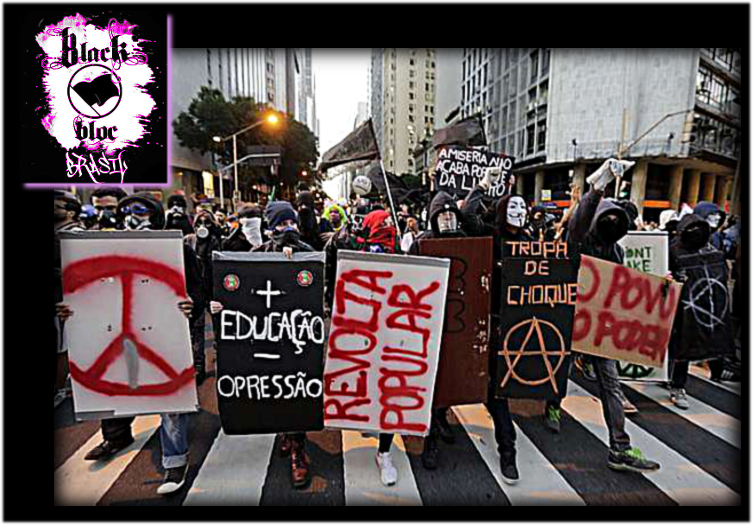
In recent weeks we have attended a debate in the wake of black bloc activity in Brazil, which involved leaders of social movements and collectives of militants.
The black bloc tactic (destruction of glass panes and windows of banks and private companies by masked youths during demonstrations) has been habitual in Chile and in Uruguay, among others, and was installed in Brazil in June 2013, reappearing with force in the demonstrations against the illegitimate government of Michel Temer.
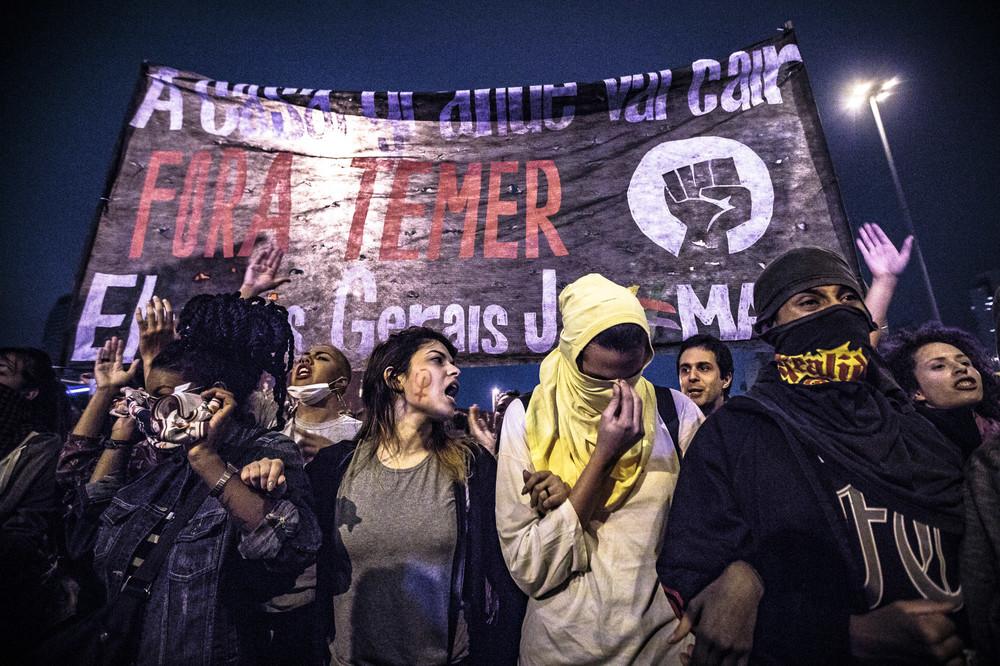
Ever since the black bloc tactics appeared, a polemic was generated in social organizations about the pertinence of those actions. Some maintain that they are negative, because they give the police arguments for repressing and thus alienate and frighten real or potential demonstrators.
Others emphasize that it’s about symbolic violence against big companies and other representations of the system, and that it has dissuasive effects on repression. The electoral parties usually condemn them adamantly.
In Brazil the polemic includes one of the more prominent referents of the most combative movements, like Guilherme Boulos, coordinator of the Homeless Workers Movement (Movimiento de Trabajadores Sin Techo, MTST).
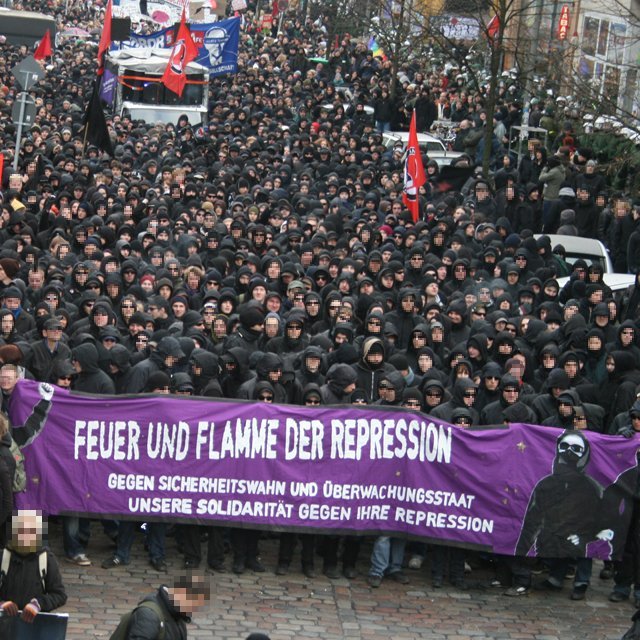
A day before the largest march against the government, Boulos asserted that: “there is no space for those practices in our demonstrations,” and said that they ought not participate in the mobilization on Sunday the 4th (goo.gl/GUDSMi). He was harshly criticized for defending the “criminalization” of those who employ theblack bloc tactic.
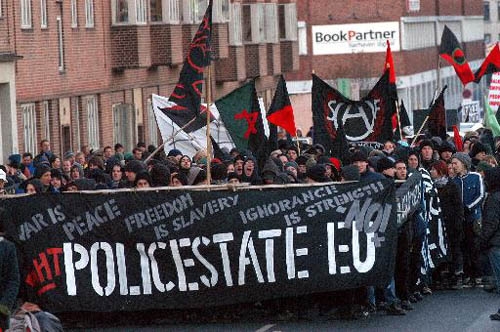
A little later Boulos published a note on his blog, in which he explains: “I disagree with the tactic because it separates people from the mobilizations and they make isolated decisions, but decisions that affect us all.”
He rejects the accusation of criminalizing the tactic and remembers that the MTST has been “severely criminalized for practicing direct action,” noting that the movement has members in prison and with on-going criminal proceedings (goo.gl/zxqzST).
Some 100,000 people participated in the demonstration on Sunday, September 4 in Sao Paulo. The organizers, the Fearless People Alliance, in which the MTST plays a preponderant role together with some 30 social movements and political organizations, and the Popular Brazil Front, dominated politically by the PT and the CUT union confederation, told the masked ones to show their faces or they would abandon the march.
No incident occurred. Nevertheless, the military police attacked them when the demonstrators were dispersing and arrested 26 youths, because “they sought to practice violent acts.”
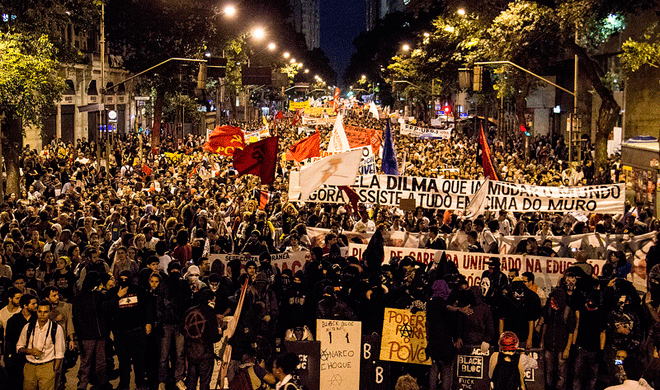
There was not the least black bloc “provocation” on this occasion, but the repression was equally relentless. The polemic continues its course with arguments that range from questioning the violence to the convenience of its use when families with children participate in the demonstrations, including the supposition that they always use infiltrators to provoke police repression. Some considerations seem necessary.
The first is that talking about a tactic isn’t good or bad in the abstract, but can rather be convenient, or not, according to the circumstances. We are not faced with a question of principles. It’s necessary to comprehend that not all of those who cover their face are adept at the black bloc tactic, that they don’t form an organization, nor are they necessarily anarchists, nor do they use the tactic always and everywhere. Those who use it today may not do it tomorrow, and vice versa.
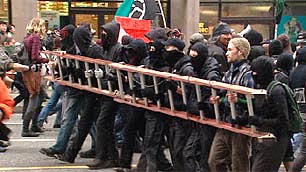
The second is that those who employ the black bloc tactic are radical youths, anti-capitalists, who reject the economic system and police repression. Counter to existing prejudices, they do not belong to the comfortable middle classes; they live in the peripheries, and have studied and worked since they were very young.
From what I am familiar with in Uruguay, because of the data that they contribute from Chile and from the research of the authors of Mascarados(Geração Editorial, 2014), we’re talking about individuals around 20 years old, many of them women, who suffer from police persecution in their barrios. Although they are few, they show “the profound crisis in which the Brazilian left is debated” (p. 19).
Zapatista march: obviously a separate black bloc tactic would be irrelevant
The third turns around the principal argument that is used against that tactic: it facilitates police repression and frightens a part of the demonstrators, either because the callers make it clear that the marches are peaceful or rather because the repression that follows the black bloc tactic affects individuals that don’t want to suffer police violence. It classifies them as “provocateurs.”
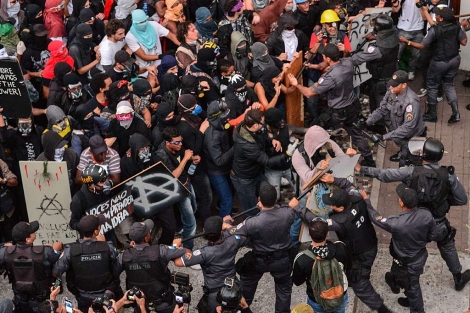
The argument is solid, especially when the masked ones act and withdraw before the police arrive and end up randomly repressing people. But the problem is not only in those who use that tactic, but also in the very same demonstrators, who aren’t used to being organized and attend individually. Does anyone imagine that a group of youths would use the block bloc tactic during a demonstration of the EZLN support bases in San Cristóbal de las Casas?
The fourth question is related to the use of similar tactics on the part of police or military infiltrators in demonstrations. As a youth from Sao Paulo pointed out in an excellent report for the Brazilian edition of El País, “I believe that one who breaks a newspaper stand or burns a bus, for example, either didn’t understand anything or is an infiltrator” (goo.gl/2G6lck). It’s possible to differentiate between black bloc actions and police provocations, because an interest in doing it always exists.

Lastly, the theme that the journalist Eliane Brum outlines: “While destruction of the demonstrators’ bodies by military police is naturalized, the destruction of material goods is criminalized” (goo.gl/mdRPKj). In her opinion, we’re dealing with a “heritage of slavery and genocide” that has still not been overcome. In other words, the black bloc tactic, agree with it or not, proposes a dilemma for us: do we accept, without further ado, the state’s monopoly of violence?
———————————————————–
Originally Published in Spanish by La Jornada
Saturday, September 17, 2016
http://www.jornada.unam.mx/2016/09/17/opinion/018a1mun
Re-Published with English translation by the Chiapas Support Committee.. Leave a Comment at Chiapas Support
original en castellano
Black bloc como táctica y excusa
Desde que aparecieron las tácticas black bloc se generó una polémica en las organizaciones sociales sobre la pertinencia de esas acciones.
Algunos sostienen que son negativas, porque dan argumentos a la policía para reprimir y de ese modo alejan y atemorizan a los manifestantes reales o potenciales. Otros destacan que se trata de violencia simbólica contra grandes empresas y representaciones del sistema, que tiene efectos disuasorios sobre la represión. Los partidos electorales suelen condenarlas de forma tajante.
En Brasil la polémica incluyó a uno de los más destacados referentes de los movimientos más combativos, como Guilherme Boulos, coordinador del Movimiento de Trabajadores Sin Techo (MTST). Un día antes de la mayor marcha contra el gobierno, Boulos aseguró que en nuestras manifestaciones no hay espacio para esas prácticas
, y dijo que no debían participar en la movilización del domingo 4 (goo.gl/GUDSMi). Fue duramente criticado por defender lacriminalización
de quienes emplean la táctica black bloc.
Poco después Boulos publicó una nota en su blog, en la que explica:discrepo con la táctica porque aparta personas de las movilizaciones y toman decisiones aisladas, pero nos afectan a todos
. Rechaza la acusación de criminalizar la táctica y recuerda que el MTST ha sido duramente criminalizado por practicar la acción directa
, destacando que el movimiento tiene militantes presos y con procesos en curso (goo.gl/zxqzST).
En la manifestación del domingo 4 en Sao Paulo participaron unas 100 mil personas. Los organizadores, la alianza Povo Sem Medo, donde el MTST juega un papel preponderante junto con unos 30 movimientos y organizaciones sociales y política, y el Frente Brasil Popular, hegemonizado por el PT y la central sindical CUT, se dirigieron a los encapuchados para que descubrieran sus rostros o abandonaran la marcha.
No se registró ningún incidente. Sin embargo, cuando los manifestantes se dispersaban la policía militar los atacó y detuvo a 26 jóvenes, porque pretendían practicar actos de violencia
.
En esta ocasión no hubo la menorprovocación
black bloc, pero la represión fue igualmente implacable. La polémica sigue su curso, con argumentos que van desde el cuestionamiento a la violencia hasta la conveniencia de su empleo cuando participan familias con niños en las manifestaciones, incluyendo la suposición de que siempre la usan infiltrados para provocar la represión policial. Parecen necesarias algunas consideraciones.
La primera es que al tratarse de una táctica no es buena ni mala en abstracto, sino puede ser conveniente, o no, según las circunstancias. No estamos ante una cuestión de principios. Es necesario comprender que no todos los que se cubren el rostro son adeptos de la táctica black bloc, que no forman una organización ni son necesariamente anarquistas, ni usan la táctica siempre y en todo lugar. Quienes la utilizan hoy pueden no hacerlo mañana, y viceversa.
La segunda es que quienes emplean la táctica black bloc son jóvenes radicales, anticapitalistas, que rechazan el sistema económico y la represión policial. En contra de los prejuicios existentes, no pertenecen a las clases medias acomodadas; viven en las periferias, estudian y trabajan desde muy jóvenes.
Por lo que conozco en Uruguay, por los datos que aportan desde Chile y por la investigación de los autores deMascarados (Geração Editorial, 2014), se trata de personas en torno a 20 años, muchas de ellas mujeres, que sufren la persecución policial en sus barrios. Aunque son pocos, muestranla profunda crisis en que se debate la izquierda brasileña
(p. 19).

La tercera gira en torno al principal argumento que se utiliza contra esa táctica: facilita la represión policial y espanta a una parte de los manifestantes, ya sea porque las convocatorias aclaran que las marchas son pacíficas o bien porque la represión que sigue a la táctica black bloc afecta a personas que no quieren sufrir violencia policial. Se les califica de provocadores
.
El argumento es sólido, sobre todo cuando los encapuchados actúan y se retiran antes de la llegada de la policía que termina reprimiendo a personas al azar. Pero el problema no está sólo en quienes usan esa táctica, sino en los propios manifestantes, quienes no suelen estar organizados y asisten individualmente. ¿Alguien se imagina que un grupo de jóvenes utilice la táctica block bloc durante una manifestación de las bases de apoyo del EZLN en San Cristóbal de las Casas?
La cuarta cuestión se relaciona con la utilización de tácticas similares por parte de infiltrados policiales o militares en las manifestaciones. Como señaló un joven de Sao Paulo en un excelente reportaje de la edición brasileña de El País, creo que quien rompe un puesto de periódicos o quema un autobús, por ejemplo, o no entendió nada o es un infiltrado
(goo.gl/2G6lck). Es posible diferenciar entre las acciones black blocs y las provocaciones policiales, siempre que exista interés en hacerlo.
Por último, el tema que plantea la periodista Eliane Brum: Mientras la destrucción de los cuerpos de los manifestantes por la policía militar está naturalizada, la de los bienes materiales es criminalizada
(goo.gl/mdRPKj). En su opinión, se trata de una herencia esclavista y genocida
que aún no ha sido superada. Dicho de otro modo, la táctica black bloc, acordemos o no con ella, nos plantea un dilema: ¿aceptamos, sin más, el monopolio estatal de la violencia?

 The Free