
Published on by
‘Incredible’ News as Banking Giant HSBC ‘vows’ to Ditch New Coal, Tar Sands, and Offshore Arctic Drilling Projects
 The development is “yet another signal to Donald Trump and the rest of the world that, despite their worst laid plans, the era of fossil fuels is coming to a close.”
 Climate groups applauded HSBC’s announcement that it is moving away from fossil fuels. (Photo: ItzaFineDay/flickr/cc)
In another signal that “the era of fossil fuels is coming to a close,” Europe’s biggest bank, HSBC, announced Friday that it will no longer fund oil or gas projects in the Arctic, tar sands projects, or most coal projects.
The move was cheered by climate campaigners on social media, who said, “This is huge,” and called it “incredible news.”
BREAKING: @HSBC, Europe’s biggest bank has just announced that it will no longer provide funding for new tar sands pipelines. #stoppipelines #StopKM pic.twitter.com/TK4ceLYlkl
— Greenpeace UK (@GreenpeaceUK) April 20, 2018
According to Daniel Klier, group head of strategy and global head of sustainable finance at the financial giant, the bank recognizes “the need to reduce emissions rapidly to achieve the target set in the 2015 Paris Agreement to limit global temperatures rises to well below 2°C and our responsibility to support the communities in which we operate.” The changes are laid out in HSBC’s updated energy policy, which says it will no longer provide financial services for
- a) New coal-fired power plant projects, subject to very targeted exceptions of Bangladesh, Indonesia and Vietnam in order to appropriately balance local humanitarian needs with the need to transition to a low carbon economy. Consideration of any such exception is subject to: (i) independent analysis confirming the country has no reasonable alternative to coal; (ii) the plant’s carbon intensity being lower than 810g CO2/kWh; and (iii) financial close on the project being achieved by 31 December 2023
(HSBC finances new coal-fired power plants inBangladesh, Vietnam and Indonesia. All three countries are on the front line of climate change and have significant renewable energy potential, a crucial tool to sustainable poverty eradication.)
- b) New offshore oil or gas projects in the Arctic
- c) New greenfield oil sands projects
- d) New large dams for hydro-electric projects inconsistent with the World Commission on Dams Framework
- e) New nuclear projects inconsistent with the International Atomic Energy Agency (IAEA) standards
The announcement, said Kelly Martin, director of Sierra Club’s Beyond Dirty Fuels Campaign, “is an important step forward for Europe’s largest bank, and yet another signal to Donald Trump and the rest of the world that, despite their worst laid plans, the era of fossil fuels is coming to a close. There is no future in Arctic fossil fuel operations. There is no future in tar sands. And there is no future in coal.”
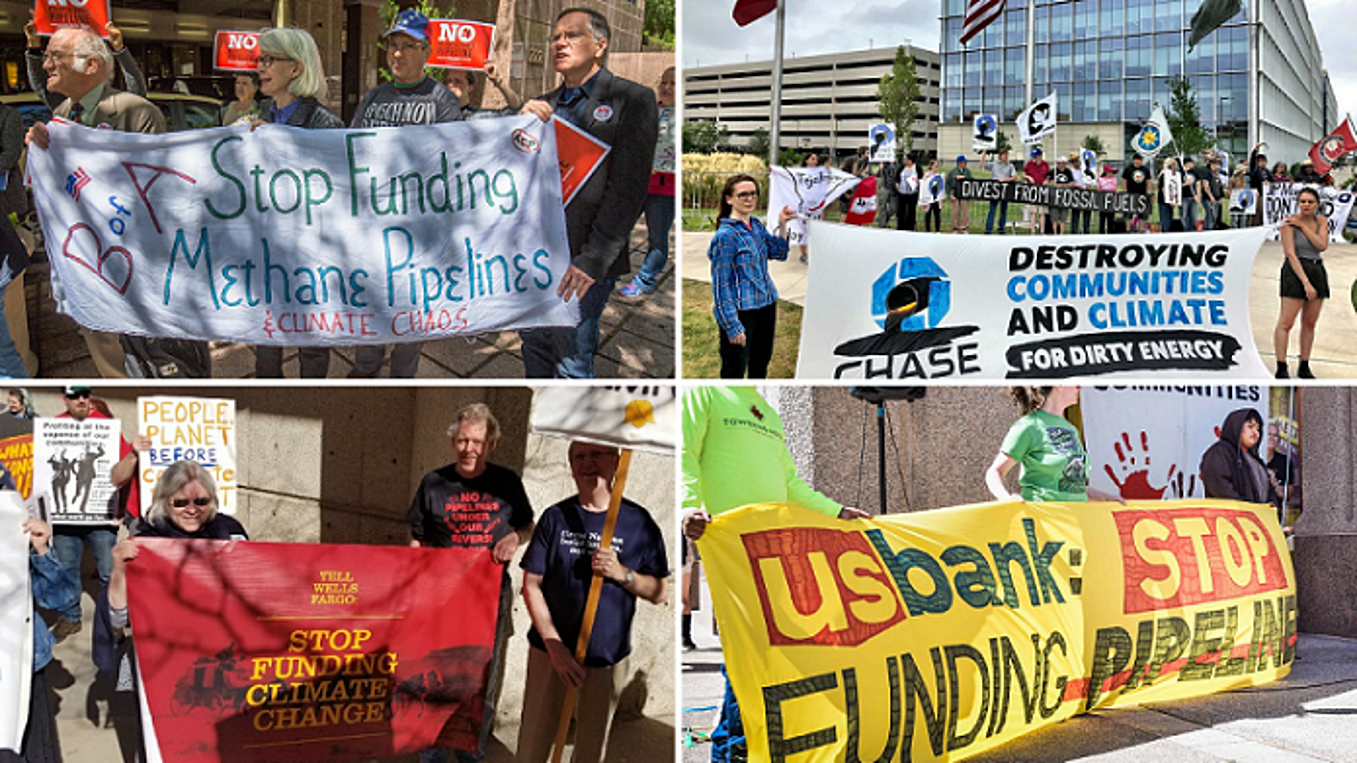 According to Keith Stewart, senior energy strategist at Greenpeace Canada, “Financial institutions around the world are seeing the reputational and material risks these pipelines pose in a post-Paris world where respecting Indigenous rights and the need to transition off of fossil fuels is smart business and not just good public relations.”
Canadian Prime Minister Justin Trudeau, who appears to be ready to subsidize the widely opposed Trans Mountain tar sands pipeline, should take note of the shift by HSBC, added Stewart.
“Before deciding to write a check to Kinder Morgan, Justin Trudeau should ask himself if he wants to rush in where HSBC fears to tread,” he said.
While HSBC’s announcement, as well as similar actions taken by other banks like BNP Paribas, should be lauded, the institutions need to go further, added Sierra Club’s Martin.
She said that “it cannot be overstated how critical it is that HSBC and the world’s other major banks immediately end financing for all fossil fuel projects around the world.
Institutions should no longer continue financing any fossil fuel projects when cheaper, cleaner, more reliable energy solutions like wind and solar are readily available.”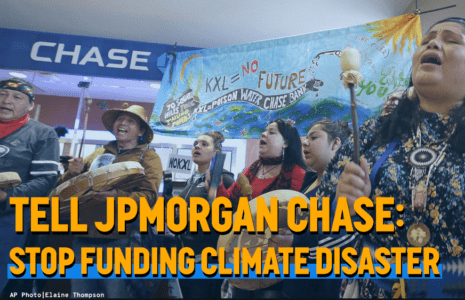
Global Banks, Led by JPMorganChase, Invested $1.9 Trillion in Fossil Fuels Since Paris Climate Pact
The news come a month after a report showed that banks are continuing to bankroll the climate crisis by funneling $115 billion into tar sands, offshore oil drilling, and coal mining projects.
That report, entitled “Banking on Climate Change” and endorsed by dozens of environmental groups, ranked HSBC the seventh worst in the world for the financing of “extreme fossil fuels.” It also found that from 2016 to 2017—”Even as the impacts of climate change become increasingly apparent”—it made a $2.6 billion increase in such financing.
This work is licensed under a Creative Commons Attribution-Share Alike 3.0 License

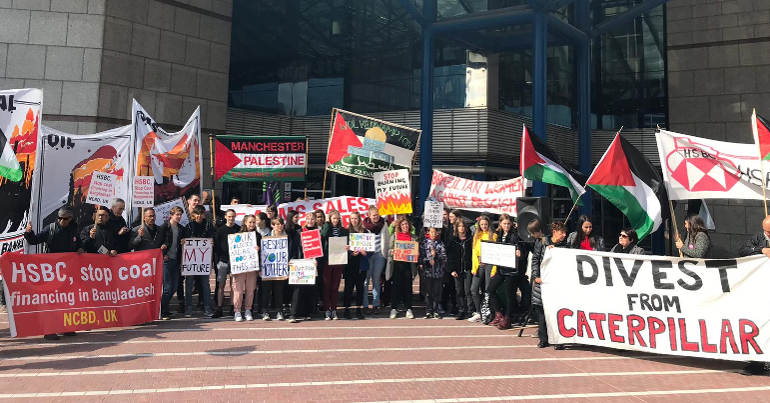
Activists demanded HSBC stop funding war and global climate change
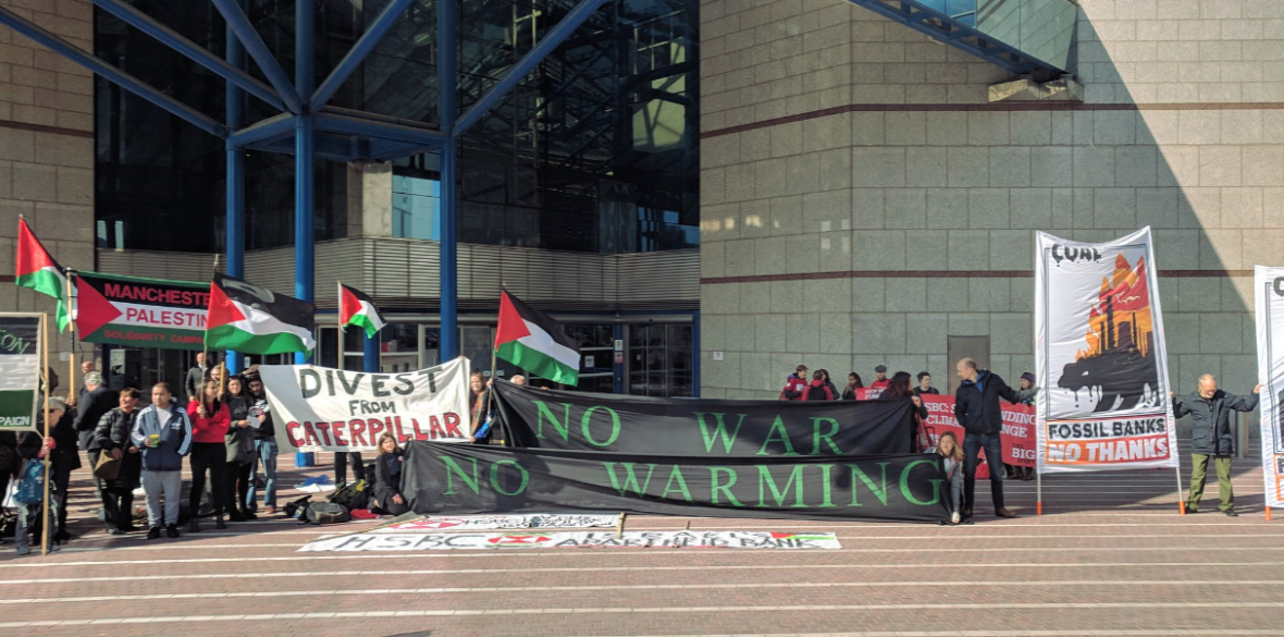 Outside the conference centre where the AGM of HSBC was taking place there were 100’s of us, joining forces to demand that HSBC stops fuelling the climate crisis. And, we were not just outside the meeting in Birmingham. There were tens of thousands of school children across the UK that on strike to demand urgent action on climate change.
Members of the Bangladeshi diaspora also took part in the protests outside the HSBC AGM saying that any fossil fuel projects financed by HSBC would have a devastating impact in one of the world’s most vulnerable areas to climate breakdown.
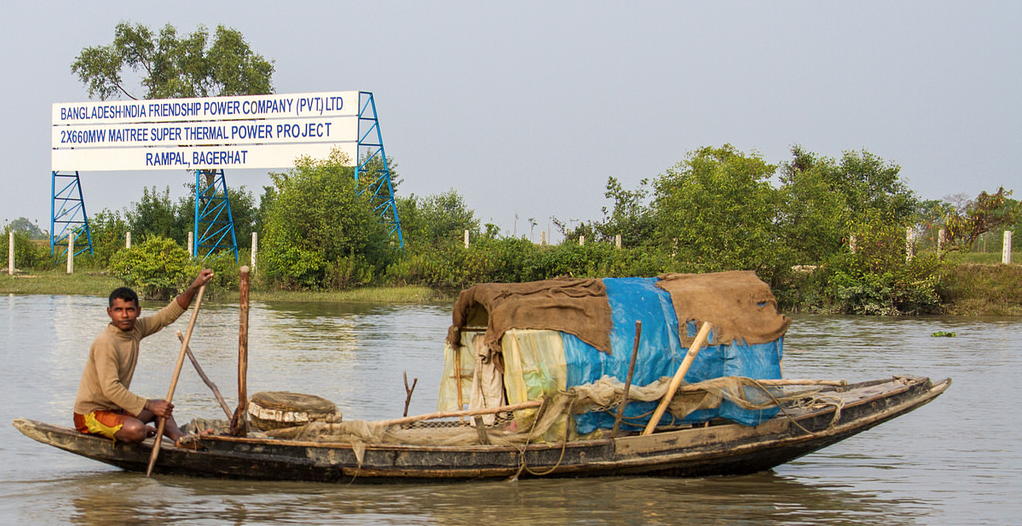 HSBC is currently leading a consortium of banks to finance the dredging of the Payra Port in the Bangladesh delta. The port is being expanded to allow larger ships to carry the Twenty million metric tonnes of coal that will be imported every year through the port to be used in the five coal power plants to be constructed in the area.
HSBC’s announcement that it will stop fossil fuel investments may not include Bangladesh, citing ”New coal-fired power plant projects, subject to very targeted exceptions of Bangladesh, Vietnam and Indonesia.in order to appropriately balance local humanitarian needs with the need to transition…” They could argue that these mega projects are not ”New”.
These coal plants have also raised human rights concerns, notably around land being grabbed without compensation, and farming and fishing livelihoods – let alone the devastation that could be caused by damaging the Sundarbans. The Sundarbans is the world’s largest mangrove forest and a UNESCO world heritage site that conserves the mangrove ecosystem in Bangladesh.The construction of any new coal power plant is inconceivable given the scientific findings of the UN´s Climate Science Panel. Every ton of coal burned makes an immediate contribution to the quantity of CO2 in the atmosphere causing long term and irreversible climate change.
HSBC, until now, does not just fund coal but also tar sands oil, arctic oil drilling and deepwater oil and gas exploration.
Bangladesh is one of the most vulnerable countries to climate change. As HSBC’s coal financing policy for Bangladesh will push it to more danger, we demand they do not invest in coal in Bangladesh and in the delta region. We do not need dirty coal energy.
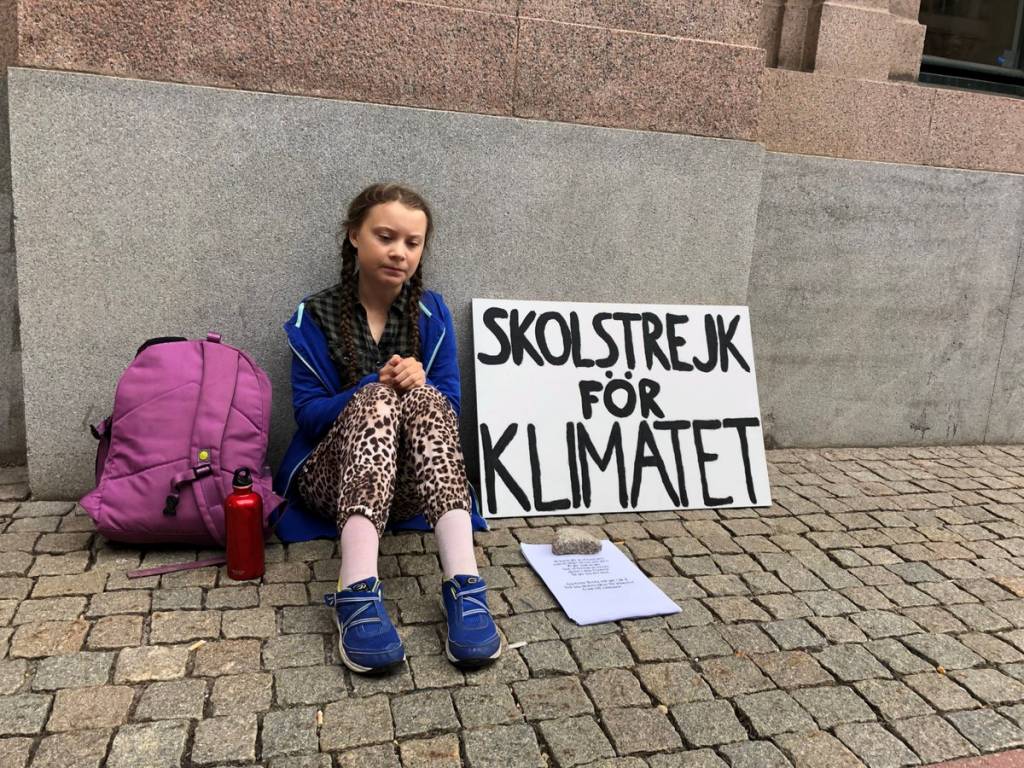
Every year Bangladesh suffers from climate related disasters including floods, droughts and salinisation of freshwater supplies leading to the displacement of 100,000’s of people. There are over 40 million people living in highly vulnerable conditions on the banks of the Delta, and the Sundarbans provide a vital buffer zone against the frequent cyclones and storms that pound the Bangladeshi coast
The 10,000 km2 Sundarban mangrove forest in Bangladesh is itself home to around 500,000 people who are dependent on the mangroves for their livelihoods which include growing rice, fishing and tourism. Local protests against coal fired power plants have been met by brutal repression and activists on the ground say it is now difficult for them to campaign against the plants.
In 2016 police acted as industrial security force and opened fire on a demonstration of 1500 unarmed people, killing 4 people and injuring 100’s more. People were protesting against two China-backed power plants at Bashkhali in Chittagong, a location in southeastern Bangladesh near Cox’s bazar port.
Three people were killed in a similar coal-shooting in 2006 in Phulbari in northwest Bangladesh. Coal-finance and coal-business does not only pollute environment and fuel climate crisis but also kill innocent and unarmed people when they protest or speak truth.
Currently Bangladesh produces very little of its electricity from coal and whilst many other countries in the world are looking to transitioning away from coal, banks like HSBC announce new investment into coal-trade in Bangladesh. This would fuel further violence in the country and the region. People are organising against fossil finance.
This movement had to happen, we didn’t have a choice. Many of the climate strikers taking action aren’t allowed to vote. Imagine for a second what that feels like.
Now imagine what it’s like being from a community already facing the impacts of climate change, watching the potential uprooting of our livelihoods, from fishing to farming and knowing that there are big banks that are going to make all this much worse. Where the decisions are taken thousands of miles away in conferences like the one taking place in Birmingham today.
Wouldn’t you protest too, if you thought doing so could help protect your own future?
We have to go on strike, because we don’t have a choice, in the same way that the organisations protesting outside the HSBC AGM today don’t have a choice. We’ve relied on adults to make the right decisions to ensure that there is a future, we’re asking grown-ups to follow our lead: we can’t wait any longer.
We may not have all of the answers but what we do know is that we need to keep coal, and all fossil fuels in the ground, phase out subsidies for dirty energy production and seriously invest in renewables.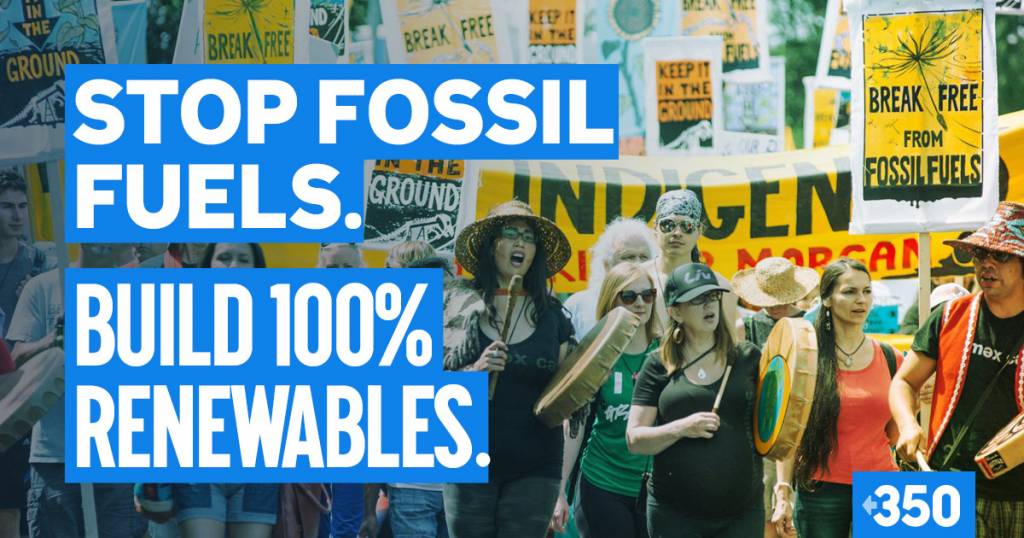
Our world is on fire, we are demanding the transition to a fossil fuel free world now. This is about climate justice and a safe future for all.
This movement had to happen. And now, you adults have a choice, it could start today with HSBC divesting from fossil fuels.
HSBC was the 7th biggest of the banks continuing to bankroll the climate crisis by funneling $115 billion into tar sands, offshore oil drilling, and coal mining projects. Now its time to put pressure on all of them. Royal Bank of Canada, Toronto Dominion Bank, and JPMorgan Chase all passed the coal-heavy Chinese banks to become the biggest bankers of extreme fossil fuels last year. JPMorgan Chase increased funding to coal mining by a shocking 21 times and quadrupled its financing of tar sands oil.

Global Banks, Led by JPMorganChase, Invested $1.9 Trillion in Fossil Fuels Since Paris Climate Pact
https://www.ecowatch.com/global-banks-fossil-fuels-2632255522.html
Report Finds Major Banks Ramped Up Fossil Fuel Financing by $115 billion
That report, entitled “Banking on Climate Change” pdf here
Switch from fossil fuels! Divest your bank and energy https://campaigncc.org/timetoswitch
HSBC faces protests at AGM over investments in arms companies

 The Free