One-hectare plot ‘recovered’ in Sant Cugat to make an urban garden
from La Directa.. translation TheFreeOnline.. orginal in Catalan below
A group of activists and neighbors have made public the construction of a self-managed urban garden and a multipurpose popular space, available to the whole neighborhood. The almost ten thousand square meters of land belongs to CaixaBank and has been abandoned for more than twelve years
PUBLISHED: June 13, 2020 / Guillem Martí Guillem Martí guimmart
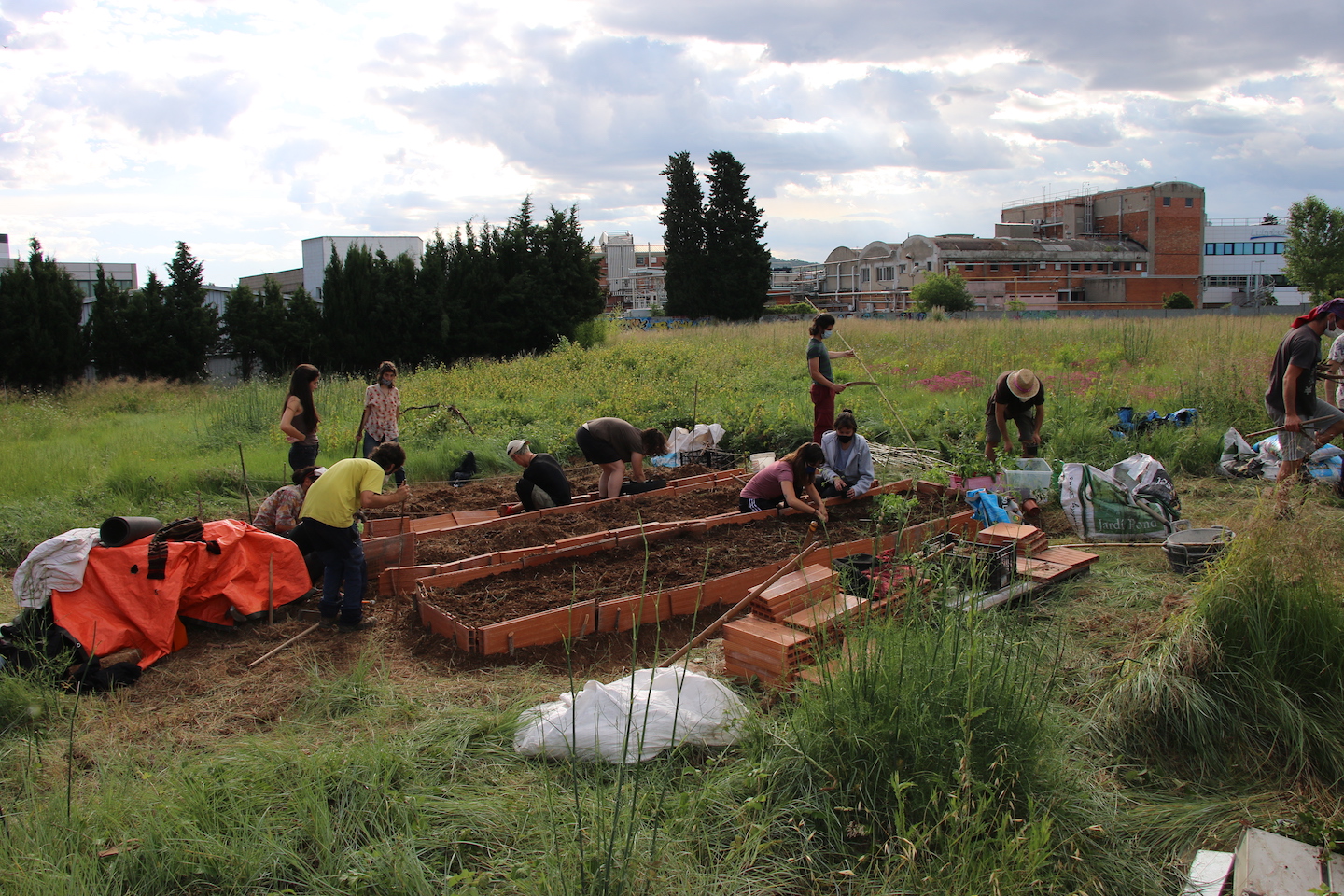
Located on the outskirts of the neighborhood of Sant Francesc, adjacent to the old town of Sant Cugat del Vallès, and at the beginning of the industrial estate of Can Magí, there is a plot of land that years ago had housed an old factory, according to aerial photographs of the Cartographic and Geological Institute of Catalonia, of which only the foundations remain.
They are 9,595 square meters in disuse, covered with tall grass and some trees, which, for more than twelve years, were hidden from view by sporadic pedestrians passing through the area by a long wall.
However, some neighbors say that the factory had been abandoned for more than fifteen years before going to the ground. Since 2012, the land has been owned by Servihabitat, CaixaBank’s real estate company, but for a few days now a group of activists has been working on it to build the Horta Alliberada de Sant Cugat, (Liberated Garden) which opened to the public on Saturday, June 13th.
The activists have been preparing the ground for a few days and creating the first terraces in the most fertile area, “to make it attractive to the neighborhood and to counter the pejorative image that can be had of the squatters,” says Pau, member of the garden assembly.
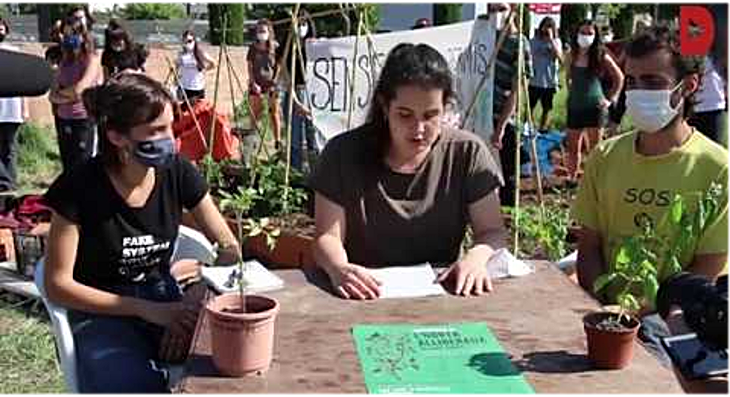
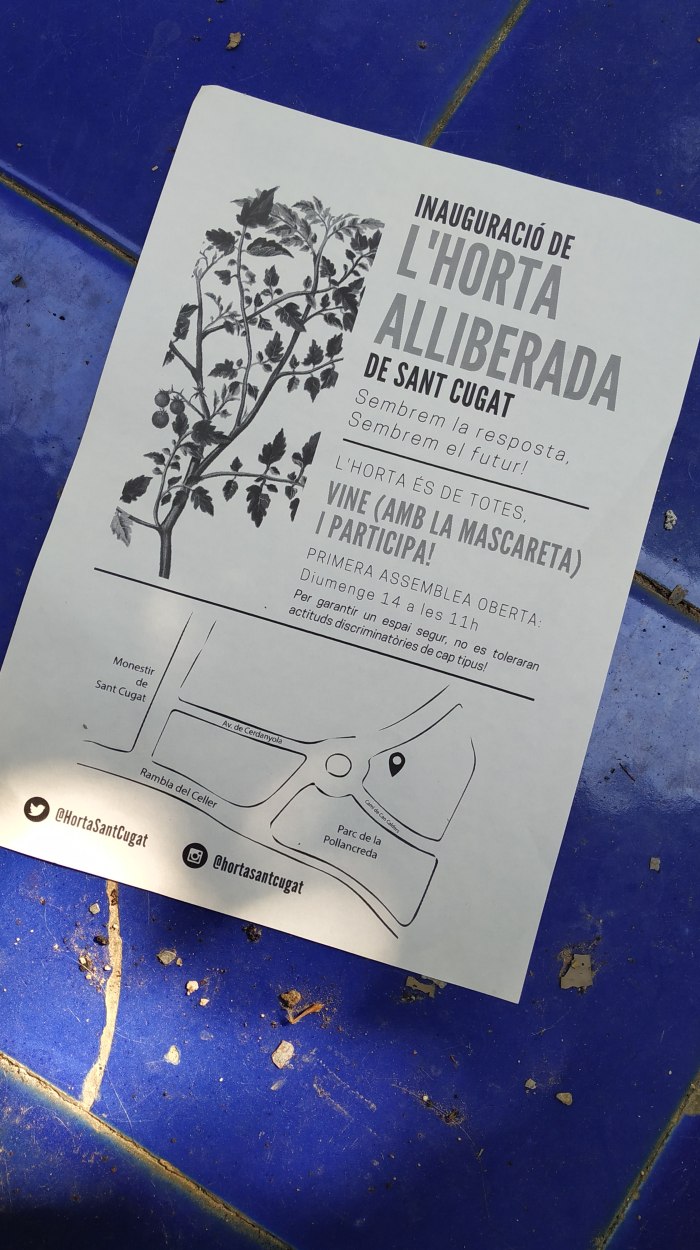
Supporters of the project and local entities have met in the early hours of Saturday morning to spread the project among the neighborhood, hang posters, hand out leaflets and make information pickets, and a press conference has been convened with local media where has read a manifesto. The first open assembly of the Garden will be held on Sunday, but always respecting the safety measures and restrictions imposed by phase two of decontamination.
“One of the goals of the garden that we have set ourselves from the beginning is to reach all sectors of the population,” explains Marta, also a member of the assembly.
“We have written the manifesto in three languages, including Arabic, to represent the cultural diversity of the neighborhood, unlike the City Council,” he added, referring to the segregation by cultural origin and origin that is it ends up generating among the users of other urban gardens of the municipality.
Following this line, they will seek the creation of a heterogeneous assembly that does not have as much militant presence, as happens in other areas of the town, in order to facilitate the approach of the whole neighborhood, mirroring projects such as the Horta Alliberada de Sants.
Apart from the urban garden, the space also hopes to serve as a multipurpose stage for various self-managed activities, events and concerts “that adapt to the reality of the neighborhood,” says Pau.
Today, little police presence is expected, thanks to the favorable legal situation of the space, as it is not built up and has been abandoned for a long period of time. During the previous day’s work, police interrupted the activity and identified three of the activists, but did not prevent their continuation.
One of the municipalities with the highest income but with the most inequalities
Among the political objectives of the project to occupy the Garden is a clear will to fight the inequality caused by the capitalist economic and political system, and which has become even more evident, according to the manifesto, during the pandemic. of the coronavirus.
To deal with the economic crisis for COVID-19, the assembly is committed to agroecology, community ties, horizontality, self-management and mutual support, as alternatives “to the monopoly of the agro-industry, which it promotes inequalities, the exploitation of natural resources and pollution ”, three major protagonists of the climate crisis.
Among the factories that are around the perimeter of the orchard, there is a chemical plant of the multinational Lubrizol, specialized in the manufacture of plastics, which since its opening has met with criticism to represent a possible danger to the public health. Lubrizol has nine thousand employees worldwide and is part of the American conglomerate Berkshire Hathaway, whose main shareholder is billionaire Warren Buffet, considered by Forbes magazine to be the richest man in the world in 2008. .
In Sant Cugat there is a difference of seventeen thousand euros per year in per capita income between the richest and the humblest neighborhood, which is precisely the neighborhood of Sant Francesc
The “unfair” distribution of resources has a special meaning in Sant Cugat del Vallès. It currently holds the record for the highest per capita income and the lowest unemployment rate, according to a study published by the National Statistics Institute among municipalities with more than twenty thousand inhabitants, and the fourth in Spain.
However, almost a third of the population of the municipality says they have difficulty surviving month to month, according to the Sociological Observatory of the City Council in 2019.
Clara Hosta, from the Sant Cugat Tenants ’Union, explains to La Directa that“ due to the exorbitant cost of housing in the town, an average salary is not enough to reach the end of the month. There is practically no rent of less than 900 euros ”.
According to the Foundation for Applied Economics Studies, Sant Cugat also has another record: being one of the municipalities with the greatest inequality among citizens and where higher incomes accumulate more wealth, reaching a difference of seventeen thousand euros per year per capita income between the richest and the humblest neighborhood, which is precisely the neighborhood of Sant Francesc, along with the neighborhood of Les Planes.
Since the beginning of the coronavirus pandemic, the social services of the Consistory have attended to more than four thousand people, from a population of more than ninety thousand inhabitants.
Finally, the manifesto also focuses on pointing out the lack of political will of the City Council —a coalition government of ERC, CUP and PSC—( note: ERC left republican,CUP anarcho republican,PSC socialist) to make effective the declaration of a climate emergency that was made during the plenary session of December 16. 2019. Among otherproblems, access to the community garden program is closed due to bad timetable and the difficulty of accessing it if you are not part of an entity or due to bureaucratic obstacles, which, according to activists, “encourages segregation.”
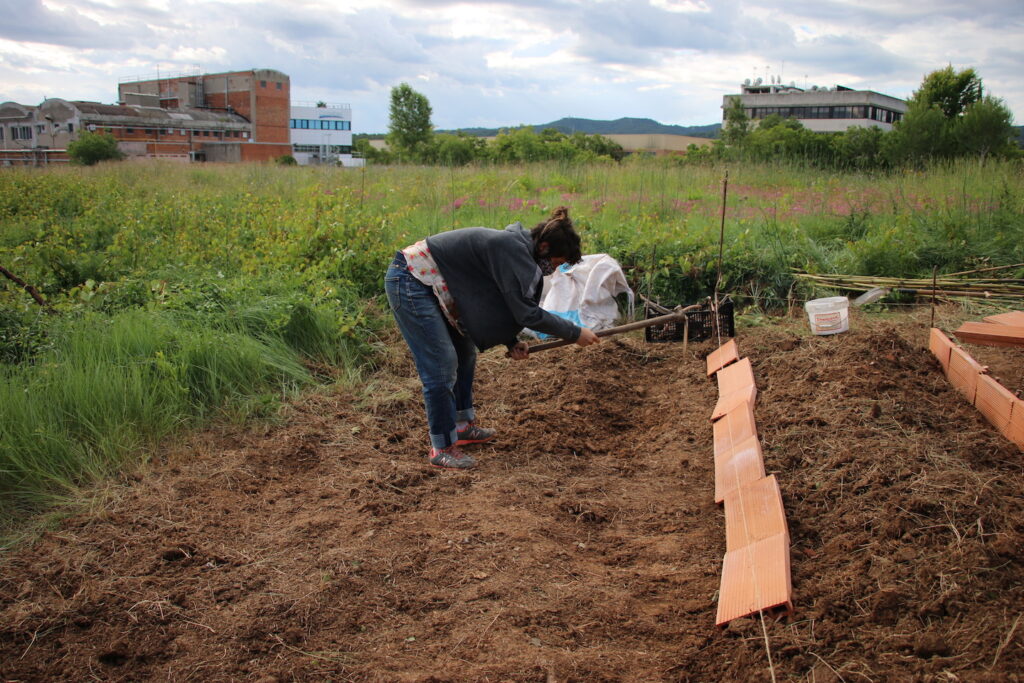
Currently, in Sant Cugat there are five active urban gardens, and two inactive ones that have been waiting for years for inauguration, but according to Marta, an activist of the assembly, “until now there was still no garden where you could go freely ”, because“ the remunicipalization of occupied orchards creates bureaucratic obstacles and working hours that then do not fit the real needs of the people. ”
Recuperen un solar d’una hectàrea a Sant Cugat del Vallès per fer-hi un hort urbà
PUBLICAT: Juny 13, 2020 Guillem Martí
Un grup d’activistes i veïnes ha fet pública la construcció d’un hort urbà autogestionat i d’un espai popular polivalent, a disposició de tot el veïnat. El terreny de quasi deu mil metres quadrats és de CaixaBank i es trobava abandonat des de feia més de dotze anys
/ Guillem Martí Guillem Martí guimmart
Ubicat als afores del barri de Sant Francesc, annex al nucli antic de Sant Cugat del Vallès, i al principi del polígon industrial de Can Magí, hi ha una parcel·la de terreny que anys enrere havia albergat una antiga fàbrica, segons les fotografies aèries de l’Institut Cartogràfic i Geològic de Catalunya, de la qual tan sols en queden els fonaments.
Són 9.595 metres quadrats en desús, coberts d’herbes altes i algun arbre, que, durant més de dotze anys, van quedar amagats de la vista de les vianants esporàdiques que transiten la zona per una llarga paret, característica pel seu color blau, i que du el logotip de la promotora immobiliària vallesana Grupo Alcaraz. Algunes veïnes però, asseguren que la fàbrica, abans d’anar a terra, ja duia més de quinze anys abandonada.
Des de 2012, el terreny és propietat de Servihabitat, la immobiliària de CaixaBank, però ja fa uns dies que un grup d’activistes ha estat treballant-hi per construir l’Horta Alliberada de Sant Cugat, que s’ha obert al públic avui dissabte 13 de juny. https://www.youtube.com/embed/SWCg8VcmIoQ?feature=oembed
Les activistes han estat uns dies preparant el terreny i creant els primers bancals a la zona més fèrtil, “per fer-lo atractiu al veïnatge i per treure’ns la imatge pejorativa que es pugui tenir de l’okupació”, explica el Pau, membre de l’assemblea de l’horta. Simpatitzants del projecte i entitats locals s’han reunit a primera hora del matí de dissabte per difondre el projecte entre veïnat, penjar cartells, repartir fulls volants i fer piquets informatius, i s’ha convocat una roda de premsa amb mitjans locals on s’ha llegit un manifest. Diumenge es celebrarà la primera assemblea oberta de l’horta, això sí, respectant sempre les mesures de seguretat i les restriccions imposades per la fase dos de desconfinament.
“Un dels objectius de l’hort que ens hem marcat des del principi és arribar a tots els sectors de la població”, explica la Marta, també membre de l’assemblea. “El manifest l’hem escrit en tres idiomes, incloent-hi l’àrab, per representar la diversitat cultural del veïnat, a diferència de l’Ajuntament”, afegeix, fent referència a la segregació per origen cultural i de procedència que s’acaba generant entre les usuàries d’altres horts urbans del municipi.
Seguint aquesta línia, buscaran la creació d’una assemblea heterogènia que no tingui tanta presència militant, com passa a altres espais del poble, per tal de facilitar l’acostament de tot el veïnat, emmirallant-se en projectes com l’Horta Alliberada de Sants. A part de l’hort urbà, l’espai també espera servir com a escenari polivalent per realitzar diferents activitats autogestionades, actes i concerts “que s’adaptin a la realitat del barri”, puntualitza el Pau.
Durant la jornada d’avui s’espera poca presència de la policia, gràcies a la situació jurídica favorable de l’espai, ja que no està edificat i que estat abandonat per un llarg període de temps. Durant la jornada de treball del dia anterior, la policia va interrompre l’activitat i va identificar tres de les activistes, però no va impedir-ne la continuïtat.
Un dels municipis amb més renda però amb més desigualtats
Entre els objectius polítics del projecte d’okupació de l’hort, hi ha una clara voluntat de lluita contra la desigualtat provocada pel sistema econòmic i polític capitalista, i que s’ha fet encara més evident, segons diu el manifest, durant la pandèmia del coronavirus. Per fer front a la crisi econòmica per la COVID-19, l’assemblea aposta per l’agroecologia, els llaços comunitaris, l’horitzontalitat, l’autogestió i el suport mutu, com a alternatives “al monopoli de l’agroindústria, que fomenta les desigualtats, l’explotació de recursos naturals i la contaminació”, tres grans protagonistes de la crisi climàtica.
Entre les fàbriques que es troben al voltant del perímetre de l’hort, hi ha una planta química de la multinacional Lubrizol, especialitzada en la fabricació de plàstics, que des de la seva obertura ha topat amb crítiques per representar un possible perill per a la salut pública. Lubrizol compta amb nou mil treballadores arreu del món i forma part del conglomerat nord-americà Berkshire Hathaway, l’accionista principal del qual és el multimilionari Warren Buffet, considerat per la revista Forbes com a l’home més ric del món l’any 2008.
A Sant Cugat hi ha una diferència de disset mil euros anuals de renda per habitant entre el barri més ric i el més humil, que justament és el barri de Sant Francesc
La distribució “injusta” dels recursos té un sentit especial a Sant Cugat del Vallès, la població de Catalunya que actualment ostenta el rècord de major renda per càpita i amb menys atur, segons un estudi publicat per l’Institut Nacional d’Estadística entre municipis de més de vint mil habitants, i la quarta de l’Estat Espanyol. Tanmateix, quasi un terç de la població del municipi assegura tenir dificultats per arribar a final de més, segons l’Observatori Sociològic de l’Ajuntament del 2019.
Clara Hosta, del Sindicat de Llogateres de Sant Cugat, explica a la Directa que “a causa del desorbitat cost de l’habitatge al poble, amb un sou mitjà no és suficient per arribar a final de mes. Pràcticament no hi ha cap lloguer inferior a 900 euros”.
Segons la Fundació d’Estudis d’Economia Aplicada, Sant Cugat també té un altre rècord: ser un dels municipis amb una major desigualtat entre la ciutadania i on les rendes més altes acumulen més riquesa, arribant a una diferència de disset mil euros anuals de renda per habitant entre el barri més ric i el més humil, que justament és el barri de Sant Francesc, juntament amb el barri de Les Planes. Des de l’inici de la pandèmia del coronavirus, els serveis socials del Consistori han atès més de quatre mil persones, d’una població de més de noranta mil habitants.
Finalment, el manifest també se centra a assenyalar la manca de voluntat política de l’Ajuntament —govern de coalició d’ERC, CUP i PSC— per fer efectiva la declaració d’emergència climàtica que es va fer durant el ple del 16 desembre del 2019. Entre d’altres, després que l’accés al programa d’horts comunitaris resti tancat per manca de places i per la dificultat d’accedir-hi si no formes part d’una entitat o per traves burocràtiques, fet que, segons les activistes, “fomenta la segregació”.
Actualment, a Sant Cugat hi ha cinc horts urbans actius, i dos d’inactius que resten des de fa anys a l’espera d’inauguració, però segons explica la Marta, activista de l’assemblea, “fins ara encara no existia un hort on tu poguessis anar lliurement”, perquè “la remunicipalització d’hortes okupades crea unes traves burocràtiques i horaris de funcionariat que després no encaixen amb les necessitats reals de la gent.”

 The Free