Because this is the only way he can conduct a campaign after his botched errors in all he has done. He’s trying to stay out of prison, he’s a cornered, wounded animal. He resorts to the basest instincts of his lizard mind and projects them to the Kool-Aid drinkers.
The news of Stuart Christie’s death arrived by phone halfway through yesterday afternoon from comrade René after he asked if I had heard the bad news and after I quizzed him brusquely: Who’s dead? I could tell from his tone of voice that it must have been somebody close who had passed away.
René’s answer stopped me in my tracks, because even though Stuart had told me a week before that the cancer had left him still hoarse and that the findings of his medical tests were none too encouraging, it never at any moment occurred to me that he would be taken so quickly. I am surrounded by several male and female comrades – more or less of my own age – who are in none too rude health and at my age (due to turn 93 shortly) the thought that one’s days are numbered is just “normal”.
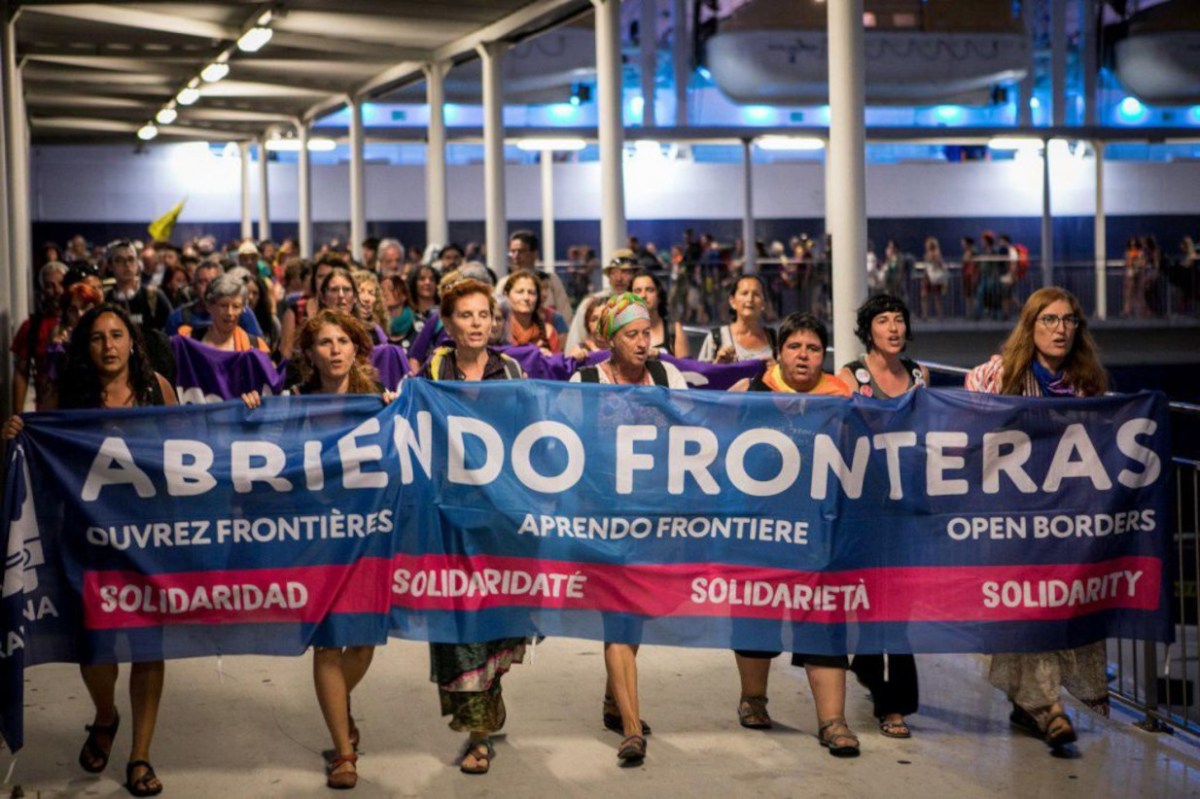
Abriendo Fronteras caravan mobilizes for the regularization of migrants
Migrant Caravan 2020
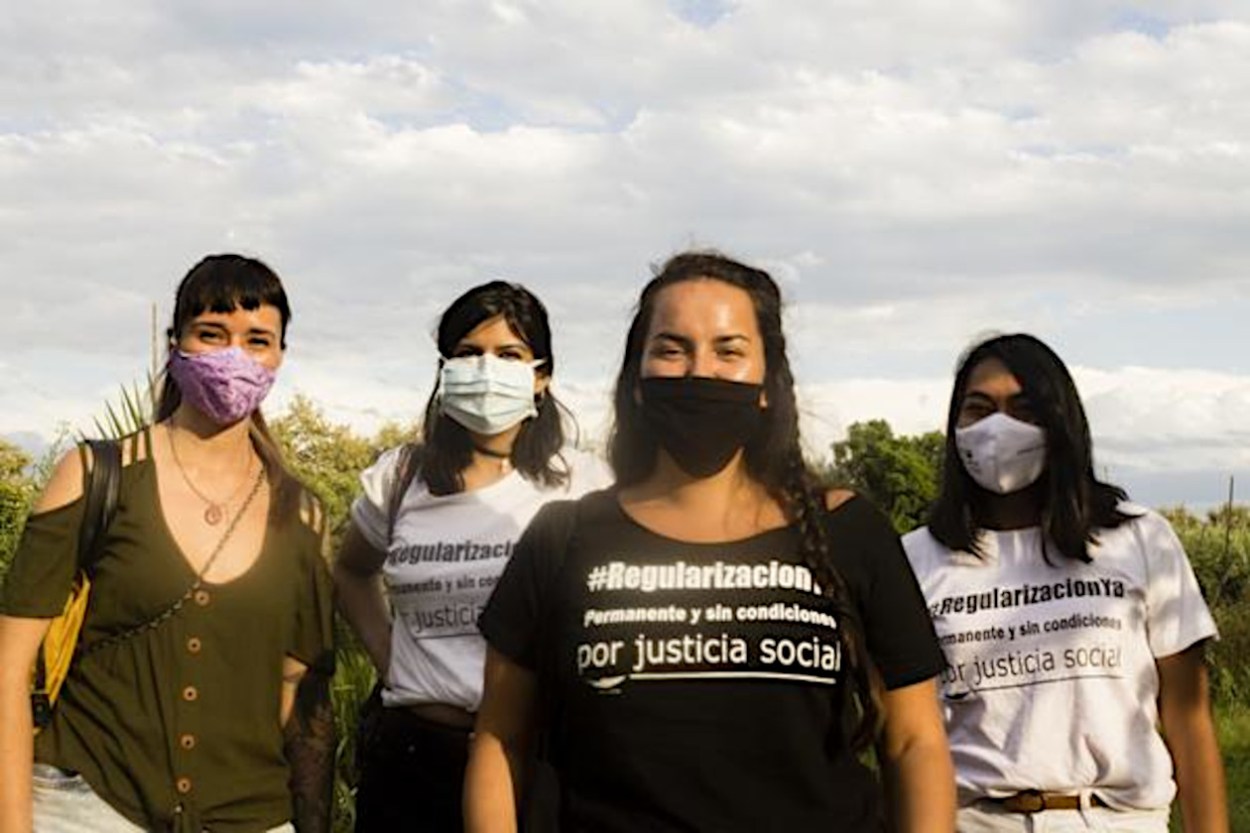
Activists of the RegularizaciónYa movement participate in the demonstration of the 2020 Abriendo Fronteras Caravan in València. Mathias Rodriguez
On its fourth day of activity, the 2020 Opening Borders Caravan has demanded the unconditional regularization of migrants living in an “unsustainable” situation, with an immigration law that obliges them to remain illegally.
“This year Caravana has not been able to travel but we are not going to silence the voice,” says Emilia Moreno de la Vieja, spokesperson for the Caravana. “We continue to denounce all the violations suffered by migrants,” he adds.
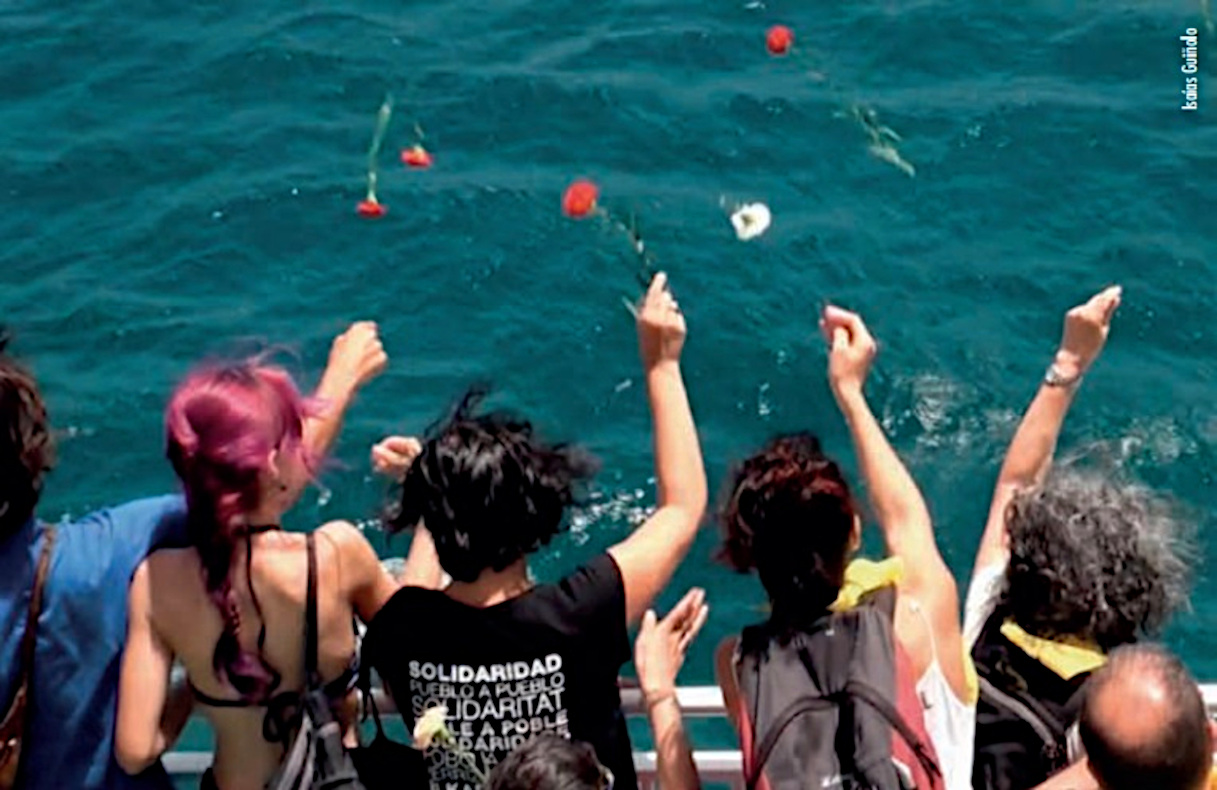
The demonstration in Valencia began last Saturday at 7 p.m. from Avenida de los Naranjos to the promenade, with the aim of making visible that the Mediterranean is a space of no-law where institutional racism causes thousands of deaths with total impunity .
Fundamental social change involves two intertwined processes. On the one hand, it means shutting down the mechanisms that impose disparities in power and access to resources; on the other hand, it involves creating infrastructures that distribute resources and power according to a different logic, weaving a new social fabric.
While the movement for police abolition that burst into the public consciousness a month ago in Minneapolis has set new precedents for resistance, the mutual aid networks that have expanded around the world since the beginning of the COVID-19 pandemic point the way to a new model for social relations.
Food distribution at Woodbine, a social center in New York City.
The following report profiles three groups that coordinate mutual aid efforts in New York City—Woodbine, Take Back the Bronx, and Milk Crate Gardens—exploring their motivations and aspirations as well as the resources and forms of care they circulate.
This is the first installment in a series exploring mutual aid projects across the globe.
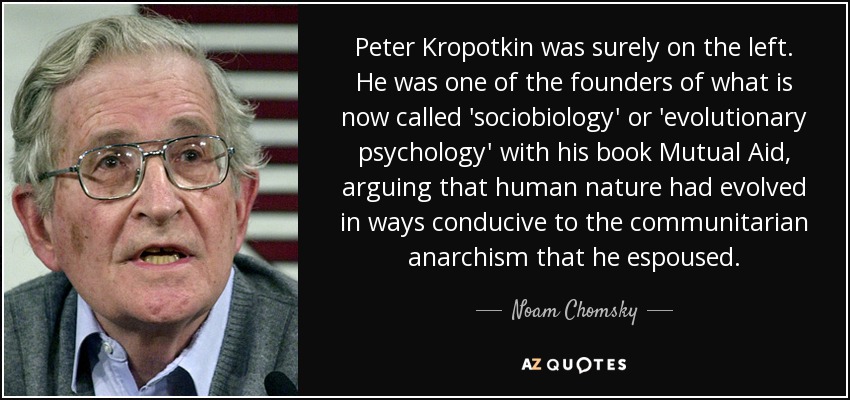
With politicians such as Rep. Alexandria Ocasio-Cortez calling for the people to engage in mutual aid in order to survive the COVID-19 crisis, those not previously familiar with the term might never guess it was coined by an anarchist scientist who advocated against central government.
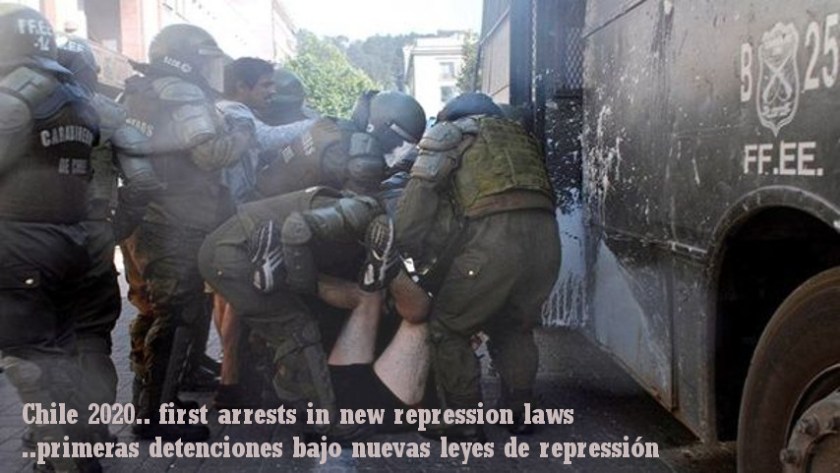
Desde el levantamiento insurgente del pueblo en octubre de 2019 hemos vivido una revuelta constante en que ya no se tolera ni aguanta pasivamente las decisiones del estado que en nada contempla nuestros intereses, vemos también que el aparato represor hace esfuerzos por volver a criminalizar y encarcelar todas las formas de lucha, o por el contrario, aplacarlas con migajas: lo hemos visto con la creación de leyes que penalizan el uso de capucha, las barricadas, el corte de calle, o la inyección de dineros en ayudas sociales como paupérrimas cajas de comida y bonos.
Pero ha quedado en evidencia que sus medidas no bastan y menos aun pueden invisivilizar las aberraciones de este modelo de dominación las cuales se hacen más evidente en un contexto de crisis sanitaria. .
Son por estas razones que ahora más que nunca debemos estar al lado de quienes han sido encarcelados por enfrentarse con decisión a este sistema de injusticia y opresión y que arriesgan extensas condenas en los juicios que se aproximan.
Hoy estamos frente a una nueva etapa en cuanto a la prisión de lxs compañerxs de la revuelta, se van cumpliendo los plazos de investigación y se avecinan los juicios.
Algunxs ya han sido condenadxs mediante juicio abreviado. Hay compañerxs a lxs que se les pide más de veinte años de cárcel, dejando en evidencia el castigo ejemplificador que pretenden dar a la protesta social, y mientras tanto vemos cómo siguen cayendo personas por negarse a agonizar pasivamente, de hambre, de virus, de capitalismo.
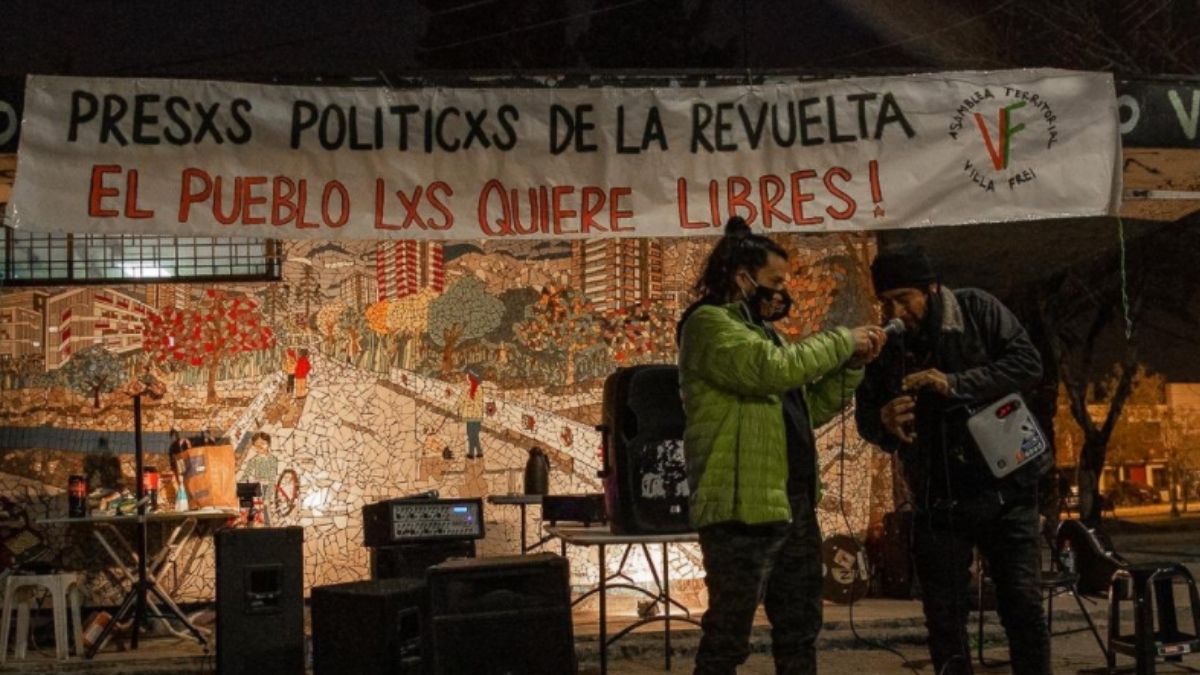
Lxs presxs de la revuelta han sido judicializados como delincuentes comunes, no reconociendo su calidad de prisionerxs políticxs; abrazamos a todas y todos los prisioneros que por distintas causas se encuentran tras los muros.
Esta omisión del aparato estatal es una negación del caracter transgresor y político de las acciones por las cuales han sido perseguidos y acusados.
En este escenario represor y punitivo, la solidaridad y la exigencia de libertad de nuestrxs presxs políticxs de la revuelta se torna urgente y fundamental entendiendo que la solidaridad por sobretodo debe forjarse desde un quehacer revolucionario, que por una parte se manifieste en el apoyo directo que lxs presxs requieren pero que al mismo tiempo esté en concordancia con una práctica de lucha y trasformación social.
Es por esto que nuestro horizonte de lucha se situa en la fortaleza y consolidación de una movilización social que exija en las calles y en los distintos territorios la libertad de todxs lxs presxs políticxs y sea, a la vez, parte sustancial de las justas demandas y luchas de lxs oprimidxs
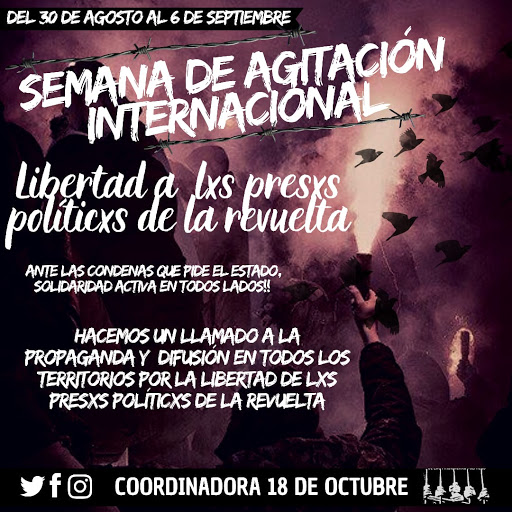
Es por esto que ante las condenas que busca el estado contra lxs presxs de la revuelta, hacemos un llamado de solidaridad nacional e internacional para exigir su inmediata libertad, con la certeza que la contundencia y persistencia de las expresiones de solidaridad, tanto dentro como fuera del país, son fundamentales en este camino de lucha que hemos ido trazando conjuntamente por la libertad de nuestrxs compañerxs. Extendemos este convocatoria apelando a las múltiples iniciativas y acciones solidarias que surgan desde cada territorio. ANTE LAS CONDENAS QUE BUSCA EL ESTADO SOLIDARIDAD ACTIVA EN TODOS LADOS¡¡¡ LIBERTAD A LXS PRESXS DE LA REVUELTA Y A TODXS LXS PRESXS POLÍTICOS¡¡¡ COORDINADORA 18 DE OCTUBRE.
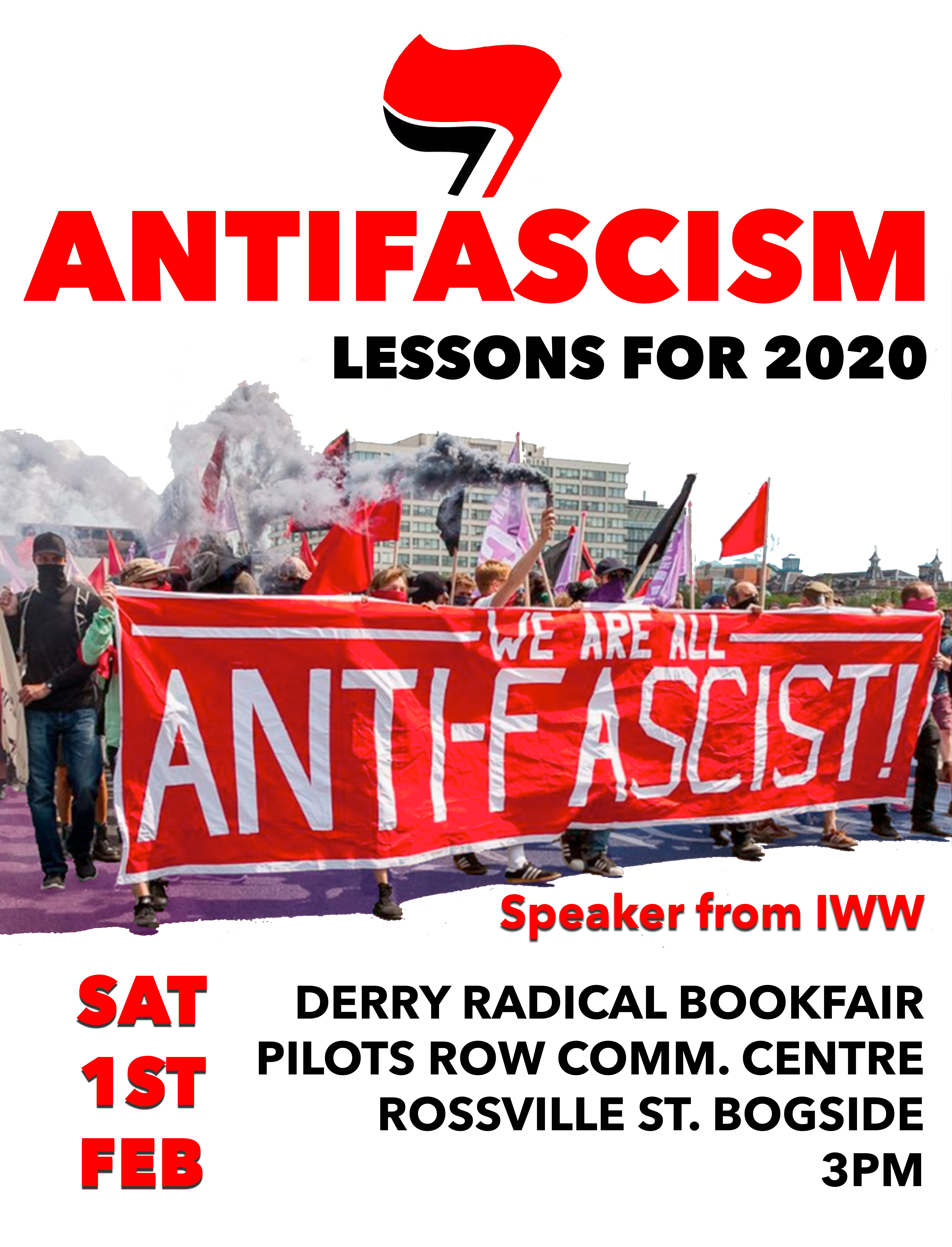
In the face of a global resurgence of authoritarian far-right governments, policies and even social behaviour, there is a need to build an anti-facist strategy that pays special attention to the root causes of xenophobia, racism, misogyny.
A society where competition and the pursuit of individual wealth are promoted as the ultimate goals and values is bound to normalise inequality, because it feeds from it.
Opposing this normalisation is at the core of a clear anti-facist strategy. What are we fighting against? Who benefits from prejudice? And most importantly, what can we do about it?
A speaker from the Industrial Workers of the World Ireland Branch leads the discussion on Antifascism: Lessons for 2020.
Saturday 1st February at the Derry Radical Bookfair, Speakers Corner, Pilots Row Community Centre @ 3pm
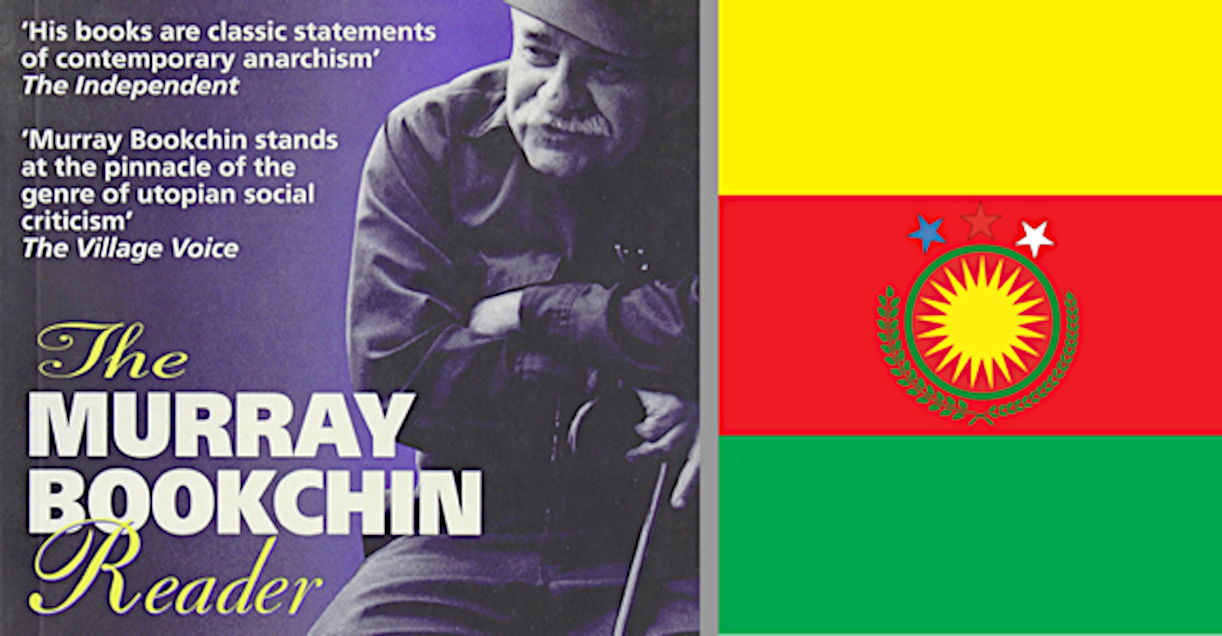
Kropotkin is often heralded as the most important classical anarchist theorist. Bookchin–influenced heavily by Kropotkin– is one of the most seminal theorists in post-classical anarchist period of anarchism. Kropotkin and Bookchin advocate for very similar yet distinct prescriptions of a good society.
They have similarities of anti-statism, anti-capitalism, anti-hierarchical praxis more broadly, socialization and communalization of land, the means of production, distribution, and consumption, more specifically communist forms of distribution according to ability and need.
They even both emphasize the necessity of communal forms as well as an emphasis on technology and achieving a post scarcity society by organizing finitude in a way to make it so there is more than enough for everyone economically.
Despite Bookchin’s departure from anarchism towards the end of his life, communalism draws ”from anarchism” a “commitment to antistatism and confederalism, as well as its recognition that hierarchy is a basic problem that can be overcome only by a libertarian socialist society,” (Bookchin 2007).
Many of the most important substantial analyses of problems and solutions are consistent between classical anarcho communism of Kropotkin and the non-anarchist yet libertarian communist communalism of Bookchin–so many that there are more similarities between them than there are between Kropotkin and many neo-anarchists
For Kropotkin, anarchists ought to create anarchist specific organizations, organize federations of affinity groups for direct actions, build revolutionary communes, and participate in radical trade unionism.
Kropotkin prescribes worker internationals and refers to worker internationals as waging a “direct…battle of labor against capital- not through parliament but directly by the means that are generally available to all workers,” (Kropotkin 2014, 466).










 In the face of a global resurgence of authoritarian far-right governments, policies and even social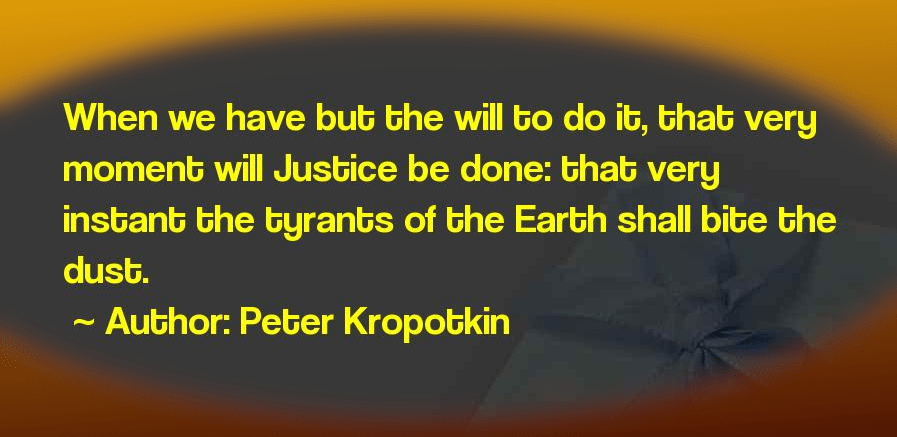


 The Free