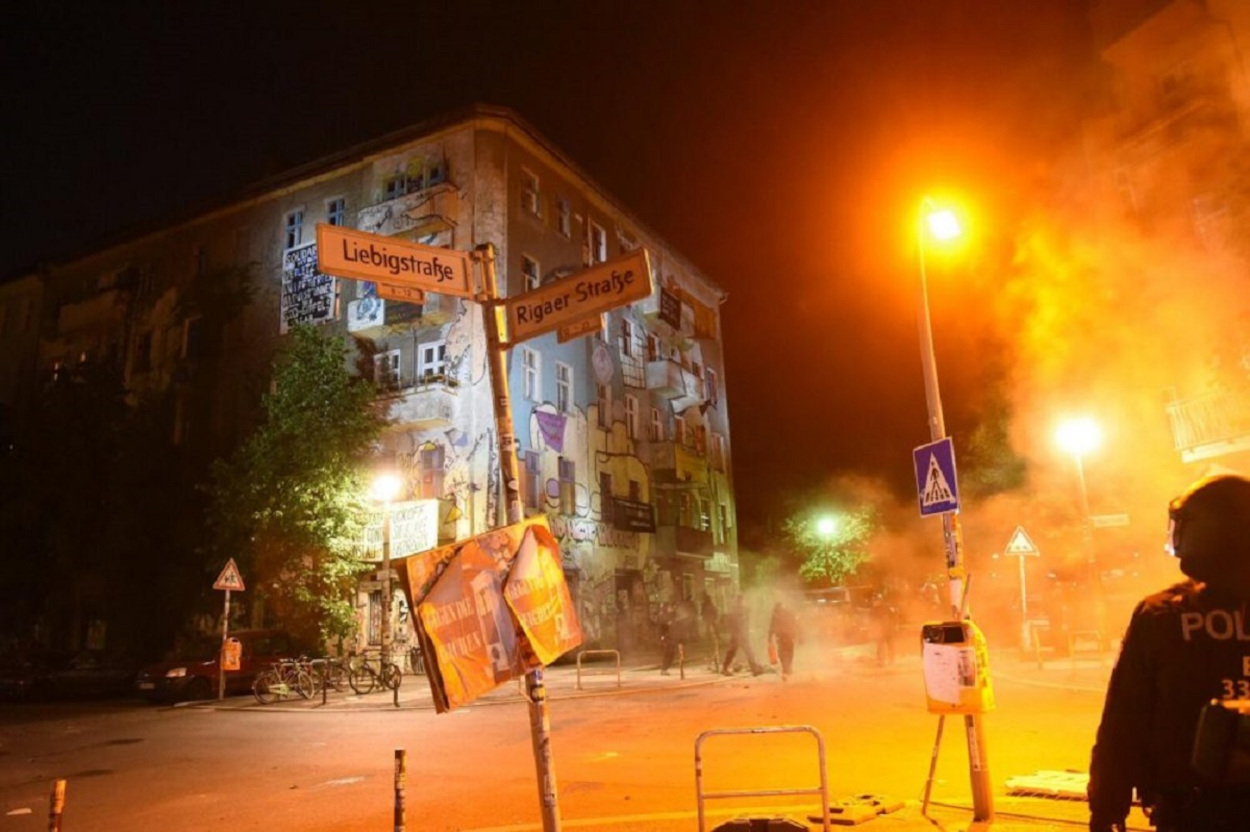
Berlin. Update of the international call for the defence of Liebig 34. Originally published by Defend Liebig 34.
Liebig 34 is being threatend by eviction. When state, cops and the owner want to evict, they will only have a desaster on their hands.
As an anarcha-queer-feminist selforganized house-project without cis-men, directly at the square „Dorfplatz“ in Friedrichshain, Liebig 34 is a place where resistive actions and collective moments are decided and organized.
A place where self-organization becomes a dangerous word, where a project is becoming a starting point of struggles and not just a space of self-reference and alternative entertainment.
Today, we mourn the passing of our friend and comrade, David Graeber, a tireless, insightful, and wide-ranging thinker. In his honor, we present his essay, “The Shock of Victory,” which he composed for the fifth issue of our journal, Rolling Thunder, exploring how anarchists can set long-term goals so as not to be caught off guard by our victories.
David’s unexpected passing takes us by surprise. Only days ago, we were corresponding with him about Facebook’s decision to ban anarchist pages to placate the Trump administration. David was among the first to respond with a support statement, charging that “Nothing could conceivably be more violent than to tell us—and particularly our young people—we are forbidden to even dream of a peaceful, caring, world.”
This was in character for David. He was not just an intellectual—he was always eager to take a stand, putting himself in the thick of things. He participated in the Direct Action Network in New York City leading up to the massive demonstrations against the Free Trade Area of the Americas ministerial in Quebec City in April 2001 at the high point of the so-called “anti-globalization” movement. He was an instrumental participant in the founding of Occupy Wall Street and engaged in the debates about “violence” that followed, confronting the same self-righteous pundits that other anarchists did. He was one of the first to direct international attention to the revolutionary experiment in Rojava when it was threatened by the Islamic State, and joined us a year ago in calling for solidarity when Turkey invaded.
He put his body on the line along with his reputation, braving tear gas as well as academic retaliation. After Yale forced him out for his political beliefs, David was compelled to move overseas to find a university position commensurate with his abilities. He got a corporate publishing deal, yes, but he got it by refusing to compromise, not by watering down his politics.
David wrote—and thought, and said, and did—more than we could possibly summarize here. We hope that others will compose a proper eulogy to him, recounting all of his activities and contributions across a wide range of fields. Even when we disagreed—our analysis of democracy is in part a response to David’s account of democracy in essays such as “There Never Was a West“—we always learned from him. He was a stalwart friend and a worthy adversary.
In Graeber’s most transcendent work, such as the essay “What’s the Point If We Can’t Have Fun?”, he grapples with the basic ontological questions about freedom and the cosmos. This is how we remember him, weaving together different threads to present a vision of self-determination that extends from subatomic particles to entire societies and ecosystems:
“Is it meaningful to say an electron ‘chooses’ to jump the way it does? Obviously, there’s no way to prove it. The only evidence we could have (that we can’t predict what it’s going to do), we do have. But it’s hardly decisive. Still, if one wants a consistently materialist explanation of the world—that is, if one does not wish to treat the mind as some supernatural entity imposed on the material world, but rather as simply a more complex organization of processes that are already going on, at every level of material reality—then it makes sense that something at least a little like intentionality, something at least a little like experience, something at least a little like freedom, would have to exist on every level of physical reality as well.”
He passed away at the young age of 59. Our hearts go out to everyone who survives him. We mourn his passing and grieve for all the things that David had yet to share with us.
David Graeber, rest in peace.
The essay we share here emerged from a discussion about the legacy of anti-capitalist struggles at the turn of the century, during the protests against the World Trade Organization, the World Bank, and proposed “free” trade initiatives such as the Free Trade Area of the Americas. Anarchists and other anti-capitalist protesters played a major role in delegitimizing the WTO and World Bank and even succeeded in blocking the passing of the FTAA agreement—yet afterwards, many of the participants in the movement were dejected, dismayed that we had not succeeded in abolishing capitalism entirely.
Following this discussion, we invited David to expand his thoughts in an essay for Rolling Thunder, and the result was the following essay, “The Shock of Victory.”
Chances are you have already heard something about who anarchists are and what they are supposed to believe. Chances are almost everything you have heard is nonsense.
Many people seem to think that anarchists are proponents of violence, chaos, and destruction, that they are against all forms of order and organization, or that they are crazed nihilists who just want to blow everything up. In reality, nothing could be further from the truth.
Anarchists are simply people who believe human beings are capable of behaving in a reasonable fashion without having to be forced to. It is really a very simple notion. But it’s one that the rich and powerful have always found extremely dangerous.
At their very simplest, anarchist beliefs turn on to two elementary assumptions. The first is that human beings are, under ordinary circumstances, about as reasonable and decent as they are allowed to be, and can organize themselves and their communities without needing to be told how. The second is that power corrupts.
Today 26.8.20 marks one year since the armed hooded men of Chrysochoidis invaded the refugee squat of Spyrou Trikoupi 17 and the neighboring Transito squat. It was early in the morning when they forcibly pulled out families with young children from their beds–people who after much hardship and suffering had found a place to grow roots again in these buildings.
They took them from their home and distributed them in miserable camps to live in the dirt and with indifference in canvas tents. Since then, a barrage of state terrorist attacks on refugee and political squats has led to evacuations, snatching of people, beatings, and arrests.
David Graeber, a brilliant thinker and anarchist comrade passed away yesterday. We republish his essay: What’s the Point If We Can’t Have Fun? Image above: David Graeber (left, with microphone) speaks at Maagdenhuis Amsterdam, 2015-03-07 Originally published by The Baffler. Written by David Graeber. My friend June Thunderstorm and I once spent a half an…
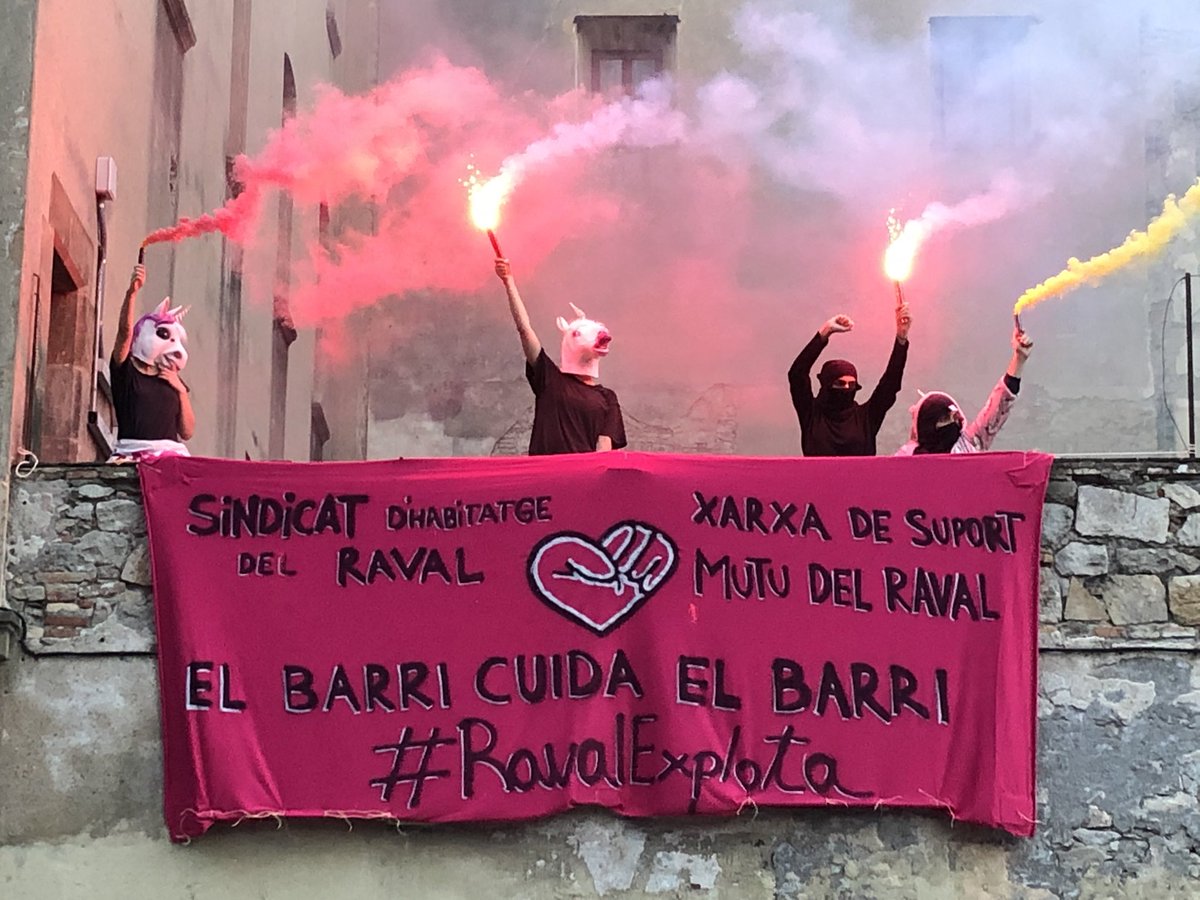
Hundreds if not thousands of Mutual Aid initiatives have sprung up across Iberia during the Capitalist collapse of the pandemic. For us this illustrates the perversity of the ‘Dog Eat Dog’ system and shows how anarchism here is alive and well just under the surface.
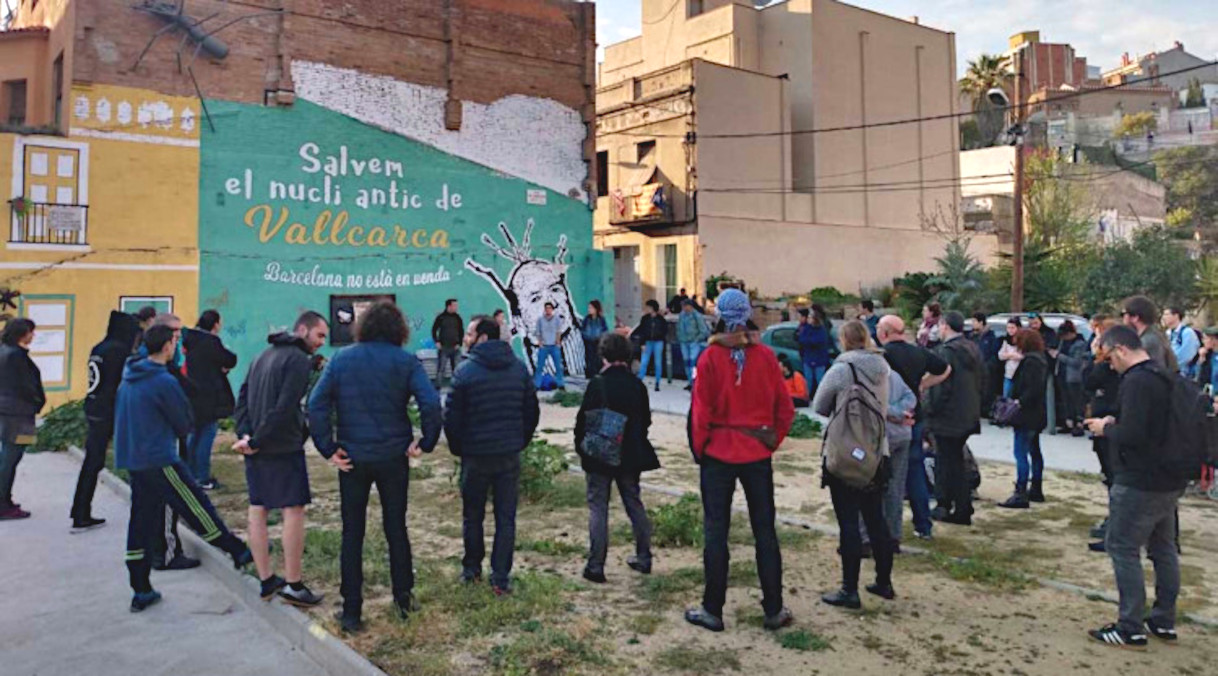
We share links to find out much more, and focus on a couple of radical cases in Catalunya.
info: shared from media and participants.translations by TheFreeOnline
Updateable Map of Mutual Aid projects in central Barcelona , by the CUP ‘anarcho-republicans ‘ https://twitter.com/cupbarcelona.
Solidarity is our Greatest Weapon..LA SOLIDARITAT ES LA NOSTRA MILLOR ARMA
Covid-19 MutualAid – Local organising to support the most vulnerable
Xarxa de Suport Mutu d’Horta-Guinardó
Like many other #mutualaid communities throughout the world, we focus on providing resources and connecting people to their nearest local groups, to willing volunteers and to those in need.
El Raval, an old city centre Barrio is made up of poor families, immigrants, anarchists, old people, students and tourists, mostly employed in the informal ‘black economy’ of bars, restaurants and tourism which simply DISAPPEARED when the Covid virus struck. @RavalSuport @RavalSindicat
Policing is many things and all of them are about mobility. Police arrest mobility through traffic stops and checkpoints, interrupt mobility with borders and curfews, monitor mobility by helicopter or camera, force mobility by firing tear gas or sending in police dogs.
Originally published by Verso Books. Written by David Correia.
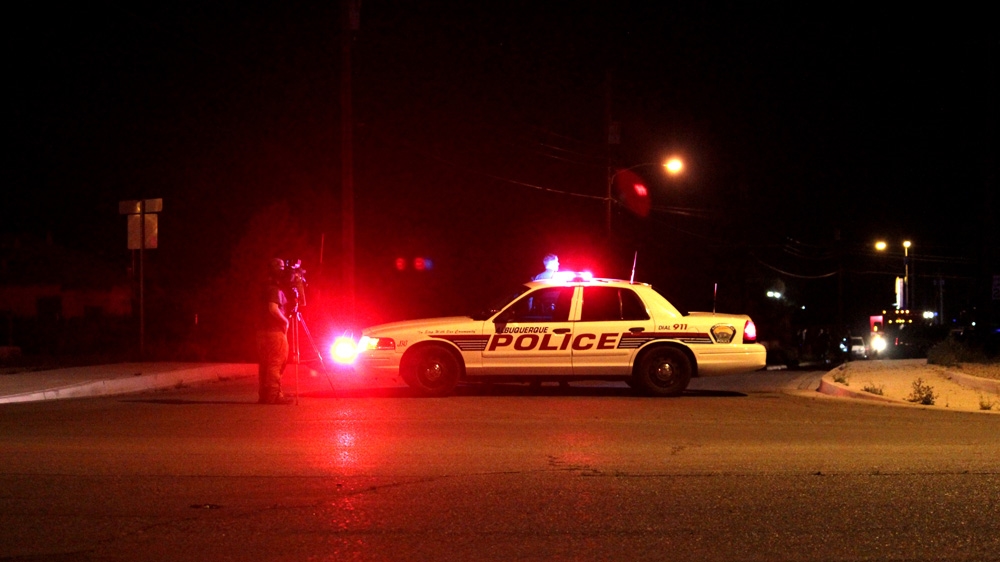
Don’t call it a nickel ride, like they do in Philly. And it’s not exactly a rough ride, like the kind the cops give in Baltimore. It’s called a Nine Mile Ride in Albuquerque because that’s where the ride ends.
It begins in downtown Albuquerque, often near Steelbridge, the current name of what used to be known as the Albuquerque Rescue Mission. Or sometimes Albuquerque cops grab someone from the International District near the Albuquerque Indian Center, a place they call the “War Zone.” That’s where the ride starts.
If you want to know what happens along the way, head out onto the street. Bring water and Covid-19 masks with you because everyone living on the streets needs both desperately. “In the last three months,” one man told us “they cut every one of our water supplies. Cops carry water but they won’t give them out… They have it, they just don’t give it to you.”
Don’t just start asking questions. First give out water. Distribute masks. Then ask if the cops harass them. We went out into the streets late in the afternoon last month, just as the rain arrived to cut the heat. We met a man at a bus stop in the International District and offered him water and a mask.
He thanked us, and then we asked about the cops. Before we could even finish the question he interrupted to say, “hell yeah, they harass me. It’s everyday. They sit there around the corner, watching us, watching me, and roll up on me.” He’s was sitting at a bus stop telling us that cops roll up on him at bus stops, often the only place he can find shade, and tell him to keep moving. “I’m at a bus stop,” he’ll tell them. No matter. Just keep moving.
So he keeps moving. Everyone tells us this. To be policed on the street is to be constantly on the move. It is to be constantly told by a cop you don’t belong. If you’re Native they’ll say, “Go back to the Rez.” Just keep moving.
Policing is many things and all of them are about mobility. Police arrest mobility through traffic stops and checkpoints, interrupt mobility with borders and curfews, monitor mobility by helicopter or camera, force mobility by firing tear gas or sending in police dogs.
There’s this famous essay from 1982 that most cops have probably never read even though it perfectly describes everything they do. It’s called “Broken Windows” and in it two criminologists explain the importance of mobility. They start by admitting something cops never admit. Police patrol has zero “impact on crime rates.” It doesn’t matter how many cops you send out on patrol. More patrol does not result in less crime. And yet despite this, they emphasize patrol as the fundamental police practice. And this is so because social order, they claim, is a product of police patrol. People are afraid, they write, but they’re not afraid of crime. They’re afraid of something else, something called disorder. And you find disorder, they write, wherever you find people who don’t belong.
And so cops are always on the move, out on patrol, on the beat, in pursuit, on the hunt, confronting those they decide don’t belong. People are afraid of “being bothered by disorderly people,” the Criminologists claim. And so the job of the cop is to be on the move, patrolling, in order to “elevate… the level of public order.”
That sounds vague but they have something specific in mind. The job of police is to confront the “panhandlers, drunks, addicts, rowdy teenagers, prostitutes, loiterers, the mentally disturbed” and tell them to get lost. This, they write, is the job of police. While “citizens can do a great deal, the police are plainly the key to order maintenance.”









 The Free