
By Georgina Littlejohn January 3, 2021 https://uspire.life/ shared with thanks

Now here’s a man you’ve no danger of bumping into down at your local supermarket.
In fact, farmer Martin Crawford probably hasn’t brought any shop produce for quite a while because for the last couple of decades he’s been growing his own.

But we’re not talking about your average allotment, oh no. Think bigger – think, forest.
A forest that is modelled on natural woodland and is capable of producing tons of food with as little as a few hours’ work a month.
Forest gardening is a novel way of growing edible crops while nature does most of the work.
Unlike in a conventional garden, there is little need for digging, weeding or pest control. Species are chosen for their beneficial effects on each other, creating a healthy system that maintains its own fertility.

He said: “In the light of our changing climate it is important that we find new ways of growing food sustainably, without compromising soil health, food quality or biodiversity. Forest gardening offers an exciting solution to the challenge.”
His two-acre forest garden is in Dartington and he also has a smaller site in the village of Littlehempston, both in Devon.

Watch the beautiful short video of Martin Crawford’s forest garden on National Geographic. An answer to the future of food? https://t.co/SEikYiiHwH#forestgarden #garden #gardening #sustainablegardening— Green Books (@Green_Books) April 29, 2020
But forest gardens are not normally something that should work in the south west of England. It is standard practice in the tropics, where gardens mimic the rainforest in assembling layers of productive planting beneath the canopy of tall trees.
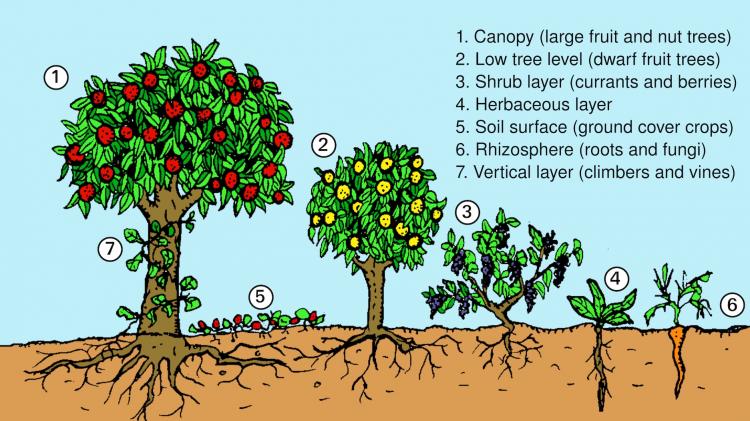
In the UK, forest gardens look more like woodland, with a top layer of larger fruit trees, often hung with vines and climbers, a lower layer of smaller fruit and nut trees, and an understorey of bamboos and berry-bearing shrubs.
Below come perennial vegetables, while mats of herbs and sprawlers cover the ground.

And it was climate change that inspired him.
Speaking to Gardens Illustrated, he said: “All our growing systems should be storing carbon; plants and soil are currently the only way of taking carbon out of the air. No-till agriculture will help a bit, or even scattering a few trees through a grassy field. But forest gardens are the system that stores most carbon while yielding lots of crops.”
“I can’t solve the world’s problems. I’m not a protestor – I’d rather put my energy into practical stuff. But I do believe in the ripple effect. If I can be the stone that makes a few ripples, and those ideas spread out, that’s as much as I can do.”

 The Free
One thought on “When is a vegetable garden sustainable?…When it’s a forest!”