
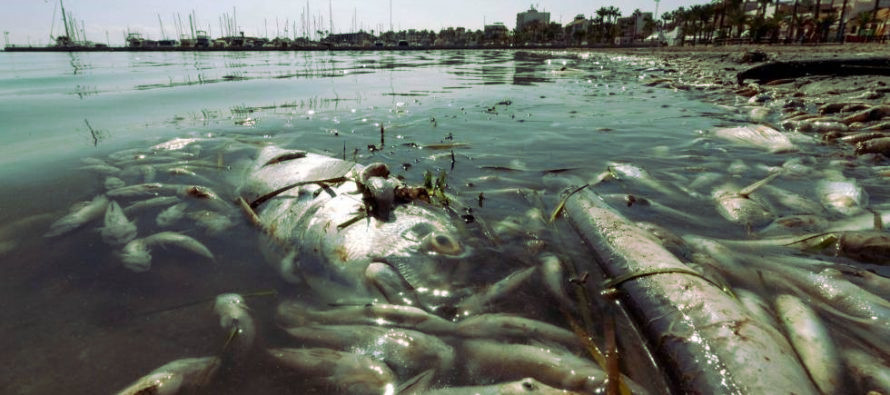
The 21 X 11 km lagoon Mar Menor, jewel of the Spanish coast, is today a Green Soup. The latest eutrophication and mass die-offs in August 2021 emptied the Paradise Beaches at the height of the Tourist season.
#SOSMarMenor #MarMenorEnPeligro #MarMenorVivo
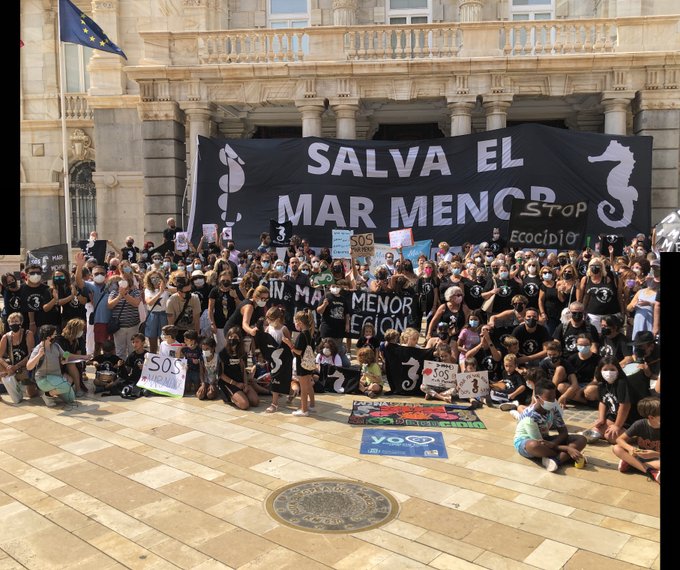
Four to five tons of dead fish were removed from the lagoon within a week. Shortly thereafter, a large demonstration took place, surrounding the entire lagoon on August 28, 2021.. [7]
The lagoon has suffered ecocide, every environmental crime imaginable, for decades, ignored by the right wing authorities of the conservative People’s Party and despite strong local defense campaigns.
A large demonstration is being held today in defense of the Mar Menor in Murcia, Spanish State, supported by 185 groups, to demand solutions for the Mar Menor.
The demonstration, will demand an urgent solution from the administrations to the critical state of this ecosystem. The appearance of thousands of dead fish on its shores, in the middle of the tourist season, has generated numerous headlines in state and international media.

The feeling of loss and indignation has permeated the entire regional society and has crossed the Murcian borders. The Mar Menor is/was one of the most unique and emblematic natural spaces on the peninsula.
Rallies will also take place in support of the demands for a living Mar Menor in Brussels, Madrid, Valencia, Pamplona-Iruñea, Bilbao, Donostia and Alicante. #SOSMarMenor
The organizing groups emphasize that the main origin of the eutrophication process is in the entry of fertilizers (nitrates) from the agricultural sector of Campo de Cartagena, but this is just one of a whole range of severe aggressions.
There are multiple scientific reports that indicate that without a regulation of the use of fertilizers, together with agro-environmental measures that prevent the flow of nutrients from their origin so that they do not reach the ecosystem, their recovery will be impossible.
Pedro Luengo, coordinator of Ecologists in Action of the Murcian Region, has stated: “While the regional government focuses on ineffective ‘end-of-pipe’ measures, which only act on the symptoms and not on the root of the problem. From the scientific field and from social organizations, the reconversion of the agricultural model towards a more sustainable system is being proposed ”.
These measures include the environmental recovery of the boulevards and natural flood zones, the establishment of a renatured strip around the ecosystem and the application of natural systems against erosion, as well as green filters that eliminate most of the sediments and fertilizers that they currently arrive at the Mar Menor. Half measures proposed before but never implemented.
Complaint to Europe

The demonstration in Murcia and the concentrations of support in different municipalities coincide with the formal complaint that ClientEarth and Ecologistas en Acción have presented to the European Commission.
Región Murciana • Ecologistas en Acción

flamingoes on the salt marsh at the north end of Mar Menor
Environmental Catastrophe
Rampant Ecocide/ Climate Change/ Capitalism/Pollution/Tourism/
translated from Wikipedia Español
The balance of the Mar Menor ecosystem is extremely fragile. Despite the fact that a law was passed in 1987 to protect the lagoon and its surroundings,7 its lack of application and its annulment in 2001 have caused the environmental problems of this natural space to be extraordinarily aggravated for the following reasons:
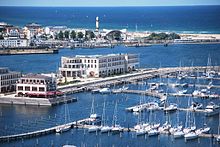
A “Mediterraneanisation” of the waters of the Mar Menor: The widening and dredging of the Estacio channel in 1973 to allow the passage of Mediterranean vessels into the lagoon, more specifically to the marina of Tomas Maestre.
A commitment was made by the minister of public works in 1979 to restore the damage done and thus comply with the coastal law that says that everything must be returned to its natural state, something that was never fulfilled, radically altered the salinity indices and the temperature of the waters.8
Clogging of the lagoon (loss of surface and depth) due to sediment dragging from mining activity and by deforestation through the boulevards that flow into the Mar Menor.

Contamination produced by nutrients mainly nitrates, originating from the expansion of irrigated agriculture in the surroundings of the lagoon and dragged through the boulevards and arrival by underground contributions from the Cartagena field aquifer (aquifer officially contaminated by nitrates since 2001) which causes an increase in the concentration of organic matter, especially phytoplankton (microalgae), thus accelerating the eutrophication processes. 9
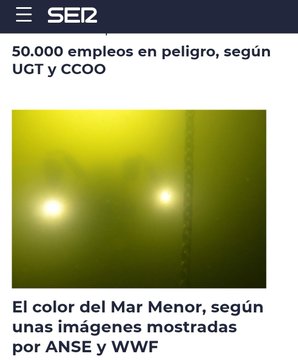
In the spring and summer of 2016, an enormous growth of phytoplankton stained the waters in what since It was then known as “green soup”, which prevented light from reaching the bottom except on the shores and thereby causing the death of 85% of its seagrass beds.

Agricultural runoff water discharges (saturated with nitrates) from coastal municipalities, especially through the so-called Rambla del Albujón.
Urban saturation of the coasts and alteration of natural conditions by construction of roads, dredging of ports, canals, artificial restoration of beaches and infrastructure related to tourism.10
Contamination by hydrocarbons from motor boats and removal of funds by the fastest, such as jet skis.
Cotylorhiza tuberculata, one of the opportunistic jellyfish of the Mar Menor.
Changes in ecosystems. These changes in the environmental conditions of the lagoon have caused enormous changes in the ecosystems, species and fishery resources. Previously frequent species have disappeared, or have been extraordinarily reduced, some of great economic value such as eel or shrimp and others such as the seahorse and others such as the Caulerpa prolifera,11alga

have spread massively, which already covers 95 % of the sandy bottoms and the Rhizostoma pulmo and Cotylorhiza tuberculata jellyfish that in some years have become an apparent pest of millions of individuals, but that nevertheless filtered the water reducing phytoplankton and dampening eutrophication, of which they were a symptom .12 13
Invasive species. Since the opening of the Estacio channel and the massive influx of water from the Mediterranean Sea, there has been the invasion of some non-Mediterranean species. Thus, the presence of the blue crab (Callinectes sapidus), from the American Atlantic coasts14 and the bursatella slug ((Bursatella leachii) that comes from the Red Sea, have been detected.15
Ecocide, manifested in the massive death of marine fauna, October 12 and 13, 2019: The degradation of dead organic matter in this large lagoon, in turn a consequence of the long eutrophication described above, caused a phenomenon of anoxia (lack of oxygen) in the northern basin of the Mar Menor, with thousands and thousands of fish and crustaceans dying on the shores due to lack of oxygen in the water.
This tragic episode was repeated at the end of August 2021 in the other areas of the lagoon.
Se convoca una gran manifestación en defensa del Mar Menor en Murcia
5/10/2021 | Área, portada, Región Murciana “ El jueves 7 de octubre tendrá lugar una manifestación que se espera multitudinaria, apoyada por 185 colectivos, para exigir soluciones para el Mar Menor.
- El jueves 7 de octubre tendrá lugar una manifestación que se espera multitudinaria, apoyada por 185 colectivos, para exigir soluciones para el Mar Menor.
- El apoyo social a estas reivindicaciones ha provocado la organización de concentraciones simultáneas en otras ciudades como Bruselas, Madrid, Valencia, Pamplona-Iruñea, Bilbao, Donostia, Zaragoza y Alicante.
- La manifestación viene precedida de multitud de actos reivindicativos desde mediados de agosto que exigen al Gobierno regional que salga de su inmovilismo y aplique medidas eficaces para devolver la salud al Mar Menor.
- La protesta coincide con la queja formal presentada a la Comisión Europea por la organización benéfica de derecho ambiental ClientEarth y Ecologistas en Acción, donde se exige que se tomen medidas por los incumplimientos de distintas directivas.
Organizaciones en defensa del Mar Menor, entre ellas Ecologistas en Acción, han convocado para el jueves 7 de octubre, a las 20:00, una gran manifestación por la recuperación de este importante ecosistema, apoyada por 185 colectivos sociales, vecinales y sindicales.
La protesta arrancará en la sede de la Delegación del Gobierno en Murcia y en la del Gobierno regional, y terminará en la Consejería de Agua, Agricultura, Ganadería, Pesca y Medio Ambiente, de la que dependen la mayoría de competencias necesarias para poner remedio a la crisis ecológica de la laguna.
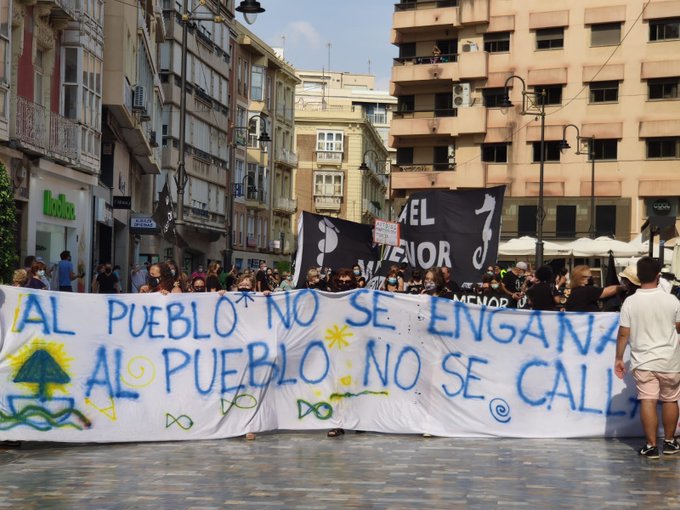
La manifestación, que se produce tras casi dos meses de actividad constante por el Mar Menor, demandará a las administraciones una solución urgente al estado crítico de este ecosistema, en especial al Gobierno regional, que ostenta las principales competencias en materia de ordenación territorial y de protección ambiental. Aunque hace años que se demanda la puesta en marcha de medidas, la aparición de miles de peces muertos en sus orillas, en plena temporada turística, ha generado numerosos titulares en medios de comunicación estatales e internacionales. También ha provocado una gran alarma social, tanto en las poblaciones cercanas como en el resto del territorio.
El sentimiento de pérdida e indignación ha permeado en toda la sociedad regional y ha traspasado las fronteras murcianas, ya que es uno de los destinos turísticos por excelencia de la costa. El Mar Menor es uno de los espacios naturales más singulares y emblemáticos de la península. Por ello, al mismo tiempo que la manifestación en Murcia, tendrán lugar concentraciones en diferentes puntos del Estado en apoyo a las reivindicaciones por un Mar Menor vivo. Bruselas, Madrid, Valencia, Pamplona-Iruñea, Bilbao, Donostia y Alicante son algunas de las localidades en las que se podrá escuchar el grito #SOSMarMenor.

Desde los colectivos organizadores se subraya que el origen principal del proceso de eutrofización está en la entrada de fertilizantes del sector agropecuario del Campo de Cartagena. Son múltiples los informes científicos que indican que sin una regulación del uso de abonos, unida a medidas agroambientales que eviten el flujo de nutrientes desde su origen para que no lleguen al ecosistema, será imposible su recuperación.
Pedro Luengo, coordinador de Ecologistas en Acción de la Región Murciana, ha declarado: «Mientras el Gobierno regional pone el foco en medidas ineficaces de final de tubería, que solo actúan sobre los síntomas y no en la raíz del problema. Desde el ámbito científico y desde las organizaciones sociales se plantea la reconversión del modelo agrícola hacia un sistema más sostenible». Entre estas medidas destaca la recuperación ambiental de las ramblas y zonas naturales de inundación, el establecimiento de una franja renaturalizada alrededor del ecosistema y la aplicación de sistemas naturales contra la erosión, además de filtros verdes que eliminen la mayor parte de los sedimentos y abonos que llegan actualmente al Mar Menor.
Queja ante Europa
La manifestación en Murcia y las concentraciones de apoyo en diferentes municipios coinciden con la queja formal que ClientEarth y Ecologistas en Acción han presentado ante la Comisión Europea. El equipo de expertas y expertos medioambientales de ambas organizaciones afirma que la continua falta de protección del Mar Menor infringe la legislación nacional y de la UE, e insta a Europa a que tome medidas urgentes contra el Estado español.

La comunidad científica ya ha advertido del impacto que tienen esas actividades. Sin embargo, el Gobierno regional y el español no han conseguido controlar el aumento imparable del regadío, en parte ilegal, ni reducir de forma efectiva su impacto. La legislación de la UE exige a las autoridades estatales que tomen las medidas necesarias para evitar el deterioro de las áreas protegidas y la calidad de las masas de agua, como el Mar Menor, el acuífero del Campo de Cartagena y la Rambla del Albujón. Sin embargo, el equipo de personas expertas que han elaborado la denuncia creen que España ha incumplido esta obligación legal al tomar solo medidas superficiales para salvaguardar el Mar Menor.
Contenidos relacionados
- Confirman que el Mar Menor es una «sopa verde»
- Crisis en el Mar Menor: Proponen la creación de una franja renaturalizada
- El proyecto de Colector Norte del Mar Menor es un error
- Las recientes lluvias demuestran que son necesarias medidas en origen y basadas en la naturaleza

 The Free