A Ukrainian government official frequently cited as a source by western news media for her allegations of atrocities committed by Russian troops has been fired by the Ukrainian parliament, in part because of the unevidenced nature of those claims.
Horrific allegations from Ukraine’s Human Rights Commissioner include a 9-month-old baby being penetrated with a candlestick and triplets, 9, being raped in front… ALL 100% LIES
A Ukrainian official has been relieved of her duties over her handling of reports detailing sexual assault allegations made against Russians in Ukraine.
On Tuesday, the Ukrainian parliament, the Verkhovna Rada of Ukraine, removed Lyudmila Denisova, the parliament’s commissioner for human rights, from her post, according to Ukrainska Pravda. No new appointment has been made to fill the role.
The move to dismiss Denisova came after outrage about the wording used in public reports about alleged sexual assaults committed by Russians, as well as the alleged dissemination in those reports of unverified information. Despite accusations from Ukraine, the Kremlin has repeatedly denied that Russian soldiers have committed war crimes or sexual assaults during the invasion.
As it happens, Newsweek is one of the many western outlets who have uncritically cited Denisova’s unevidenced claims in their reporting of events in Ukraine. She was the “Ukraine official” in Newsweek’s incendiary April headline “Russians Raped 11-Year-Old Boy, Forced Mom to Watch: Ukraine Official,” an article whose entire first half featured unevidenced claims by Denisova.
"The racist occupiers must bear the strictest responsibility!" said Ukrainian Parliament Commissioner for Human Rights, Lyudmila Denisova, of Russian soldiers. https://t.co/ObN7cDbEJv
A Ukrainian official has been relieved of her duties over her handling of reports detailing sexual assault allegations made against Russians in Ukraine.
The new REPowerEU Plan presented last week by the European Commission is the latest proposal of measures that would speed up the transformation of Europe’s energy landscape..
The dependence on fossil fuels imported from Russia may be the most pressing issue tackled by the proposal. For the first time, geothermal energy has been included as a mainstream solution to address the challenges associated with both Russian aggression and climate change.
This is good news. only deep geothermal energy can offer not just gigawatts, but terawatts of clean and sustainable baseload energy needed by industry and large-scale district heating and cooling.
Deep geothermal energy can be harvested almost anywhere – at depths of 5 km and more. The problem is that the costs associated with traditional conventional drilling in depths of more than 3 km in the hard rock under increasing pressure and temperature rise exponentially.
GA Drilling, a technology company from Slovakia, is one of the few tech startups developing contactless drilling solutions to enable linear cost increase of drilling to any depth – and it is the only one based in the EU.
GA Drilling has now associated with Narbors to: accelerate field commercialization and eliminate traditional economic barriers of ultra-deep projects to expand global access to geothermal energy.. see report below
Its unique drill bit Plasmabit has already caught the attention of major global players in the drilling and oil industry as the technology to power the deep geothermal revolution, anywhere.
With “Plasmabit inside”, the existing drilling equipment and rigs developed originally for conventional oil and gas exploration in shallow sediments will be able to unlock the vast potential of deep geothermal energy in hot hard rock, guaranteeing the economic viability of geothermal projects.
***********
Nabors invests in ultra-deep geothermal drilling technology company
Apr 1, 2022 shared with thanks
Nabors Industries added to its clean energy portfolio with an $8 million investment in geothermal technology company GA Drilling. GA Drilling’s PLASMABIT drilling tool will be integrated into Nabors’ automated and lower-emission drilling operations.
The collaboration aims to accelerate field commercialization and eliminate traditional economic barriers of ultra-deep projects to expand global access to geothermal energy.
GA Drilling joins Nabors’ geothermal ecosystem, which is comprised of three other prior venture investments in geothermal companies. These technologies were assembled to help make geothermal energy widely accessible across geographies, while reducing cost per unit of energy generated to match the cost of other energy sources.
“Now is the time to invest in innovative and bold geothermal solutions that have the potential to unlock terawatts of clean, renewable and reliable energy on a truly global scale,” said Anthony G. Petrello, Nabors Chairman, CEO and President. ecosystem.”
“The present agreement will allow us to move faster through the final stages of PLASMABIT development, to integrate this revolutionary drilling tool into the systems of the rig. Nabors will introduce European high-technology capacities into the US market. Together, we will work toward meeting imminent demand to rapidly diversify the global energy mix.”
**********
Quaise’s ultra-deep geothermal drilling plans: Your questions answered
Quaise says it has a plan, and the technology, to drill deeper than ever before and unlock the vast geothermal power of the Earth to re-power fossil-fired electricity plants with green energy
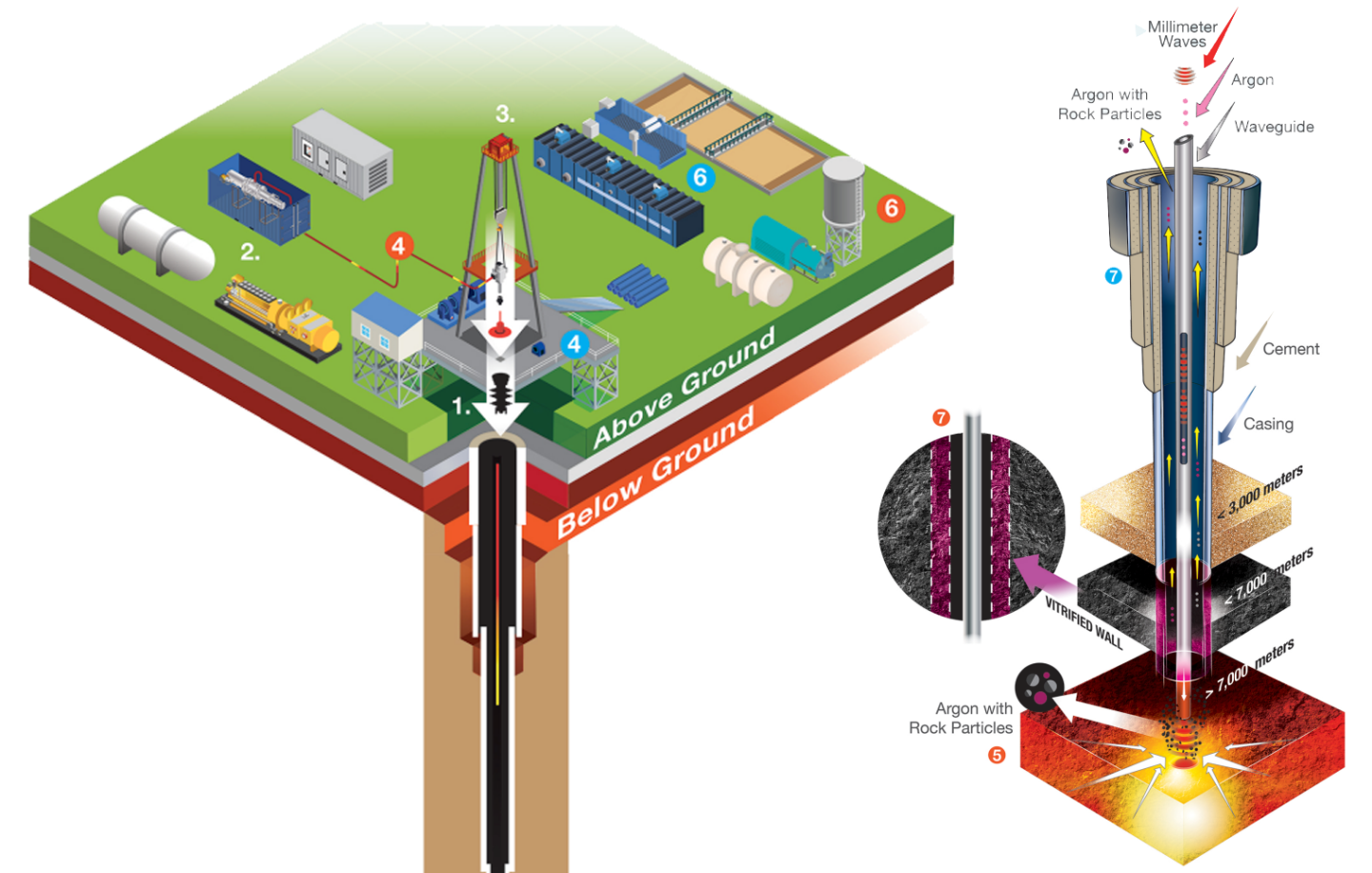
Quaise’s ultra-deep geothermal power plan is one of the most exciting and fascinating green energy projects we’ve seen. In a nutshell, this Boston-based MIT spin-off says it has repurposed powerful millimeter-wave beam technology – originally developed to superheat plasma in fusion experiments – to blast through previously undrillable rock far below the Earth’s surface.
The company says this will allow it to drill bore holes far deeper than has ever previously been possible, going down far enough to access rock temperatures around 500 °C (932 °F). That’s well past the point where water becomes heated to a “supercritical” state that radically boosts the efficiency of geothermal power extraction.
More or less any existing power station that uses fossil-fueled heat to create steam and run turbines can be connected to a totally reliable, 24-hour supply of green energy that’ll keep those turbines turning without a single puff of CO2 escaping, and without the worrying intermittency of other renewable sources like wind and solar energy.
Quaise’s hybrid ultra-deep drilling rig will combine conventional rotary drilling with gyrotron-powered mm-wave directed energy drilling, pressure-purged with electromagnetically-transparent argon gas
It’ll be surprisingly quick, too. The deepest hole humanity has ever drilled to date took nearly 20 years to reach a depth of 12,289 m (40,318 ft), but Quaise says its hybrid drilling rig – using a traditional rotary bit to get through the easy stuff and a gyrotron-powered energy beam to melt, fracture and vaporize the tough stuff – will take just 100 days to deliver you a hole 20 km (12.4 miles) deep.
If all hurdles can be cleared the end result gets you a long-term green energy supply, in a stable bore hole lined with glassy melted rock, wherever you want it.
The details and history are fascinating, and I thoroughly recommend you read our original story to learn a lot more. But as with any radically disruptive idea like this, enquiring minds are going to have questions.
Your questions answered
Here at Atlas we’ve collected the best – and a few of the worst – questions from both these sources, and put them to Quaise CEO and co-founder Carlos Araque, who was kind enough to get back to us. His lightly edited responses are reproduced below.







 The Free