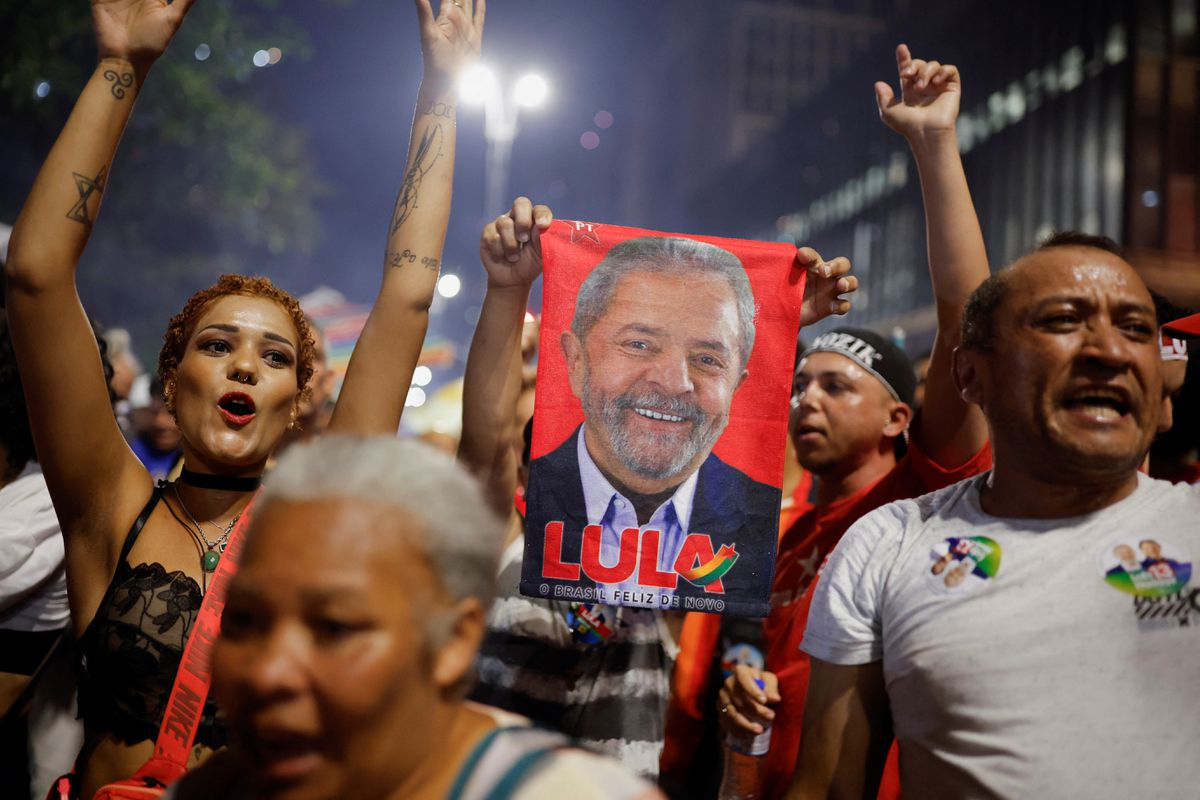
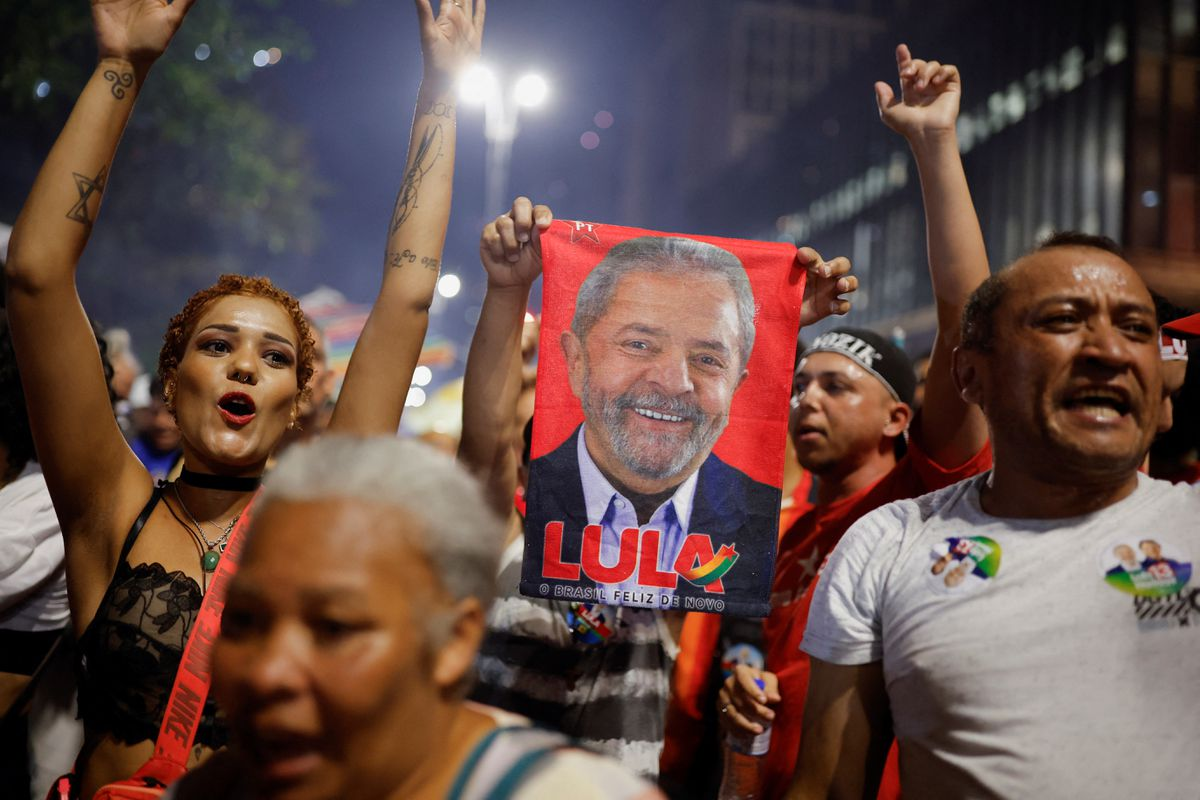
Supporters of the left-wing candidate celebrate on Paulista Avenue Lula da Silva, candidate of the left, has won the presidency of Brazil with more than 96% of the votes counted. The Datafolha institute already considers him the winner of the presidential elections over the far-right Jair Bolsonaro.
LulaPT 60,274,223 %50.9
Jair BolsonaroPL 58,144,711 %49.1
With 99.90% of vote sections accounted for (471,586 of 472,075). Results based on a total of 118,429,081 valid votes.
“You may not have seen the changes we (the PT) carried out, but your gardeners, your drivers, your bodyguards, and your maids did.”[25] Millions erupted into applause as their Lula spoke truth to power.”
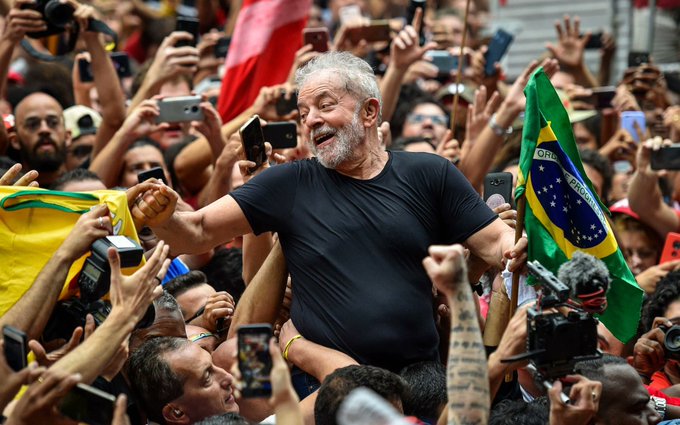
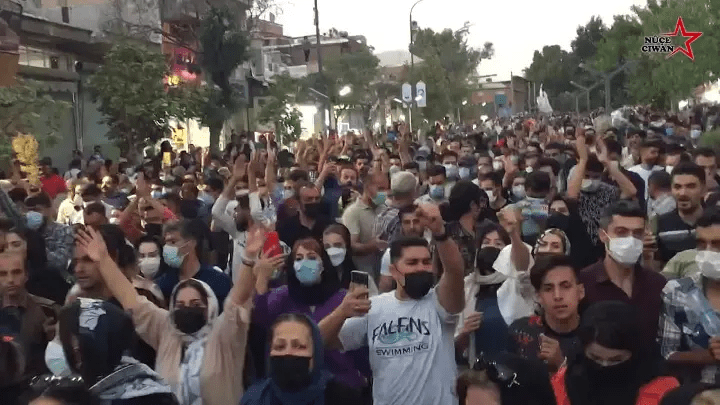
The thousands of followers of the former president from the period 2003 and 2010 have taken to the streets to celebrate his triumph.
Lula da Silva, candidate of the left, has won the presidency of Brazil with more than 96% of the votes counted.
The Datafolha institute already considers him the winner of the presidential elections over the far-right Jair Bolsonaro.
The thousands of followers of the former president from the period 2003 and 2010 have taken to the streets to celebrate his triumph.
Though narrow, the election result will change Brazil and the world. It’s not just one man or party :-The major section of corrupt deputies and parties are committed to supporting whoever is the new President. In the balance is the key future of the Amazonia climate tipping point., the direction of the BRICS alliance and the future of a multipolar world, the end of extreme racism, poverty, misogyny, neo-liberalist looting and ….
….For the past two weeks Globo,CNN Brasil and the other mouthpieces of the economic and political establishment have published headlines stating that Datafolha polls give Lula 45% of the vote and Bolsonaro 33%.[11] A student of Trumpian tactics, Bolsonaro has for the past four years positioned himself as the victim of “the liberal media” and “fake news.”[12]
A military insider and political “outsider,” Bolsonaro has more recently made a list ditch effort to implement populist economic measures to shore up more votes, approving a $7.7 billion dollar stimulus package, which increases cash handouts to struggling families by 50%. According to the same Brazilian study, 61 percent of voters view this eleventh hour move as politically motivated to cut Lula’s lead in the polls.[13]
Brasilia, 30 Oct. (Sputnik/EUROPA PRESS) – El candidato de izquierda Luiz Inácio Lula da Silva (50,83 por ciento) se ha impuesto por un estrecho margen a su rival y actual presidente brasileño, Jair Bolsonaro (49,17 por ciento) con el 98,81 por ciento escrutado.
Lula afianzó así las opciones de remontada tras un inicio del recuento en el que Bolsonaro estaba por delante.
Igual que ocurrió en la primera vuelta del 2 de octubre, Bolsonaro ha aparecido como la opción más votada hasta bien avanzado el recuento. Entonces fue Lula quien logró más respaldo, aunque no el suficiente como para lograr la victoria directa en primera vuelta.
Más de 156 millones de personas estaban llamadas a votar en estas elecciones, las más polarizadas de la historia del país, con dos propuestas antagónicas.
La campaña ha sido una de las más violentas que se recuerdan en Brasil. Este domingo, los electores también han votado para elegir al gobernador de São Paulo y de otros 11 estados que no resolvieron el resultado en primera vuelta.
La jornada se ha visto empañada con denuncias de que la Policía Federal de Carreteras, un cuerpo considerado cercano a Bolsonaro, realizó cientos de operaciones en las que detuvo a autobuses para revisar la documentación de los votantes, especialmente en los estados de nordeste (donde Lula tiene mayoría), lo que atrasó el ritmo de votación. El presidente del Tribunal Electoral, Alexandre de Moraes, declaró que lo ocurrido no afecta en los resultados.
«Hoy es posiblemente el 30 de octubre más importante de mi vida. Y creo que es un día muy importante para el pueblo brasileño porque está definiendo el modelo de Brasil que quiere, el modelo de vida que quiere», declaró Lula esta mañana al depositar su voto.
Por su parte, Bolsonaro dijo que tenía «expectativa de victoria por el bien de Brasil». «Tuvimos buenas noticias en los últimos días. Si dios quiere, ganaremos hoy por la tarde», afirmó.
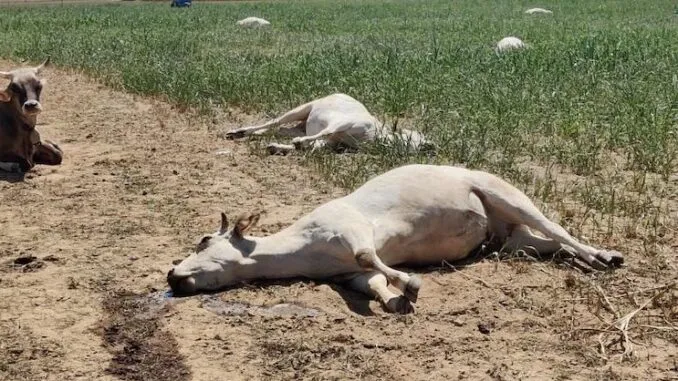
Dairy farmers in Australia are being forced to inject dangerous mRNA vaccines that contain spike proteins into cattle just so they can remain in business. Just like in humans, the jabs are causing severe reactions in many of the animals and a large percentage of them are dying instantly.
According to reports, 35 out of 200 cows suffered “instantaneous death” after being administered the toxic vaccine.
Uncanceled.news reports: Analysts consider the mandatory vaccination of cows as a direct attack on food supply. Many of them are asking if the milk and other by-products would contain the spike protein that actually harmed the animals.
“Dairy herd DNA is altered. Milk is altered and you consume it. Butter constitution, yogurt, cheese, and meat are altered. Will chicken and other meats be next?” Principia Scientific…
El exmandatario Luiz Inácio Lula da Silva y el presidente Jair Bolsonaro cerraron ayer sábado sus campañas en los mayores colegios electorales de Brasil, que serán decisivos para la ajustada segunda vuelta de las presidenciales de hoy domingo.
Lula, favorito en todos los sondeos, participará en una marcha en la icónica Avenida Paulista de la ciudad de Sao Paulo para «celebrar la democracia», en compañía de sus principales aliados, entre ellos su compañero de fórmula, el liberal Geraldo Alckmin.
La asesoría del exjefe de Estado (2003-2010) señaló que será «un desfile», al que han invitado a los entregadores de aplicaciones móviles y que estará dividido por colores, cada uno de los cuales hará referencia a un «desafío» de Brasil.
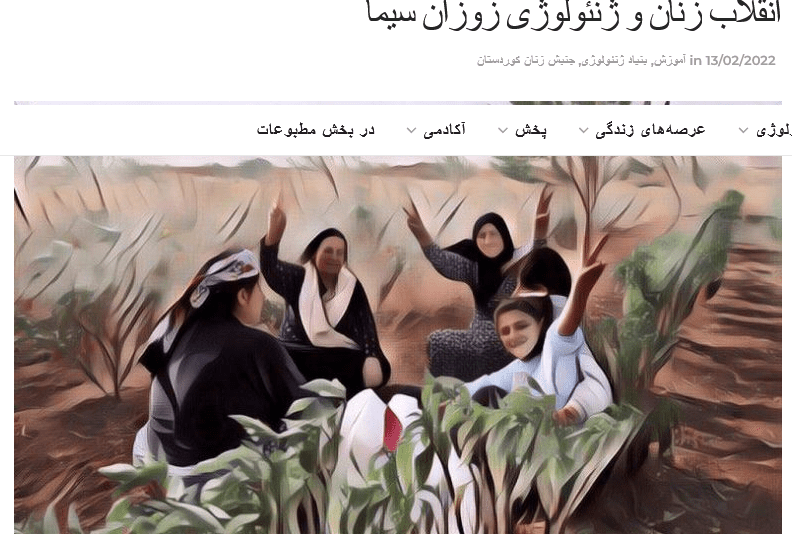
The heroism of the Kurdish guerrilla women is accompanied by the painstaking work of women indulging in groundwork to organize and innovate alternative forms of resistance that would be a step in accomplishing the kind of world the women’s movement in Kurdistan wishes to achieve and inhabit.
It is perhaps true that the Kurdish resistance garnered most media attention with the circulation and popularization of images of female militants of Kurd armies, symbols of a revolution where women were more not mere victims of violence, but important actors and agents.
However, there is a longer history of social revolution that precedes these women taking up arms – a revolution that sought to change interpersonal relationships, community rules and settings and ways of dissemination of information and ideology and pave the way for a future that allows the imagination and realization of radically transformed spaces.
Even before garnering media attention in the West, Kurdish women were being recruited to militant forces, forming Congresses, and parties were forming women’s wings. On 8 March 1995, the first women’s congress took place, and by 1999 the PKK had a separate women’s wing. (Melis, 2016)
In the early 1990s, by some estimates, women made up a third of the fighting force of 17,000 militants in the PKK. (Ozcab, 2007) PKK leader Ocalan’s views that centered women and anti-patriarchal resistance in the fight against the state and capitalism, largely stemming from Engel’s writings and Marxist-Leninist ideology, served as an important base for Kurdish women’s resistance.
The Kurdish movement’s aim later shifted to a goal of ‘democratic confederalism’. We can find traces of both these visions in the ideals and beliefs that have governed Kurdish feminist actions.
Forty-seven people have so far been charged with offences relating to the disturbance. Many had initial charges of affray and violent disorder escalated to riot before they reached the Magistrates Courtand received crazy long sentences.
Campaign statement by Justice for the Bristol Protesters
Justice for the Bristol Protesters (JBP) is a group of parents, friends and supporters of those charged with riot and given harsh prison sentences as a result of being involved with the protest against the Police Crime and Sentencing Bill in Bristol on 21 March 2021.
Most of these protesters are young people, who had never been in trouble with the police before and were demonstrating legitimately against the Police Bill for the right to peaceful protest and freedom of expression..
Many were subject to violent attacks by Avon and Somerset Police who hit them with batons and bladed them with riot shields; at least one protester was knocked unconscious and another, a young woman of colour, Mariella Gedge-Rogers, feared for her life as she was pinned to the ground in an unprovoked attack by three police officers:
I was kneed to the floor by police and dragged around the floor by another officer whilst 3 officers held me down and one stood on my hand with their boot, my head was on the curb…this experience was very frightening…I didn’t know if I would get back up. I feared for my life... The Canary, 4/3/22
In contrast, the police claims of serious injury to officers were later retracted.
Forty-seven people have so far been charged with offences relating to the disturbance. Many had initial charges of affray and violent disorder escalated to riot before they reached the Magistrates Court.
It is very rare in England and Wales for the riot charge to be used in legitimate protests and requires permission from the Director of Public Prosecution. While many cases are still awaiting sentence or are going through the Courts, at least 15 people have so far been convicted of riot and sentenced in total to over 75 years in prison.
Such widespread use of the riot charge in this instance, compared to other more serious disturbances where the riot charge was not brought, looks like an assault on our legitimate right to protest and a deliberate attempt to silence dissent.
The young people caught up in the disturbances of 21 March 2021 were standing up for everyone’s right to freedom of speech and have paid a very heavy price. As well as disproportionately harsh prison sentences, many have been traumatised by their experiences and have been demonised by the mainstream media. JBP aims to restore their reputations and get them the justice they deserve.
The state made an example of our loved ones. We demand they are returned to us immediately.
note: One of Max’s clear mistakes is to link Iraqi Kurd support for the Irani Women’s Uprising to the local US proxy Barzani Govt (KRG). The support comes from the anti-Barzani Sulaymaniyah Governate which as a result suffered lethal air raids from Iran as well as continuing the murder campaign by Turkey ofAzadi supporters and the Jineoloji women’s leader Nagihan Akarsel
Editor’s Note: The following was originally published by the Grayzone.
MAX BLUMENTHAL: Welcome to The Grayzone.
Protests inside Iran triggered by the death of Mahsa Amini, a young woman who was picked up by Iran’s morality police on the grounds of supposed indecent exposure, have drawn massive international attention. Media around the world are following these protests, and on social media the hashtag surrounding Mahsa Amini’s name has generated more attention and retweets than almost any hashtag in Twitter history.
So how much of this international response is authentic? And how much of it is related to genuine concern for Iranian women—and not long-standing Western desire for regime change in Tehran? To better understand this issue, I spoke to a woman inside Iran. Her name is Setareh Sadeghi. She is an independent researcher, a translator, a teacher, and a Ph.D. She lives in the city of Esfahan.
Setareh Sadeghi, let’s talk about you and your own political views before we get into some of the details of these protests and the campaign behind them.
You studied the U.S. Civil Rights Movement as part of your Ph.D., and you’re also a student of propaganda [analysis]. Where do you situate yourself within the Iranian political spectrum, and specifically do you support women protesting the morality police and issues like the hijab?
SETAREH SADEGHI: Well, yes, as you mentioned, I finished my Ph.D. in American Studies, and I studied propaganda analysis as part of my Ph.D. dissertation, and the rhetoric of social movements as well. So, I have always been supportive of the Iranian government as a whole—the notion of an Islamic republic—but I have also been critical towards a lot of the things that happen in my country, like many of the other people who live here.
So, for the issue of hijab, as someone who believes in hijab and has always practiced it, I am totally against the morality police. By the way, in Farsi, the word that we use for it is the “Guidance Patrol,” but in English it’s usually referred to as the morality police, and I’m totally against it. I have been a part of the people, especially women, who took it online and used hashtags to talk about how they do not believe in the morality police even though they believe in hijab. And this is not something new. It has been in place from many years ago, but it’s become more significant this year.
So, even before these protests and before the tragic death of Mahsa Amini, people were talking about it online and I was also one of them, because I saw this was totally unacceptable. And even in my personal life—because I have friends who do not believe in the hijab and they don’t want to practice it, or they practiced it in a way that did not fit the standards of the Islamic Republic’s law of the dress code, and they were stopped by the morality police. In at least three cases that I remember, I would just go talk to the morality police and tell them, as someone who believes in hijab, I am totally against what they’re doing, and this is not the way they should enforce the law. Because it’s not always that they… the morality police don’t always arrest people. Their main job was to go and tell people. But even that, I’m totally against it and I don’t think that’s something that works, mainly because a lot of people who live here believe in some sort of dress code. I think as a woman, I think that’s not something that people should tell us. Like, I believe in law and order, but also, I don’t like being told those details, like how to dress and how to appear in public.
MAX BLUMENTHAL: So, what is the role of the morality police and how much public opposition is there to this unit of the security services? And are they known for being as brutal as they’re currently being portrayed?
SETAREH SADEGHI: Well, yes, they are known as being brutal because Iranian women don’t find it acceptable—not necessarily because everything that they do is brutal, but some harsh treatments are an integral part of the way they enforce the hijab law. But it’s also that, while I think a lot of people are against the morality police, it’s not that everyone is against the mandatory hijab law. So, these are two things that should be studied differently. A lot of people, I mean, there are different surveys, and different surveys in different provinces show a different percentage of people believing in obligatory or mandatory hijab, and I think that’s something that has to be dealt with based on the local culture of each province.
And that is also reflective of how the protests are going on, for example, in my hometown, because it’s considered more conservative and more traditional. The protests there are very much smaller than what you could see in other cities, for example, in Tehran or Rasht or other cities where the protests were significant compared to what is going on in my town. So, yeah, there are also people who believe that the morality police should be in place but the methods that they’re using should be different.
So, I think if you want to categorize women and people who live inside Iran, we have people who are totally against the mandatory hijab. They don’t believe in hijab at all and, obviously, they don’t believe in morality police. We have people who believe in hijab, but they don’t believe in the morality police or the mandatory hijab. We have people who believe in hijab, and they believe in the morality police, but they don’t believe in the methods that they are using. And that also creates a collective of people who are against the morality police but, again, based on how they feel towards it, their participation in these protests is different.
MAX BLUMENTHAL: So, let’s talk about the issue of Mahsa Amini. What do we know about her death? Most people in the West who are following this believe she was beaten to death by the morality police in police custody. Has that been established as the case, and is that the understanding even of the protesters in Iran?
SETAREH SADEGHI: Not really. I mean, even a lot of those Western media outlets corrected their headlines or started using different terms, referring to the case when the CCTV footage of the moment when Mahsa Amini fell and went into a coma was published. So, a lot of people believed that footage, about how some people said that she had bruises on her legs when she was taken to hospital, which shows that there was a beating. But the footage clearly shows that she was in good health conditions when she was there, based on what we see.
An investigation has been ordered. The files all are not yet published. There are talks about it, but there’s not a final statement by the state. The last thing that they have said is that the probe shows that there was no beating involved. They even released the CT scans of her brain and, as I said, there was CCTV footage. So, while there are protesters who believe that the beating happened, there are also a lot of protesters who think that it did not happen. But the fact that a young woman died in police custody only because of violating the dress code is something unacceptable, no matter what exactly happened in police custody.
MAX BLUMENTHAL: You’re in Esfahan, which is a large city in Iran, outside of Tehran. Most of the protests, as far as we know, have been centered in the capital of Tehran, and you have been receiving a wave of death threats for reporting that the protests in your city were very small and that the protests have not spread to key Iranian cities. Is that still the case?
SETAREH SADEGHI: Well, because I have already blocked a lot of people, and because the person who started those threats, as someone who knew me in person, at this point I can say that I haven’t received any new threats. But it was because I appear on different media and I have talked about Iran as a political analyst, I’ve always received insulting or sometimes death threats. But this time it was really unprecedented, as it was started by someone who knew me in person and had my personal information, and even the number of the people who attacked me was really huge.
And it started with the Independence Farsi account on Instagram, publishing a snippet of my interview and disregarding all the criticism that I had against the morality police, the crackdown on everything, and just saying that I lied about the number of the people participating in the protests, or the fact that these protests are much smaller than the ones that we witnessed, for example, in Esfahan in 2019. But at the same time there were a lot of people who were totally against even the Islamic Republic. But I mentioned that, and they verified it and they said that they were part of the protests, and that’s true. It was not significant because, as I said, Esfahan is a conservative and more traditional city, and people take to the streets on different issues. The morality police are, I guess, not the number one issue for people who live here. And I talked to my friends who don’t observe the hijab completely or according to the law, and they said that this is really not their number one issue, and so they don’t want to be part of the protests.
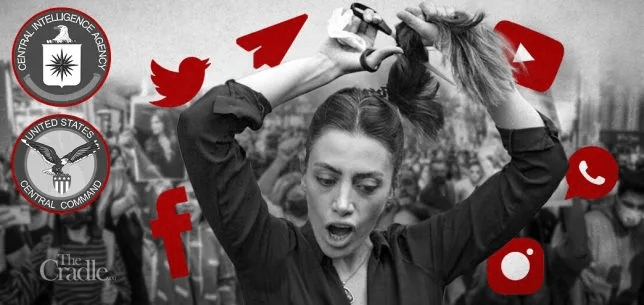
MAX BLUMENTHAL: Right. We’ve seen large protests over the price of food or economic issues in Iran that were totally ignored in Western media. So, what do you make of the response in Western media, not just Western broadcast media but social media as well? The Mahsa Amini hashtag is one of the most popular hashtags in history, as you tweeted. It’s as if there are no other issues in the entire world. Do you think the outrage that we’ve seen on social media is authentic, or something that is being encouraged or pushed by Western—specifically NATO—states, the same way that there was a massive social media amplification campaign around the so-called Arab Spring?
SETAREH SADEGHI: Yeah, that’s true. I mean, social media has never been a true reflection of what’s happening in different societies, especially not Iranian society, because Twitter is blocked here, and a lot of people do not have access to it. So, the number of Iranian users on Twitter is not significant because they use other [platforms]. For example, Instagram. Before these protests Instagram was not blocked, and a very large proportion of the population had Instagram accounts, especially because they also used it for selling products and they had their businesses on it; especially a lot of women run their own business on Instagram. But Twitter is very different and it’s something that is known by Iranians. Even those who are on Twitter, they know that it’s very different from the realities on the ground. And it’s surprising how when there was, especially in those towns where the protests were met, the crackdown on it was really severe and a lot of people couldn’t even use the hashtags, [but then] broke a record, which tells us that there is something that doesn’t come from Iran.
And there is a history of fake hashtags and fake accounts and trolls on Twitter, trying to portray Iran in a different way, and it’s not only about a protest. There are other cases. For example, there was a time when, if you posted anything positive about your life in Iran, you would be attacked by these trolls, because they said that you are normalizing Iranian people’s misery, as if there is no normal life in Iran and the only thing that you are allowed to post online about Iran is just all the problems and the grievances. They attacked a university professor for only posting pictures of him[self] inside a cafe in Tehran, for example.
So, we also have the case of Heshmat Alavi, who apparently is a Twitter user who posts against the Islamic Republic on Twitter. And it’s interesting that when Trump withdrew from the JCPOA [Joint Comprehensive Plan of Action known commonly as the Iran nuclear deal], he mentioned that the JCPOA is facilitating Iran’s crackdown on its people or on certain issues, and two Washington Post journalists asked for a source. And the source that Trump offered was an article written by Heshmat Alavi. And an MEK defector later also talked about how the camp in Albania, the MEK camp in Albania, uses its members to start hashtags and make them a trend, and they’re paid to post about it.
MAX BLUMENTHAL: Just quickly, for those who don’t know, the MEK is the Mojahedin-e-Khalq, which is a U.S.- and Saudi-backed opposition movement, dedicated explicitly to regime change in Iran and replacing it with its cult-like leader, Maryam Rajavi. They have been based in Albania under the watch of the US military and U.S. intelligence, and it’s there that they maintain a troll farm, as you said, to spin out hashtags against the government in Iran. And this account, Heshmat Alavi, apparently was a sock puppet run out of this troll farm.
SETAREH SADEGHI: Yeah, that’s what the investigation shows. And even for the recent hashtag, the historical hashtag trends about Mahsa Amini, a few Iranian users track them and try to find out where those hashtags come from. And then you see a lot of users just posting nonsense, like alphabets and then using the hashtags, and right now I think it surpassed a hundred million times the hashtag words in Farsi and in English, and they come from a limited number of users. I think it’s less than 300,000 users that have been using the hashtags, but it already has the historical trend on Twitter.
And it’s interesting how, as you said, the protests in 2019, because at that time they were also really huge in my neighborhood. And in Esfahan I did not see any reflection of it online, because usually, like that protest was more by the working class and the middle class because it had economic causes, and it affected a larger proportion of the population. So naturally it was bigger, but you wouldn’t hear about it 24/7 on mainstream media or on social media. But this time, it’s a social issue, and it’s a very important issue for women, but at the same time it’s not really as big as the previous protests that we had. But we already have a historical record of hashtags for it, so it totally shows that it’s not reflective of what is actually going on in Iran.
MAX BLUMENTHAL: Well, The New York Times is also reporting that the US State Department and its allies are trying to get communication gear into Iran. However, much of the noise about these protests appears to be coming from the outside. Because of an issue that Westerners can relate to, we’re deluged with identity politics here and we don’t have large economic protests here in the United States anymore, outside of maybe some union activity, some strikes. This is a case of the weaponization of identity, and obviously a real issue, as you point out, a real issue with the morality police may be not at the top of the agenda but something that upsets a section of the population in Iran.
But outside much of the noise is being made by Iranian exiles or expats, and one of the key voices who’s emerged in U.S. media, cable news media, is a figure named Masih Alinejad, who I’m sure you know. She’s been backed by the U.S. government, paid hundreds of thousands of dollars in contracts with the Voice of America, which is the U.S. government’s global broadcasting system. She’s met with former CIA director and Secretary of State Mike Pompeo. Recently she cooked up a phony plot in coordination with the U.S. government and the FBI, claiming that the Venezuelan security services were going to kidnap her and take her on speed boats to Iran. It was one of the most ridiculous plots I’ve ever heard, and it was widely reported in U.S. media. Now she’s back. So, what do you make of Iranian expats kind of taking the mic and becoming the voice of the Iranian public?
OH, LOOK: it's Massih Alinejad with Mike Pompeo. Now why would that & f tons of smuggled arms, coming from Azerbaijan into Iran for 'protestors' make me wonder if this is the US co-opting another grassroots mvmt…on the heels of Russia receiving untold #'s of kickass drones… pic.twitter.com/0Pq1WkQatI
— Captain Crusty Abolish NATO ~ End ALL Sanctions (@CaptainCrusty66) September 24, 2022
SETAREH SADEGHI: Well, I wouldn’t mind. Obviously, Iranian women would be very happy if those in exile really wanted to be a voice for women inside, but the thing is they are just echoing the voice of, I would say, a minority and just a section of the population in Iran that they agree with.
I think they also believe in the Western liberal notion of freedom for women, and not the notion—they don’t really care. I’m not talking about everyone, obviously, but some of these people who are given a voice and whose voices are amplified over the voices of women inside Iran, they’re just repeating the Western notion of freedom for women. And they do not understand that women in Iran can have a different notion of freedom, and [that] they have other priorities when it comes to women’s rights and women’s activism.








 The Free