The Spanish Socialist Movement (MS) and Organized Anarchism

Translation by thefreeonline on January 7, 2023 / By @BlackSpartak 5 Jan 2023 Spanish original: alasbarricadas.org

We have spent two or three years watching the construction of what has been called the Socialist Movement (MS), a plural process with different aspects and realities depending on the territory. For those who do not know it, it is the process of renewal of state communism, beginning in its most dynamic part: Euskal Herria.

Looking back, after the 2008 crisis, the Basque National Liberation Movement (MLNV) entered into crisis. There was a renewal at the base and in its leadership a sector of the middle class and working aristocracy took control, which has been the one that has reached our days.

The youth of the Izquierda Abertzale (IA) used to be in the gaztetxes (occupued social centres) or in the student and youth movement. It was precisely in this sector that the rupture that gave rise to the Socialist Movement (MS) occurred. But we have to take into account other factors that were occurring in those years:

The end of ETA, which contributed to relaxing the police and political persecution against the Basque National Liberation Movement (MLNV). Despite some police and media stunts, the repression visibly decreased, loosening the traditional “closing of ranks” that characterized the Abertzale Left.
The radicalization of ELA and its consolidation as the largest union of the transforming left, not only in Euskal Herria but in the entire State. This radicalization even caused it to overtake LAB on the left, the latter being subject to the dynamics of AI.
The rise of the struggles in other territories. To start 15M, but to characterize the period, we will refer to the Catalan Sovereign Process.

Regarding this point, that of Catalonia, in sectors of the AI they saw with envy how a mass movement in favor of independence had been created. They noticed that this movement was cross-class and brought together very different interests that only coincided in the need for independence.

However, the Independentist Process was defeated in 2017, and at that time all the contradictions appeared at once. It was possible to see the destructive work of the Catalan politicians who boycotted the process from within, while facing the outside they proclaimed themselves very independentistas.

Clashes between pro-independence parties were a constant and the society that supported them became disenchanted with them.

Returning to Euskal Herria, at the II Ernai Congress in 2017, a paper was presented with the title Kantauri, which sought to restore the class independence of Basque youth, subject to the interests of the middle class.

Miles de personas se manifiestan en Pamplona en apoyo al ‘Gaztetxe Maravillas …

As can be seen, the malaise and the lack of clear referents, was forged in the gaztetxes and gazte asanbladak of the whole of Euskal Herria.

The Basque National Liberation Movement (MLNV) had certainly always been a movement with good training schools for cadres. It was also a movement that was surrounded by magazines, collectives or even public organizations of a Marxist-Leninist nature. In other words, communism was normalized at an aesthetic and political level within the MLNV. When the new generations who felt out of place in AI became aware, they subscribed to that ideological framework.

Basque anarchism had no opportunity to occupy that space. First, because it had been in trouble with the AI communists themselves in the previous decade.

Then because this scene was very focused on anti-development or environmental campaigns and little managed to transcend outside of that area.

Finally, due to the subcultural nature of Basque anarchism in many places, it made it a world apart from its neighbors.

At a general level, anarchism in the Spanish state had a crisis in 2015-16 that saw many groups disappear. Its crisis coincided with the one experienced by the social movements in the state.

We could hardly have connected (or even taken into account) with the people coming from the Marxist camp who were looking for new referents right in those years.

This could only be achieved with direct, constant, honest and long-term contact, demonstrating a solidity and open-mindedness from our field that we have almost never had as a result of our political culture, focused on our own movement and the creation of free forms of life without taking into account the capitalist context.

By not making the gestation of a revolutionary and socialist project from anarchism a priority, it was difficult for people trained or socialized in other socialisms to approach us.

The political culture transmitted to the Abertzale youth gave it a certain political solidity that forged into a new organization, the Socialist Movement (MS) around 2018. From there it began to develop a clearly communist strategy and program. Ikasle Abertzaleak, the student wing of the AI, soon fell under its influence and a new socialist feminist organization, Itaia, developed.

. The meetings became more and more massive, leading to the creation of the Gazte Koordinadora Sozialista, GKS, in 2019, which came to gather the gazte asanbladak under communist influence. Their meetings drew attention, such as the Gazte Topagune Sozialista de Altsasu in 2021, in which there were some 2,500 young people from all over the Basque Country.

This process began to attract attention in other territories of the state. In the ‘Catalan Countries’ (Catalonia plus parts of Aragon, Valencia, Baleares and France), after the 2017 fiasco, the independence movement suffered a political crisis. In its anti-capitalist sector, the Esquerra Independentista, a dissension arose that called for a return to the Marxist theses, momentarily leaving aside the demand for national liberation.

Therefore, there has been an abandonment of the traditional thesis of the Esquerra Independentista, the Popular Unity.

The rupture has not occurred in a very peaceful way, perhaps like most ruptures, but it has generated a new movement carried through the Horitzó Socialista magazine. Various assemblies from Arran, the youth organization, the SEPC, the student organization, and some people from Endavant, began to swell this trend, which still does not have a very solid structure.

Another of the processes is the Encounter for the Socialist Process (EPS) of Castilla, which has carried out presentations in Madrid, Burgos and Valladolid. The EPS takes the work done in Euskal Herria by the GKS as a reference.

Although with its own characteristics. Some militants who come from anarchism see this process as a reconstruction of the political space of the Autonomy of the 90s, which could unite Marxists and anarchists in the same movement.

Manifestación por las calles de Bilbao para pedir la amnistía de los …elmundo.es

In Aragon, Purna took this line a long time ago, as a renewal process in the face of the crisis suffered by left-wing Aragoneseism when Podemos emerged in 2014.

In Galicia, a process similar to the Spanish one is taking its first steps, taking the GKS as a reference. In this case, militants who have been in other Marxist organizations of Galician national liberation pivot towards this process.

As characteristic points, all these processes that will soon begin to form part of the same political space, as soon as they are coordinated. They demand the political independence of the working class, that is, that the leadership arise from the labor movement itself and not from the universities or wealthy environments, as we have seen in many left-wing parties in recent decades.

On this anarchism could not agree more. Another of the MS’s workhorses is its criticism of social democracy and its disastrous influence on today’s society and on revolutionary movements. What are they going to tell us? We have been writing about it in the libertarian press since 1874.

The Basque Socialist Movement (MS) is creating Socialist Councils, as organizations for the political and strategic leadership of the proletariat. In other words, they come to be like the embryo of the communist party that they intend to build. These agencies also claim to control the economic process.

They say that the future communist party should not be just another party in the parliamentary struggle but rather an “embryo state” that will develop its own forces to expropriate capital. It is not specified if they will do it through cooperatives or if they are talking about building their own economy outside of capitalism until they have enough strength to expropriate the companies.

These movements are an effort to delimit the ideology and the political line (communism through the socialist revolution) to avoid that different tactics take place within them. They put a lot of emphasis, especially the Basque MS, on organizational centralization.

Given this, we have to say that former militants of the libertarian movement have joined these initiatives. Orphans of organization, they go where they see possibilities. In certain cases they continue to believe that these processes are under construction and that they will be able to contribute their grain of sand so that they do not become Leninist parties to use.

However, it must be said that the symbolic weight that Leninism has among the cadres of the MS will make it extremely difficult for any of these organizations to drift towards autonomy or councilism.

After all, much of their militancy comes from traditional communist culture, even if it was filtered through national liberation movements. Its project is to renew the international scene of communist parties, and build the socialist state. As clear as day.

Another aspect that stands out is its large size it in Euskal Herria. That makes it a unique movement in Western Europe.

As a qualification we could say that, although it is true that in Euskal Herria the Socialist Movement (MS) reaches very important quantitative levels, it must also be recognized that it is a split of what was already a mass movement. The people who join the MS today no doubt would have joined the Basque National Liberation Movement (MLNV) ten years earlier.

We will have to see if they reach new sectors of Basque society or if there is stagnation in the coming years.

El Movimiento Feminista de Vitoria ocupa un palacio para reivindicar su …

Social and organized anarchism in the state has historically been reduced to unions and small short-term sociopolitical entities. It is in the last decade when more solid attempts have emerged to create anarchist organizations such as Apoyo Mutuo, Embat, the FEL or some local and regional anarchist federations and various collectives throughout the state.

They have never enjoyed great numerical support since the usual profile of anarchist militancy has been very little prone to organization in recent decades. And when it is organized it is for very specific topics given the great difference in criteria that we have as a starting point.

It is curious, to say the least, that people who have not wanted to join our organizations because they did not consider them useful or good enough, now join communist organizations – just as a decade ago other people with anarchist ideas like them joined the CUP or Podemos.

Is it a generational thing? Maybe when you reach an age you consider that ours doesn’t work and you go to the neighbor’s instead of trying to improve ours? Is it so difficult to create a powerful anarchist movement?

In the Spanish state, the role of political organization within the anarchist camp has been occupied by anarcho-syndicalism. This has brought him certain problems by confusing unions with anarchist collectives, which has given rise to not a few internal conflicts.

Anarcho-syndicalism has been a rarity in the ecosystem of the anti-capitalist left. It is a political project that understood itself as self-sufficient. Therefore, the policy of alliances has tended to be non-existent in the periods of weakness of anarchism (80s and 90s).

Alliances are now being made with other unions for demands and defense, but not to build a hypothetical post-capitalist society or a social revolution, partly because no one else on the left thinks like anarcho-syndicalism (that is, that the unions are the backbone of post-revolutionary society and manage social, economic and political life).

If sociopolitical anarchism has any function today, it is precisely to connect these union structures that already exist with other movements not oriented towards anarchist ideas, such as feminism, environmentalism, the housing movement or movements against the crisis. that may arise.

It is essential to create our own political space so as not to depend on outside interests such as those of the Socialist Movement (MS) which, as soon as it develops, will promote contempt for our main ideas and our tactics.

And it is curious that what the new Revolutionary Socialism asks for, the political independence of the working class, is something that we take for granted in our union organizations: if nobody works for you, let nobody decide for you.

The advice is that we learn how they have built their political space. The truth is that it is to take off your hat in the Basque case. In other places everything is yet to be built, and surely we can learn many things.

However, our anarchist project requires combining militants who are in anarcho-syndicalism with others who are in the social and solidarity economy, with others who are in social movements or in other experiences of community and associative life.

We are facing a period of growing uncertainties because global capitalism is in crisis. Periods of crisis in the system have always benefited the appearance of contesting currents, which propose radical changes in social relations.

We have to build our movement thinking about gaining hegemony in our territory, and that begins with intervention in society. This implies a significant paradigm shift compared to recent years. Even if we don’t succeed, the fact of trying and basing our action on precisely that is already a huge qualitative leap.

Social and organized anarchism has a project, program and organization and is connected on an international scale. Although it has not been able to transmit it in a massive or attractive enough way, and that is its weak point.

For this reason, there are those who join social and solidarity economy, neighborhood, ecosocialist, communalist or democratic confederalist projects, based on anarchist principles but in movements that do not claim to be anarchists.

That is why we must strengthen our structures, because we will do important things when we have a significant size. Without a doubt, we will travel this path with these new movements, true companions of social anarchism and anarcho-syndicalism to build the egalitarian and libertarian society.

But in order not to get lost, we need those strategic organizations that analyze reality, read the situation, that start from the principles and anrchist historical memory, that are clear about the objective of anarchist communism, and that propose tactics to all popular movements and concrete strategies to advance towards our model of socialism, not always compatible with the one proposed by the Socialist Movement.

However, we can consider MS a breath of fresh air in the Marxist panorama, lately very leaning towards reactionary ideas, although we’ll see.

For our part, let us be clear that strength is in the organization. The organic process initiated by other sectors should have repercussions -for the better- also in anarchism.

(translators note: In Spanish the terms anarquista and libertaria are interchangeable. We translate libertaria as anarchist, not libertarian which may confuse with the US rightwing meaning.)

@BlackSpartak

read original in Spanish HERE

Imprimir / 2520 lecturas/ Enviar a un amigo

Jailed anarchist’s hunger strike exposes Italy’s harsh isolation regime

thefreeonline on 7th Jan 2023 by thecollective from Courthouse News via anarchistnews.org 3 comments

We create the anarchy we’d like to see in the world

alfredo cospito chilling with an anarchist cat

(Photo courtesy of Cospito family via Courthouse News Service). The inmate is among nearly 750 people in Italy — most of them mafia gangsters — who have been cut off for years from communicating with the outside world.

Italian authorities put Alfredo Cospito into its tough prison system of isolation in 2022 after designating him an anarchist terrorist.

(CN) — Inside a maximum-security prison on the island of Sardinia, a 55-year-old militant Italian anarchist is on hunger strike: He says he’d rather die than live the rest of his life locked away under Italy’s harsh system of isolating inmates considered so dangerous to society they need to be cut off from communicating with the outside world.

Alfredo Cospito’s hunger strike — in its 77th day on Wednesday — is renewing a thorny debate over the legality of Italian laws that permit the state to almost entirely seal off imprisoned leaders of criminal organizations and terrorist groups from contact with the world beyond the prison walls.

Cospito’s case is gathering some support, especially on the political left, because his history of criminal activity as a militant anarchist is less violent than that of others languishing inside Italy’s regime of extreme isolation.

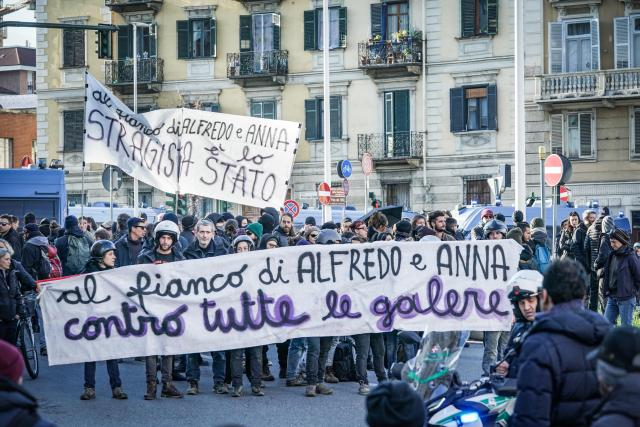
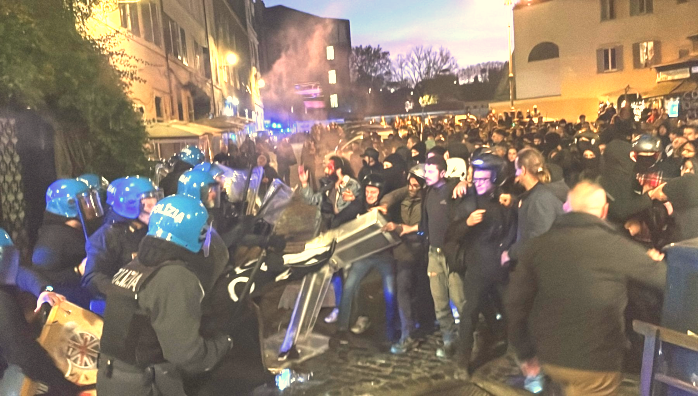
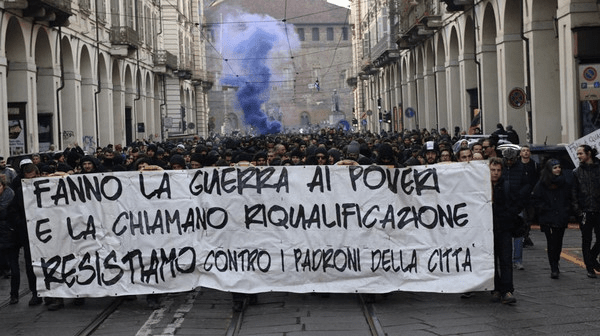
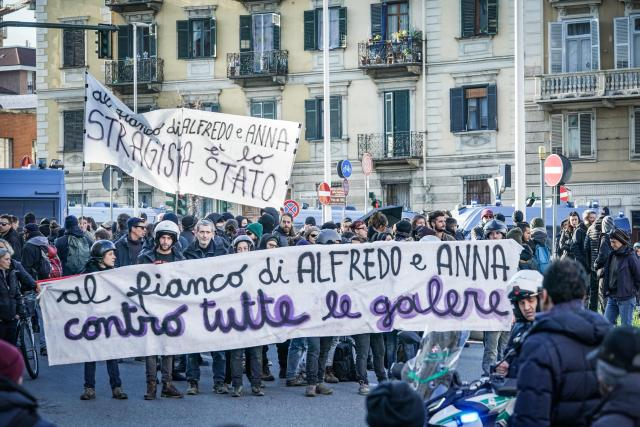
For weeks, there have been sporadic acts of protest and vandalism in support of Cospito. Anarchists have marched in Italian cities, spray-painted city walls, smashed bank machines and windows in Rome, and strung up protest banners equating Cospito’s imprisonment to torture. Banners have shown up dangling from towering construction cranes, outside a prison and down the side of a building at the prestigious Sapienza University of Rome.

On Dec. 2, a firebomb destroyed the car of an Italian embassy official in Athens, Greece, in an attack linked to Greek anarchists angry over Cospito’s imprisonment.

And his case has become a topic in Italian media, sparking clashing opinions over whether this regime of isolation — one of the most extreme in the European Union — is an inhumane form of punishment.

Roma, manifestazione per Alfredo Cospito:

In 2012, Cospito shot Roberto Adinolfi, the chief administrator of Ansaldo Nucleare, an Italian nuclear energy company, in the leg with a pistol. Cospito declared in court that he shot Adinolfi to protest the development of nuclear energy in the wake of the Fukushima nuclear disaster in Japan.

A previous attack was subsequently linked to Cospito: the 2006 detonation of explosives outside a police academy in Fossano, a town in Piedmont in northern Italy. No one was injured in that late-night explosion.

Last April, Italy’s high court ruled that the jailed Cospito had acted as a chief instigator of anarchist terrorist activity communicating with fellow anarchists through books, articles, online writings and comments while serving prison sentences inside the high-security prison in Bancali, Sardinia.

Authorities accused him of acting as a leader of a militant anarchist group with links outside Italy known as the Informal Anarchist Federation-International Revolutionary Front. This collective of “insurrectionary anarchists” was viewed as a growing threat in a 2014 report from the Combating Terrorism Center at West Point, the American military academy.

By branding him a leader of the anarchist movement, Italian authorities ordered Cospito into total isolation, cutting off his contact with the outside world. He joined Italy’s notorious and savage mafia bosses in the most secluded corner of the country’s prison system.

Flavio Rossi Albertini, the anarchist’s lawyer, said that by going on hunger strike Cospito is “basically saying a more courageous Italian state would have gotten rid of him sooner by shooting him in the back, killing him outright, instead of subjecting him to this condition.”

These harsh detention laws — known by the shorthand “41 bis,” a reference to the number of the corresponding article in Italy’s penal code — go back to 1975, an era of violent political turbulence, but are most often associated with Italy’s fight against the Sicilian mafia in the 1990s.

Under this prison regime, some 743 figures of the Italian underworld are locked away in near-total isolation and forbidden most communication with the outside world. Many of these gangsters have spent up to 30 years in isolation.

At regular intervals, the status of inmates in isolation is reevaluated, but it is rare for detainees in the 41 bis regime to be placed back into the general prison population, Albertini said.

Italian authorities, jurists and mafia experts argue that only by isolating mafia bosses can chains of command be broken and the activities of criminal groups contained. The harsh conditions have also led criminals to break their code of silence and become informants.

Critics, though, contend the harsh conditions of the 41 bis system — commonly called simply “hard prison” — amount to torture, trample on prisoners’ human rights and stand in violation of the Italian Constitution, which requires the state to rehabilitate prisoners.

Italy’s Justice Ministry did not immediately respond to queries from Courthouse News about this special prison regime.

In 2002, Italy further codified the 41 bis system into the law and expanded its use against members of terrorist groups.

Cospito is the first and only anarchist to be placed into isolation, Albertini said. Prior to him, three members of the New Red Brigade, a paramilitary communist group, were cast into 41 bis system. They were accused in the assassination of two professors involved in liberalizing labor laws in Italy. The professors were shot dead in 1999 and 2002.

The Italian penal system has room to put 750 inmates in extreme isolation and 749 of these cells are occupied, Albertini said.

It’s called “hard prison” for good reason.

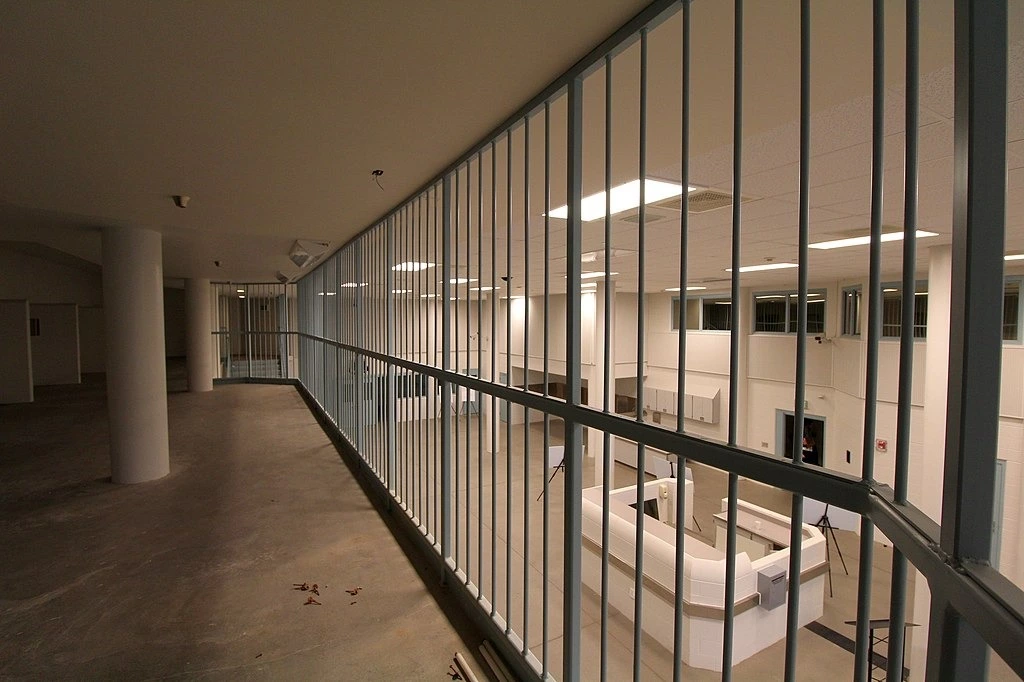
These inmates are allowed to leave their cells and go outside for just two hours a day, though when they are let out they are surrounded by walls more than 20 feet high.

Inside their small cells, they are given a bed, table and one chair, which is fixed to the floor. Inmates are largely forbidden from possessing personal items, even books, and they are under surveillance 24 hours a day. Contact with prison wardens is extremely limited, as is communication with family members and lawyers.

They are allowed to socialize for one hour a day only with the three other inmates inside the same 41 bis block. In Cospito’s case, the other inmates in his area have been in isolation for nearly three decades, Albertini said. One of those inmates doesn’t leave his cell any more; another one is forbidden from leaving his cell during the day; and developing a relationship with the third inmate is difficult because he suffers from psychological problems, Albertini said.

“These individuals are walled in alive and buried with this system of detention; they have no chance of having relations with the outside ever again,” Albertini said in a telephone interview.

With his hunger strike, according to his lawyer, Cospito is saying: “This is no longer living; faced with the prospect of living so many more years in prison under this condition, it’s better to end my life now.”

Albertini said Cospito wants to expose the harsh conditions imposed on 41 bis inmates and for this reason he’s drinking water and taking a Vitamin B supplement to prolong his hunger strike as long as possible.

Since he started his protest on Oct. 20, Cospito has lost 77 pounds in weight, he said. “The state of his health is beginning to become critical.”

Albertini argued for leniency toward Cospito because his relationship with fellow anarchists cannot be compared to how hierarchical organizations such as the mafia and the Red Brigades function. He said the Informal Anarchist Federation is without a command structure and that it is far-fetched to compare Cospito to a mafia boss or Red Brigade militant.

“It’s well known that anarchists are not inclined to like organizations, most of all top-down organizations,” Albertini said.

As the lawyer sees it, Cospito’s imprisonment under the 41 bis regime is really about silencing him as a political voice.

“Applying the 41 bis regime to Cospito is about shutting him up, but this was not supposed to be the purpose of 41 bis,” Albertini said. “Without doubt, he is a political prisoner.”

Albertini said Cospito initially was sentenced to 20 years in prison for detonating the explosives at the police academy. But after his case reached Italy’s highest court, the Supreme Court of Cassation, it was reclassified in July 2021 as a “massacre against the security of the state,” a crime that carries a life sentence.

“In other words, the most serious crime in our judicial order,” Albertini said.

He called that sentence a miscarriage of justice.

“Think about it: In Fossano, 500 grams of gunpowder were used — the kind of amount usually used for New Year’s fireworks” shows, Albertini said about Cospito’s conviction for attacking the carabinieri training academy.

By comparison, the mafia used 350 kilograms of TNT to kill Giovanni Falcone, a Sicilian magistrate investigating the mafia, when his convoy of cars was blown up in 1992 outside Palermo. The magistrate’s wife and three police officers escorting him were also killed in the blast.

That attack and another bombing that killed Falcone’s colleague, fellow Sicilian magistrate Paolo Borsellino, and five police officers led the Italian parliament to pass laws to lock up mafiosi in the 41 bis regime.

Cospito has received some attention in the media and support from legal scholars, but Albertini argued that support for his client remains a taboo because of his anarchism.

The lawyer criticized Amnesty International for not speaking out against his detention in isolation. Amnesty International did not immediately respond to a query from Courthouse News.

Albertini also faulted the European Court of Human Rights for past rulings that found fault with the system but did not call for its banishment.

The Strasbourg court has examined the 41 bis system in several cases and ruled that it does not amount to torture even when it has been imposed for lengthy periods of time.

Italy’s Constitutional Court also has upheld the 41 bis regime though it has tinkered with how it operates, for instance giving inmates more time to talk with their lawyers and allowing prisoners in 41 bis blocks exchange among themselves items such as soap, sugar and coffee.

Courthouse News reporter Cain Burdeau is based in the European Union. Follow @https://twitter.com/cainburdeau

Tags:  Alfredo Cospito hunger strike MSM

Add new comment

more news below comments

**************

Comments

best to comment at anarchist news HERE

this may be msm but at least

Submitted by anon 11:21 (not verified) on Fri, 01/06/2023 – 11:18

this may be msm but at least the author knows there is a difference between anarchists, communists & mafiosi.

I wouldn’t call this MSM

Submitted by aaaaaaaaaaaaaaa… (not verified) on Fri, 01/06/2023 – 11:40

I wouldn’t call this MSM though, it’s pretty niche publication, but still I think you underestimate the MSM that the article referes to. There have also been positive article on this hunger strike in la Repubblica, even one by PD Senator Luigi Manconi.
Good article though, regardless.

fair enough. i’m in the us

Submitted by anon 11:21 (not verified) on Fri, 01/06/2023 – 12:51

fair enough. i’m in the us tho, where msm can’t tell a fascist from a communist from an anarchist …

**************

30th November: Day of Action in Solidarity with Alfredo and other Comrades on Hunger Strike

#AlfredoCospito #AnarchistPrisoners #HungerStrikehttps://t.co/730lcwOPc7 pic.twitter.com/T1Rs9h6YI5— Abolition Media (@abol_media) November 25, 2022

In international news, November saw a lot of energy and action around the ongoing hunger strike of Italian anarchist prisoner Alfredo Cospito.

November 30th was called as a day of action in solidarity with Alfredo and other hunger striking prisoners, and there’s a call to extend that into a week of action lasting until December 5th, when Alfredo and his co-defendant Anna Beniamino, who is also on hunger strike, will appear in court…. Anna Beniamino | prisonersolidarity.com

Alfredo and Anna’s hunger strike, against the incredibly harsh “41 bis” prison regime, has been joined by others, including Italian anarchist prisoner Juan Sorroche Fernandez, French anarchist prisoner Ivan Alocco, and an intermittent strike by UK anarchist prisoner Toby Shone.

You can listen to a short audio interview about the hunger strike, here.

International actions in support of the hunger strikers have included a banner drop outside the Barton jail in Hamilton, Canada, and a truck arson in Milwaukie, Oregon, USA.

Related Posts

Anna Beniamino trial Scripta Manent anarchist prisoners Alfredo Cospito hunger strike Italy

Statement by Anna Beniamino, anarchist prisoner December 6, 2022

Hunger strikes> solidarity with Alfredo> jailed in solitary Nov 11, 2022

BRISTOL PRISON NOISE DEMO! KILL THE BILL! FREEDOM FOR GOPAL, RYAN, KTB PRISONERS, TOBY, ALFREDO… !December 31, 2022

Scientists develop a cancer vaccine to simultaneously kill and prevent brain cancer

by thefreeonline from Scientific Inquirer on January 7, 2023 by Bricemarsters

Scientists are harnessing a new way to turn cancer cells into potent, anti-cancer agents.

New dual-action, cancer-killing vaccine tested

In the latest work from the lab of Khalid Shah, MS, PhD, at Brigham and Women’s Hospital, a founding member of the Mass General Brigham healthcare system, investigators have developed a new cell therapy approach to eliminate established tumors and induce long-term immunity, training the immune system so that it can prevent cancer from recurring.

The team tested their dual-action, cancer-killing vaccine in an advanced mouse model of the deadly brain cancer glioblastoma, with promising results.

Findings are published in Science Translational Medicine.

“Our team has pursued a simple idea: to take cancer cells and transform them into cancer killers and vaccines,” said corresponding author Khalid Shah, MS, PhD, director of the Center for Stem Cell and Translational Immunotherapy (CSTI)  and the vice chair of research in the Department of Neurosurgery at the Brigham and faculty at Harvard Medical School and Harvard Stem Cell Institute (HSCI).

“Using gene engineering, we are repurposing cancer cells to develop a therapeutic that kills tumor cells and stimulates the immune system to both destroy primary tumors and prevent cancer.”

Cancer vaccines are an active area of research for many labs, but the approach that Shah and his colleagues have taken is distinct.

Instead of using inactivated tumor cells, the team repurposes living tumor cells, which possess an unusual feature.

Continue reading “Scientists develop a cancer vaccine to simultaneously kill and prevent brain cancer”

The U.S. Prison Industrial Complex, A Domestic Military Operation: Over-Policing, Mass-Incarceration, Slavery, and Capitalism

lyumon1834's avatarDer Friedensstifter

The U.S. Prison Industrial Complex, A Domestic Military Operation: Over-Policing, Mass-Incarceration, Slavery, and Capitalism

Karl Fluri
Although the United States has branded itself as the bastion of freedom both at home and abroad, it is abundantly clear to any objective observer that, just as U.S. imperialism undermines those claims on a global scale, the fascist police state and “prison industrial complex” that exists in the nation today do the same on a domestic front.

The United States maintains the highest military budget in the world to defend its worldwide hegemony.For the fiscal year 2022, the six US Department of Defense (DOD) subcomponents each received$1.64 trillion.This is quite well known, but the fact that the United States police forces, should they be regarded as a national military, would rank third on the planet in terms of budget, only behind China and the U.S. military itself, may shock some.

With national spending of around$126 billion on police, many police departments in…

View original post 4,310 more words

Ukraine regime ‘could get the BOMB’ in 2 yrs-it has the fissile materials, tech, specialists, and even delivery means.

from thefreeonline 6 Jan, 2023 15:12 at Top Banned News Site By Olga Sukharevskaya, ex-Ukrainian diplomat

Nuclear Ukraine? Amid ‘concerns’ over alleged Russian threat, the world overlooks the real danger. Kiev is capable of building an atomic device, and its leaders often outline such thoughts

. Getty Images / Digital Vision/ shared with thanks

Last year, Western media and high-ranking politicians actively discussed the possibility of Russian troops using atomic weapons in Ukraine. There has even been speculation on the likelihood of a nuclear war breaking out.

However, it could be said that the risk is probably a lot higher on the other side of the barricades. 

see also:‘Who will blink first?’ Is nuclear war between Russia and the US possible?

Ukraine’s Atomic History

Ukraine was a nuclear state after the collapse of the USSR, when 1,700 active atomic warheads remained in the country.

Its politicians of that time had the prudence to abandon this status. The weapons were taken to Russia under international control, and their means of delivery were destroyed. Ukraine’s missile silos, with the exception of one which is now a museum near Kiev, were blown up, while its strategic bombers capable of carrying nuclear weapons were either transferred to Russia or destroyed.

Despite this, there were still many nuclear specialists in Ukraine, as research into nuclear fission has been conducted in Kharkov since the 1930s.

In addition, five nuclear power plants were built in Ukraine during the Soviet years: Zaporozhye, Rovno, Khmelnitsky, and South-Ukrainian, as well as the infamous Chernobyl, where an accident involving a power unit led to an explosion that spewed radioactive fallout throughout Europe.

see also:Dead Hand’s nuclear revenge: What would happen if the West launched an attack on Russia?

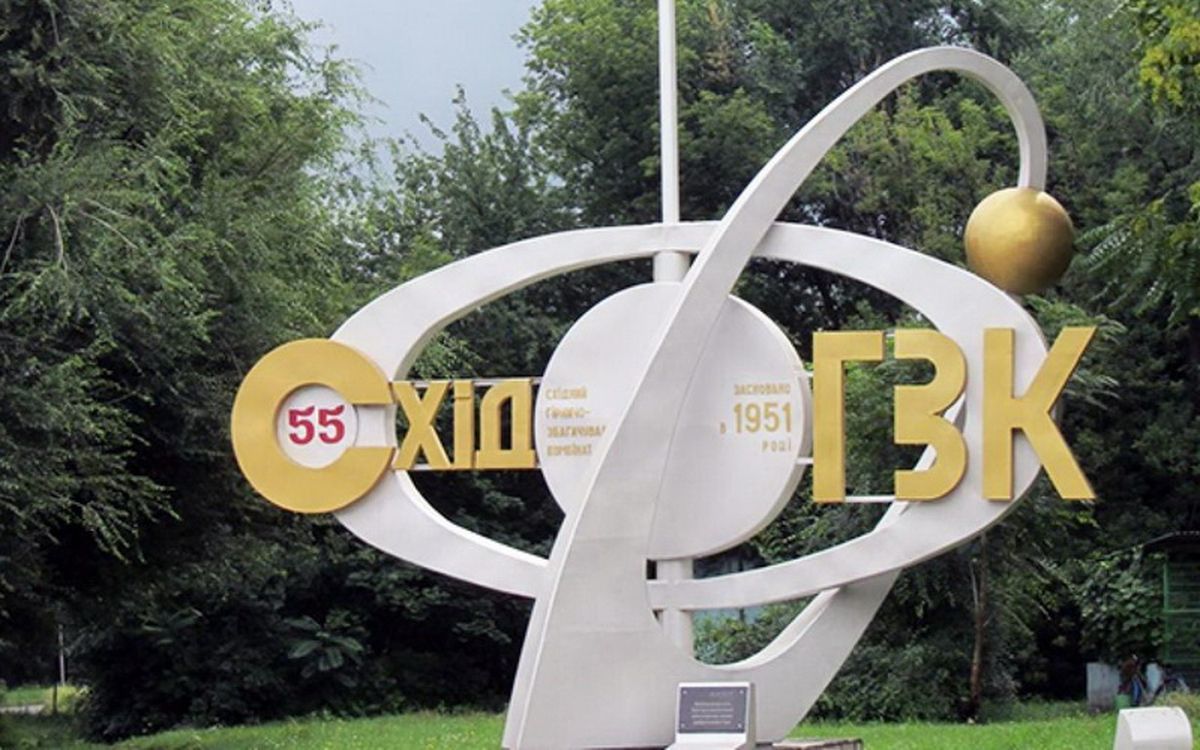
In addition, uranium is extracted at a deposit in Ukraine’s Kirovograd Region and enriched at a plant in the city of Zheltye Vody. In the 2010s, there were plans with Russia’s Rosatom to build a plant in Ukraine that would produce fuel for nuclear power stations. However, these were abandoned after the Maidan coup in 2014, when the country adopted an adversarial stance towards Russia.RT

Vostochny Mining and Processing Plant. ©  uatom.org

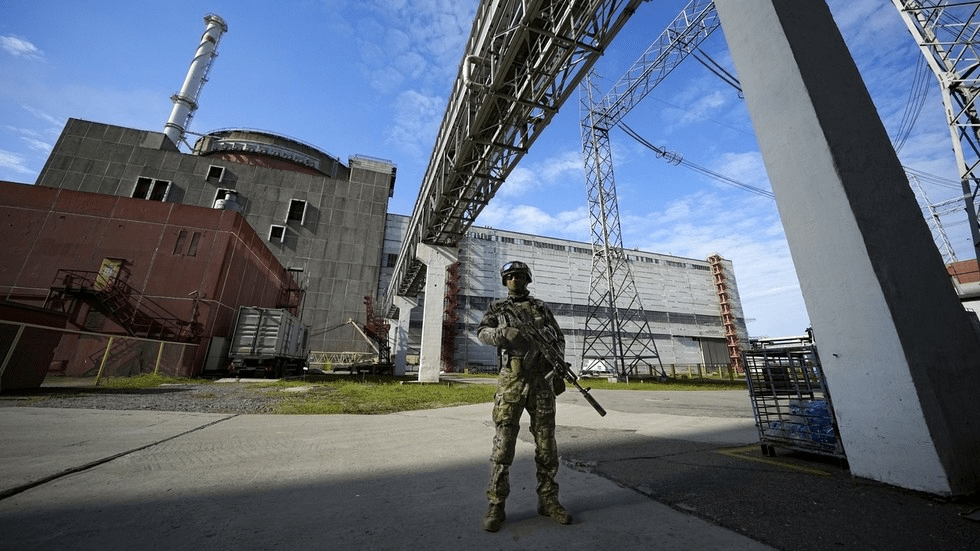
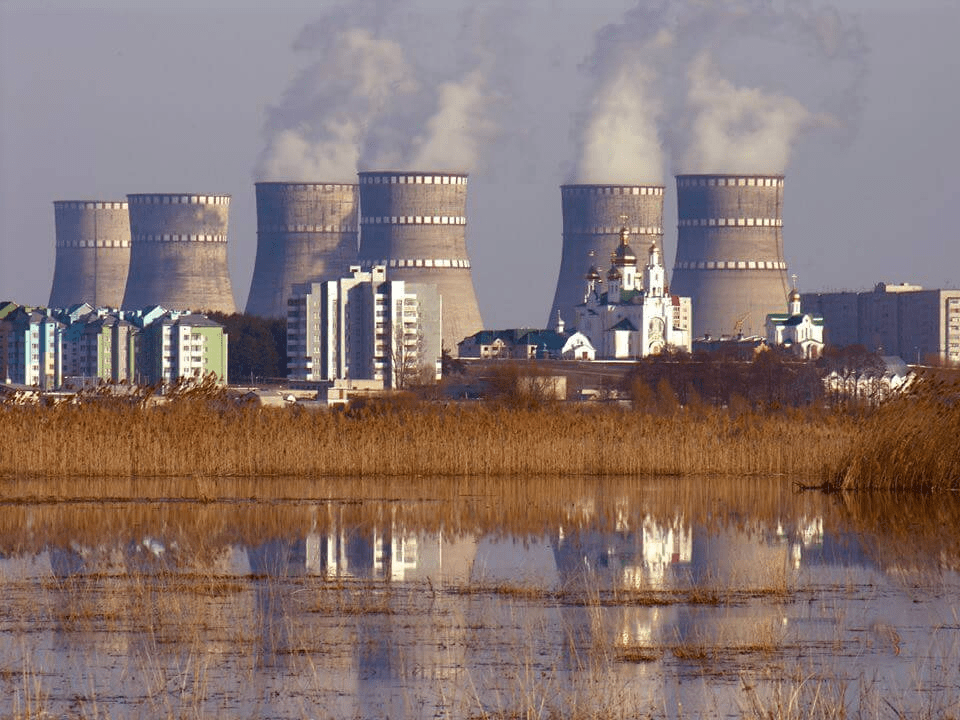
At present, three of Ukraine’s five original nuclear power plants remain under its control. Chernobyl, which continued to generate electricity even after the 1986 accident, was finally decommissioned in 2020, while Zaporozhye, the largest nuclear power plant in Europe, has been guarded by Russian troops since last year.

It is currently being run by Rosatom but does not produce electricity, largely for safety reasons. This is due to regular rocket and artillery attacks by Ukrainian troops, which have damaged numerous pieces of auxiliary equipment.

see also: Leaked documents expose Ukrainian attempts to destabilize Russia and draw NATO into a full-scale war with Moscow

Push to Reobtain Nuclear Weapons

It should be noted that not everyone in Ukraine was happy that the country gave up its nuclear weapons. Ukrainian politicians have often failed to hide the fact that their dream of reobtaining nuclear weapons is not so much connected with their country’s security, as the desire to dictate their will to the rest of the world.

Radical Ukrainian nationalists were particularly dissatisfied with the abandonment of the country’s nuclear status, and many of their manifestos contain a clause calling for it to be restored.

see also:Can the UN’s mission to Europe’s largest nuclear power plant prevent a Chernobyl-style catastrophe?

For example, “the return of nuclear weapons” is specifically cited as a goal in paragraph 2 of the Military Doctrine section in the program statement of the Patriot of Ukraine organization, while paragraph 7 of its Foreign Policy section reads: “The ultimate goal of Ukrainian foreign policy is world domination.”

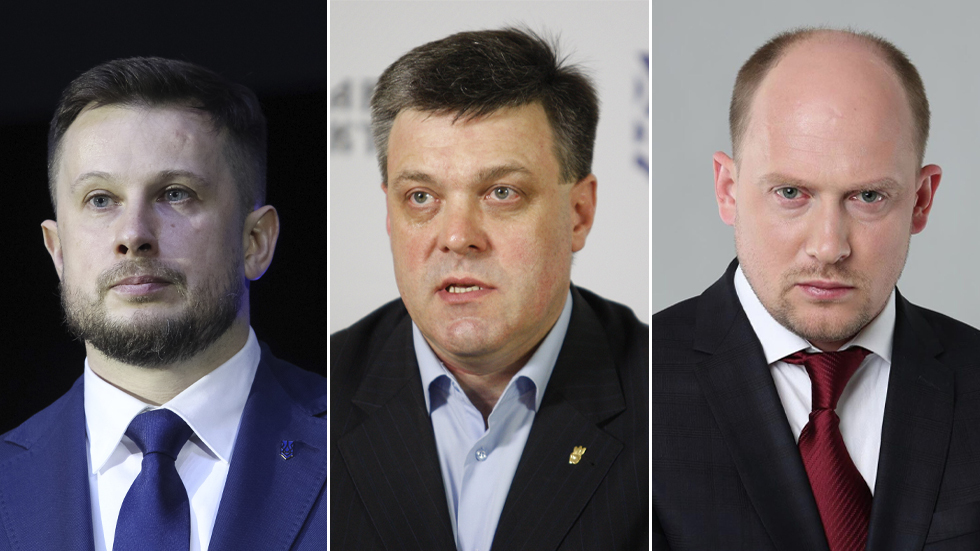
Patriot of Ukraine was created in 2014 by the notorious Andrey Biletsky, who formed it based on the ideology of the neo-Nazi Azov Battalion and had dreamed of Ukraine possessing nuclear weapons as far back as 2007.

In 2009, the Ternopil Regional Council, which was then dominated by Oleg Tianibok’s neo-Nazi Svoboda Party (called the Social-National Party until 2004), demanded that Ukraine’s president, prime minister, and head of the Verkhovna Rada “terminate the Budapest Memorandum of 1994 and retore Ukraine’s nuclear status.”

Ukraine’s longing for an atomic bomb especially increased after February 2014. In an interview with USA Today in March of that year, Ukrainian MP Pavel Rizanenko called Ukraine’s accession to the Treaty on the Non-Proliferation of Nuclear Weapons a “big mistake.”

And that was not just the opinion of one MP. Just a few days later, representatives of the Batkivshchyna party, headed by ex-Prime Minister Yulia Timoshenko, and UDAR, headed by Kiev’s current mayor, Vitaly Klitschko, including the secretary of the parliamentary Committee on National Security and Defense, Sergey Kaplin, submitted a bill on withdrawing from the non-proliferation treaty.

Kaplin claimed that Ukraine could create nuclear weapons in just two years because it already had almost everything necessary: The fissile materials, equipment (except centrifuges), technology, specialists, and even means of delivery.

In September of the same year, Ukraine’s minister of defense, Valery Geletey, also expressed the desire to develop nuclear weapons.RT

(L) Andriy Biletsky; (C) Oleh Tyahnybok; (R) Serhiy Kaplin ©  Pavlo Conchar / SOPA Images / LightRocket via Getty Images; STR / NurPhoto via Getty Images; Facebook

In December 2018, the former representative of the Ukrainian mission to NATO, Major General Pyotr Garashchuk, announced the real possibility of Ukraine creating its own nuclear weapons.

In 2019, Aleksandr Turchinov, who usurped power in Ukraine in February of 2014, called Ukraine’s renunciation of nuclear weapons a “historic mistake.”

Following him, in April 2021, the Ukrainian ambassador to Germany, Andrey Melnik, stated that if the West did not help Ukraine in its confrontation with Russia, the country would launch a nuclear program and create an atomic bomb.

And on February 19, 2022, before the start of Russia’s special military operation, Ukrainian President Vladimir Zelensky announced at the Munich Security Conference that Ukraine has the right to abandon the Budapest Memorandum, which proclaimed the country’s nuclear-free status.

Perhaps the most striking statement by a Ukrainian politician was made by David Arakhamia, the head of the Ukrainian parliament’s ruling parliamentary faction, Servant of the People. “We could blackmail the whole world, and we would be given money to service (nuclear weapons), as is happening in many other countries now,” he said in mid-2021.

Range of Possibilities

Is Ukraine technically capable of creating an atomic bomb? Absolutely. Yes, enriching uranium-235 to the purity necessary to set off a chain reaction would cost a lot, primarily to create centrifuges for separating isotopes.

However, though this may be the most effective way to separate isotopes, it’s not the only one.

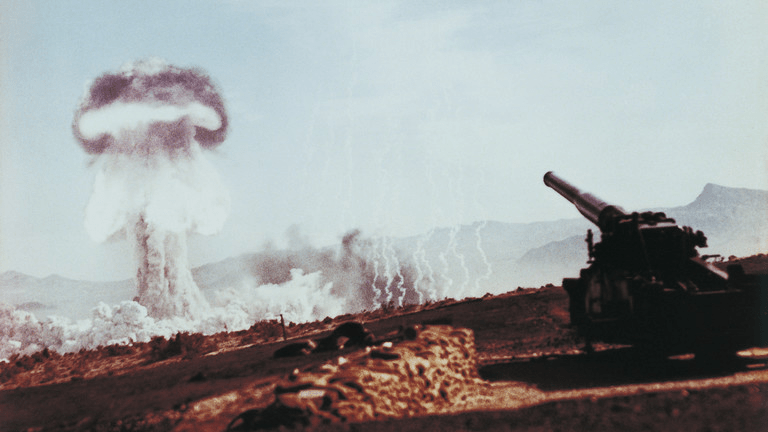
The first American bombs dropped on Hiroshima and Nagasaki were created without the use of this technology.

In addition, it should not be forgotten that there are not only uranium, but also plutonium bombs. Breeder reactors are used to synthesize this chemical element, most often using heavy-water reactor technology, and research reactors are capable of producing weapons-grade plutonium.

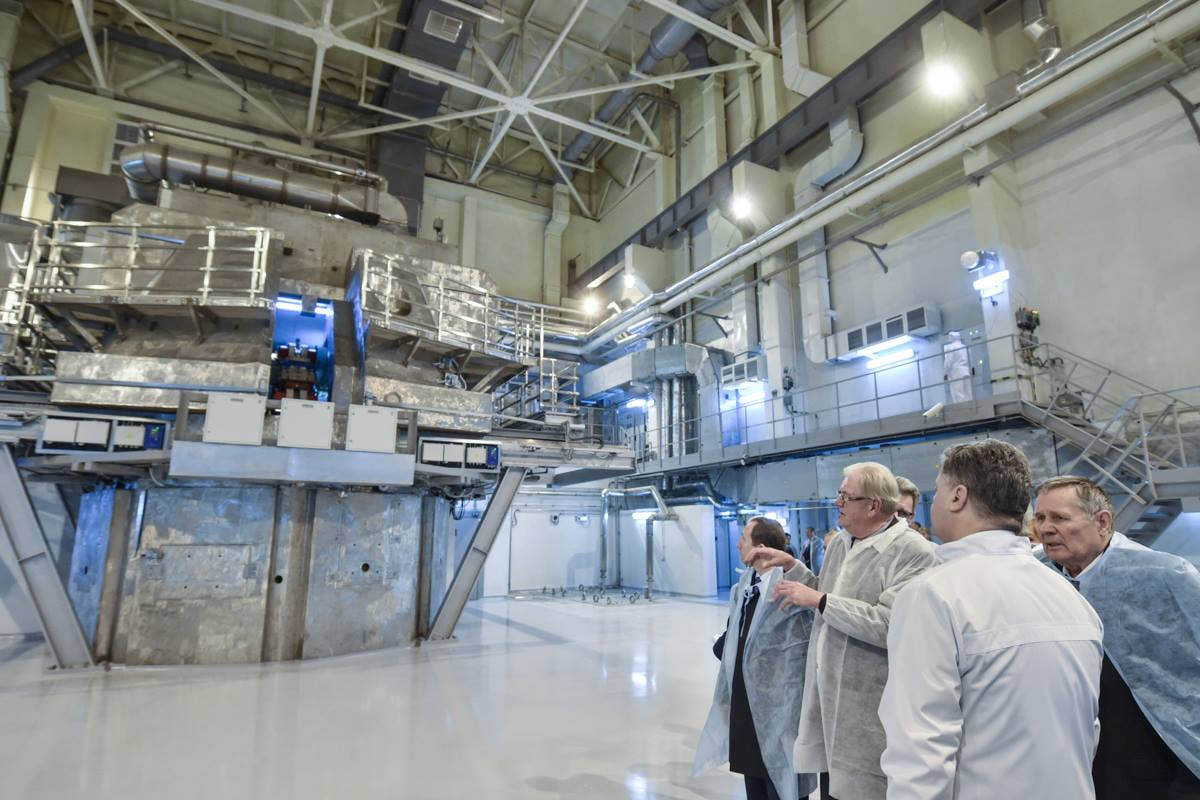
There is presently a nuclear research installation at the Kharkov Institute of Physics and Technology, and a VVR-M reactor suitable for plutonium production at the Institute for Nuclear Research of Ukraine’s National Academy of Sciences in Kiev.

Until March 2022, there was a US-built facility in Kharkov that could produce isotopes by irradiating the starting materials with a powerful neutron flux, which could also be used to develop fissile materials for a bomb.RT

Nuclear installation ‘Neutron Source’

In addition, Ukraine has the technical capability to create a nuclear weapon based on uranium-233, rather than uranium-235, which is usually used. A similar bomb was tested by the US in 1955 during Operation Teapot, and its power was comparable to that of the Fat Man bomb that destroyed the Japanese city of Nagasaki.

To obtain uranium-233, it is enough to replace one of the fuel assemblies of a conventional nuclear power plant reactor with a thorium-232 cassette, a supply of which is located near Mariupol, a city that was fiercely defended by Ukrainian nationalists from the Azov regiment earlier this year.

There is another indirect sign that both uranium and plutonium versions of nuclear weapons have been secretly developed at the direction of the post-Maidan authorities.

At the beginning of 2021, Ukraine completely banned the export of spent nuclear fuel (SNF) to Russia, as was required by an agreement on its supply by Rosatom. SNF, among other things, is a source of weapons-grade plutonium, which can be isolated from fuel cells that have been in a nuclear power plant reactor.

Radioactive threat from Kiev persists – Moscow

Nuclear Power on the Brink of Disaster

Just as dangerous is the nuclear power policy pursued by the Ukrainian government.

Ukraine inherited five nuclear power plants with 18 active reactors from the USSR. Three of them located at the Chernobyl NPP were decommissioned by 2000.

Five of the six reactors at the Zaporozhye NPP, three of the four reactors at the Rovno NPP, one of the two reactors at the Khmelnitsky NPP, and all three reactors at the South Ukraine NPP have exceeded their original lifespans and received extensions of their operating lives for another 10 to 15 years.

The license extensions have sometimes been granted with violations of existing regulations since, after 2015, Ukraine’s State Nuclear Regulatory Inspectorate stopped cooperating with Russian vendors and has not overhauled reactor vessels, which become brittle after prolonged exposure to neutron radiation.

Continue reading “Ukraine regime ‘could get the BOMB’ in 2 yrs-it has the fissile materials, tech, specialists, and even delivery means.”

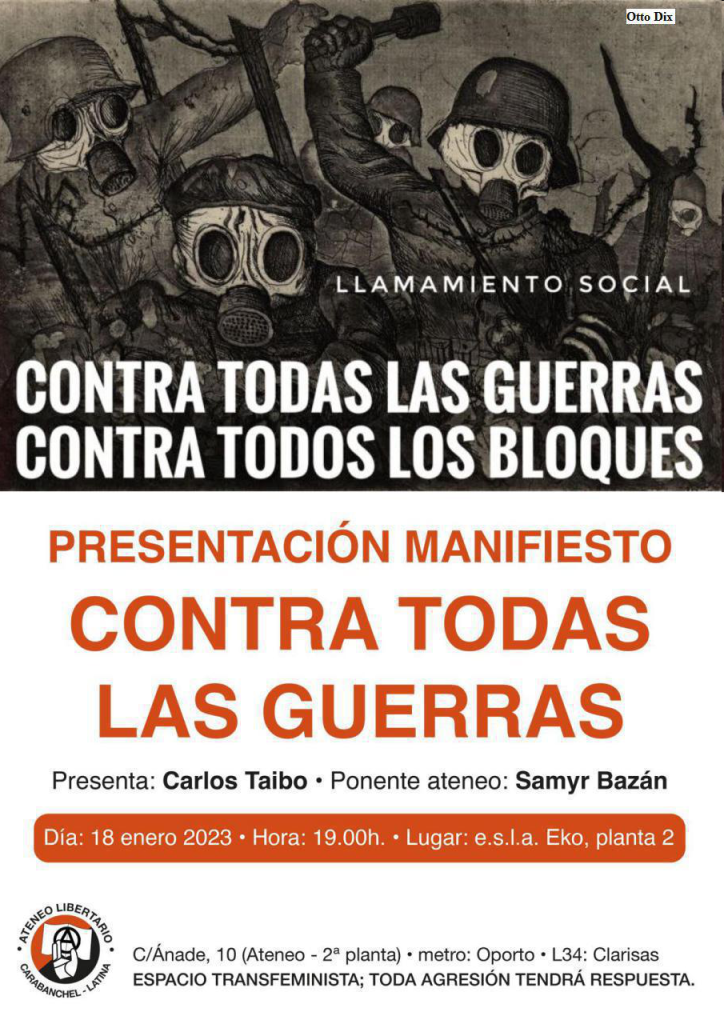
Presentación manifiesto “Contra todas las guerras”

Ateneo Libertario Carabanchel Latina's avatarAteneo Libertario Carabanchel Latina

ESTA NO ES NUESTR GUERRA. RAZONES PARA LA MOVILIZACIÓN GENERALIZADACONTRA LA GUERRA IMPERIALISTA

En los últimos meses estamos asistiendo en el este de Europa a una
confrontación entre dos polos imperialistas en pugna por posiciones y
recursos. La guerra en Ucrania:

Descripción: 👉Se ha cobrado decenas de miles de vidas humanas desde febrero,
produciendo muerte, destrucción y éxodo a su paso. Refugiados,
exiliados, movilizaciones forzosas, desertores.

Descripción: 👉La enorme movilización militar está acelerando los graves problemas
derivados de la crisis energética y ecosocial a la que nos ha llevado el
capitalismo, lo que repercute en subidas de precios de productos básicos
que afectan (y afectarán más) a amplias capas de la población.

Descripción: 😡En el Estado Español, un Gobierno supuestamente de izquierdas viene
desarrollando una política claramente militarista, siguiendo totalmente
la línea de la OTAN, encabezada por EEUU. Decisiones peligrosas que no
responden a otra cosa que a mantener los privilegios de su…

View original post 227 more words

Important Thread: About 70% Of Our Immune System Is Located In The Gut

Lou's avatarTales from the Conspiratum

Click on the thread, it’s worth it. A goldmine of information.

View original post