
from thefreeonline on By Malik Miah at Red Ant Admin

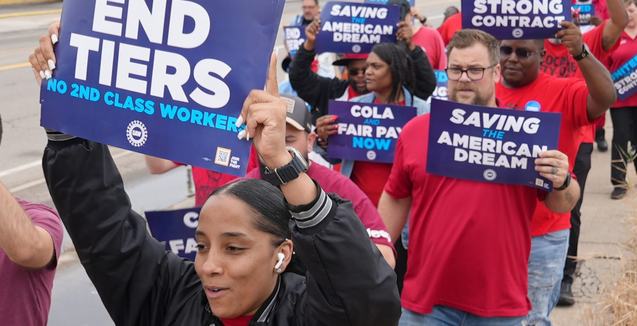
What’s being called the “summer of strikes” (more accurately an upsurge of labor agitation) is inspiring more workers to fight back.
“We build those cars!” chanted striking auto workers.
On September 15, at midnight, the United Automobile Workers (UAW) President Shawn Fain said rolling strikes against major US-owned auto companies were launched. Some 12,700 assembly line workers at three plants in Michigan (Ford), Ohio (Stellantis) and Missouri (GM) hit the picket line. The UAW represents 150,000 workers.
This is the first time the union has launched a strike hitting each of the big three manufacturers at the same time.
Fain was elected president in March against long dominant incumbent opposition. He said the strike was class warfare between the working class and the billionaire class.
Fain laid out the stakes days before the strike began:
“Living paycheck to paycheck, scraping to get by? That’s hell. Choosing between medicine and rent is hell. Working seven days a week for twelve hours a day for months on end is hell. Having your plant close down and your family scattered across the country is hell. Being made to work during a pandemic and not knowing whether you might get sick and die or spread the disease to your family is hell.
“Enough is enough. It’s time to decide what kind of world we want to live in and it’s time to decide what we are willing to do to get it.”
A Struggle for the Industry’s Future
“Enough is enough. It’s time to decide what kind of world we want to live in and it’s time to decide what we are willing to do to get it.”
The strike takes place as the traditional automakers invest billions to develop electric vehicles (EVs) while still making most of their money from gasoline-driven cars. The negotiations will determine the balance of power between workers and management, possibly for years to come. That makes the strike as much a struggle for the industry’s future as it is about wages, benefits and working conditions.
The established US carmakers — General Motors, Ford Motor and Stellantis (which owns Chrysler, Jeep, and Ram) — are trying to defend their massive profits and their place in the market in the face of stiff competition from non-union Tesla, owned by the world’s richest man Elon Musk who hates unions, and foreign automakers from Europe and Asia (including Mercedes Benz, Volkswagen, Toyota, Honda, Kia and Hyundai) that are non-union.
Executives and business analysts have characterized what is happening in the industry as the biggest technological transformation since Henry Ford’s moving assembly line started up at the beginning of the 20th century.
They don’t mention that the auto workers in the 1930s organized sit-ins and pitched battles to build their independent unions. Their strike actions along with those of workers in many other industries forced the Federal Government to pass labor legislation favorable to most workers. At that time, the US ruling class feared a workers’ revolution against capitalism.
Continue reading “US Auto Workers: ‘Stand-Up Strike“Living paycheck to paycheck, scraping to get by? That’s hell.”













 The Free