This is a video from 2015, 1 year after a Western-sponsored coup in Ukraine brought outright neo-Nazis to power.
🇺🇦 Ukrainian neo-Nazis.
This is what the West doesn't want you to see.
This is a video back from 2015, one year after the Western sponsored coup in Ukraine brought outright neo-Nazis to power.
The residents of Avdeevka are protesting against Ukrainian Nazis who are opening up… pic.twitter.com/bGeyK5MfVG
— Ignorance, the root and stem of all evil (@ivan_8848) February 19, 2024
BACK IN 2025… The residents of Avdeevka are protesting against Ukrainian Nazis who are opening up military bases next to their shopping centers and then shelling Donetsk civilians with artillery.
“We are sick of the Ukrainian fascists who surrounded our Avdeevka!”
They are killing us! They are trying to open up a military base right next to the shopping centre! 90% of us want to be a part of the Donetsk People’s Republic!”
Where do you think these people are now?
What do you think the Ukrainian regime and their pocket neo-Nazis have done to them for 9 years before the Russian special military operation finally freed the city?
https://www.commondreams.org/news/us-export-lng Common Dreams Jessica Corbett February 15, 2024 9 Dems Join House GOP in Bid to Reverse Biden LNG Pause One campaigner called out legislators for “acting quickly to protect a few big polluting industries while continuing to disregard the health, energy, and environment needs of entire families and neighborhoods.” Nine Democrats joined with all […]
The Biden Regime destroyed gas supplies of its European dependencies and forced them to buy US LNG frack gas at many time the price – a boom for the powerful corporate energy lobby. Next move was to “pause” new LNG exports to keep the price high and placate Climate activists. But the Texas cowboys want unlimited expansion and new pipelines to ensure it.
‘Alarming’: FERC Ignores Climate Impacts and Rubber-Stamps Texas Pipeline
“The world does not need more LNG, and FERC is out of step with the reality of the climate crisis and communities impacted by these projects,” one advocate said.
The commission limited its review of the Saguaro Connector Pipeline to a 1,000-foot stretch of the project on the Texas and Mexican border.
If built, the pipeline could transport as many as 2.8 billion cubic feet of fracked gas per day to an export facility in Mexico, where it would be shipped to Asia and Latin America.
The decision comes weeks after the Biden administration paused Department of Energy (DOE) approvals of new liquefied natural gas (LNG) exports while it updates its assessment criteria.
“It’s alarming that FERC would approve the Saguaro Connector Pipeline based on a narrow environmental assessment that ignores the vast majority of the project and its impacts,” Doug Hayes, senior attorney for Sierra Club’s Environmental Law Program, said in a statement.
“Rubber-stamping this project means vulnerable communities along the route will be at risk so oil and gas companies can pad their pockets by sending U.S. gas cheaper to Asia via Mexico.”
“FERC is responsible for sending gas out of the country and that is exactly what this pipeline is doing. Why do they not have purview over the whole pipeline?”
Friends of the Earth Action argued that the approval was inconsistent with the administration’s LNG approval pause.
“The decision to approve the Saguaro connector represents a colossal failure to consider the public interest,” the group posted on social media. “If LNG approvals are on pause, FERC shouldn’t be rubber-stamping this pipeline!”
The pipeline will be 155 miles long and four feet in diameter and is intended to carry gas from the Permian Basin in Texas to the border.
Once there, another pipeline still in the works will carry the gas 500 more miles to a proposed LNG export facility on Mexico’s Pacific coast.
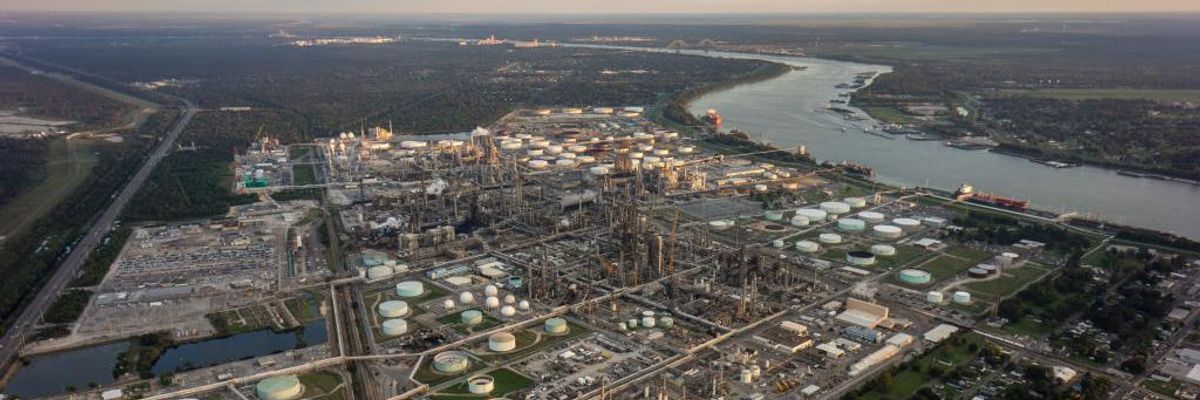
An aerial shot of the chemical plants and factories that line the roads and suburbs of the area known as “Cancer Alley”
‘Death Sentence’: Reports Call for End to Big Oil’s US Sacrifice Zones
“People’s lives and the environment are being devastated at the hands of big business,” one human rights researcher said.
Amnesty International and Human Rights Watch both published reports on Thursday detailing how the fossil fuel industry has harmed the health and environment of communities in Texas and Louisiana, and how state and federal regulators have failed to protect them.
The amount of gas that would pass through the Texas portion of the pipeline every day is twice the amount used by the state of Vermont in a 24-hour period, according toInside Climate News.
West Texas communities along the pipeline’s route are worried about what could happen if the pipeline were to explode, since many have limited medical facilities.
For example, the pipeline passes within one mile of Van Horn, a low-income, majority Hispanic community.
“Having a pipeline so close to town, carrying extremely flammable gas at high pressure, places an unnecessary risk on a good portion of Van Horn’s citizens,” resident Tomas Mansfield said in a statement.
“While our emergency services work very hard at keeping us safe, a major disaster would overwhelm what services we do have, and additional help is at least 80 miles away. Trauma centers are over 100 miles away—our hospital is only a Level IV trauma center, and major traumas are usually flown to El Paso.”
Typically, FERC will sign off on an entire pipeline route if it crosses state lines.
Because this part pr the pipeline only passes through the state of Texas, the commission says it is only responsible for the portion of the pipeline near the border.
However, the Texas Railroad Commission, which approves pipelines in the state, does not have any authority over a pipeline’s route.
It also signed off on the pipeline before the residents of Van Horn were even aware of it, according to Inside Climate News.
Frontline communities and environmental groups argue that FERC should consider the entire pipeline route because it will carry gas destined for overseas export.
Culberson County Hospital (left) and Van Horn Rural Health Clinic (right) are shown in Van Horn, Texas, where residents are concerned about the local health system’s ability to cope with a major pipeline explosion.(Photo: Texas.pics/Wikipedia/
“The people of West Texas are looking to FERC since the Texas Railroad Commission has disclaimed any responsibility for the siting and routing of this pipeline,”Deborah Pendleton, who owns land near the pipeline’s route, said in a statement. “FERC is responsible for sending gas out of the country and that is exactly what this pipeline is doing. Why do they not have purview over the whole pipeline?”
“It’s common knowledge FERC works for big oil and gas, not the people. This was a predetermined decision.”
Indigenous communities, meanwhile, are worried that the pipeline will damage local ecosystems and sacred spaces, such as geothermal hot springs located close to the border.
“Our concern is that the pipeline is going to go through the hot springs,” Christa Mancias-Zapata, the executive director of the Carrizo/Comecrudo Tribe of Texas, toldDeSmog. “Anywhere you go in that area is a sacred site to our people.”
The fight against the pipeline connects to the broader Gulf Coast struggle against oil and gas infrastructure that has sacrificed the health of communities and ecosystems in the region.
“In South Texas, we’re fighting to save the last pristine part of the Gulf Coast from extractive industry,” Mancias-Zapata said at an anti-LNG protest in New Orleans. “We’re trying to stop it from taking our sacred lands, our sacred sites, and destroying the natural infrastructure that Mother Earth created for us.”
There is also a growing movement to stop the LNG buildout for the sake of the global climate. The Biden administration’s approach to the pipeline illustrates contradictions within its climate policy, as it at once approves controversial developments like the Willow oil drilling project in Alaska and pauses LNG export approvals to further consider their emissions, among other factors.
Petrochemical plants also produce plastics, a major environmental pollutant and health hazard. Yet their production is set to double by 2040, Amnesty said, with a spiderweb of pipelines bringing, the liquid gas (not LNG) from the new western Permian fields to giant billion dollar new plastics complexes on the Gulf Coast with the aim to corner the World Plastics Market.
In early November 2023, the State Department asked FERC to perform an analysis of the project’s entire lifecycle greenhouse gas emissions, rather than just those of the border stretch, in line with administration policy.
Advocacy group Public Citizen, which is a legal intervenor in the pipeline’s FERC hearing, requested that the department account for its recommendation, and has now promised to ask for a rehearing of FERC’s decision.
“The commission’s decision ignores the harm record methane gas exports have on raising US Americans’ energy bills and exacerbating climate change, all to prioritize feeding more gas to China,” Tyson Slocum, director of Public Citizen’s Energy Program, said in a statement.
“The Saguaro export pipeline’s only purpose is to bypass the log-jammed Panama Canal to send U.S. produced gas to planned LNG export terminals on Mexico’s Pacific Coast.”
Residents also say they will continue to battle the pipeline.
“This approval was expected by all of us watching,” frontine rancher Bill Addington who works with the West Texas Legal Defense Fund said in a statement. “It’s common knowledge FERC works for big oil and gas, not the people. This was a predetermined decision. We will defeat the Saguaro LNG export project.”
Numbers can be dehumanizing. Alone, they could hardly convey the reality of the ongoing Israeli genocide in Gaza. The latest official numbers, however, are critical.
The Government Media Office in Gaza published an update about the scale of destruction by the Israeli army in the besieged Gaza Strip, starting on October 7.
The count is not final, due to the fact that over 7,000 Palestinians remain missing, and are presumed dead – either under the rubble of their homes, or scattered in the streets in areas that civil defense workers cannot reach.
The numbers, stats and estimates below cover the period between October 7, 2023, and February 11, 2024.
Genocide in Numbers
128 days of the war.
2,438 massacres.
35,176 martyred and missing.
28,176 martyrs whose bodies have reached the hospitals.
Note to readers: Please click the share button above. Follow us on Instagram and Twitter and subscribe to our Telegram Channel. Feel free to repost and share widely Global Research articles.
Featured image: Palestinians line up to fetch some water in a refugee camp in Gaza. (Photo: Mahmoud Ajjour, The Palestine Chronicle)
Here’s the video of Israel’s daily Guernica terror raid on the civilians of Gaza Rest assured, Biden is pushing hard to ensure they have more weapons to fill the streets with body parts and blood
The USA and Israel have long been plotting to LIQUIDATE GAZA and finally the DIABOLICAL, INHUMAN AND TOTALLY ILLEGAL PLAN IS TAKING SHAPE.
From the start it was pretty obvious. How was it possible, for example, that thousands of poorly armed ‘prisoners’ of Gaza would storm through the strongest border wall on earth totally by surprise, despite being heavily infiltrated by Israel? Why did the Israeli elite sell of their stock just days before?.
Why did Israel set out to totally destroy North Gaza and drive destitute survivors more and more south till most are crammed into Rafah on the Egyptian border?
Why did the US suddenly CUT OFF MUCH AID to Egypt just weeks beforehand, leaving it open to blackmail on the point of bankruptcy?
Because the plan all along was to force the Gazans out of their now completely uninhabitable home, and bulldoze the remains for luxury resorts.
Egypt will protest a lot, and even the western media may be allowed to complain for a few days, but the newsround will pass on to other disasters, and perhaps Egypt will receive “unrelated support”.
If they go through with this fascist plot – stranding up to two million survivors in an empty desert for profit and privatising food aid away from the “complicit” United Nations, it means the final end of any morality and peace on the planet.
Tel Aviv’s insistence, with complicit US permission and military guarantees, on going ahead with its planned attack on Rafah despite international pressure has been unshaken, for the obvious reason they plan to expel the Palestinians even though the area is where 1.4 million are living, the vast majority of whom have been forcibly displaced – some multiple times – by Israeli bombardments and ground operations.
Even more obviously Israel insists it will soon fully occupy and control the short Egypt/Gaza border
Palestinians displaced to Rafah are suffering from a lack of sufficient shelter, food, water and medicine, and the United Nations and human rights groups have warned that the humanitarian disaster in the besieged enclave is rapidly worsening.
Israel is delighted, and recently invited nazi chanting Israeli demonstrators to block aid lorries getting through.
India is a great nation and culture of small farmers, now faced with utter destitution as western agri-business and vulture funds force their control with WTO help.
Farmers marching to New Delhi gather near the Punjab-Haryana border at Shambhu, India [Rajesh Sachar/AP Photo]
Farmers are demanding a legal minimum price for their crops as they march to New Delhi and ask government to fulfill its promises.
Thousands of farmers on tractors and trucks are marching towards the Indian capital, New Delhi, to push the government to address their demands, including guaranteed prices for their produce and debt waivers.
Police in Haryana state, which borders Delhi, on Tuesday fired tear gas on farmers to prevent them from reaching the capital, which has been converted into a fortress, reviving memories of the 16-month-long agitation by the farmers two years ago. Multiple entry points to the capital have been sealed by erecting barriers of barbed wire, spikes and cement blocks.
Police officers stand guards as barricades are erected on a national highway to stop farmers at the Singhu border in New Delhi, February 13, 2024. [Anushree Fadnavis/Reuters]
Authorities have banned large gatherings in Delhi and suspended internet services in several Haryana districts ahead of the March to Delhi, called by farmers from Punjab and Haryana along with several other northern states.
Aside from organisations from Punjab and Haryana, unions from the states of Uttar Pradesh, Rajasthan and Madhya Pradesh are also participating in the march as they demand government intervention to help the ailing agriculture sector, which is central to the country’s food security.
The Samyukta Kisan Morcha (SKM), Kisan Mazdoor Morcha (KMM) and Kisan Mazdoor Sangharsh Committee are spearheading the protests. The organisers said more than 200 farm unions are participating in the March to Delhi.
The SKM played a key role in the 2020-2021 protests that forced Prime Minister Narendra Modi to repeal three farm laws that farmers feared would have benefitted corporations at their expense. Farmers have accused Modi’s government of failing to fulfill its promises to farmers since then, including doubling their incomes.
The SKM has called for a nationwide rural and industrial strike to express disapproval of the government.
Aruna Rodrigues Hybrid Bt cotton, the only commercialised GM crop in India, has failed conclusively.
Based on this failure and the evidence on GM crops to date, the Union of India’s proposal to commercialise herbicide-tolerant (HT) mustard will destroy not just Indian mustard agriculture but citizens’ health.
The farmers are demanding legal guarantees of a minimum support price (MSP), which acts as a safety net for the farming community; waivers of farm loans; and a rollback of policies they say hurt farmers.
The MSP, which is the cost at which the government purchases crops from farmers, provides farmers with an assured income for their produce amid market uncertainties.
Farmers marching to New Delhi distribute food near the Punjab-Haryana border at Shambhu, India [Rajesh Sachar/AP Photo]
The demand is for the MSP to be fixed at least 50 percent higher than the cost of production of any crop.
Farmers are agitating against the planned privatisation of the electricity sector. State governments currently provide subsidised electricity to farmers, which helps bring input costs down.
They are also demanding compensation for the farmers who died during the 2020-2021 protests.
“There have been around 750 martyrs during the struggle,” said Vijoo Krishnan, the general secretary of the All India Kisan Sabha, an organisation participating in the current protests.
Another demand is the dismissal of a federal minister whose son was accused of running his car over farmers in Uttar Pradesh’s Lakhimpur Kheri district in October 2021.
The protests also seek to ensure that the promises made by Modi’s Bharatiya Janata Party (BJP) in 2021 are acted on.
“The three acts have been withdrawn, but BJP-ruled states are trying to bring them through the backdoor. Even the recent budget has sought to privatise post-harvest activities,” Krishnan said.
Modi’s government formed a committee to address farming issues, but it failed to include representatives from Punjab, Haryana and Uttar Pradesh, all major grain producers. The committee has hardly made any progress.
In the meantime, farmers continue to struggle with longtime problems. Debt due to crop failures causes thousands of Indian farmers to take their lives every year. Agriculture output has been reduced by extreme weather and dwindling water sources caused by climate change.
How has the BJP government responded?
A government delegation has held negotiations with the protesting farmers, but the talks have not yielded results. On Tuesday, Indian police tear-gassed and detained some farmers who clashed with them at the border between Haryana and Punjab. Police also dropped canisters of tear gas from a drone at one of the border points in northern Haryana state that leads to Delhi.
Devinder Sharma, an Indian agricultural expert, pointed out that farmers have been cut off from the capital as Delhi’s and Haryana’s borders have been fortified by authorities.
“How can we keep them away from the country? From the capital? From the decision-making?” he asked.
Farmers run for cover after police fired tear gas to disperse protesting farmers who were marching to New Delhi near the Punjab-Haryana border [Rajesh Sachar/AP Photo]
What were the 2020-2021 protests about?
During the earlier protests, farmers protested against laws passed by the BJP government that allowed farmers to sell produce directly to bulk buyers and make contract farming easier.
While Modi said the laws were aimed at liberating the farmers, they prompted the resignation of Harsimrat Kaur Badal, the food processing minister, who called the legislation “anti-farmer”. Modi was forced to withdraw the three farm laws in 2021.
In 2022, Modi’s administration promised it would set up a panel of farmers and state officials to find ways to ensure support prices for all farm produce. Farmers have accused the BJP government of lagging behind on that promise.
What impact will the protests have on the Indian elections?
The march comes months before a general election, which the BJP is expected to win.
“We don’t know how this protest proceeds and if it results in workable solutions,” Sharma said, adding, “If it lingers on, then only will it have an impact on the election.”
Advertisement
Farmers comprise two-thirds of India’s 1.4 billion people, accounting for nearly a fifth of the country’s gross domestic product, according to government figures. Hence, farmers form an influential voting bloc, and parties try to gain their support.
Krishnan said the BJP is being condemned for its “anti-farmer and anti-worker policies”.
As it seeks the farmers’ votes, the Modi government last week conferred the nation’s highest civilian honour on former Prime Minister and agriculture leader Chaudhury Charan Singh and MS Swaminathan, a pioneer of the agricultural revolution in the 1960s and ’70s.
Farmers are marching to the Indian capital asking for a guaranteed minimum support price for all farm produce [Rajesh Sachar/AP Photo]
Fall Of Avdeevka Signs Fall Of Hopes Of Sponsors Of Ukraine
The conflict in Ukraine has reached a breaking point marking the gradual shift of the initiative on the battlefield to Russia and a growing disarray among the supporters of Kyiv.
Since mid-2023, Kyiv’s forces have thrown away an incredible amount of military equipment and manpower in fruitless attempts to break through the Russian defense in the southern sector of the frontline. NATO-equipped and NATO-trained detachments planned to carry out a victorious march on Crimea but ended up in unmarked graves all around the Donbass steppe.
The butchery of Ukrainian reserves organized by the Kyiv leadership and its foreign advisers led to the capture of only a few empty villages in the gray zone.
By February of 2024, a crack had formed in the parallel reality existing in the MSM coverage and statements of US and EU diplomats.
Hopes of sponsors of Kyiv to skim the cream off the Russian “defeat on the battlefield” and the “collapse of its statehood” were destroyed.
The Russian flag was finally hung on the battered monument to the thousands of Soviet soldiers who died here to liberate the town from Hitler’s nazi invaders in 1943
The cost of the conflict is growing day by day. In turn, the Russian economy that they wanted to throw into the “stone age” seems to be doing much better than anybody among mainstream economic analysts even allowed themselves to think about.
The Biden administration has been struggling to push the new “aid” package to Zelensky and hangers-on. The fixation of the Biden Team on Ukraine instead of dealing with internal economic and social challenges plays into the hands of his opponents in the upcoming presidential election. From the useful tool in the standoff with Russia, Ukraine became a bargaining chip in internal political games.
Ukraine’s newly US equipped nazi Azov Brigade, now renamed the special ops 3rd Assault Brigade arrived in Avdeevka just 3 days ago, only to face total defeat and flee the Russian victory- see..The 3rd separate assault brigade transfers to Avdiivka for …2 days ago
Both Democrats and Republicans would be happy to move away from this situation by laying blame on the failure on their opponents. European minions of Washington are in an even more complex situation. They have already undermined own economical potential and burned a lot of bridges with Russia.
These are highlighted by the collapse of the Ukrainian attempts to keep control of Avdeevka, which is strategically located close to the city of Donetsk. In the past 24 hours, Russian units were able to split the remaining Ukrainian forces into two isolated groups from the northeastern direction.
Russian units took control of the “Zenit” fortified area, on the territory of the former air defense base, as well as entered the so-called Brev no, Vinogradniki and Cheburashka. Parts of Kyiv troops deployed there are fleeing their positions or surrendering to the Russians.
Meanwhile, General Aleksandr Tarnavksy, the head of the operational-strategic group of the Ukrainian Armed Forces active in Avdeevka claimed that all is under control and his forces are just carrying out a “maneuver”. Apparently, the next stage will be to claim that nobody even wanted to control that unimportant town and the entire situation was an epic success. No surprise, even the most dedicated supporters of Kyiv have doubts about the prospects of the regime.
I’m not known as a problem solver. In fact, the only instance there is on the books of me solving problems is when my wife wants to vent. As you know, women don’t want you to solve their problems, they just want you to listen. She was trying to tell me that, but I was […]





 The Free