The Greek-owned bulk carrier MV Laax is taking on water after it was hit by Houthi missiles off the coast of Yemen on Tuesday, Reuters has reported, citing security services.
The Houthis – a Shia Islamist group that controls a large part of war-torn Yemen – has been attacking merchant vessels since October, calling it an act of solidarity with Palestinians in Gaza.
According to the US Central Command (CENTCOM), the Houthis fired five anti-ship ballistic missiles off the Red Sea coast. The Marshall Islands-flagged MV Laax was reportedly struck by the three of the missiles, but continued its voyage. The ship did not report any injuries.
The Houthis warned in March that their attacks on ships supposedly linked to the US, UK and Israel “will have a great impact.” The militants have vowed to continue disrupting shipping along the vital trade route, in response to Israel’s war against Hamas in Gaza.
The Seatrade Maritime News website reported this month that the Houthis had managed to expand the range of their activities, with a recent strike on the container ship MSC Orion around 170 miles south of Yemen’s island of Socotra.
The US has responded by carrying out strikes on Houthi targets in Yemen, with the UK occasionally joining in. The EU has dispatched its own vessels to patrol the Red Sea and protect shipping lanes.
According to Lloyd’s List, weekly transit through the Bab-el-Mandeb strait, which connects the Red Sea and the Gulf of Aden, has fallen by 60% due to companies being forced to reroute their vessels.
Land sustains life on Earth. Natural spaces such as forests, farmlands, savannahs, peatlands and mountains, provide humanity with the food, water and raw materials it needs to survive.
While that might sound like an insurmountable task, it is not, say experts. On 5 June, the planet will celebrate World Environment Day 2024, which will cast a spotlight on how everyone can help end land degradation and restore blighted landscapes.
“Governments and businesses have a leading role to play in reversing the damage humanity has done to the Earth,” says Bruno Pozzi, the Deputy Director of the Ecosystems Division of the United Nations Environment Programme (UNEP). “But everyday people also have a vital role to play in restoration, which is crucial to our future as a species.”
Here are seven ways to get involved in ecosystem restoration on World Environment Day as outlined in the practical guide We Are #Generation Restoration.
Globally, at least 2 billion people, particularly from rural and poorer areas, depend on agriculture for their livelihoods. However, our current food systems are unsustainable and a prime driver of land degradation. There is a lot we can do to fix this. Governments and the finance sector can promote regenerative agriculture to increase food production while preserving ecosystems.
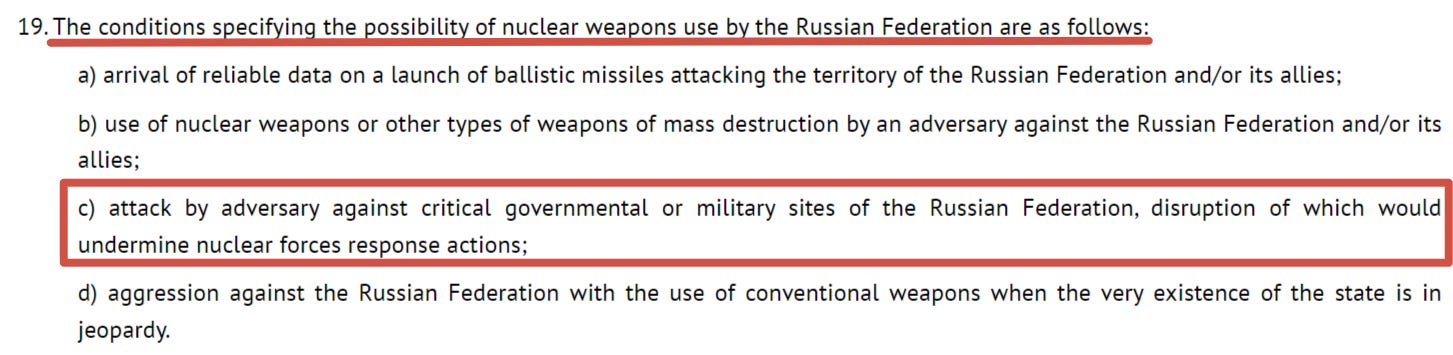
The mother of all provocations is that Ukraine has now attacked and damaged a strategic Russian early warning nuclear ICBM long range detection radar in Voronezh, triggering 19c of Russia’s nuclear response doctrine:
May 25, .. Let’s get right into the most pressing development: a narrative overload has swelled around the topic of allowing Ukrainian strikes on Russian soil.
It has suddenly become the top coordinated focus for the entire deepstate establishment, with Zelensky and complicit Congressmembers forming a critical mass of pressure against the Biden administration, with some claiming they’re gaining headway.
You have to really read between the lines to understand the hidden layers of what’s going on: such heavily coordinated campaigns are never spontaneous but almost always part of a deeply thought out strategic shift to veer the war in a new direction.
The reason is obvious: Ukraine is at a crossroads and a potential breaking point. The political situation has hit rock bottom, with Zelensky’s authority and legitimacy quickly unspooling; the manpower issue is reportedly very bad and is not being addressed by the newly announced mobilization; and on top of all that, Russia appears on the brink of opening up another in a series of new fronts that could bring the AFU to the brink by stretching the lines like never before.
There are increasing signals that the covert plan from the globalist controllers is to get Ukraine to leave Russia with no choice but to escalate drastically and bring NATO in some form, whether limited or not, into the fight. Ex-British MP Andrew Bridgen stated that this is the real reason why Rishi Sunak has called an early election—he refuses to be a ‘war time president’.
Listen to the chilling details below: *video at original post
This comes on the heels of articles like the following which reveals that British special operation forces have already been operating on the frontline in Ukraine, in greater capacities than we think:
Though not exactly a sterling source anymore, just to dress the scene, Rybar likewise claimed that Taurus missiles are already in Ukraine:
“Taurus missiles are already in Ukraine, their combat use is a matter of time. Berlin is just waiting for instructions to announce this,” said the author of the expert analytical project “Rybar”, assessing the statements of the British Minister of Defense.
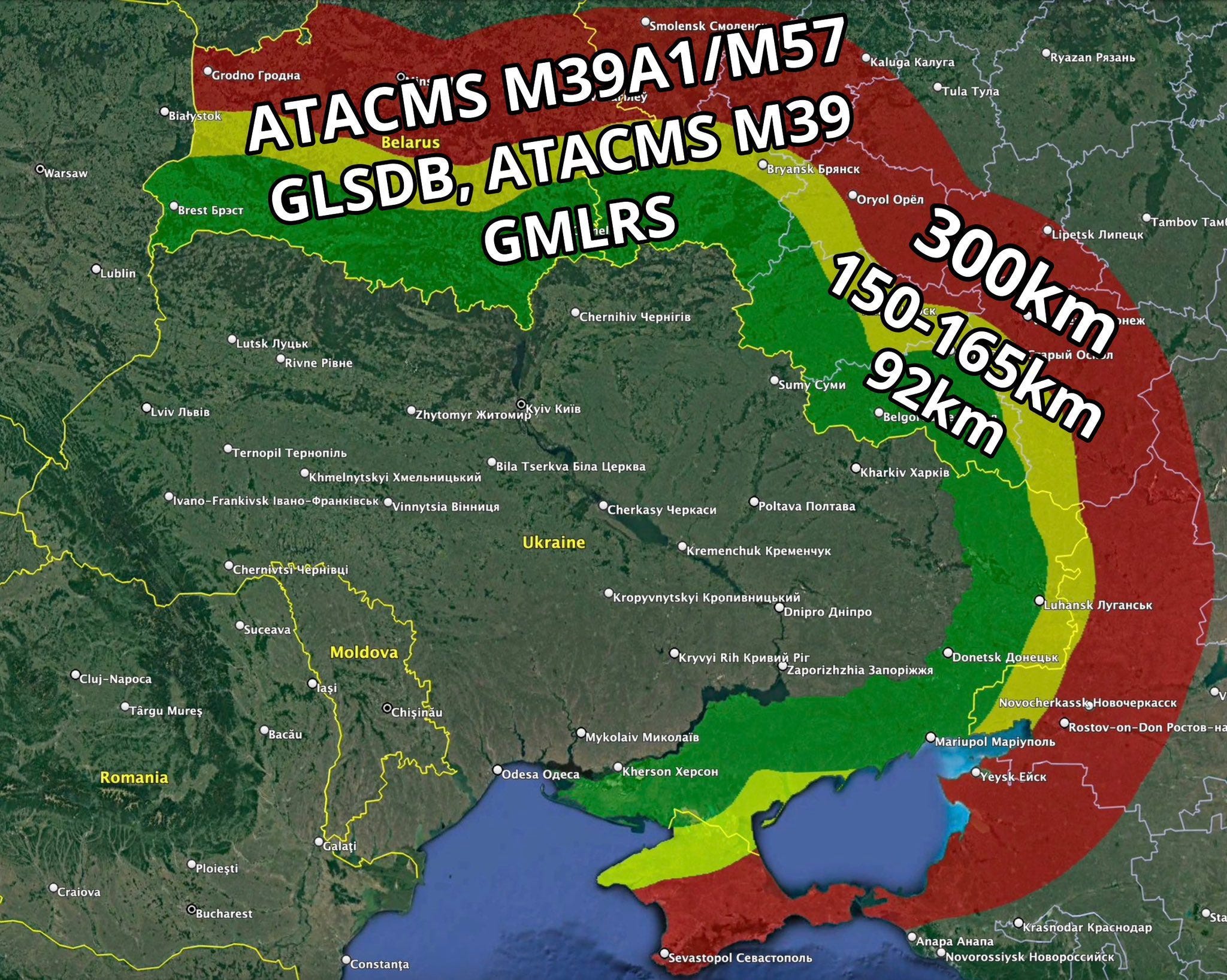
Previously, military experts reported that deliveries of weapons (including ATACMS and Storm Shadow | Scalp missiles) are always carried out before talk of “quick deliveries” begins. Also, a colossal scandal was caused by the leak of negotiations between the Bundeswehr leadership about the launch of “dozens of Taurus across the Crimean Bridge by the hands of NATO military.”
In addition, Western military analysts noted that Taurus missiles will be able to fly from the Sumy region of Ukraine to the capital of Russia – Moscow and other cities, factories, etc.
In accordance with the script given him, Gary Kasparov also declared his encouragement for Ukraine to begin striking large Russian cities like Moscow and St. Petersburg with the new weaponry:
Stoltenberg and a host of other apparatchiks followed suit in the highly coordinated push:
As quick reminder, Russian General Evgeny Buzhinky stated the following a month or so ago:
“I do not have firm information about how the Russian president and Russian military command will act, but I am sure that if the strikes of Taurus of ATACMS are very harmful for Russia, then I presume we will at least strike the logistical hub in the territory of Poland in Rzeszów. In this case, it will be up to the United States to decide what to do. Either to go to the Third World War with mutual destruction or leave the Poles to fight Russia alone,” retired Russian Lieutenant General Evgeny Buzhinsky, told the New Rules podcast.
You might be thinking this is all just speculative hearsay and threadpulling thus far. But Russia has clearly read the tea leaves and signaled in kind, as the defense ministry announced they would be conducting an unprecedented series of tactical nuclear exercises. This would revolve around finetuning the launch of tactical combat nukes, rather than strategic ones that fly across the ocean. The message here is simple and clear: Russia is issuing the response that if things continue escalating in the current dangerous direction then Russia may have no choice but to bring much more devastating weaponry to bear.
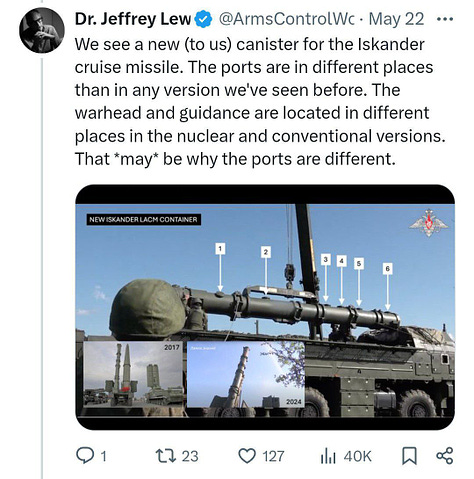
A video of one of the exercises was released, showcasing a tactical nuclear Iskander being readied, which you can see is even uncommonly blurred out to hide its unique nuclear-capable warhead:
Western commentators began to note the never-before-seen differences in this nuclear variant of the Iskander K and M variants:
“Zelensky wants a conflict between the United States and Russia to begin,” American television The Hill.
But why should Russia suddenly worry about this? Ukraine has been attempting to strike Russian targets for a while now without much success. Well, because now Ukraine is having serious success. I previously reported on the Russian S-400’s troubles against the ATACMS missile: the problems have gotten much worse for Russia. S-400s are now being regularly taken out to pasture by the barely stoppable ATACMS.
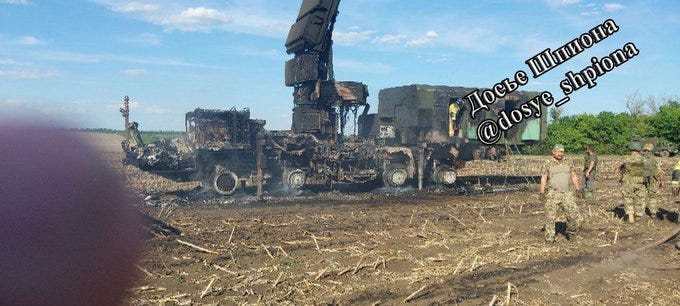
Another battery was just decimated yesterday in Donetsk with a second claimed one being hit in Alushta, Crimea again, though there’s no definitive evidence on that yet. Though I should note I’m not sure it’s proven the below is an S-400, as some suggest it could have been an S-300/350 series based on the destroyed radar.
But here we can finally see in full color how it goes down with the newly released Ukrainian footage. Not only is the S-300/400 and surrounding Shorad defenders—if any—incapable of neutralizing the guiding Shark drone, but the ATACMS missiles themselves overwhelm the battery:
*videos at original post
How do we know it’s ATACMS and not anything else? The extremely wide cluster munitions spread is consistent with the much larger ATACMS rather than HIMARS, for instance, which carries less munitions and has a far smaller spread.
Also, in the post-strike damage video seen above you can clearly see a discarded ATACMS fuselage on the ground. Ukraine also released a video showing a launch of up to 8 or more ATACMS, though it’s not 100% clear it is meant to show this one specific attack, though that appeared to be the implication.
So: assuming that launch was in fact connected to this particular S-400 hit, what can we surmise? The S-400 battery clearly launches a slew of missiles, and most analysts are interpreting that to mean that the battery did manage to shoot down almost the entire ATACMS package, with only one missile hitting cleanly at the end. But that one was enough to destroy virtually the entire battery.
The problem is: the S-400 is meant to have a 400km detection range. But the system is clearly engaging the ATACMS only seconds away from their impact. This could indicate a major shortcoming of the system, or merely our lack of details.
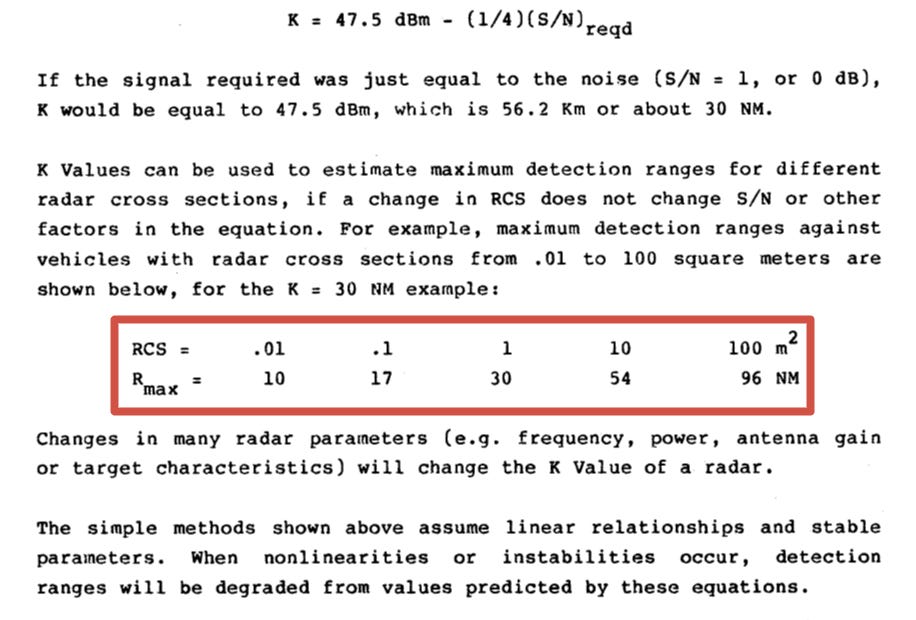
For instance: sure, the radar itself can detect 400km in the most optimistic/idealistic conditions, but:
That’s only for maximal-sized objects with huge RCS’s like B-52s. A missile, even a large one like an ATACMS, would still be detected at a much closer range—it’s simply down to mathematics. In fact, as the calculations in the above image show, a sub 1.0 RCS object (which most missiles are) would be detected at approximately 30km or less.
The S-300/400 systems can and are loaded with a variety of different missile types for different purposes, some being very short range missiles. If this particular battery was equipped with mostly short ranged ones then it would not be able to engage the ATACMS at long range anyway.
There’s no telling of the crew training of the particular unit.
Some pro-Russian analysts say it’s still a success when the systems are shooting down “most” of the ATACMS at 70-90% rate. The problem is, when your S-300/400 are being attrited with multiple batteries taken out each week, it doesn’t matter if your success rate is 90%—your systems are still failing in their primary duty. It’s just that it’s not a failure particular to them but of the entire AD eco-system. There appears to be a lack of integration (IADS) and a holistic approach to detecting objects at safe ranges, which includes utilizing AWACS and other airborne platforms. The fact that the S-400 is only responding at the final moments of the missiles’ arrival time and time again is a deep issue in detection for the Russian forces.
If it is true that another system was likewise hit in Alushta, Crimea just a day later, then it means Russia has no way of reliably stopping the ATACMS as they are pretty much hitting anything at will.
Unverified report below which could be mostly fake, though the strike was caught on camera, but no real details are yet verifiable:
Again bad news from Crimea. We lost almost 30 military and air defense systems
Another missile strike, which the enemy launched on Crimea on the evening of Thursday, May 23, led to serious consequences. “Some of the missiles penetrated our air defense system. Unfortunately, the attack was too large. The consequences are serious,” said a source in the General Staff.
According to our data, the losses suffered as a result of the strike are heavy. In the Simferopol region (in particular, in Gvardeysky), Alushta and not far from Bakhchisarai, unfortunately, there were hits.
Three S-400 air defense systems, one S-300 air defense system, and several radars were lost. Also, more than 20 pieces of equipment that were being prepared to be sent to the SVO zone were damaged or completely lost. There is information about the loss of two Su-25 aircraft, but we do not have one hundred percent confirmation of this information; it still requires verification.
As a result of the strike, 29 soldiers were killed and more than 35 were wounded.
We want to say an important thing. While the authorities, including the new leadership of the Ministry of Defense, promise to protect personnel and equipment, and our army simultaneously suffers such heavy losses, we will talk about these losses in detail. With the hope, in particular, that the problems with the air defense of Crimea, which have been known for a long time, will be resolved.
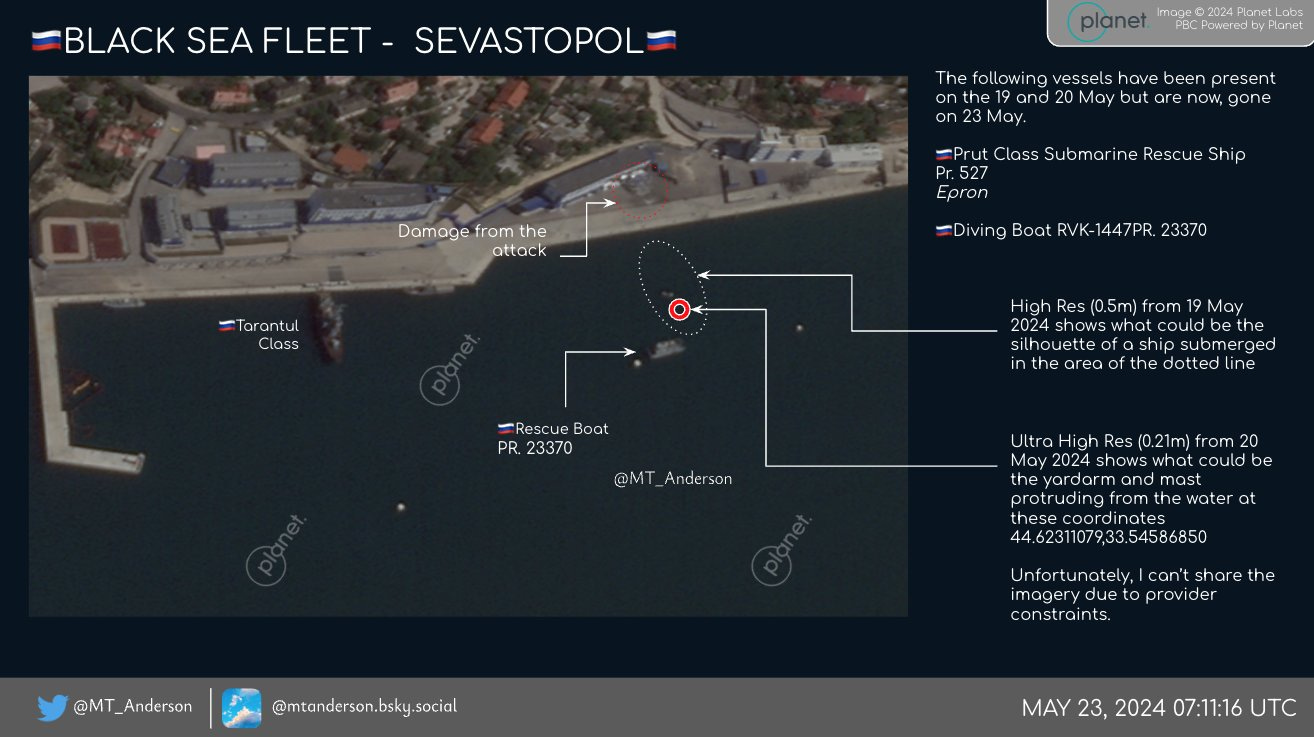
Keep in mind, this comes after another ATACMS strike hit Sevastopol port and reportedly sunk another Russian Corvette. There was no proof until satellite images appeared to show something potentially half-submerged in the waters:
A list of recent attacks with claimed shoot downs:
12 ATACMS attack on Dzhankoy airport which destroyed atleast one S-400 destroyed on 17th April
10 ATACMS shot down on 20th April
5 ATACMS shot down on 29th April
2 ATACMS at a training field of 1 which one missed on May 1st
Unknown amount of ATACMs intercepted on 7th of May
1 ATACMS at an ammo depot in Lugansk 13th of May
10 ATACMS shot down on 15th of May
5 ATACMS were shot down and some managed to hit Belbek airfield, destroying/damaging multiple planes on 16th of May,
5 ATACMS used to destroy S400 launcher and other systems in Donestk on 22nd of May.
Multiple ATACMS used on the night between May 23 and 24 to hit Alushta, Crimea
In total, we know more than 50 ATACMs have been used in various attacks since the aid was passed. All in the span of 30-40 days
There is now satellite evidence coming in that a Russian airfield in Krasnodar was hit by drones, with multiple planes damaged. They appear to have been scrapped or inactive planes again for a variety of reasons.
Satellite images of the Kushchevskaya airbase in the Krasnodar Territory after another raid by Ukrainian kamikaze drones.
You can see the traditional lack of protective hangars for stationary aircraft. Presumably, the Su-27 fighter and the Su-30SM next to it were damaged during the strike. The Su-34 bomber with its “wings” removed looks more like a high-quality mockup.
The remaining planes, judging by the photo, left the airfield after the strike.
Ultimately, if I had to guess about the failures of the S-300/400, it would be the following for now:
As I said, detection range for a low RCS missile could be as low as 30km. The ATACMS is very small by ballistic missile standards: 13ft long and 1600kg, compared to the Iskander’s 24ft length and 3800kg—it’s virtually half the size.
Let’s assume it gets detected at 30km, at Mach 3 speed, this gives the operator’s less than 30 seconds to react. That may be fine for a single object—or even a small handful—but for a saturation of nearly a dozen or more missiles it could bring the engagement procedure down to the bleeding edge of training and panic. And this is assuming the initial detection is 30km—it could be even less, particularly if the crew isn’t super alert and engaging in a bit of lax sleeping on the job.
With, let’s say, 20-25 seconds, you have to communicate between several crew members, select the targets on the screen, and do a variety of other procedures just to even begin firing the missiles. By the time the missiles come out, the first few ATACMS may already be directly overhead. Given that they release their cluster munitions at a certain distance/altitude away from you, this gives you even less time to shoot it down than it would a missile that still has to fly the full final stretch of kilometers to impact you directly.
I should say the above is fairly speculative, as some sources claim the S-400 radars (Cheeseboard, Gravestone, etc.) should detect an object of 0.1m2 RCS at far greater ranges like 80-200km, but this may simply not be the case in reality—no one knows for sure.
What we do know is the Pantsirs are not detecting Storm Shadows until something like 10-15km give or take, so double that for ATACMS is not unrealistic, though S-400 radars are supposed to be far more powerful. Also, those “idealistic” detection ranges are generally advertised as PR from very narrow ‘window mode’ scans of the sky, where the radar concentrates all its power into one narrow 30-40 degree area, which is not how you scan for threats from all directions.
This is only used if you already know the general location of a threat. For a wider general purpose sentry scan, the electromagnetic power is dispersed, and detection is consequently made at far smaller ranges.
Lastly, I do think there’s good chance there were other things thrown at that S-400 system because if you look closely, some of the fired missiles go straight upward, while others immediately pitch over horizontally, as if to chase much lower altitude inbound objects, which could likely be anything from Storm Shadows, Neptunes, HARM, Mald decoys, Brimstones, or even drones. But again: this would still constitute a failure of IADS as S-400s are not supposed to operate alone but as part of a network which includes heavy Shorad support.
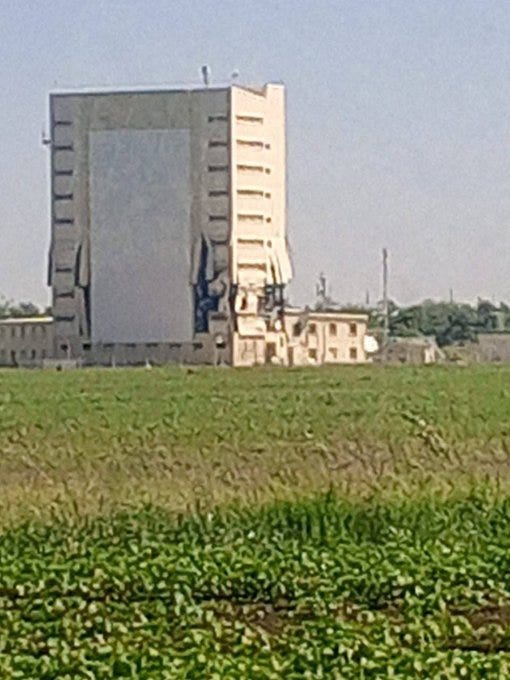
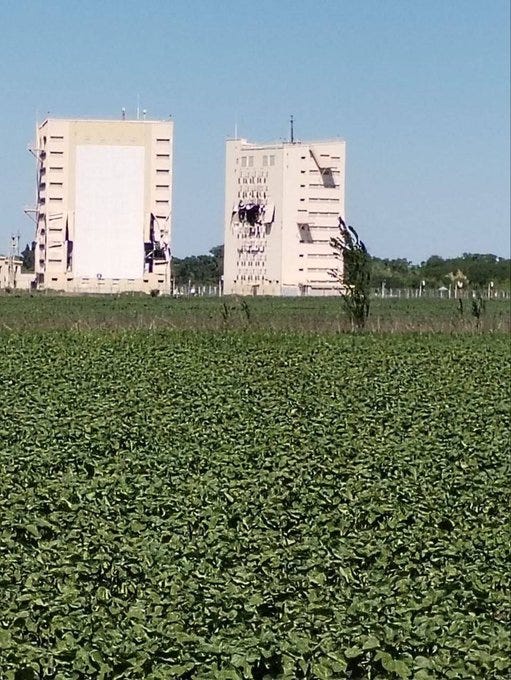
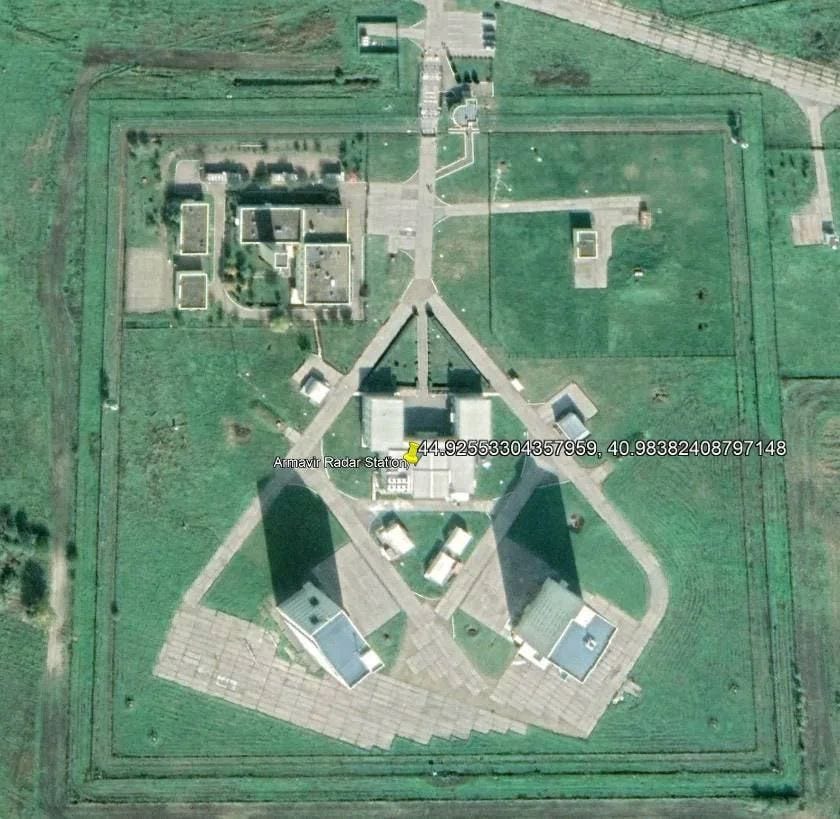
But the mother of all provocations is that Ukraine has now attacked and damaged a strategic Russian early warning nuclear ICBM long range detection radar in Voronezh:
Apparently Ukraine has attacked a Russian ballistic missile early warning radar in Armavir, Russia. This destruction of this particular radar node has limited direct military utility for Ukraine, due to its coverage. I guess some one really wants to test stability.
FighterBomber writes:
The enemy is slowly disabling the components of our main argument – the components of the nuclear shield. Attacks strategic nuclear weapons carrier bases and nuclear attack warning elements.
As soon as the enemy realizes that the damage is critical and we cannot respond with unacceptable damage, he will immediately strike with everything he has.
Paragraph 19c of the Basic Principles states: “attack by an adversary against critical governmental or military sites of the Russian Federation, disruption of which would undermine nuclear forces response actions”. This effectively means any interference of any kind against civilian or military infrastructure, which would undermine nuclear retaliation capability.
Ukraine is now carrying out the slow de-arming and neutralization of Russia’s nuclear triad on behalf of NATO, which is an extremely existentially dangerous position for Russia to be in. Thus, Russia is now within its doctrinal rights to respond with nuclear retaliatory force—and Ukraine is just beginning its escalations.
So this is the main reason we are now at a potential crossroads:
Ukraine is poised to potentially prick Russia badly and now has the demonstrated capability to do so without Russia able to reliably neutralize the threats. If Ukraine gets the go ahead to use ATACMS and perhaps even the Storm Shadows, Taurus, etc., on Russian soil—not counting Crimea, which they’ve already done as they consider that not to be Russian territory—then all hell could break loose as Russia has not demonstrated the capability to stop the ATACMS reliably, and Ukraine could very well hit extremely sensitive targets that would put Russian command and control at a historic crossroads.
But why has Ukraine suddenly begun to demonstrate such an ability to hit important Russian objects? Answer: mostly because it has poured the remainder of its money toward asymmetric style warfare. You see, none of these attacks damage the real Russian army or change any of the calculus on the ground.
But given that Ukraine knows that nothing it can do will change that, it has wisely decided to pour the remainder of its resources into drones and long range weapons capable of at least shaking things up in very asymmetrical ways.
The goal is clear: Zelensky and co. likely want Russia to respond with tactical nukes. For Zelensky—dictator of a country which has already brushed off the world’s worst nuclear reactor disaster in Chernobyl, and which cheerily irradiates its own land with Western supplied depleted uranium shells—a small nuclear incident is the tiniest of possible prices to pay for his regime being saved by subsequent NATO intervention.
Any Russian tactical nuke use would be merely demonstrative, anyway, and would not have much battlefield utility. Ukraine’s forces are not concentrated, and are dispersed enough that a tactical nuke would not yield any particularly high casualties of either manpower or materiel.
The only place where the AFU’s troops are concentrated is precisely the area where you cannot use nukes: Ukrainian cities in the rear lines.
Though I should say, one area where nukes would do wonders is taking out Ukrainian airfields. That may not kill many soldiers but would totally devastate large fields which almost no amount of conventional missiles can take out, preventing their future use not only for Ukraine’s own remaining air fleet but the planned F-16s.
But there are other potential ways Russia could escalate without nukes, for instance finally clamping down on NATO surveillance flights and threatening to shoot down the drones over the Black Sea. This is actually a much larger deal than it seems: given that the U.S. has no real way of militarily responding to this, it would be a big humiliating black eye for NATO to have its drones shot down, and be unclothed as impotent to do anything about it.
NATO doesn’t have the Black Sea infrastructure or presence to really launch any kind of convincingly retaliatory actions and would be put into a geopolitically tight spot.
Keep in mind, word is that Germany is still peremptorily against allowing Taurus usage, particularly on Russian soil; and for its part, I personally doubt the Biden admin will allow ATACMS usage there either.
I personally view the preceding events as an information attack meant to continue the ‘strategy of tension’ against Russia. Yes, there’s still a chance of it being otherwise, but my analysis is that highest probability remains with this being a provocation.
For instance, it was just announced Biden will not even be attending Zelensky’s flouted Zurich ‘Peace Summit’:
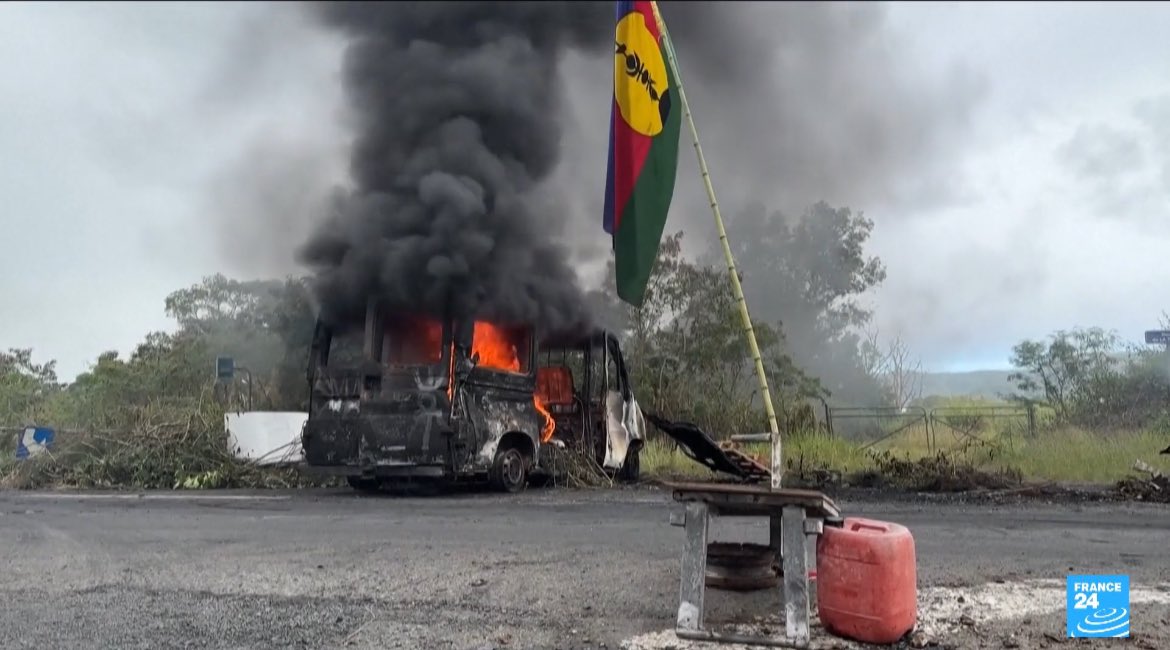
The state of emergency declared by French PM Macron on May 16th is proof that France is yet again mobilising its military police to suppress another popular uprising against its colonial rule. It is no surprise when the past struggles for independence of the indigenous Kanaks reaching its peak in the ‘events’ of the 1980s […]
Autor Antonio Marquet Editorial Universidad Autónoma Metropolitana-Azcapotzalco Año 2011 Sobre el libro Aún hay quien se pregunta con una actitud que apenas esconde inveterados dejos homofóbicos si existe una cultura gay. Pregunta insidiosa que intenta negar la riqueza expresiva de una comunidad que ha sobrevivido a una de las constantes más vergonzosas de la historia […]
Photograph Source: José Fuertes – https://creativecommons.org/licenses/by-sa/4.0/ Reposted from Counterpunch Delegates loyal to President Luis Arce dominated the 10th Congress of Bolivia’s Movement toward Socialism (MAS) Party held in El Alto in early May. They selected Grover García, chief of a governmental agency and formerly of a farmworkers’ union, to be MAS’s new leader, replacing former president […]
Una bolsa de plástico puede tardar más de 500 años en degradarse. Una pila tirada a la basura tiene componentes que seguirán siendo nocivos 1000 años después. Una botella de vidrio necesita 4000 años para desaparecer. Y el polvo radiactivo de las explosiones nucleares podrá ser detectado dentro de 100.000 años. Indelebles, las marcas de […]









 The Free