
Anarchist transhuman sci-fi collective Radon have published multiple digital journals over the last few years exploring themes including dystopia, rebellion and social conflict.
from thefreeonline on 11th June 2024 By thecollective at anarchistnews From Freedom News

NEW- The Free is now on Telegram: https://t.me/thefreeonline
Rob Ray interviews the editors.
Could you explain the background of the collective?
We created Radon Journal to fill a niche that we wished existed when we were young: the intersection of science fiction and anarchism. We made a new space expressly for those who want to look toward the stars while envisioning blueprints for a better society. Anarchist praxis often deals with working in the present to build a better future, and so extending this timeline a little further naturally provides excellent sci-fi.
A large portion of what Radon does is outreach to educate the public about what these concepts entail. Because science fiction is more than just robots and spaceships and anarchism is more than Molotov cocktails and black bloc.
Two of the co-founders spent their high school years DIY-publishing science fiction books together, went into the world to be independently radicalised into anarchists, then reconnected 12 years later to combine their passion and skills for a new generation of writers.
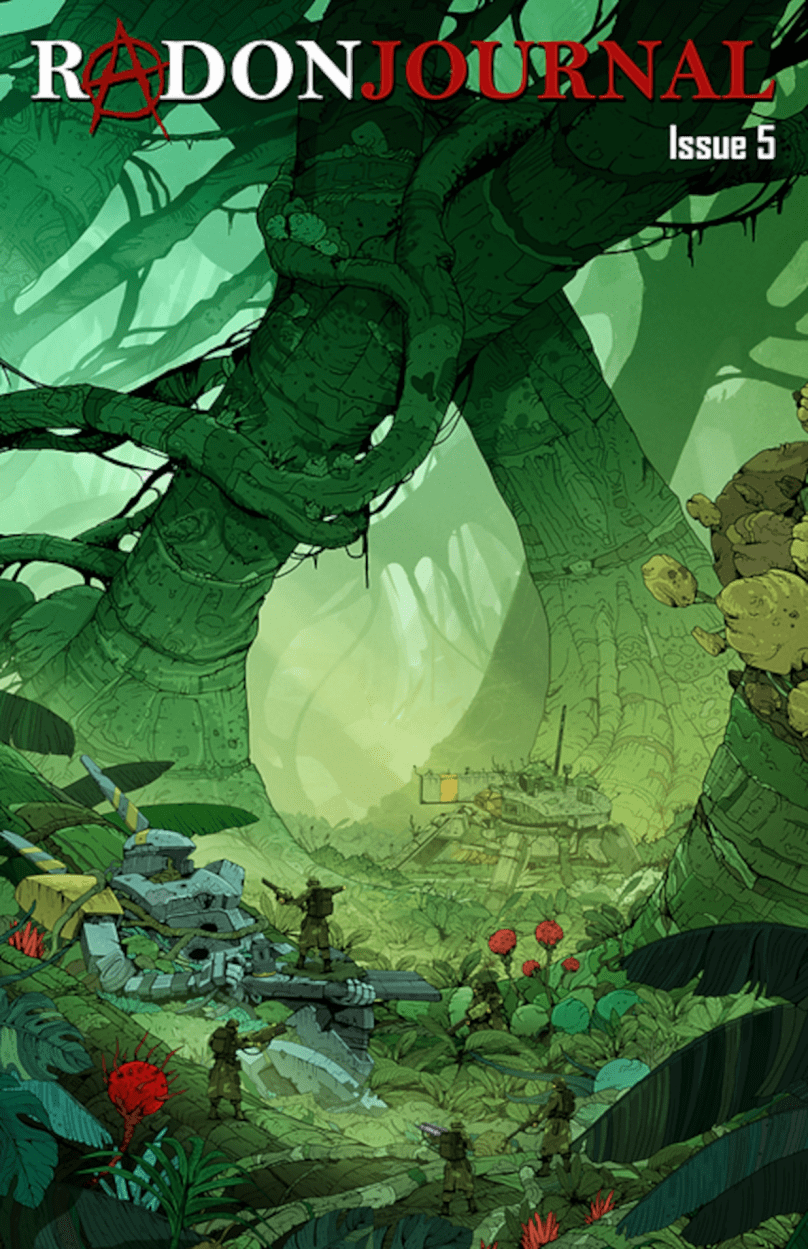
Radon also focuses on transhumanism in its journal because anarcho-transhumanism is one of the newest and most misunderstood anarchist schools of thought and melds perfectly with what we do as a sub-genre of science fiction.
Ursula Le Guin, the most successful anarchist sci-fi writer of our time (in terms of reaching minds), passed in 2018 and devastated us. We aim to continue her legacy of combining anarchist politics with science fiction stories and showing the world that an egalitarian future is possible while also warning of potential dystopian worlds if we’re not vigilant.
How difficult has it been finding a balance between dystopian, generally speculative, and more “utopian” (or post-scarcity) approaches?
Dystopia does seem to be one of our most popular submission categories. And it’s not hard to see why. Late-stage capitalism continues to tighten its grip, Earth is dying, and the world is falling back into fascist dictatorships. Our millennial generation has discovered that the promises of our future were lies and that the only things we can count on are what we claw back through direct action.
We would like to see more post-scarcity stories submitted to us serving as tales of how anarchist societies might exist in a sci-fi setting. That said, we let each issue coalesce into its own identity based on the nature of the stories that are submitted during each issue reading window. The more utopian and solarpunk stories tend to find homes in magazines specifically reading for those genres.
The majority of our submissions come from science fiction authors who include leftist social commentary in their work, rather than anarchists who write science fiction. We would like this ratio to balance out more in the future.
Transhuman fiction has had a fairly strong uptake in anarchist circles, possibly more so than solarpunk. What do you think the draw has been?
To us, transhumanism and anarchism logically go together and complement one another. Anarchism, as we all know, aims to increase our general social and economic freedoms.
Meanwhile, transhumanism aims to give us physical freedom and remove scourges of human existence, such as death and human limitations.
The concept is likely gaining attention due to the technology around us now increasing at an exponential rate. It is natural that we pay more attention to the implications and possibilities of technology as both individuals and society grapple with change.
We want to be free to explore not only this planet but the entire cosmos, unshackled by such arbitrary things such as money or natural life-span. There is so much to learn about our reality, and we humans are endlessly curious. There’s no reason why we should let ourselves suffer and die if we can prevent it

Conversely eugenicist types can also be attracted via the ‘improvement’ aspect. How have you tended to work through that end of things?
We believe that any parent would jump at the chance to easily and safely prevent diseases in their child. But we recognise that the technology could easily be used by the wrong hands and accompany evil eugenics practices. So, do we prevent any technological progress from occurring due to fear of misuse? What happens if capitalists use this technology? How would anarchists use it instead? Is the ethical use of new technology somewhere in the middle? We don’t know the answers, and it is in exploring this middle ground that great stories are born, and what we hope to publish.
You’re also right that there are several loud right-wing techno-libertarians (such as Elon Musk) who have done a shockingly good job of tying themselves to the concept of transhumanism. There is an ongoing battle being fought in most transhuman groups (especially large ones in the US) between the left and right for ownership of the label. Some Radon editors are semi-active in these groups working with other anarchists and communists to push out the right-libertarians and reclaim the label in popular culture before it’s too late.
We firmly believe that transhumanism is inherently a far-left philosophy intimately tied with anarchist thought. Radon exclusively approaches transhumanism through a social anarchist lens and rejects all tech bros and their beliefs.
Few technologies are inherently moral or immoral. Every invention increases humanity’s ability to do good equally as much as it increases our ability to do evil. For instance, the invention of the aeroplane allowed us to quickly and easily reach and connect with our fellow person. But it also allowed humanity to quickly and efficiently kill entire populations.
I enjoyed Jonathan Olfert’s Whiskey Mud (Issue 2), and the idea of exploited or restricted minds runs through many of your stories — there’s a crossover with cyberpunk in that sense. What are your thoughts on this concept as a preoccupation of modern sci-fi?
We may not have cyberpunk listed as one of our main tenets, but our editors equally love the sub-genre. Blade Runner and Altered Carbon are among our favourites. Who knows, maybe we’ll add it as a listed term one year, as we would love more cyberpunk submissions.
Continue reading “Interview: Radon Journal: how anarchist societies might exist in a sci-fi setting”







 The Free