La diplomática también destacó que su país “no ve ni ha visto nunca a China como su oponente”, sino que quiere ver a Pekín como “su amigo”. Kiev estudiará la posibilidad de participar en la cumbre propuesta por China para resolver el conflicto ucraniano con la participación de Rusia, afirmó la embajadora de Ucrania en Singapur, Ekaterina […]
The war in Ukraine is being fought on NATO’s (the U.S.) side with NATO weapons and ammunition, and on Russia’s side with Russian weapons and ammunition. The majority of commentators say that, thus far, Russia has the advantage. No one is blaming Ukraine’s soldiers for this. On the NATO side, there is silence about whether its weaponry and ammunition are performing less effectively than Russia’s weaponry and ammunition — which cost far less.
Only less than half of it goes to pay for education, healthcare, and the other necessary goods and services to the benefit of the nation’s domestic population, America’s citizenry.
It is a military operation, even more than it is an operation to serve the citizenry. That’s a fact, not an opinion, about the U.S. Government — but it is a hidden fact (as that link above documents to be true).
The official U.S. Government spending on its military is only what is being paid out of its Defense Department, which is now around $900 billion per year (vastly more than any other nation’s).
However, over $600 billion more per year is spent, each year, on America’s military, that’s not being counted in the official ‘defense’ (actually aggression) figure (over and above that $900B amount).
No other country except possibly China now (in order to prepare for war with the U.S. so as to prevent a U.S. take-over of China’s Taiwan Province) hides its excessive military spending this way, because none needs to — none is so fat with sheer corruption in its military.
Even America’s colonies, such as England, Germany, France, Italy and the rest of NATO, aren’t that corrupt.
The U.S. population are gifted with a perfect national-security situation of more than 3,000 miles of ocean separating them from potential attack by a foreign power, plus only two bordering nations, both of which (Mexico and Canada) are on friendly terms with the U.S. Government.
On any rational consideration, therefore, America’s need for national-security expenditures isn’t $1.5T per year but at most only $100B ($100 billion) per year.
All the rest, above that sum, is imperial expense, in order to control the entire world for the benefit of its billionaires who control international corporations and who own controlling interests in the giant ‘defense’ firms (which receive the profits from this $1.5T+ of governmental spending each year.
Suni and Butch in blue,Floating about. The Space Station is packed , with at least 9 astronauts in one photo
The two NASA astronauts are stranded aboard the International Space Station as their spacecraft, a Boeing Starliner, continues to ‘experience multiple technical difficulties’.
Now the US may have to suffer more space humiliation and ask their Russian enemies to return Suni and Butch to Earth on their reliable Soyuz craft or else on the Space X, also now docked on the ICC, if the Starliner cannot be remotely repaired.
September 2022..Disaster: New Boeing Starliner failure! It was a frustrating disappointment in 2022 for commander “Butch” Wilmore and co-pilot Sunita Williams, who were in the process of strapping in for launch when the scrub was announced. The moment brought to mind one of Wilmore’s favorite sayings: “You’d rather be on the ground wishing you were in space than in space and wishing you were on the ground.”Now in 2024 he’s really Trapped in Space
There is some justifiable doubt whether NASA can fix the craft remotely, as they have been unable to make it flight-worthy on Earth during 7 years! The 2 astronauts were meant to stay for only one week on the 1st crewed flight..
During a press conference on Tuesday, NASA and Boeing announced that the two Americans – Suni Williams and Butch Wilmore – will not be coming back to Earth before June 26 at least, as experts are struggling to fix the spacecraft.
NASA astronauts Butch Wilmore and Suni Williams The long, thorny history of Boeing’s Starliner spaceship – MSN – Way back in 2014 Boeing got $4.2 BILLION to develop a “commercial crew” transportation system. It was too embarrassing to have to always depend on the Russians.
10 years later, after unbelievable farcical delays and a $1.4 billion cost overrun the maiden trip set off, only to have at least 4 helium leaks and thruster problems, and leave its 2 US astronauts STRANDED on the Space Station awaiting repairs.
Incredibly Starliner’s first flight carrying astronauts was actually targeted for a launch seven years ago. About two years later, in December 2019, Boeing was at last ready to send an empty Starliner up to the Space station but new faults set back the date again and again until 2024.
Why the legacy company has struggled endlessly with the spacecraft isn’t all that clear. Comparisons have surged with the ongoing safety plague on Boeing Jets with various whistleblowers denouncing a culture of safety shortcuts to boost profits.
However in the ongoing Starliner debacle saving money can hardly be the reason. Answers from Boeing leaders have been at times stunningly opaque.
Suni enjoys waving to home from the Space Station
It’s been quite a scenario starting in 2019 with software failures that caused the thrusters to fire so long it didn’t have enough gas to get to the space station.
The Boeing CST-100 Starliner initially registered several mechanical issues during its maiden manned launch on June 6.
En route to the station, the crew reported problems with five thrusters and four helium leaks, and another leak was revealed soon thereafter.
Prior to the flight, the company also stated that the spacecraft already had a “small helium leak” but insisted it was not a critical “safety of flight issue” and could be managed.
“A little bit more time” – but they’re already 7 years late!
NASA’s Commercial Crew Program manager Steve Stich explained on Tuesday that the reason for the hold up was the agency’s desire “to give our teams a little bit more time to look at the data, do some analysis, and make sure we’re really ready to come home.”
Stitch also insisted that NASA doesn’t currently foresee a scenario in which the two astronauts would not be able to come home on the Starliner. The return trip is currently scheduled for June 26, when the crew will attempt to land in the White Sands area of New Mexico. If that proves impossible, then the next “prime opportunity” would be a week later on July 2.
Despite the extended delay, NASA’s Dana Weigel, who manages the agency’s ISS program, said the crew is feeling positive. Boeing’s vice president and program manager for the Commercial Crew Program, Mark Nappi, has also said the crew was taking advantage of the extra time and saw the situation as an “opportunity” to do more work.
She was worried. A month earlier, a plane had slammed into the side of a pentagon-shaped building just down the road from our house.
“OK. Uh, can I go to the homecoming game?”
“Well, sure!”
“But like, I’m new at school so… can I just go by myself? So I can make friends?”
“Of course, honey.”
I couldn’t believe it worked. My high school was right next to a metro station—I was obviously just going to hop on the train and go to the protest.
“I hope we win.”
“Me too! I’ll pick you up at 8.”
When I got off at the Dupont Circle stop, my punk rock role model older-sister-figure who always tempted me to skip school for cool shit was already waiting for me.
“So…what are we protesting? Bush? The World Bank? The war?” I asked, not caring too much as long as we got to fuck shit up.
“Cars.”
“Cars?”
“Yeah, we’re taking over a street.”
“What do you mean ‘taking over’?”
“Like, with couches and DJs and stuff.”
“DJs?!”
The Reclaim the Streets action in Washington, DC in October 2001. A photograph by the author, aged 14 at the time, digitally restored for this publication. Note the white van to the right.
That did not clarify things for me, especially because people in the march that scooped us up were carrying placards decrying all the evil institutions and people I had mentioned.
But once we hit 21st and P, a black-masked affinity group, moving with purpose and apparent planning, ran out of the crowd to a nearby alleyway and pulled out orange cones stenciled with an image of bellbottomed dancers inside a diamond-shaped traffic symbol.
They lined up the orange cones on either end of the block. Unlike other marches I had been on—in which the point was to keep moving so that an affinity group could break out, quickly destroy the windows of a bank or Starbucks, then disappear among the mass again—the point of this demo seemed to be just to be here.
Someone handed out flyers with the same bellbottomed dancers traffic symbol, saying something about streets not belonging exclusively to cars, about reinventing public space as a wonderland of joyous community instead of an artery for capital.
Another affinity group quickly established good relations with the workers at a local café, who let us use the bathroom and get water throughout the afternoon. This happened so quickly that there must have been some prior, behind-the-scenes organizing with the workers. A bunch of them did have piercings and funny hair.
As I stared at the café, marveling at all the moving parts in this troublemakers’ Rube Goldberg machine, a cheer erupted behind me, drawing my attention back to the crowd. A junker car—presumably acquired especially for the occasion—was rolled out of its parking spot, tagged up with “Reclaim the Streets!” and a circle A, and flipped over.
Some genius found a pole to lay inside its wheel well and people pulled couches all around it so that anyone could chill and watch the skaters grind the spectacle of destruction.
That’s when the final party favor opened its doors: in the middle of the block, a white work van in an alley became a DJ booth playing techno. BOOM BOOM. And loud! Vibing my body down to its core.
I live chasing that feeling: the loss of control, the impossibility of remaining unmoved, the need to get down. I had a Fatboy Slim CD at home, but I had never heard techno this loud, or around this many other people. I scanned the crowd once more—it wasn’t just bigger now, it was transformed.
The protestors with their placards and the anarchists with their black masks were still there, but out of nowhere there were way more party freaks: JNCOs, goggles, candy necklaces, frost-tipped hair.
I overheard a couple of the ravers talking.
“Yo, I’ve never been to something like this.”
Claremont Road.
“I know bro. I’ve heard of outlaw parties before, but this is wild.”
Just as this departure from traditional protest tenor mesmerized me, it was also a captivating deviation from the routine techno party. The alchemy of underground scenes kept cooking gold—the sun was setting and the party was just getting bigger and bigger.
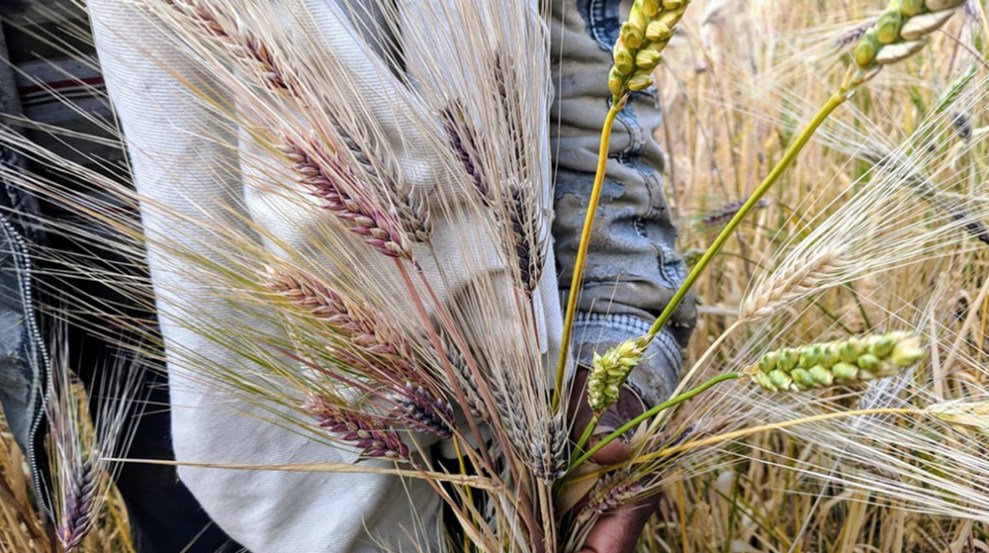
A farmer in Ethiopia cradles a handful of maslin, mixed grains including different varieties of wheat and barley, that are grown together. Courtesy of Alex Mcalvay
When Zemede Asfaw was growing up on a farm in eastern Ethiopia, he soaked up plant lore and other traditional knowledge the way a tree takes in sunlight and converts it to energy. “I knew the crops, and the wild plants, and the fruits and other things,” says Zemede, who goes by his given name..
The practical methods he learned covered every aspect of farming: Instead of stone walls or wire fences, plant field edges with darker crops, so the bold colors of red sorghum, for example, create a clear border between the family’s plot and that of a neighbor.
Leave a few wild olive or acacia trees in the fields to harvest sustainably, over time, for firewood, animal fodder, or building materials.
And instead of sowing the seeds of a single grain in orderly rows, spread a mix of grains all over the field, “mimicking nature so crops have random distribution patterns, as in natural forests,” he says.
A handful of different wheat and barley varieties grown together in a single field in northern Ethiopia. Courtesy of Alex Mcalvay
Once harvested, these grain mixtures could be turned into many things: nutritious bread, a kind of roasted-grain trail mix called kolo, beer, and the potent clear spirit known as areki.
Now an ethnobotanist at Addis Ababa University, Zemede conducts field research in northern Ethiopia. The dominant grains grown there are different than in the region of his youth—his family grew sorghum and maize, while the northerners prefer barley and wheat, better suited to their mountainous highlands—but the principle is the same:
“We’ll plant the things that go together and are compatible with each other,” Zemede says. “Our farmers are good at mirroring nature.”
Ethiopia is one of the few places in the world where farmers still grow maslins, the general term for different varieties and species of grain that are sown in the same field, or intercropped. Maslins sustained humans for millennia, possibly predating the rise of agriculture more than 10,000 years ago.
These grain mixtures tend to be more resilient to pests and drought, and to lend more complex flavors to breads, beer, and booze.
Worldwide, maslins fell out of favor long ago, replaced nearly everywhere by sprawling, single-grain monoculture—but a small and passionate group of scientists, including Zemede, is hoping to change that.
A paper published October 13 in Agronomy for Sustainable Development makes the case for maslins to be revived by farmers around the world, for tastier bread, healthier crops, and more sustainable agriculture. The question is, why is it taking so long?
“We call it the Masluminati, a global conspiracy that no one is talking about,” jokes Alex McAlvay, lead author of the new paper and a botanist at the New York Botanical Garden’s Institute of Economic Botany.
He’s kidding, of course, but while farmers and botanists the world over are familiar with companion planting and agroforestry (such as growing coffee in the shade of other trees), maslins, says McAlvay, have “flown under the radar for some reason.”
He only learned of them when visiting Ethiopia on an unrelated project; overhearing farmers talk about planting teff, sorghum, and other grains together piqued his curiosity and, says McAlvay, “I went down the rabbit hole.”
The fact that maslins are grown today only in Ethiopia and pockets of Georgia, Eritrea, and a handful of other countries belies how widespread they once were.
There is solid archaeological evidence that growing maslins goes back at least 3,000 years, and possibly much earlier. Wild wheats such as einkorn grow naturally beside wild varieties of oats, barley, and rye grasses, and may have been foraged before the advent of agriculture.
But finding the first maslins is particularly tricky.
“Maslins are difficult to detect,” says Claire Malleson, an archaeobotanist at the American University of Beirut. Malleson was not involved in the new paper, but has studied intercropping in ancient Egypt.
To find evidence of early maslins, Malleson and her peers sift through millennia-old middens—essentially garbage dumps—and whatever was left behind in hearths and granaries, where different grains may have been mixed together long after harvest, making it almost impossible to piece together how the crops were actually grown.
An 1847 woodcut depicts the beehive-shaped granaries of Thebes in ancient Egypt. Sir John Gardner Wilkinson/Wikipedia Commons
“I think they were probably used all over the place, either specifically or because that’s just how things grow,” she says. “Obviously now in farming it’s all very carefully harvested, but in the past it was all scattered everywhere.”
While extensive archaeological documentation of maslins may be lacking, echoes of their global prevalence can be found in language. Nearly every farming region on the planet had its own lexicon for growing mixed grains, from weedy, almost indestructible ryes to millets, wheats, and barleys.
by Suzanne Burdick, Ph.D. Excess death data from 47 countries in the Western world show that excess mortality has remained high for the last three consecutive years — despite COVID-19 lockdown measures and COVID-19 vaccines, concluded the authors of a peer-reviewed study published Monday in BMJ Public Health.
“This is unprecedented and raises serious concerns,” said the team of Dutch researchers, who analyzed all-cause mortality reported in the “Our World in Data” database.
The open-access database included reports from the Human Mortality Database — known as “the world’s leading scientific data resource on mortality in developed countries” — and the World Mortality Dataset, which researchers used to track excess mortality during the COVID-19 pandemic.
In addition to presenting excess death figures, the Dutch authors cited research showing negative health outcomes related to COVID-19 vaccination programs and lockdown measures.
The researchers called on government leaders and policymakers to “thoroughly investigate underlying causes of persistent excess mortality.”
Earlier this year, Norwegian researchers published a peer-reviewed study in BMC Public Health, showing an increase in excess non-COVID-19 mortality — or deaths attributed to causes other than a COVID-19 infection — in Norway in 2021 and 2022. TrialSite News reported on the Norway study last week..
The study authors noted a “temporal concordance” between Norway’s increase in non-COVID-19 excess mortality and the country’s increase in mRNA COVID-19 vaccination.
Dr. Pierre Kory told The Defender, “This is unsurprising and totally in line with what we have argued is the effect of the mRNA vaccines.”
Kory — who has written numerous op-eds calling for an investigation into what’s causing excess deaths — said there are “numerous mechanisms of the spike protein used in the shots [that] cause endothelial damage and hypercoagulability [excessive blood clotting] leading to heart attacks, strokes, aortic aneurysms.”
June 18, 2024 By Palestine Chronicle Staff 17 people were killed and dozens injured in the central Gaza Strip, after residential homes were bombed at dawn on Tuesday in the Nuseirat and Bureij refugee camps. The Gaza government media office announced that the Strip is rapidly heading toward famine, accusing Israel and the Biden administration of […]
















 The Free