ACTIVISTS SPEAK OUT– Abdullah Öcalan is still jailed because he is the Key to peace. He is uniquely trusted for his practical revolutionary ideas and for leading 2 long ceasefires with the endless Turkish repression.-
from thefreeonline https://wp.me/pIJl9-EpX on 12 October 2023 By Gemma Parera at El Salto via Rebelion.Org Translation. thefreeonline/ Tgram: t.me/thefreeonline
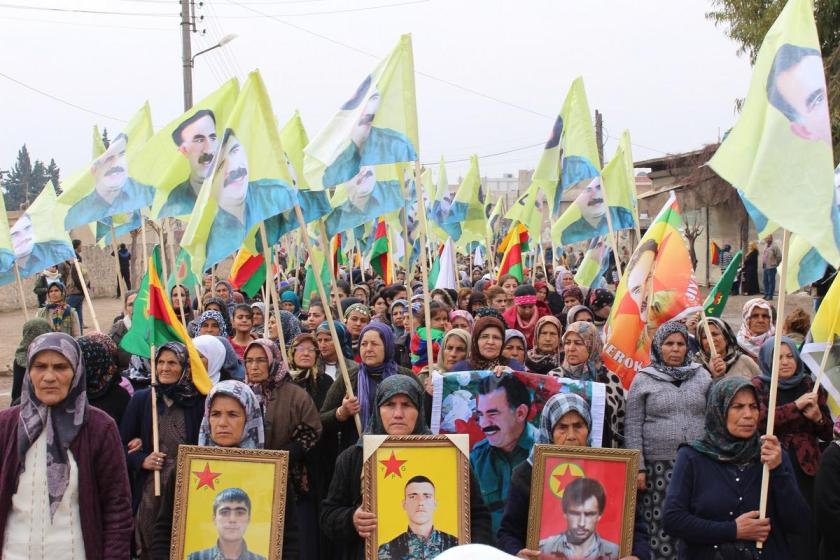
Abdullah Öcalan is the political leader of the Kurdistan liberation movement and the PKK (Kurdistan Workers’ Party), and launched the proposal of Democratic Confederalism that inspired the 2012 revolution in Rojava (western Kurdistan located in Syria) and the political model that has since been built with the Democratic Autonomous Administration of North and East Syria.
For many international activists, the ideas of Abdullah Öcalan and the Kurdistan liberation movement are a source of inspiration.
“It is the most alive revolutionary movement in the world at the moment, the most confrontational and the one with the most real power of change,” says Maddi.
Maddi came into contact with the Kurdistan liberation movement ten years ago in what she defines as “a change of political cycle” in Euskal Herria.

“It was not only the end of the armed struggle, but also the dismantling of an entire political movement that was articulated in society,” explains this young activist who, in search of new horizons, participated in a brigade that went from Euskal Herria to Rojava. Ana and Sílvia also share the experience of having been in Rojava where they went to learn about the role of women in the resistance against the Islamic State and the political paradigm and social model that made it possible.
Ona, who was also able to see it first hand, highlights how she was marked by learning about a “democracy that is not representative, but based on people taking responsibility for resolving their own basic needs and in which it is understood that without the liberation of women we cannot liberate the whole of society.”

For them, learning about this thought and this practice has meant a new way of understanding militancy as “a life choice, with more initiative and its own strength,” says Maddi.
“If you are looking for a path of determination in the struggle, without giving up, the Kurdish movement is an example,” adds Sílvia.
At the same time, getting close to this movement has represented for this militant of the left-wing independence movement a new way of practising internationalism: “you know perfectly well that we are comrades and that we could fight side by side here or on the other side of the world and this has implications for all revolutionary struggles and movements.”
In a similar sense, Ana insists on the value of the struggle linked to a strong commitment: “it has made me feel a little more what freedom is, that freedom when you are fighting and you go with your comrades to the end with whatever it may be.”

- Amid ongoing crackdown on Kurds, Turkey mulls renewed peace talks with PKK10/11/2024 ● 3:44 PM
- Turkey sent 190 military vehicles in 2 weeks to reinforce troops in northern Syria: rights group
Ideas that transcend territories
Abdullah Öcalan’s ideas are not only intended to be a proposal for Kurdistan or the Middle East, but they represent a new paradigm to guide a revolution on a global scale.
According to Maddi, in Euskal Herria the ideas of Rever Apo (as the Kurdish leader is also known) have not had enough influence in the current context of weakness of the political revolutionary movement, but at the same time he believes that “they could help to think critically about our revolutionary and political history and contribute new visions regarding the organisation, taking into account that the Kurdish movement, like the Basque one, emerged from Marxism-Leninism but has developed in a more flexible and original way, combining elements of other ideologies, currents and cultures”.
According to Sílvia, “the Kurdish liberation movement has contributed to generating greater sensitivity to the issue of national liberation among the non-independence left”.
She believes that sometimes “it is easier to show solidarity with the national liberation struggle of Kurdistan, the Sahara or Palestine than with the one next to you”.
In turn, she believes that the example of the Kurdish struggle can transform the national liberation struggles themselves by promoting that they be “non-nationalist, non-identitarian, inclusive and democratic.”
For Ana, this has to do with the fact that “Democratic Confederalism allows for a territorial organization that goes beyond established borders, taking into account that where we live there are many people with different origins, trajectories, religions or languages and we seek to unite all these diversities in a political proposal for liberation.”
In addition, Sílvia also feels that, in one way or another, Abdullah Öcalan, as leader of the Kurdistan liberation movement and at the same time as leader of the PKK, contributes to changing the vision of political organizations that exists among the social movements that are further away from them.
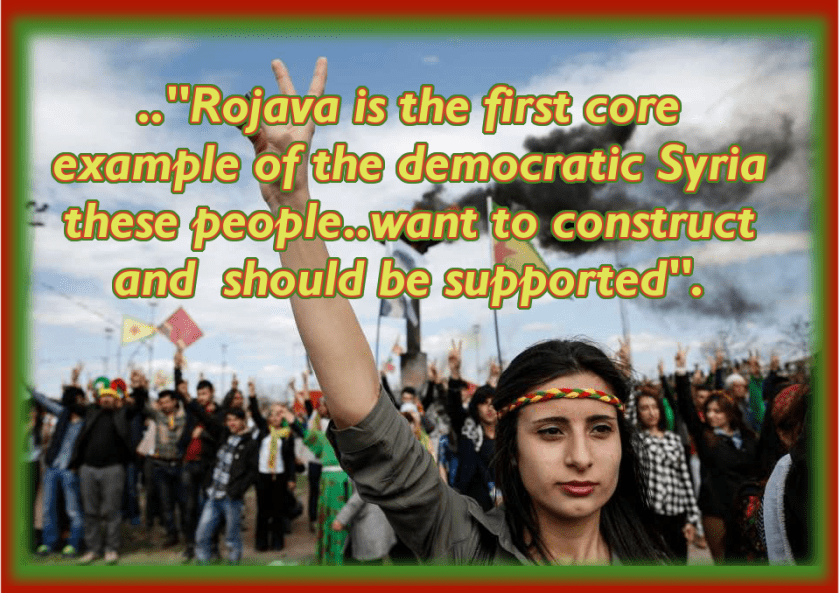
“Political parties or organizations are nothing without the massive struggle of their people and, at the same time, the massive struggles of the people without a larger-scale political organization are unlikely to overcome the confrontation with the state, NATO and international capitalism.”
The various activists agree that the political movement based on the ideas of Abdullah Öcalan has promoted what they define as a “revolutionary ethic”
“In Euskal Herria, discipline, organisation and training have developed a lot, but perhaps not as much importance has been given to this revolutionary ethic, that is, to behaviour, relationships and how we relate to unorganised people.”
Ana also highlights how the Kurdistan liberation movement puts values at the centre as something essential to the revolutionary struggle and transforms the way of understanding relationships: “here we have a more individualistic and self-referential construction, it is you and yours, and suddenly you start to feel like comrades to people who are fighting from different fronts.”
Sílvia agrees with the need for this openness, “to break with dogmatism and ‘identitarianism’, to understand the contradictory movement of ideas as a collective process of moving forward, and to live militancy not only from the head.”
For Ona, a key element of Öcalan’s ideology that can be useful to us is how it promotes “coexistence between different cultures, religions, bodies, origins or nationalities.”
In turn, according to this activist of the housing movement, Democratic Confederalism, which basically consists of the self-organization of society, is closer than we think: “for example, trade unionism is exactly that, a group of people who fight to improve working conditions. Likewise, in feminism we have a very present culture of self-organization.”
Even so, she considers that “the difference or what the thought of Abdullah Öcalan or the struggle of the comrades of the Kurdish movement could bring us is to understand that this self-organization needs a very clear strategy, to know where it comes from, where it is and where it is going.”
Jane, who came into contact with the Kurdistan liberation movement after meeting Kurdish refugees in Greece, believes that this thinking can be useful because “given the diversity in the spaces we inhabit, especially in the Valencian Country, it helps us to have a more global, integrative and analytical political vision.”
For her, “Rever Apo’s thinking makes us see ourselves as consequences of historical moments and drives us to seek change through our origins and by analyzing the current moment.”
Among the impacts that Adullah Öcalan’s thinking leaves us for these activists is also a new way of understanding knowledge through the proposal of jineolojî.
“Jineolojî is the science of women, of life, and it is based on the fact that scientific knowledge has not been able to solve social problems and, therefore, what we need is a new way of understanding the world that must be built from women and also for the liberation of women.”
The isolation of Abdullah Öcalan as collective punishment
On 15 February 1999, Abdullah Öcalan was arrested at Nairobi airport in an operation involving the intelligence and security services of several countries, including the CIA, MI5 and Mossad.
He has since been held in prison on Imrali Island, sentenced to life imprisonment and in solitary confinement.
Öcalan has not been able to be visited by his legal team since August 2019, nor by his family since March 2020. In 2022, there were 98 requests for meetings with lawyers and 49 requests for family visits, which remained unanswered.
The UN Committee for the Prevention of Torture (CPT) has denounced in nine investigations the violations of Öcalan’s human rights in prison and the European Court of Human Rights (ECHR) ruled in 2023 that the Turkish government had violated his right to a fair trial and to communication with lawyers and family.
“Abdullah Öcalan plays a role in energizing the people, in offering ideas and revolutionary hope.
In this context, his imprisonment is symbolically important because it is also intended to imprison the idea, the possibility of free and revolutionary thought,” Maddi attributes to the situation of violation of rights that looms over the PKK leader.

That same idea is conveyed by Ana, for whom “Öcalan is not just a person, but a symbol, an idea, and the states – the Turkish one, but also the Western states – do not want it to be able to develop and spread.”
For Jane, “it is a desperate act by the system in the face of the power that the Kurdish people have managed to achieve by claiming their own identity, and if this were to be extrapolated to other territories and each people, one by one, raised their heads, the power would have no choice but to bow its head.”
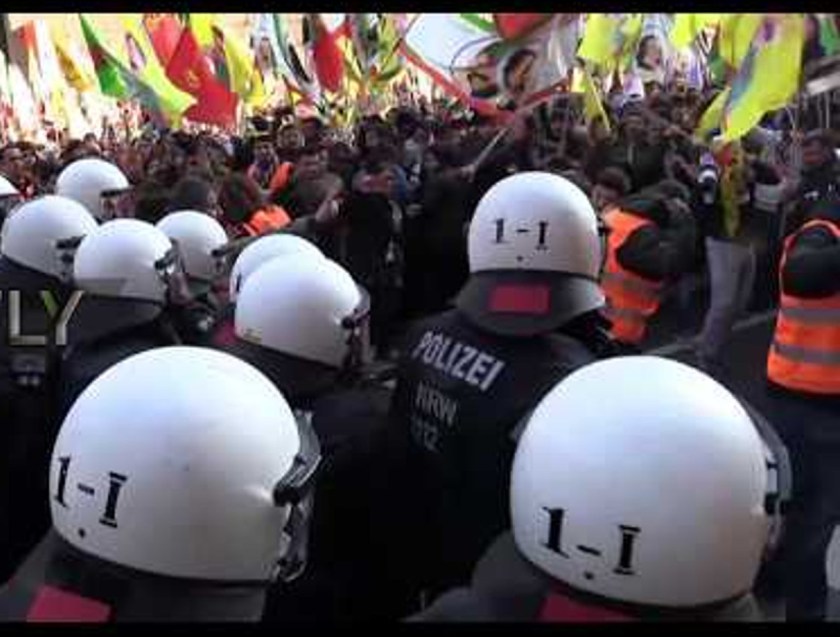
From October 1 to 10, a week of global actions is taking place for the release of Abdullah Öcalan, following the campaign “Freedom for Öcalan, a political solution for Kurdistan” that began last year taking as a reference the date of October 9, 1998 when the Kurdish people were killed.
The Kurdish leader left Syria for Europe in search of a political solution and began what has been denounced as an “international plot” that ended with his arrest.
Since then, there have been many years of campaigns, daily vigils in front of the Council of Europe building in Strasbourg, hunger strikes in Turkish prisons and outside them, demonstrations, protest actions and mass signature collections that have not yet managed to break the isolation, but which do not stop in their attempts.
Silvia believes that this shows that “even if you repress – against the guerrillas, the people who speak Kurdish in Turkey, the mothers who organize themselves, or the liberated area of north and east of Syria – the conflict is not resolved.
The repression that the Kurdish people have suffered throughout their history is enormous, as has that suffered by many other peoples in the world, but as long as the conflict is not resolved, it will continue.”
For Maddi, the broad mobilization for the release of Abdullah Öcalan has to do with the fact that “his vision and the revolution in Rojava are an important beacon for revolutionary practice.”
And he adds that “as a revolutionary prisoner, it is important for the state to silence his strength and, as a revolutionary people and movement, his freedom is necessary just like the freedom of any other political prisoner; just like the freedom of the people’s speech.”
English Translation. thefreeonline
Periódico Alternativo published this news following the creative commons rule.
***********
- Amid ongoing crackdown on Kurds, Turkey mulls renewed peace talks with PKK10/11/2024 ● 3:44 PM
- Turkey sent 190 military vehicles in 2 weeks to reinforce troops in northern Syria: rights group
- Turkish drone strike kills woman, son in Syria’s Qamishli 00:36
- AANES prepares to receive 50,000 refugees from Lebanon
- Turkish forces, SNA accused of widespread violations in NE Syria
- Returning IDP faces torture, loss in Turkish-occupied home in NE Syria
- Military projectile blast in Deir ez-Zor kills 2 children
- Syrian returnees face perilous journey to Syria
- SNA faction loots olives of 300 trees in Syria’s Afrin
- Residents in Syria’s Kobani protest against recent Turkish
- IDPs taking shelter in schools in Syria’s Hasakah suffer in summer heat – North Press 02:32
- Arson devours large swaths in Syria’s Afrin 00:25
- People of Syria’s Azaz protest against Turkey 00:26
- AANES starts building Maternity and Children Hospital in Syria’s Qamishli – North Press 00:43

 The Free