The loss of Arctic Sea ice has profound global implications, as it is a key component of Earth’s climate system. Its decline affects not only the Arctic region but also ecosystems, weather patterns, and economies worldwide. Here are the primary consequences: 1. Acceleration of Global Warming 2. Rising Sea Levels 3. Disruption of Weather Patterns […]
On Thursday, December 26, 2024, Day 447 of its brutal and protracted military onslaught against the Gaza Strip, Israel assassinated five journalists and five medical personnel, in addition to many other civilians, including children. 07:00 AM The same source identified the five slain journalists as: 08:15 AM 10:32 AM 1:52 PM 2:24 PM 4:35 PM […]
On Wednesday, December 25, 2024, Day 446 of Israel’s brutal and protracted military onslaught against the displaced Palestinian civilians in the Gaza Strip, since October 7, 2023. 8:17 AM 12:08 PM 1:00 PM 2:21 PM 4:47 PM 8:37 PM 10:52 PM
This week, we’re sharing a key in-depth conversation with Errico, a combatant member of Tekoşîna Anarşist, an internationalist anarchist formation in critical solidarity with the Rojava Revolution..
For this episode, Errico answers some questions we had about what’s been happening in Syria and concerns from within the Democratic Autonomous Administration of North and East Syria. You can find ideas and updates from the TA formation on their blog, https://tekosinaanarsist.noblogs.org. Past interviews with TA can be found here.
Errico’s voice has been re-recorded by a comrade for anonymity. The transcript is already up in the show notes and at our website for easier reading, translation and sharing and you can find past interviews we’ve done with TA linked in the show notes. And there is an announce-only signal group that anyone can join with updates and analysis by anarchists in the region or paying attention which we’ll link in our shownotes. Just a headsup, the usernames of members of this group will be visible to the all other users there and it might be a good opportunity to set up your signal username and make your phone number unfindable for better anonymity prior to joining the signal group ( https://signal.group/#CjQKIN0TDK_nsHV4uXRtLIdaUOL2R6yv7uvRs8c3RUiXLr-EEhBPEntGCDqJQOD4pzU36i6O )
We simultaneously recorded an interview with Cedric and Khuzama, two libertarian communists and editors of and contributors to the blog Interstices-Fajawat.org about their insights into Syria. This interview will be coming out soon, so keep an eye on our feed.
TFSR: Would you please introduce yourself to the audience with any name, pronouns, location, and affiliation that you want to share?
TA: Yeah, so this is Errico here. I’m talking from the provisional press office of Tekoşîna Anarşist, based at the moment a few kilometers away from the front lines. So for this, the best pronouns I can use is they then, if needed, but yeah, maybe that’s it.
TFSR: Would you remind listeners about Tecoxina Anarchist and its relationship with the PYD and the Rojava revolution?
TA: Tekoşîna Anarşist is an anarchist organization that has been working for more than seven yearsnow in the northeast Syria. We are here in critical solidarity with the revolution in Rojava. We see how the values that this revolution is like promoting are extraordinarily close to what we see as anarchism, as libertarian socialism and therefore many anarchists from all around the world has been coming here, had been fighting and defending this revolution. Some of us, we saw the need of building a more stable project that can learn from this revolution in a more collective way to be able to not only learn these lessons, but also being able to translate it and share it with other anarchist organizations and comrades all around the world.
When we talk about our works here, we are a military structure that cooperates with the Syrian Democratic Forces. We are integrated inside the Syrian Democratic Forces and we are with them in the front lines fighting against the enemies that tried to destroy this revolution. Mostly we have been in the front lines against the Islamic State but since 2018 and the invasion of the Turkish army in Afrin, we have been also in the front lines against the Turkish army and its proxies. As a military structure, also, we want to promote a reflection of what does it mean for anarchists to be engaged in a military context because we know that anarchism often has been also connected with anti-militarist movements.And this is also part of our tradition, but here we see the necessity of being part of the defense of this revolution in a military sense. So we often say that we are not a military organization, but a militarized one, because the conditions on the ground had forced us to take up weapons to defend this revolution and even our life, especially in the front lines against the Islamic State. And this was something that got a lot of international attention and this is a bit like the part that has been more mediatic. But for us, most of our work is also to function as a political organization here. As I say, critical solidarity with Rojava and trying to bring practical aspects to the meaning of international solidarity because when we talk about international solidarity, we can see that the capacity to bring solidarity on the ground with other struggles is often limited and we wanted to reflect on how we can directly bring this solidarity.
And there was this sentence that we often like from a really interesting revolutionary group from Denmark that was saying that “solidarity is something you can hold in your hands.” And we try to put this in practice and not stay in the symbolic solidarity, but be here shoulder to shoulder working with our Kurdish and with our Arab Syrian comrades and doing the work that is necessary on the ground to keep developing and defending this revolution. This means a lot of things that maybe we can talk about and discuss further in this interview but this also means relations with other political groups, with our political structures. You were mentioning the PYD, that it’s true that PYD is maybe the political body of part of the revolutionary bodies that are here. PYD is a political party that was created in 2003 to represent the voices of like Kurdish people here in northern Syria. But on the ground, and I think it’s important to understand PYD is mostly all people that is trying to bring solutions and like develop whatever is needed for the society to function. So what does it mean on the ground? They have an office and when people have problems, when there are conflicts in the different things that happen in the daily life, people often go to this office and discuss with the friends to try to find solution. This includes a big range of things like from how new buildings that are being built are coordinated, to garbage collection, but especially it comes to political talks with different elements. So there is like a close relation between PYD and the autonomous municipalities of each area that they try to help each other to solve the social problems.
There’s a nice story, you know… In the town that I’m right now, we were buying groceries so often in the shop that we kind of became friends with the shop owner. And some months ago, this shop owner asked “how are you?” and he was telling us that now he was asked to be responsible for the PYD office and this was him inviting to their office. So we came over for tea and were talking a bit about the situation of the city and the problems that they were facing. So we have a friendly relation, but the PYD is mostly like a local social center, mostly they have their office that functions as a social center to talk with the neighbors and discuss the situations on the ground. So this is part of our work, this diplomacy of like being in contact with the situation that the people is living here facing the same challenges and difficulties and problems and try to find solutions together with them.
— In the sparse, sandy grasslands of Jarud Banner in north China’s Inner Mongolia Autonomous Region, machinery is filling wind-eroded pits and laying sand barriers while workers are busy supporting the comprehensive management of Horqin Sandy Land.
“Our independently developed sand-fixing machine processes raw materials like sand and straw into grass mats for sand barrier installation,” said Yu Dongjiang from M-Grass Ecological Environment (Group) Co., Ltd.
The sand-fixing machine is simple in structure, easy to operate, and highly adaptable to various terrains. It improves raw material utilization efficiency, enabling the installation of nearly 30,000 meters of sand barriers daily, according to Yu, who is also the project manager for the comprehensive management of the northern central Horqin Sandy Land.
Previously, the manual weaving of grass mats required significant labor and time.
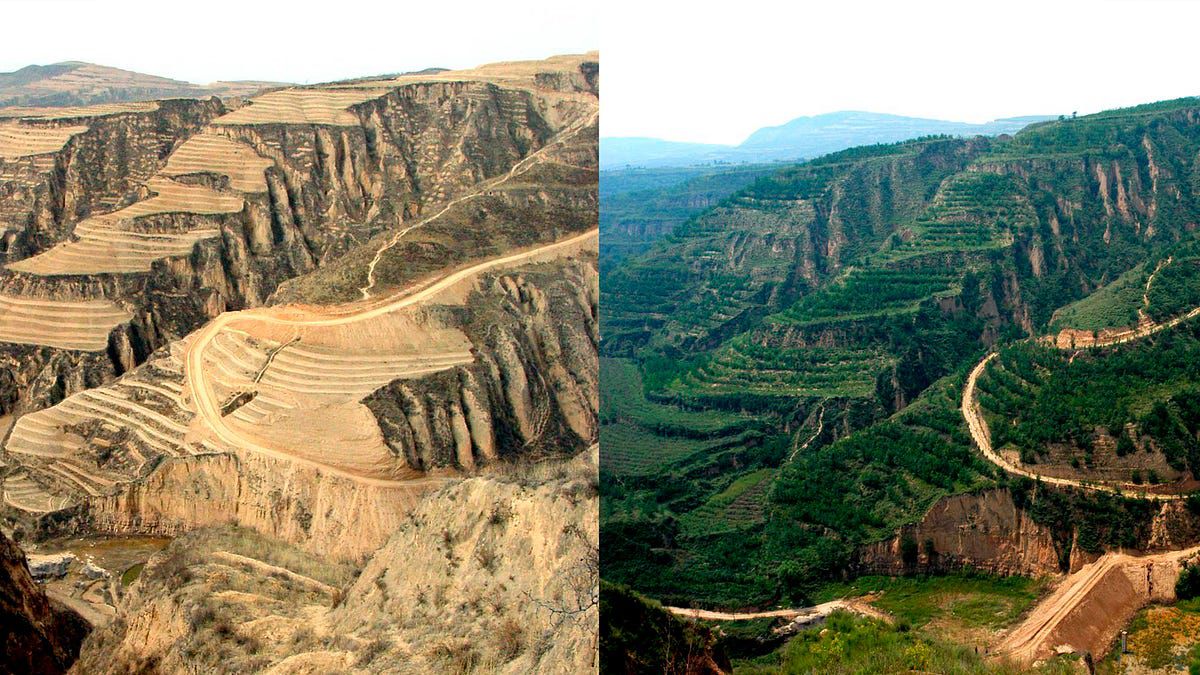
Yu’s project shows China’s wider push to advance ecological restoration. In the arid landscapes of northern China, cutting-edge technology is transforming the fight against desertification into a story of hope and renewal.
From satellite monitoring systems to innovative tree-planting tools, the integration of advanced equipment has elevated traditional reforestation efforts.
In Inner Mongolia’s Kubuqi Desert, for example, drones have been employed to plant seeds across vast stretches of barren land, significantly improving efficiency and survival rates. These seeds, combined with specially developed nutrient packs, ensure saplings thrive in challenging environments.
While in northwest China’s Gansu Province, solar energy projects are being combined with afforestation programs at the southern edge of the Tengger Desert, creating a synergy that not only restores ecosystems but also boosts local economic development.
Local villagers are also finding employment in these initiatives, blending green technology with grassroots participation.
“I never would have imagined that as a farmer, I could find work in the sand dunes,” said Qin Zhaoping, a resident of Hengliang Township in Gansu’s Gulang County. His job involves adjusting the sprinkler irrigation systems beneath photovoltaic panels and tending to the thriving sand plants.
For Qin, photovoltaic-based desert control is a meaningful effort that benefits future generations. “It generates electricity, combats desertification, and provides me with an income from working here,” he said.
According to official data, 53 percent of China’s treatable desertified land has been restored, leading to a net reduction of approximately 4.33 million hectares of degraded land.
One of the country’s landmark ecological projects is the Three-North Shelterbelt Forest Program. Since 1978, China has expanded its afforestation area by 32 million hectares under the program.
Meanwhile, China’s desertification control technologies and equipment are making their way onto the global stage, sharing ecological restoration expertise with other countries and regions.
To join the efforts of the Global South, China has launched desertification control centers with Arab states and Mongolia, created demonstration sites in Central Asia and Africa, and provided satellite technology and big data support for Africa’s Great Green Wall initiative.
In December, Yu’s company signed a memorandum of understanding with the municipal government of Ulaanbaatar in Mongolia to enhance the country’s ecological environment and promote practical cooperation
More and more reports are being shared indicating an increase in violence, including looting, robbery and executions, against Christian
and Alawite communities in various parts of Syria, carried out by jihadist militias linked to the current Syrian state or to Turkey.
In response, demonstrations were organised in various Syrian towns and villages, including the capital Damascus. Some Christian communities are calling for the right to autonomy and armed self-defence against all attacks.
Iranian authorities have arrested 10 individuals who participated in the “Women, Life, Freedom” uprising and sentenced them to death. Additionally, two women were arrested under the pretext of not adhering to the “hijab” law.







 The Free