Regreso del Carcel por problemas Mentales en Estados Unidos y Europa

En todo el EEUU, está acelerándose el regreso de la institucionalización psiquiátrica, reempaquetada y presentada como “atención moderna en salud mental” Ya han eliminado 20,000 puestos de trabajo cerrando agencias de salud mental con la excusa de bajar costes, mientras el presupuesto militar llega a 1000,000,000,000 dolares.

por Todoporhacer.orgfuente  The Guardian  18 Mayo 2025) 9279 puntos de vista ( traducido por las compañeras de Primera Vocal) via thefreeonline at https://wp.me/pIJl9-GXP

Desde el impulso de la gobernadora Kathy Hochul para ampliar la hospitalización involuntaria en Nueva York, hasta la propuesta de Robert F. Kennedy Jr. de crear “granjas de bienestar” bajo su iniciativa Make America Healthy Again (MAHA), los responsables políticos están reviviendo la lógica del encierro bajo el pretexto de cuidados. Además el gobierno de Trump va a cortar radicalmente los impuestos para los ricos y dejar miliones de pobres sin Medicaid y suplementos de comida, entre otros nedidas represivas.


lEstas propuestas pueden diferir en su forma, pero comparten una misma función: ampliar el poder del Estado para vigilar, detener y “tratar” a personas marginadas consideradas disruptivas o desviadas.

Lejos de ofrecer apoyo real, reflejan una fuerte inversión en el control carcelario, especialmente sobre personas con discapacidad, sin hogar, racializadas y LGBTQIA+.

Comunidades que a menudo han visto cómo se presenta la institucionalización como “tratamiento”, ocultando tanto su historia violenta como su legado persistente.


La locura del encierro .. en Europa – Prison Insider

Más del 40 % de las personas privadas de libertad en Italia sufren de al menos un trastorno mental. La cifra ronda el 30 % en España, el 35 % en Inglaterra y el 60 % en los Países Bajos. ….Las puertas de la prisión se han abierto para dejar entrar a las personas que sufren de enfermedades mentales. Sin embargo, la escasez de recursos y la calidad de la atención psiquiátrica, cuando la hay, no permiten responder a sus necesidades.

A falta de soluciones adaptadas, se recurre con frecuencia al aislamiento, la sujeción mecánica, y la administración de altas dosis de tratamientos farmacológicos…..La opinión pública desconfía o incluso es hostil con los enfermos mentales, quienes, al cometer un delito, dejan de verse como pacientes que requieren cuidados para convertirse en individuos “que amenazan o comprometen la seguridad o la existencia de alguien o de algo”. ….


Al hacerlo, estas políticas erradican alternativas comunitarias, socavan la autonomía y refuerzan los mismos sistemas de encierro que dicen superar.

Tomemos como ejemplo la propuesta de Hochul, que busca reducir el umbral para la hospitalización psiquiátrica involuntaria en Nueva York. Según su plan, las personas podrían ser detenidas no porque representen un peligro inminente, sino porque se considere que no pueden satisfacer sus necesidades básicas debido a una supuesta “enfermedad mental”.

Este criterio vago y subjetivo abre la puerta a un control estatal generalizado sobre personas sin hogar, personas con discapacidad y otras que luchan por sobrevivir en medio del abandono sistémico.

La enfermedad mental es el resultado de la miseria, pero aun así la estigmatizamos; de Richard Bentall

Hochul también propone ampliar la autoridad para iniciar tratamientos forzosos a un abanico más amplio de profesionales —incluidas las enfermeras de psiquiatría— y exigir que se tome en cuenta el historial de una persona, patologizando así angustias pasadas como justificación para futuras detenciones.

Esto no es una propuesta marginal. Se suma a una creciente ola de esfuerzos por reinstaurar la institucionalización en todo el país. En 2022, el alcalde de Nueva York, Eric Adams, ordenó a la policía y a los equipos médicos que hospitalizaran por la fuerza a personas consideradas “enfermas mentales”, incluso sin señales de peligro inminente.

En California, el gobernador Gavin Newsom implementó tribunales de atención que obligan a las personas a someterse a “tratamiento” ordenado por un juez.

Ahora, estos esfuerzos están siendo acelerados a nivel federal. La iniciativa MAHA de RFK Jr. propone un modelo de trabajo llamado “granjas de bienestar” como respuesta a la falta de vivienda y las adicciones. Una idea que recuerda inquietantemente a las granjas institucionales del siglo XX, donde se confinaba, vigilaba y explotaba a personas con discapacidad y racializadas bajo la excusa de rehabilitación.

Recientemente, el Departamento de Salud y Servicios Humanos de Estados Unidos anunció una amplia reestructuración que desmantelará agencias clave y consolidará el poder bajo una nueva “Administración para una América Saludable” (Administration for a Healthy America, AHA). A

lineada con la iniciativa MAHA de RFK Jr. y con la directiva de Donald Trump sobre “eficiencia gubernamental”, el plan fusiona agencias como la Administración de Servicios de Salud Mental y Abuso de Sustancias (SAMHSA), la Administración de Recursos y Servicios de Salud (HRSA) y otras en una estructura centralizada que, en teoría, se enfocará en combatir enfermedades crónicas.

Pero, a través de esta reestructuración —y del despido masivo de empleados del HHS—, el gobierno federal está desmantelando la infraestructura especializada que apoya la salud mental, los servicios para personas con discapacidad y las comunidades de bajos ingresos.
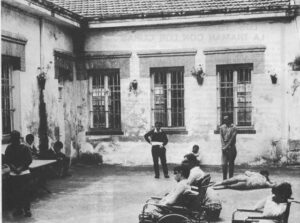
Duras condiciones y técnicas agresivas en los siquiátricos de la Diputación de Vizcaya / El psiquiátrico de Bermeo: peor que perros; hemeroteca

La reestructuración ya está en marcha: se han eliminado 20,000 puestos de trabajo, se han reducido oficinas regionales y la Administración para la Vida Comunitaria ha disuelto sus programas esenciales para personas mayores y con discapacidad, redistribuyéndolos en otras agencias sin transparencia ni rendición de cuentas.

Continue reading “Regreso del Carcel por problemas Mentales en Estados Unidos y Europa”
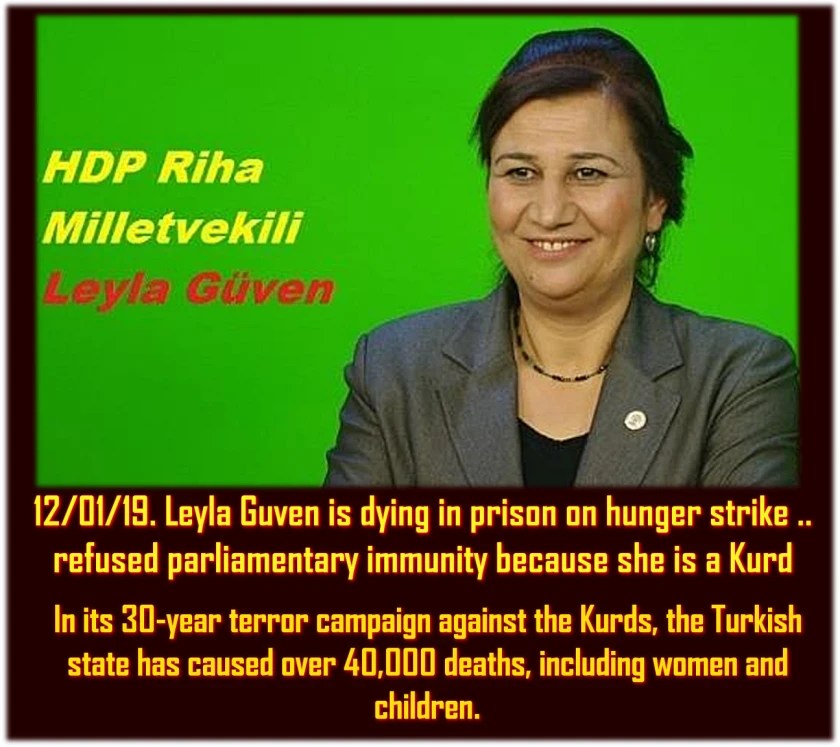
PKK surrender a victory for Turkish regime’s repression, racism, exploitation and imperialism

by slguardian 17th May 2025 via thefreeonline at https://wp.me/pIJl9-GVm Telegram–t.me/thefreeonline/3169

March 2025 note.. this ‘TheFreeOnline’ blog is banned in Turkey with dozens more pro Rojava, Kurdish, Feminist and anti Fascist sites and hundreds are jailed for criticizing Erdogan… … Turkey had censored more than 245,000 websites, URLs as of end-2018:…

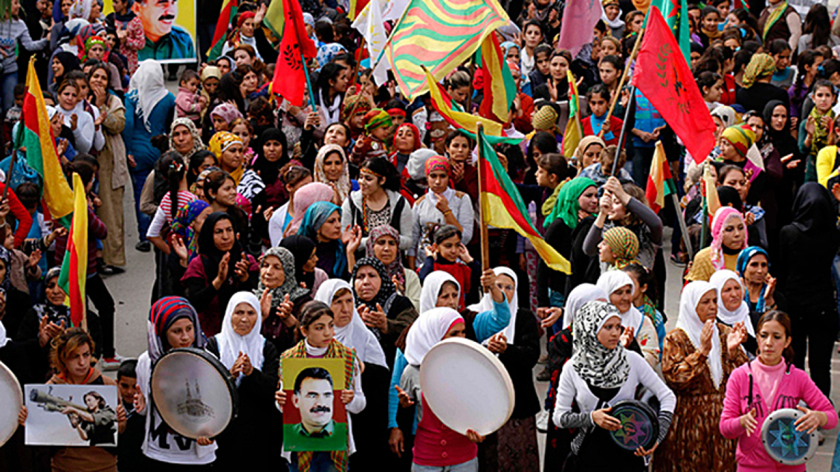
“The PKK’s 12th Congress decided to dissolve the PKK’s organizational structure and end the armed struggle, with the practical process to be managed and carried out by Leader Apo [Abdullah Ocalan ..”,

March 2nd….

“The announcement of a ceasefire by the Kurdistan Workers’ Party (PKK) (and the intention to dissolve disarm and disband following Ocalan’s call) should be heralded as a seismic moment in the modern history of resistance movements, yet beneath the diplomatic formalities and cautious optimism lurks a far more sinister truth-this is not a triumph of peace, but an orchestration of submission.

A war waged for over four decades, fuelled by the unyielding will of a people who have been denied, erased, and slaughtered, is now being dismantled at the behest of the very state that has waged an unrelenting campaign of annihilation against them.

The imprisoned leader of the PKK, Abdullah Ocalan, once the architect of the most formidable Kurdish insurgency, has now called for its dissolution, a move that reeks not of ideological evolution but of coercion, isolation, and calculated political expediency.

The world will praise this as the end of bloodshed, a necessary step towards reconciliation, but history will record it as yet another betrayal in a century-long catalogue of false promises, broken treaties, and unpunished atrocities against the Kurdish people.

To the untrained observer, the PKK has long been cast as an irritant to Turkish sovereignty, a violent and inconvenient force that defied the global order of neatly defined nation-states.

PKK were NOT terrorists! Erdogan rejected Ocalan’s Peace Plan, sabotaged their Truce. bombed their cities…thefreeonline.com/2019/Turkey Vows To Continue Military Operations As PKK Disarms (https://southfront.press/turkey-vows-to-continue-military-operations-as-pkk-disarms/)

Turkey’s Ministry of National Defense said on May 15 that it will continue to conduct operations against the Kurdistan Workers’ Party (PKK) in regions where the group is present until it is “certain” the “threat” is removed. But members of every single Kurdish and leftist group have been jailed for allegedly ‘supporting the PKK’ even by singing in Kurdish, and this ‘witch hunt’ could go on forever. Earlier in the week, the Kurdish guerilla group announced that it would dissolve itself and end a decades-long conflict with Turkey. The Turkish military will “continue to act in the regions used by the separatist PKK terrorist organization with determination until it is certain the region is cleared and will no longer pose a threat to Turkey”, a ministry spokesman said in a briefing.The spokesman referred specifically to “land search and scan activities, the detection and destruction of caves, shelters, mines and hand-made explosives”.👉Read More HERE (https://southfront.press/turkey-vows-to-continue-military-operations-as-pkk-disarms/)

But to those who have traced the scars of history across the bodies of Kurdish villages razed to the ground, families massacred in the name of nationalist purity, and a culture suffocated under the suffocating weight of enforced assimilation, the PKK was never merely an armed insurgency.

It was a defiant answer to a genocidal campaign of erasure.

The so-called Turkish Republic, built upon the Kemalist doctrine of unyielding nationalism, embarked on a mission not just to suppress the Kurdish identity but to erase it from the annals of existence itself.

When the Treaty of Sevres in 1920 offered the Kurds the promise of statehood, it was swiftly undone by the Treaty of Lausanne in 1923, which instead legitimised the violent partitioning of their lands among Turkey, Iran, Iraq, and Syria.

Kurdish names were stripped from maps, their language was banned, their mere existence was reduced to the derogatory moniker of ‘Mountain Turks,’ and any attempt at resistance was met with fire and steel.

When Xenophon chronicled the Carduchi-believed to be the ancestors of the Kurds-he wrote of a people who defied the Persian Empire, a people whose spirit was untameable, whose warriors fought not for conquest but for survival.

Continue reading “PKK surrender a victory for Turkish regime’s repression, racism, exploitation and imperialism”

Israeli Terror Regime slaughters 100’s more as Starving Families flee depraved Invasion of Gaza ruins

Netanyahu makes Hitler look moderate by drowning local Palestinians and their children in blood while claiming to be of a master race chosen by God.

by Umut Uras and Urooba Jamal On 17 May 2025 at Al Jazeera Live via thefreeonline at https://wp.me/pIJl9-GX6

Injured Palestinian children receive medical treatment at Nasser Hospital after Israeli air strike in Khan Younis, southern Gaza, on May 16, 2025 [Abed Rahim Khatib/Anadolu]

JERUSALEM/CAIRO, May 17 (Reuters) – Israel’s airforce killed at least 146 Palestinians in new attacks on Gaza over the past 24 hours and injured many more, local health authorities said on Saturday, as the country appeared set to press ahead with a new ground offensive.

Israeli strikes since Thursday have seen one of the deadliest phases of bombardment since a truce collapsed in March. The latest strikes came as U.S. President Donald Trump ended his Middle East tour on Friday with no apparent progress towards a new ceasefire.

https://www.youtube.com/watch?v=yNW6ZWUBiu0

Air strikes have reportedly killed hundreds of people in Gaza as Israel intensified its bombardment in line with a plan for “conquest” of the enclave.

Although reports vary, health officials told Al Jazeera that at least 100 people had been killed by Israeli attacks on Friday, with many more missing under the rubble.

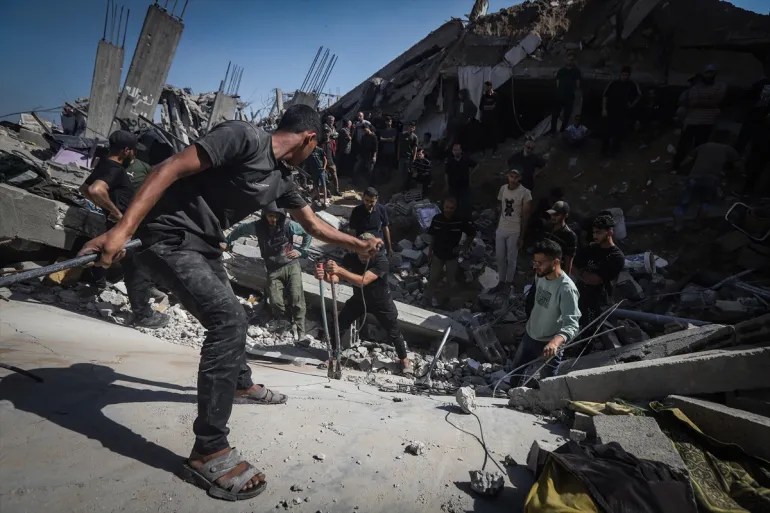
Palestinians try to dig under a building in Gaza City that was destroyed in an Israeli attack on Friday [Khames Alrefi/Anadolu]

That added to the 143 reported killed the previous day, and pushed the overall death toll in the Palestinian territory to more than 53,000 since Israel launched its onslaught in October 2023 after a Hamas attack that killed around 1,200 Israelis and saw 250 or so taken captive.

Hamas has called on the international community to hold Israel to account for what it described as a “barbaric escalation”. The Israeli military has not commented on the strikes.

Earlier this week, Israeli Prime Minister Benjamin Netanyahu reiterated a promise to push ahead with a promised escalation in pursuit of his aim to destroy Hamas, the Palestinian armed group that governs Gaza.

  • Israeli attacks on the Gaza Strip intensify, killing at least 13 more Palestinians since dawn today, including three members of the same family.

Palestinians transport their belongings as they flee Gaza City on Friday [Bashar Taleb/AFP]

The Red Crescent renews call for Israel to reopen crossings with Gaza for the entry of humanitarian aid, warning that the besieged and bombarded territory has been “left to starve and ache”.

Palestinians struggle to get donated food at a community kitchen in Khan Younis, Gaza Strip, on Friday [Abdel Kareem Hana/AP Photo]

Israel’s war on Gaza has killed at least 53,272 Palestinians and wounded 120,673, according to Gaza’s Ministry of Health. The Government Media Office updated the death toll to more than 61,700, saying thousands of people missing under the rubble are presumed dead.

Relatives of Palestinians killed in Israeli attacks on northern Gaza, mourn for their deceased loved ones, at the Indonesian Hospital in Gaza City on Friday [Khames Alrefi/Anadolu]

Smoke rises following an Israeli army air strike in the northern Gaza Strip on Friday [Maya Alleruzzo/AP Photo]

Echoes in the Tapestry of Time

A question stirs within the dark, before the mind can see,

A silent urge that shapes the void, and births reality.

From nothingness, a spark—the universe erupts in storm,

A world begins from scattered dust, and slowly, life takes form.

We peer through fractured shadows, seeking patterns in the void—

Each answer forms a question, […]

Echoes in the Tapestry of Time

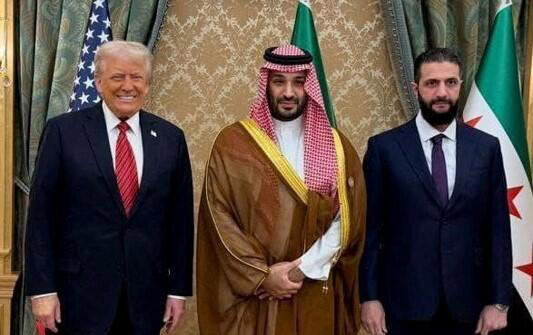
Trump to control Syria by Sanctions waivers and could protect Syrian Kurds against Turkish/ Damascus/ISIS/ SNA / Irani and Israeli enemies

on May 14, 2025 By Khalaf Ma’o at North Press Agency and thefreeonline at https://wp.me/pIJl9-GWi Telegram t.me/thefreeonline/3139

SDF confirms ongoing ‘Coalition partnership’ in Northeast Syria

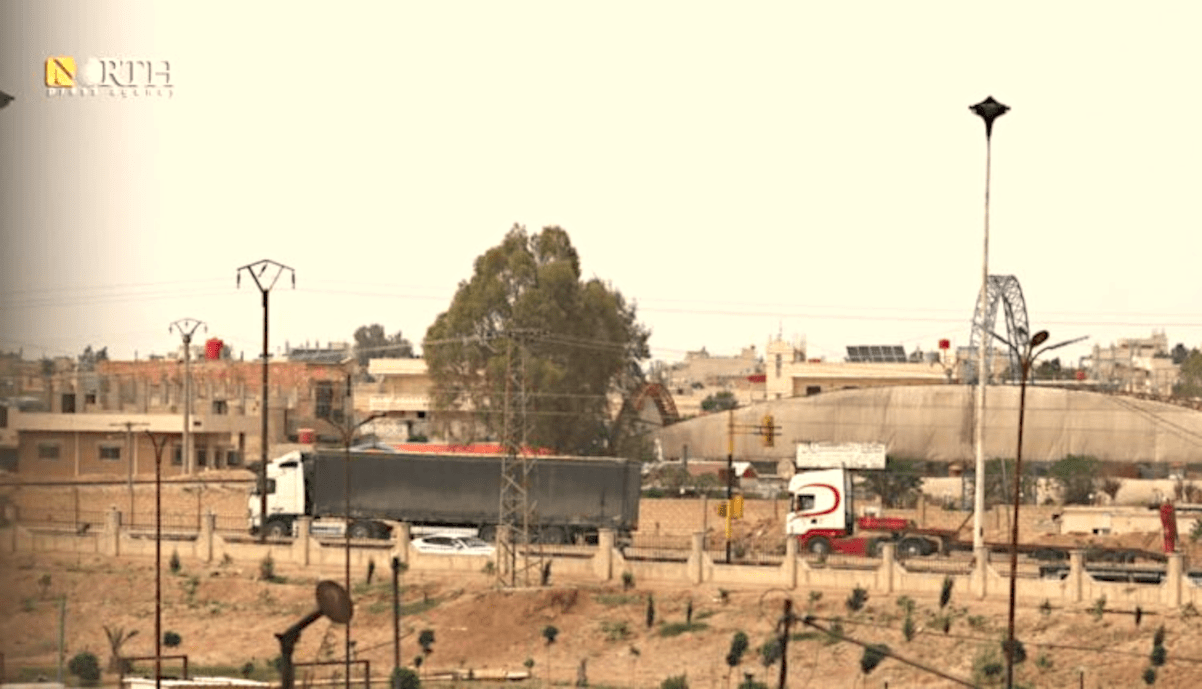
Trucks of the U.S.-led Global Coalition to Defeat ISIS loaded with logistics in the city of Hasakah in NE Syria on May 8, 2025 – North Press

DAMASCUS, Syria (North Press) – https://npasyria.com/en/125557/– The commander of the Syrian Democratic Forces (SDF) confirmed on Thursday that cooperation between the SDF and the U.S.-led Global Coalition remains active and effective.

Mahmoud Habib, spokesman for the North Democratic Brigade operating under the SDF umbrella, highlighted joint operations carried out against ISIS sleeper cells over the past two days.

In a statement posted on his official Facebook account, Habib noted that both parties have conducted day and night training exercises aimed at enhancing operational and field capabilities.

He also reported the establishment of new positions, including in the town of Sirrin, with further deployment planned soon in the Tishrin Dam housing area in southern Kobani.

Habib emphasized that additional military and logistical reinforcements have been sent to support Coalition bases in northern Syria, rejecting reports of an imminent U.S. withdrawal as “baseless illusions.”

On May 3, a source from the Global Coalition told North Press that the U.S.-led forces are conducting their largest military exercises in Syria to date, starting from their bases in the country’s east.

According to the source, the drills are being carried out from the al-Omar oil field base and its surrounding areas in the east of Deir ez-Zor, extending to the Iraqi border.

The source described the upcoming maneuvers as the most extensive since Coalition forces first entered Syria, signaling the start of a new phase of operations against what he termed “malicious organizations.”

By Khalaf Ma’o https://npasyria.com/en/125557/

US sanctions/Tariffs Hegemony wins partial control of HTS led regime in Syria

thefreeonline at https://wp.me/pIJl9-GWi

This will likely be the final end of the Syrian “revolution” with the devastated country parceled out to neoliberal profiteers funded by oil dictators and western corporations.

However it does open the option of the coercive ‘Trump Deal’ ordering an end to the regime permitting mass sectarian massacres, especially of Kurdish, Druze and Alawite minorities.

US coercive control of the economy via sanctions ‘instant renewal’ could in principle curb the ‘bad for business’ persecution of Kurds, Christians, Azeris, Syriacs, ex Assad era workers, LGBTQs… as well as the moves to return women, over half the population, to Al Qaeda/ISIS style servitude.

Sanctions lifting could also be good news for the embattled AANES/SDF area of NE Syria. It seems the US has reversed its policy of partial withdrawal from its bases there which, though only a few thousand troops, maintain Air and Logistical protection against the social revolution’s many sworn enemies.

Latest reports suggest the US has also modified its ‘look the other way’ policy and is now actively resisting Turkey’s genocidal invasions and terrorist attacks, despite it being a NATO partner.

Such reports point to a US deal to enforce a ceasefire in Manbij to curb the killings and looting by Turkish backed SNA mercenaries, as well as the quiet installation of a US post in Kobani to thwart the Turkish backed offensive to destroy the iconic Kurdish city as well as the deal to stop the Turkish sponsored bombing and killing of civilian protestors at the Tishrin Dam.

North Press also reported that the SDF spokesperson Mahmoud Habib has confirmed the establishment of new US positions, including in the town of Sirrin’s Turkish backed massacre, with further deployment planned soon in the Tishrin Dam housing area in southern Kobani.

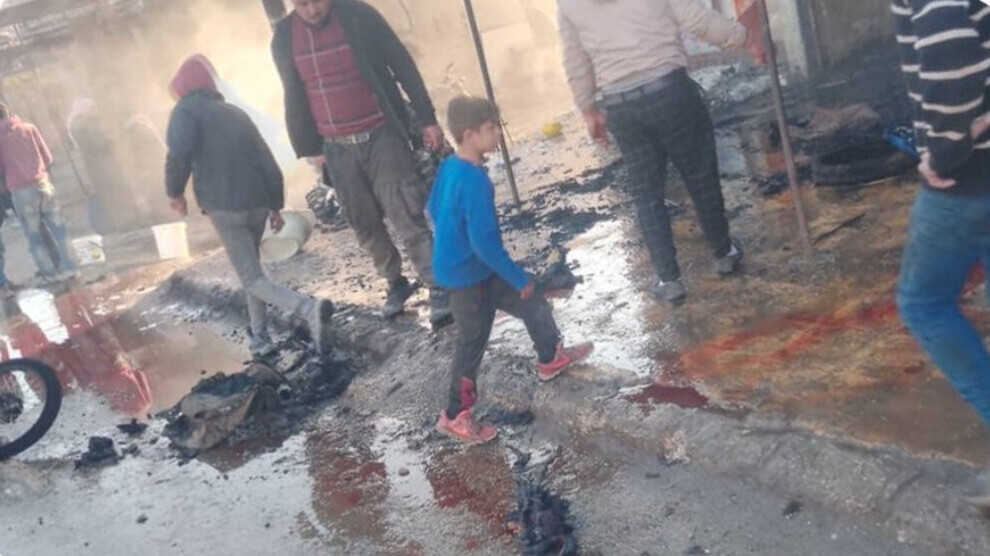
As the Turkish state continues its genocidal campaign against North-East Syria, which has escalated since the fall of the Assad regime, targeted attacks against civilians have left dozens of people dead or wounded in recent weeks. On January 28, a Turkish UCAV (unmanned combat aerial vehicle) bombed the public market in Sirrin, leaving 12 civilians dead and 13 others wounded. 

The Rojava (AANES/SDF) revolutionary example of multi-ethnic local administration and defense, for gender equality, environmental sustainability, and economic governance including communes is an obvious though much hated template for pacifying the current chaotic mess under the new Syrian rulers .

The SDF 80,000+ decentralised coalition of dozens of Kurdish led local, minority, women’s and anti -jihadi, militias are paid by the Autonomous Administration (NOT by the US).

Moves to disband the SDF by integration into the new Damascus state army have been accepted in principle, but the appointment by Jolani of a US condemned HTS war criminal as ‘commander’ to take control of Rojava has raised outraged resistance. The plan to disband may be delayed and reformed indefinitely. ( read 7 May, 2025  ..Outrage as Hevrin Khalaf’s killer made Army Leader to destroy Rojava -‘securing the provinces of Hasakah, Raqqa, and Deir Ezzor’-. – The Free )

(read..Beyond the Nation-State.. Anticolonial Resistance and the Paradigm of the PKK.. )Rojava Information Center @RojavaIC US-sanctioned Hatem Abu Shaqra, leader of Ahrar al-Sharqiya (Hevrin Khalef’s killers) spoke at the “Victory Conference,” announcing Ahmed al-Sharaa as “transitional phase” Syrian president. Today, women in Qamishlo marched to condemn Abu Shaqra’s presence in the new government. 2.197 Visualizaciones

Similarily the Trump Sanction Deal and reported reversal of withdrawal from bases raises questions on other concessions by AANES/SDF to the HTS-led ‘interim’ government in Damascus. For example the agreement to withdraw the SDF from the key Tishrin dam defense as SNA Turkish mercenaries in theory come under HTS control.

Any extension of US protection could also delay forced SDF agreements to grant the central government control of the Iraqi border, isolating them completely, as well as transferring control of the limited oil well production, etcetera.

The final surrender of the PKK resistance, while a likely disaster for Kurdish rights in Turkey and abroad, does at least invalidate the Turkish regime’s excuse that it was a banned terrorist organisation, which it always uses to jail tens of thousands for its suspected support and to justify its own terrorist bombings and invasions of suspected PKK supporters in Syria and Iraq.

(read..Turkish Repression of Kurds continues amid Depraved Bombing /Shelling of civilians in Rojava –)

related

octubre 7, 2019 Trump betrays Rojava: allows Erdogan to Bomb, Invade and Genocide anti ISIS defenders

Why the US and France are trying to murder African Revolutionary Leader, Ibrahim Traoré

Traoré’s anti-imperialist and Pan-African stance resonates with global Africans. AFRICOM’s attacks on Traoré backfire as Africans rally in his support

By Alan Macleod at MintPress News on 12th May 2025 via thefreeonline at https://wp.me/pIJl9-GRE Telegram t.me/thefreeonline/3108

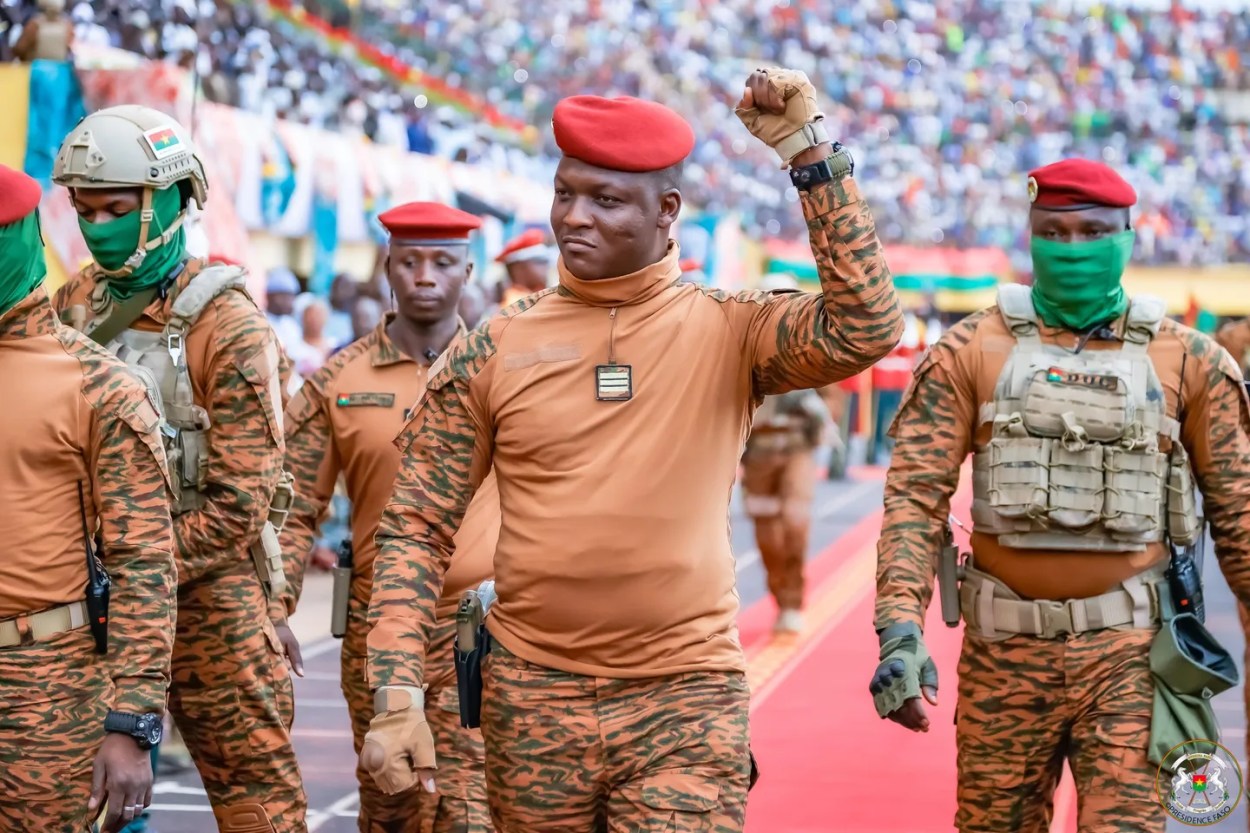
Burkina Faso’s Ibrahim Traoré is remaking his nation, and in the process, making enemies in the West.

Since taking power in 2022, the young military leader has expelled French troops, ejected Western corporations, and aligned his country with Russia, Cuba, and Venezuela.

Promoting pan-African unity and national self-reliance while surviving coup attempts, Traoré is positioning himself as a radical anti-imperialist and has drawn fire from Washington and Paris. MintPress News explores the project underway in Ouagadougou and the global forces trying to stop it

TRAORÉ IN THE CROSSHAIRS

According to government statements, Traoré narrowly survived a foreign-orchestrated coup attempt last month. Security Minister Mahamadou Sana said that the military junta foiled a “major plot” to storm the presidential palace on April 16.

The plotters, he said, were based in Ivory Coast, a Washington-backed neighbor where American military presence has recently expanded, the Pentagon identified Côte d’Ivoire as a potential site for new Navy bases following the closure of bases in Niger.

Ever since he took power in a military coup in September 2022, Traoré has been drawing criticism from Western governments, not least the United States.

On April 3, General Michael Langley, commander of U.S. Africa Command (AFRICOM), spoke before the Senate, accusing the Burkinabe leader of corruption and helping Russia and China establish an imperial foothold in Africa.

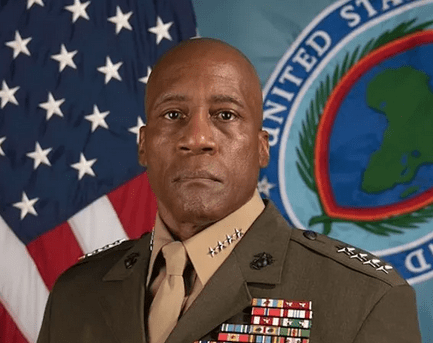
Michael Langley, head of U.S. Africa Command (AFRICOM) and U.S. Marine Corps General, implicated in Ivory Coast sourced coup attempt on Traoré on April 3rd 2025..

AFRICOM, the Pentagon’s regional command for Africa, coordinates U.S. military operations, intelligence gathering, and security partnerships across the continent, often framed as counterterrorism operations.

On the day of the coup, the U.S. Embassy changed its travel guidelines for Burkina Faso to “do not travel.” Langley reportedly met with Ivorian Defense Minister Téné Birahima Ouattara numerous times this year, both before and after the coup.

Since coming to power, Traoré has been systematically limiting the influence of Western powers in his country, calling it a matter of national sovereignty. In January 2023, he expelled the French ambassador, calling the country an “imperialist state.”

Burkina Faso & Mali Vow to Defend Niger’s New Leadership

One month later, he ordered French troops to leave Burkina Faso. This helped spark a wave of other West African nations formerly part of the French empire to do the same.

Continue reading “Why the US and France are trying to murder African Revolutionary Leader, Ibrahim Traoré”

Inside the Indigenous ‘land back’ movement in Colombia

In 2021 tens of thousands of indigenous marched on Bogota supporting the 2 month General Strike which brought down the racist colonialist regime. Yet the elite fought back, blocking land, health and social reform and on 1st May 2025 a new indigenous ‘Minga’ arrived to support a people’s Referendum

By Lital Khaikin at Waging Nonviolence on 12th May 2025 via thefreeonline at https://wp.me/pIJl9-GRD Telegramt.me/thefreeonline/3098

The 2021 Indigenous ‘Minga’ approaching Bogota

Despite facing existential threats, unarmed Indigenous guards are at the forefront of the struggle to reclaim their ancestral lands and end oil drilling in the Amazon.

Siona leader Mario Erazo Yaiguaje and Amazon Frontlines lawyer Lina Maria Espinosa during a community assembly. (Amazon Frontlines)

Sharing a border with Ecuador and Peru, the southern Colombian department of Putumayo takes its name from the Quechua term for “gushing river.” For some, its landscapes are a sacred doorway to the Amazon rainforest, a world unfathomably greater than the human.

For others, however, this land looks more like oilfields and military bases, optimized waterflood assets and strategic trafficking corridors. This difference in worldview is at the heart of peacebuilding in Putumayo and the Indigenous struggle to reclaim ancestral territories across the Amazon basin.

Indigenous ‘land back’ movement in Colombia

Colombia’s 2016 peace agreement with the Revolutionary Armed Forces of Colombia, or FARC, promised to usher in peace and restore lands to the people most affected by conflict, including Indigenous communities repeatedly displaced across their homelands.

But in Putumayo, dispersed conflict continues and Indigenous communities have been scattered across 86 reservations as their land claims remain in limbo. Financed by coca farms, the rival Comandos de la Frontera, or Border Commandos, and the Carolina Ramirez Front compete over land and drug trafficking corridors.

In the south, where remote villages straddle the border across the Putumayo River, armed groups hold nearly absolute control.

“We want the restitution of these territories from the hands of third parties, like those of the state, campesinos and armed groups,” said Fredy Javier Piaguay Ortiz, Siona (Zio Baín) leader for the Piñuña Blanco Reservation on the Ecuadorian border.

“There is a constant presence of armed groups,” he said, describing an atmosphere of heightened vigilance in these areas. “One has to be very strategic in order to endure these conditions in our territories. … There are no measures that completely guarantee freedom of movement.”

Land rights and special protections for Indigenous communities are entrenched in Colombia’s post-conflict transitional justice measures like the Truth Commission, the Special Jurisdiction for Peace, and the Victims and Land Restitution Law.

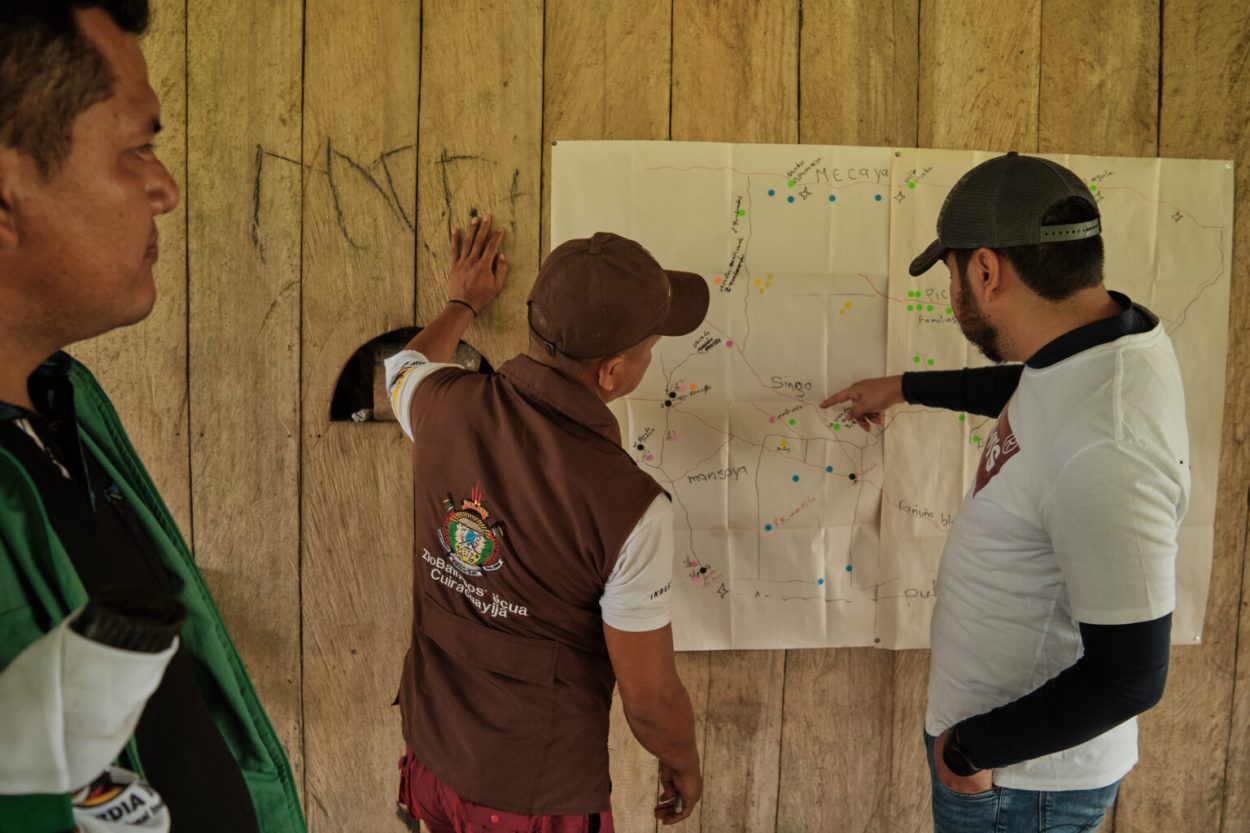
The Siona draw a map of their ancestral territory to support their land title claim with the Colombian Government. (Nicolas Kingman/Amazon Frontlines)

Putumayo has the most applications for land titles, or rights to land ownership, in Colombia. Ancestral territories make up a quarter of all applications in Putumayo to legally recognize the collective ownership and conservation of land that has been under Indigenous stewardship for generations.

Over nearly a decade, there has been little progress. The Observatory of the Territorial Rights of Indigenous Peoples reports that some requests have been idle for over 30 years.

Titles alone aren’t enough to measure the efficacy of land restitution, as plots may change hands informally and still end up under the control of armed groups, explained Lina Maria Espinosa, a Colombian attorney working with Amazon Frontlines. But they do give important legal protection.

“It is how Indigenous peoples construct their identity, and a place upon which Indigenous people depend for their collective existence, and to express themselves and their identity,” Espinosa said.

The competition is fierce and much of the land ends up in private ownership. In one of Colombia’s coca-growing hotspots, formalized land titles — that make ownership of previously informally held titles official — can also help access loans and coca crop substitution programs.

Campesinxs, or small-scale farmers, have received over half of the authorized land titles from the 7.4 million acre goal set out by the peace agreement. However, vast swathes of land have gone to cattle ranchers who have in turn driven rapid deforestation in Amazonian regions.

Indigenous land restitution does not mean displacing farming communities. It means co-existence. But in the process, both are up against a common obstruction. Oil companies have not been deterred by continued armed conflict waged largely against civilians.

Financing Colombia’s war economy at the height of the civil war, the extractive sector has laid claim to hundreds of thousands of acres in the Amazon basin and continues to drive divisions.

Hearts and minds

Mario Erazo Yaiguaje is the former governor of the Siona Buenavista Reservation and is working to advance land restitution at the Inter-American Court of Human Rights, or IACHR. He is also a member of his community’s Indigenous guard.

There are 12 recognized Indigenous groups encompassing around 51,700 people across Putumayo, including the larger groups of Awá, Camëntsä, Inga, Kichwa and Siona. Among these communities, there are an estimated 350 Indigenous guards, each unique in their customs and centering mandates on protecting their communities, cultures and the lands under their stewardship.

Siona leader Mario Erazo Yaiguaje. (WNV/Daris Payaguaje Tangoy) Tercer encuentro del proceso de intercambio de saberes para la defensa territorial en Puerto Silencio, Colombia.

Traditionally unarmed, they legitimize Indigenous authority on their own territories, Yaiguaje explained. All generations and genders participate. Elders pass on ancestral knowledge, language and a sense of social responsibility to youth for their future roles as community leaders amid the industrialization of the Amazon and the pressures of individualistic and consumerist lifestyles.

“We are armed with spirituality, valor and courage,” Yaiguaje said. “We demonstrate respect to our community and our territory.” 

Collective responsibilities vary. Territorial patrols take charge of mapping and monitoring environmental data, identifying medicinal plants and tracking animal welfare. Across different reservations, Indigenous guards may coordinate emergency response from pandemic logistics, to mutual aid after floods or landslides.

They are a mediator and buffer for conflict. Members of the guard may accompany community leaders and land defenders in public events or on errands to provide a sense of security amid the persistent threats to their lives.

According to internal norms, they may act as an alternative to colonial carceral systems like police or private security to enact justice and reintegrate offenders, including former combatants from Indigenous communities.

Land is more meaningful than just a quantity of acres, Yaiguaje explained, and the Indigenous guard cultivates a spiritual sense of control over homelands that are fragmented across reservations.

This sense of wellbeing is critical not only to sustaining the Siona’s cultural and spiritual integrity, but for maintaining morale in a fight against seemingly insurmountable opponents.

“Much of Putumayo has already been licensed for exploration or exploitation,” María del Rosario Arango Zambrano, Colombian human rights lawyer working with the Forest Peoples Programme explained. Companies that have entrenched in the Amazon basin have included Colombia’s Ecopetrol, China’s Emerald Energy, Amerisur and its Chilean successor GeoPark, and Canada’s Gran Tierra.

The fossil fuel economy is in a tenuous place as Colombia is intent on transitioning toward renewable energy. In 2023, Colombian President Gustavo Petro banned new oil and gas exploration in the country.

Later that year, Colombia endorsed the Fossil Fuel Non-Proliferation Treaty. Colombia has also pushed forward on enforcing a domestic fracking ban despite longstanding opposition from the oil lobby.

After appeals by the Siona reservations of Buenavista and Piñuna Blanco, the Colombian Supreme Court ordered an injunction on the exploration and exploitation of natural resources protecting 140,000 acres of ancestral Siona lands in 2018.

But the urgency of the peace agreement’s immediate aftermath faded. Impeded by Petro’s decrees, oil pioneers scouting Colombia’s northern regions shifted back to Putumayo. “All the interest turned toward Putumayo because they already have licenses there,” Rosario explained.

Some older oil concessions that overlap with Indigenous territories have been dormant or have just started to be developed.Sitting on one of Putumayo’s highest-producing oil fields, GeoPark’s sprawling Platanillo concession is currently in development despite the lack of Siona consent and Colombia’s commitment to protect ancestral Indigenous territories from exploration and exploitation.

Espinosa, who also provides human rights and technical training to the Siona communities of Buenavista and Wisuya, explained that oil companies and armed groups have exploited the state abandonment of these far-flung regions, ingratiatingthemselves into communities.

They do this without regard for continued conflict in Putumayo that is pushing people off their lands, or locking them into forced confinement.

“People know that the only way to maintain their territory is to quietly comply with the extortion of armed groups,” she said. “All those who benefit from the conflict enable the existence of conflict.”

There are repeated reports of oil companies co-opting local authorities like community council leaders to give the appearance of community consent. “Anyone who speaks out against their presence receives death threats or are attacked.

Continue reading “Inside the Indigenous ‘land back’ movement in Colombia”