
by Anarchist Networks (Redes Libertarias) translation thefreeonline https://wp.me/pIJl9-Hum 21 Sept 25. Tgrm t.me/thefreeonline/4273
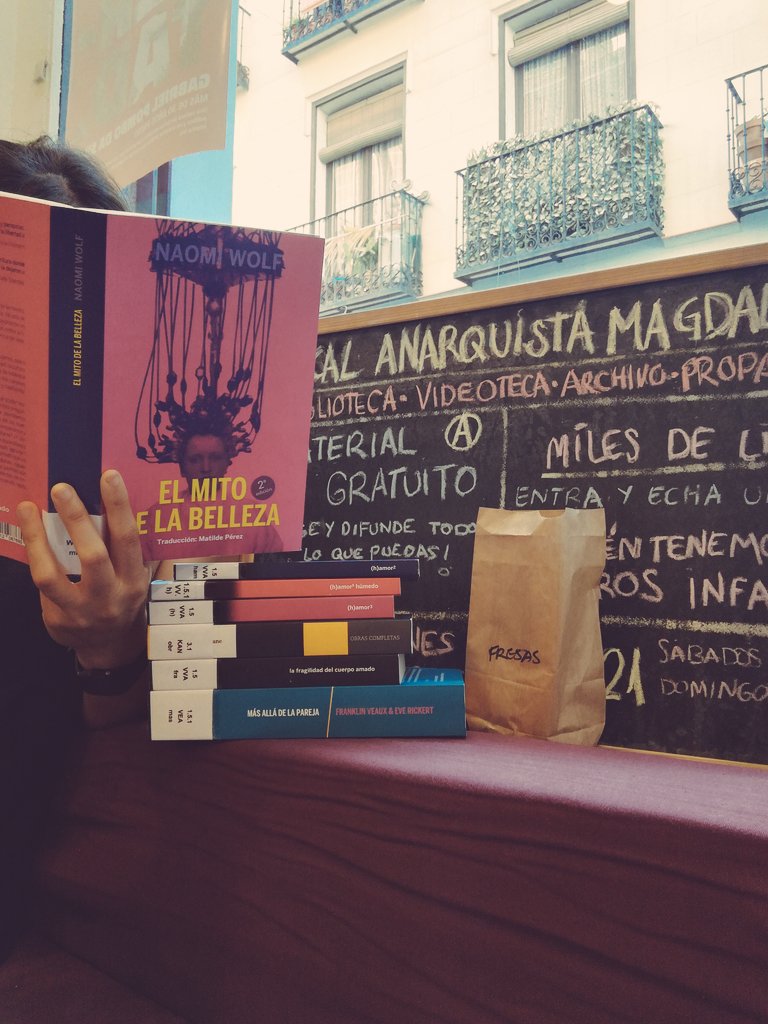
How and when did the Magdalena Anarchist Local come about? Tell us why Magdalena and how you are connected to the Lavapiés neighborhood where the Local is located.
The origin of the Local stems from a need to bring together various projects. It was born in a CNT space on Magdalena Street, a space that the union had been using since the 1970s.
In the 1990s and 2000s, they shared it with other groups that met there. There came a time when the union no longer participated in the local, and these other groups continued to use it.
To give you an idea, it was a large apartment with several rooms, so each room was used by different projects. From the Anarchist Youth of many years ago to the Anarchopunk Federation, etc., very different collectives without a common project passed through there..
Then, there came a time when the Klinamen publishing house and the Mundo Muerto distribution company also got involved, and projects began to emerge that gave rise to the library as we understand it today.
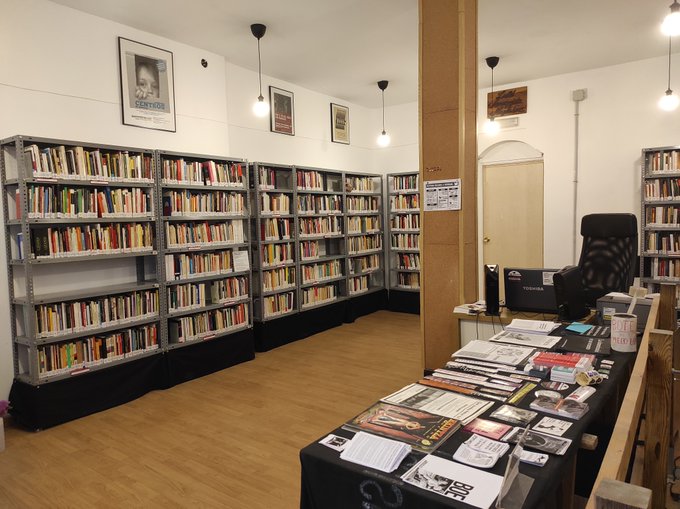
In 2003, the library was born under the name Biblioteca Social Enoch, then the bookstore, and later the video library and archive. At some point, all these projects were understood as a common project, which is Local Anarquista Magdalena.
We have never been a project directly linked to the neighborhood, although there have been many stages in which we have been.
Ultimately, we are a libertarian space whose strength is that we are in the center of Madrid and it is a meeting place, whether you have come for a book, an assembly, or an activity. We have projected ourselves more as an infrastructure for the city’s collectives than for the neighborhood.
But for several years, we have participated in assemblies against the gentrification of Lavapiés, such as STOP HOTEL (to stop the construction of the IBIS Hotel in Plaza de Lavapiés) and Paremos Hotel Cabestreros (with the intention of stopping the construction of a hotel in Plaza de Cabestreros).
We have also tried to bring the libertarian and anti-prison discourse to the streets by redefining a crossroads between two streets (Calvario and Ministriles), renaming it Plaza de Xosé Tarrio, where we have hosted screenings, talks, and workshops.
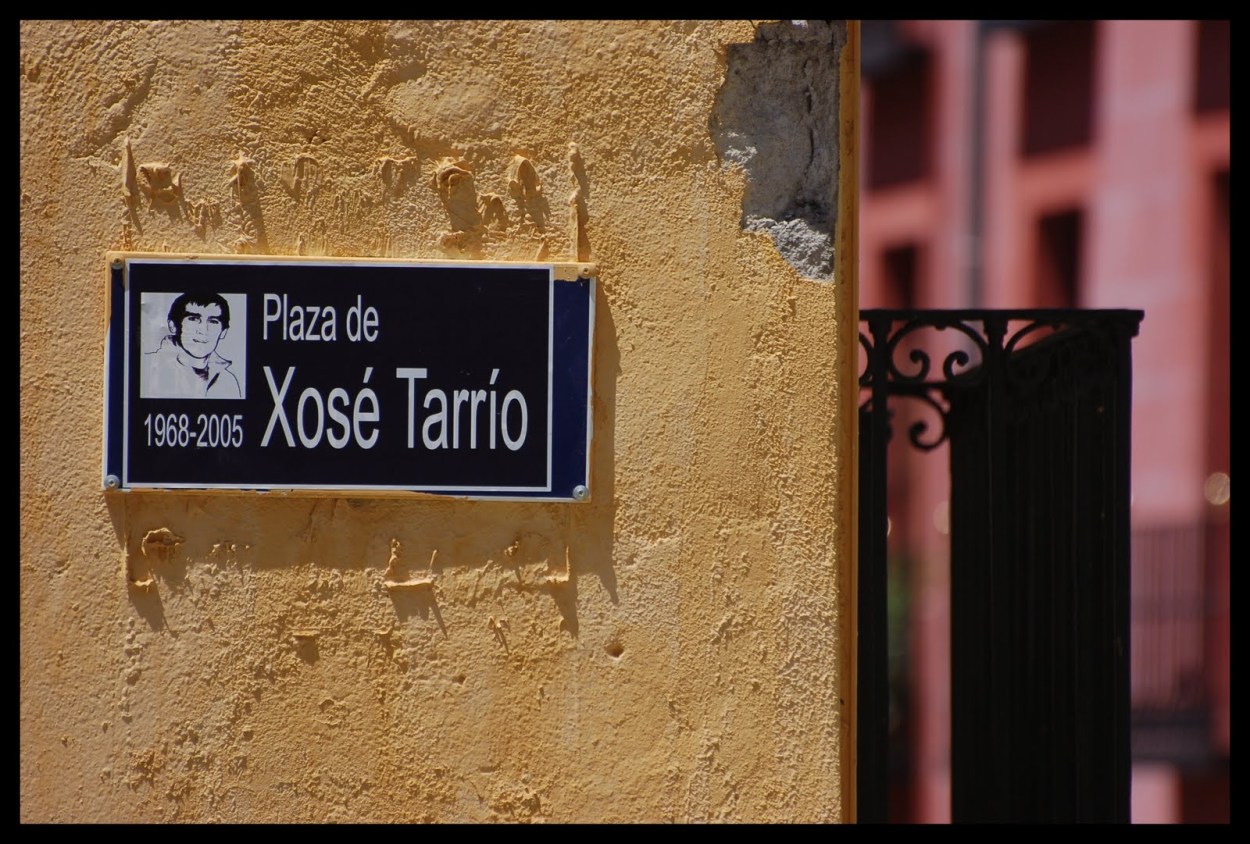
https://plazaxosetarrio.noblogs.org/
It has also been influential that the Magdalena assembly has never included anyone who lives in the neighborhood; instead, we have been people who have spent many hours in Lavapiés and have felt it is our neighborhood. Since none of us live in Lavapiés, at specific times, such as the COVID lockdown and the day of the blackout, we were unable to offer or use the space as a neighborhood infrastructure.
Also, due to the gentrification of the neighborhood and the expulsion of neighbors, fewer and fewer of our neighbors are using the space.
Despite these difficulties, we want to be a tool and an infrastructure for the Lavapiés neighborhood, something that can be complicated when we’re not there ourselves in their daily lives. But both the library and the space are available and open to the neighborhood.
In fact, we recently established a very nice collaboration with the “Lavapié Dragons,” where kids come every Tuesday to play chess.
What goals did you set when you started the club, and do you think they’re being achieved?
The library’s goal has always been to promote the dissemination of anarchist ideas and serve as an infrastructure for anti-authoritarian groups (https://localanarquistamagdalena.org/que-ofrecemos/).
The library’s origins are not as we understand them today, because at first the idea was to bring books into the prison. The catalog was sent to inmates and they were given whatever they requested. Later, it became a library that anyone who passed by could use. Although the project has evolved, the goal has been to spread libertarian ideas through the library, the bookstore, the archive, the video library, and other projects that have come together at the library.

It’s very exciting when you’re opening a Magdalena afternoon and someone comes for the first time to read something about anarchism, or to learn about a certain topic, and who uses our library as a reference. We’re happy to be that window into critical thinking.
Little by little it became a place where we could meet for demonstrations, hold meetings, collect propaganda, etc. We believe that the most beautiful evolution was the possibility of meeting different people who were involved in different struggles. Many of the people who are now in the assembly or have been in it at one time came through the anti-speciesist assembly, the assembly against the children’s centers. etc.
In fact, during the 15M and World Youth Day, there was a lot of movement, and many new people began to frequent the project. You could say that we’ve brought together people from different groups, and those people have reactivated us to do other activities.

Returning to the second part of the question, the goals and aspirations have been changing and evolving over the years… The people in the assembly aren’t the same, and those who have been there longer have also been evolving. But right now, we’re at a point where we’re happy with the project because it’s not stagnant; the library is being used, and the groups use it almost every day.
Internally, we’ve managed to emerge from a period in which we only had the capacity to manage the space and not to generate our own discourse (something we’re slowly getting back to).
For the past three years, we’ve also had a library committee (whose members don’t necessarily have to be on the Magdalena assembly) that has ensured the library isn’t a closed project, but rather a vibrant one, adding new features and doing the “dirty work” of inventorying the library collection, creating an online catalog (https://biblioteca.localanarquistamagdalena.org/), and supporting people who don’t return books (and this is a negative point, as we’ve lost more than 400 unreturned books).
One goal we’ve incorporated over the years is that, although the library has an assembly, the project is broader than that assembly itself. Magdalena is made up of all the people who open the space (and there are many of them, and thanks to them, we’re able to open every day), the groups that use it, and the people who lend books.
When the political momentum was stronger after the 15M movement, and Lavapiés was still a focal point for social movements in Madrid, and we ourselves were younger, it was much easier to meet and coordinate; it came naturally to us.
Nowadays, it’s much harder for us to find those common ground, and Magdalena serves as a glue that keeps many people and groups connected.
Given this difficulty in generating new connections and the stagnation of the project we’ve talked about, a negative dynamic developed in which we only had the minimum capacity to maintain the premises (openings and paying rent).
This combination makes it difficult for new people to participate in the project. But we’re very glad to have gotten out of that situation (having the premises closed for a whole year for renovations, followed by the COVID-19 pandemic, didn’t help much).
We’ve partly achieved this by having a more stable internal structure within the assembly (and because work and studies take up less of our time now than they did five years ago) and by creating new spaces for people to participate and learn about the space.
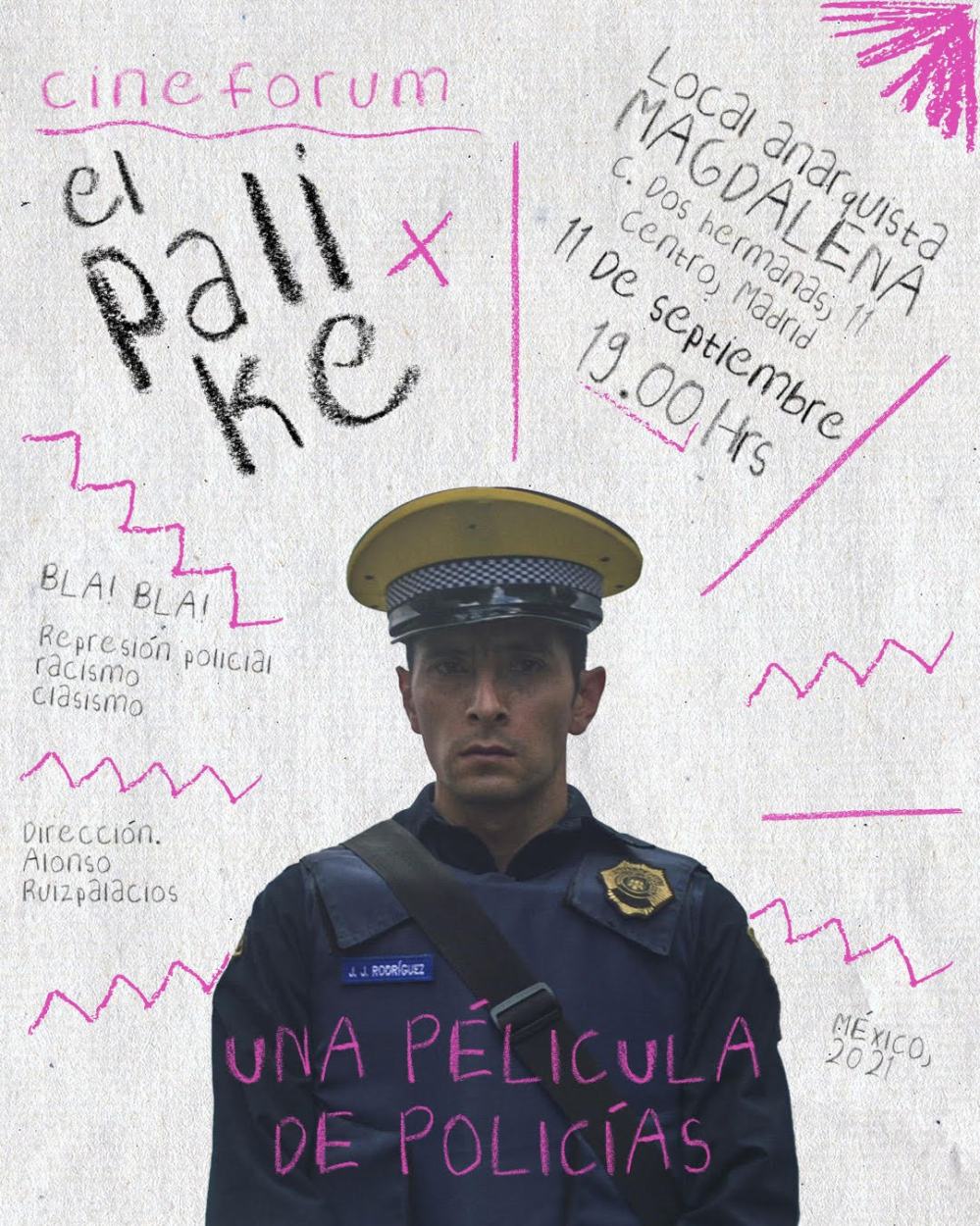
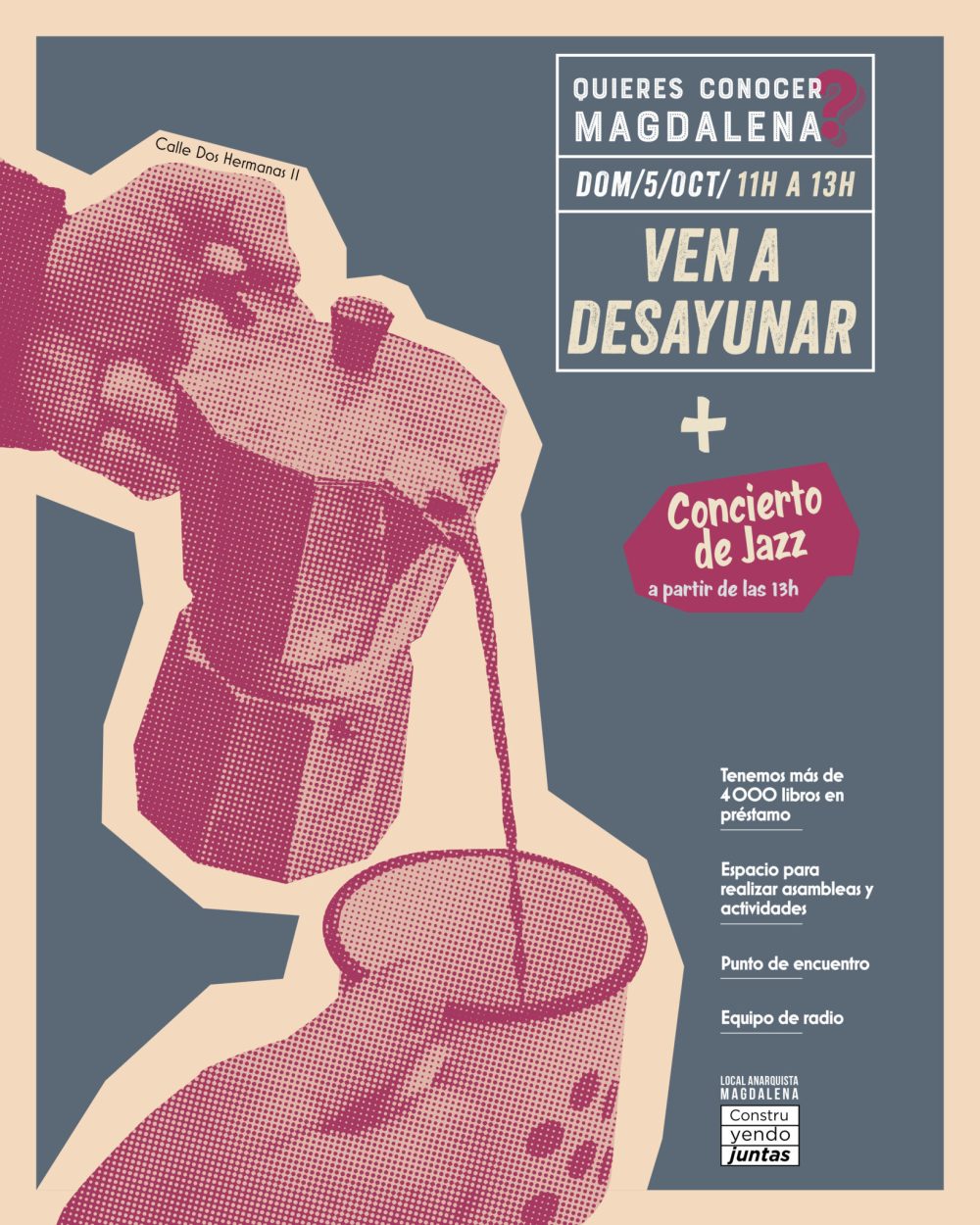
We’ve achieved this thanks to the library committee and the open work days it organizes, as well as by having regular, fixed activities (such as Breakfasts, Palike Film Forum, and the Anti-Racist Reading Club).
We’ve seen on your website that the central project is the library. What types of activities are organized around books?
As we mentioned before, one of our goals is to disseminate libertarian and anti-racist ideas, and right now we’re doing this through the library. Here’s the link to this article we wrote about why a library exists in an anarchist space… https://localanarquistamagdalena.org/por-que-una-biblioteca-en-un-local-anarquista/
And regarding the activities we organize, we don’t specifically seek to have them revolve around books; we try to do activities that can help generate our own anarchist discourse, generate debate, and encourage people to participate in everyday struggles.
The purpose of the space is to be a tool to empower these struggles, and through books, we learn to generate discourse and serve as a first approach to anarchist ideas. And if we do activities that revolve around books, it’s merely circumstantial.
Right now we have three projects in hand: C²: Conversations and Letters (debates on the reality of prisons, anti-punitivism, social control… and always creating a space to write to the people inside), Historical Walks (walks about historical or current struggles in Lavapiés or through the center of Madrid), and Conferences on Climate Change (debates and talks about the climate struggle from a libertarian perspective).
Who are the people or groups targeted by your activities? Can you explain what this thing you call a “propaganda center” is?
Any library user, who has passed by the building, who follows us on social media… Currently, in addition to the regular activities we will be organizing periodically, which we mentioned in the previous point, we can also participate.
Previously, we hold a monthly Film Forum (Palike), an Anti-Racist Reading Club, and a Breakfast. We organize the breakfast so that it can serve as a meeting point for all the people who use the space, and so that new people who are interested in participating can get to know us and the space.
The propaganda center is an area we reserve for distributing pamphlets, flyers, free newspapers, and so on. The groups that use the space leave their propaganda there.
It’s a space that has become an exchange point, where we leave our material and also borrow other people’s. Of course, anyone who passes by can take whatever they want for free, and they are often surprised to discover that all the material is available at no cost.
The idea is to spread this propaganda as widely as possible, and that’s why it’s so important to us that this center exists and is accessible to everyone who passes by.

How is the Magdalena Anarchist Club organized?
The Magdalena Anarchist Local is organized through a political assembly that manages the space, so all logistics and organization fall to that assembly. Although we do so for practical reasons, we always count on the collaboration and participation of the projects that make up the locale.
In fact, if the locale is maintained and continues today, it’s thanks to all the people who use the space. The collectives collaborate by taking on cleaning shifts, paying a monthly fee (those who can and want to), and opening the space.
There are also many comrades who, without being part of the assembly or any of the collectives that use the space, open one day a month, and because of that, we’re able to open every day of the week. We also hold open library work days for anyone who wants to participate.
What means of dissemination do you use for your activities (website, social media, etc.)?
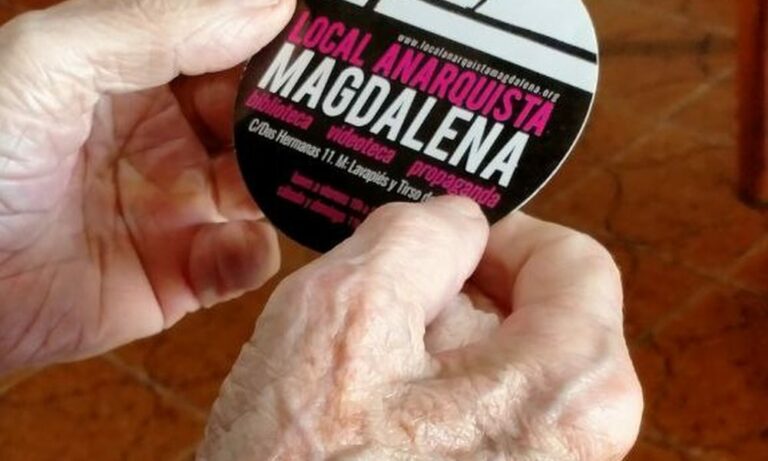
We primarily use our website and upload our activities to portaloaca, alasbarricadas, and mad.convoca.la, and we have accounts on Mastodon, Instagram, and Telegram. Whenever possible, we also like to maintain the tradition of posting posters on the street. And we always have stickers and bookmarks.
The libertarian and anarchist space seems like an archipelago of initiatives, collectives, publishing houses, magazines, etc. Do you think their coordination is necessary, or does their value lie in being dispersed through informal affinity connections like those we pursue through Redes Libertarias?
Both approaches are correct and valid, and depending on our trajectory, it will depend on the organizational and political situation of the libertarian environment and social movements, and then on internal forces.
We believe we should always aspire to generate these affinity relationships and to get to know each other among the different groups, as this can lead us to be considered in the future.
Two years ago, the Jesús Lizano Anarchist Library of the CNT in Fuenlabrada launched an initiative to create a network of anarchist libraries in the Community of Madrid, and also to organize annual conferences between them all, all under the name Libertarian Rhizome https://www.todoporhacer.org/rizoma-libertario/

We ended up abandoning that network because we didn’t have enough time or capacity to participate. However, the informal connections you mentioned remained through that network, allowing us to continue collaborating with each other, to keep each other in mind for work sessions, to share duplicate books, to organize talks, and so on.
In a city as large as Madrid, we don’t have many intergenerational meeting points or spaces where we can learn about all the existing anarchist initiatives and collectives. This makes it difficult to generate those affinity connections informally.
However, thanks to your magazine presentation in Magdalena and this interview, we’ve had the opportunity to get to know each other better, which will allow us to keep each other in mind in the future.
Returning to the previous example, it would be very powerful to have coordination between the libraries in Madrid, to have a common catalog, and to grow together. The problem we’ve often encountered is the limited capacity we’ve had to make that time for coordination, as it only gave us enough time to maintain our project.
So the answer would be yes to both approaches, and it depends on your goal and capacity to organize yourself in one way or another. The problem is that we lack reference points for coordinating groups and organizations. And on the other hand, we’re so fragmented that it’s not easy to generate those informal ties.
But in response to this, there are very interesting initiatives such as the Horizontal Coordinator or the Liza Platform.

How can we support the library?
You can make recommendations to us.
Book donations, and it’s much better to donate those books to us (the ones you consider useful, not the ones you were going to throw in the blue bin ; ). The space is rented, and we pay the rent with events we organize, one-time donations, and people who make monthly contributions.
These monthly contributions provide us with a steady income each month and are what give us stability. If you’re interested in making a one-time donation or making a contribution, you can find the information on the website.
And if you’d like to collaborate on the project so we can notify you about work days, posters, etc., email us at localmagdalena@gmail.com
****************


 The Free