Sat 7 January London Rally Trafalgar Square: Shut Guantánamo – End 10 Years of Shame
Saturday 7 January 2012: 2.0pm – 4.00pm Public Rally Trafalgar Square, London
January 2012 marks ten years of torture, abuse and arbitrary detention at Guantánamo Bay – one of the world’s most notorious symbols of injustice. The illegal US military prison has held more than 800 prisoners – most of them released without charge or trial. 171 prisoners remain, without prospect of release.
Over a dozen British nationals and residents have been illegally imprisoned at Guantánamo. Two remain: Shaker Aamer, a UK resident with a British family in south London, including a son he has never met; and Ahmed Belbacha, an Algerian national from Bournemouth. Both men were cleared for release in 2007.
President Obama promised to close Guantánamo but has not. Now prisoners may beheld indefinitely without evidence. The vast majority have never faced any charges.
Kidnapping and imprisoning people indefinitely without charge or trial, denying them their freedom and human rights,gratuitously denigrating and abusing them physically and mentally: Join the rally on 7 January 2011 to say all of this must end now.
Campaña para la retirada de la subvención a Repsol de los fondos de cooperación española
Contra que con fondos de cooperación al desarrollo se financien actividades que refuerzan la presencia de Repsol en la Amazonía Ecuatoriana
Campaña ciudadana para evitar la subvención, con dinero público, de actividades destinadas a la filantropía e imagen corporativa en el área afectada por el Bloque 16, en Ecuador. Los importantes pasivos ambientales e impactos sociales de la actividad hidrocarburífera obliga a esta compañía a realizar campañas en miras de apaciguar los reclamos y el descontento de la población.
La Agencia Española de Cooperación Internacional para el Desarrollo, AECID, ha concedido recientemente una subvención a la Fundación Repsol YPF del Ecuador por un monto total de 149.932 euros, para la ejecución de un proyecto en zona de influencia de la operación de Repsol YPF en la Amazonía ecuatoriana. (Resolución de 25 de noviembre, CAP 2º procedimiento, línea II.7) Las actividades de Repsol en América Latina y, específicamente, en Ecuador, han sido ampliamente denunciadas por la sociedad civil a ambos lados del Atlántico por daños ambientales, sociales y violaciones de los derechos humanos de las comunidades y pueblos afectados.
En Ecuador, Repsol opera el Bloque 16, ubicado sobre el territorio ancestral del pueblo waorani, afectando también a población kitchwa, gran parte del Parque Nacional Yasuní y el territorio intangible de los pueblos no contactados Tagaeri y Tagomenani. Repsol ejerce soberanía territorial sobre el Bloque 16, controlando la entrada y salida de personas, en clara violación de los derechos territoriales de los publos afectados. A pesar de la falta de información sobre la situación en el interior del Bloque, Repsol se ha visto obligada a reconocer el vertido de 14.000 barriles de crudo en 2008. Existen denuncias recurrentes sobre el aumento de enfermedades relacionadas con la actividad petrolera y daños hídricos y ambientales en la zona.
Se puede firmar la petición a través del formulario del siguiente enlace:
también se puede copiar y enviar el siguiene texto a : centro.informacion@aecid.es
DESTINATARIO: DIRECTOR DE LA AGENCIA ESPAÑOLA DE COOPERACIÓN INTERNACIONAL repsolmemata
scribo para mostrar mi preocupación por la reciente concesión de una subvención a la Fundación Repsol YPF en Ecuador. Repsol incurre en prácticas contrarias a los derechos humanos internacionalmente reconocidos, así como los principios recogidos en la política de la cooperación española, el Plan Director y estrategias sectoriales tales como la Estrategia de la Cooperación Española con los Pueblos Indígenas. Solicitamos que no se utilice el dinero público computado como Ayuda Oficial para el Desarrollo para financiar proyectos de empresas trasnacionales que, además de tener cuantiosos beneficios (más de 4.000 millones de euros en 2010), muestran poco respeto por las normas socio-ambientales y los derechos humanos internacionalmente reconocidos. Confío en que AECID cumplirá con los compromisos asumidos por España internacionalmente. Atentamente,
An Occupy movement for 2012 could gain strength and staying-power with strategies suggested by an emerging feminist critique.
As women of the Arab Spring are rediscovering, being participants, even leaders, of the uprisings hasn’t led to women’s equality—a depressingly familiar scenario, notoriously reminiscent of the 1960s aftermath of the Algerian revolution. In fact, the phenomenon is historically omnipresent (including the American revolution).
Here in the Global North, for example, women were active early in the Occupy movement. Yet that movement has presented an optic of being predominantly male (and in the United States, white and young)—as well as indifferent to the fact that capitalism simply cannot be transformed without confronting its foundation: patriarchy, itself reliant on controlling and exploiting women. And women, by the way, comprise 51 percent of the 99 percent (and virtually zero of the 1 percent).
Who then is the real constituency in need of economic justice?
The United Nations acknowledges that the world’s poor are 70 percent female. Women’s unpaid labor is worth $11 trillion globally, accounting for 41 percent of the GDP in, for instance, North America. It could well be argued that, given women’s massive amount of unpaid labor—and since women are the means of reproduction who produce the labor force itself—most women exist more under feudalism than under capitalism.
WAMMToday is now on Facebook! Check the WAMMToday page for posts from this blog and more! “Like” our page today.
Equal pay, reproductive rights, maternity leave, childcare—all are economic as well as human-rights issues. So are sweatshop labor/maquilliadores, sex trafficking/slavery/tourism, and war’s impact on women, who with their children comprise some 80 percent of refugees and displaced peoples. Women are the primary caregivers for the ill, the young, the aged, and the dying—so health costs are “women’s issues.”The pornography and prostitution industries each run into the hundreds of billions of dollars annually; China spends $27 billion just on Internet pornography. We only have statistics for a few “developed” countries on the staggering cost of domestic violence. We do know that domestic violence costs $5.8 billion a year in the United States alone.
One would think that such “women’s issues” would make unarguable the centrality to economics of female human beings. Wrong. Too often, the Occupy movement has betrayed its own vision by revealing itself as a sexist microcosm of the society it opposes. Harassment and assaults required women to define safe sleeping areas—immediate necessities yet questionable strategically, since these can become “ghettos,” while the problem, a male sense of entitlement, goes unchallenged.
Nor does this happen only in the United States, although North American sites got more press attention. Incidents of sexual assault and rape have been reported not only in New York, Cleveland, Dallas, and Baltimore, but in Glasgow, Montreal, London, and more. In some locations, male site monitors were reluctant to call police for fear that negative attention would be deleterious
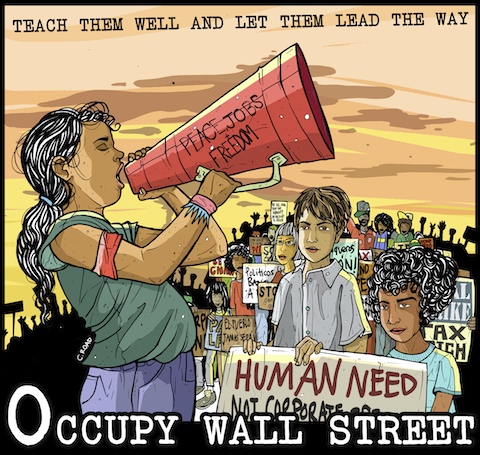
by Christy C. Road
to the Occupy “message.”
Brooklyn, Occupy Imnop, from Occuprint.org
Now, however, women are protesting that kind of protest. In Bristol, England, feminists called for “Carrying Our Safe Space With Us,” aiming to empower women to speak at Occupy general assemblies. On November 25, International Day for the Elimination of Violence Against Women, Feminists Occupy London took to the streets denouncing rape; that same day, Italian women marched in Rome, defining economic austerity measures as a form of violence against women, and citing policies that in effect force women to work multiple jobs, paid and unpaid. In Manila, Occupy was taken over by women, becoming Occupy RH (reproductive health), Filipina-led. Women in Slovenia, New Zealand, and Australia publicly decried the lack of safety for women at Occupy sites.
Such international groups as Code Pink, WomenOccupy, RadFem, the Filipina network Af3IRM/GabNet, and others raised women’s profile, thus challenging men’s hegemony. The Feminist Peace Network established the Occupy Patriarchy website, to provide a supportive, global space for feminist analysis, response, organizing, and networking within the global Occupy movement.
Having caught the world’s imagination with an admirable energy, seemingly spontaneous and seemingly grassroots, the Occupy movement is now poised at a crossroads. It has enormous potential—but lasting change will require consciousness that doesn’t ignore the majority of humanity. It needs to break free of being “a guy thing” or risk drowning in its own rhetorical generalities.It’s not as if certain models aren’t there. The women of England’s Greenham Common “occupied” turf decades before OWS—they endured, and won. Irish women barred doors to keep men from storming out of Northern Ireland peace talks. Women in Liberia sat singing for months in a soccer field to birth a revolution. Market women in Ghana brought down a government. Gandhi acknowledged copying the concept of Satyagraha— nonviolent resistance—from India’s 19th century women’s suffrage movement.
These are different—and long-lasting—techniques of protest, by which at first it seemed the Occupy movement was influenced. (At the risk of offending anarchists, I’ll paraphrase two of the Women’s Media Center slogans: “You have to name it to change it,” and “You have to see it to be it.” As a woman who once agreed “Level everything, then we’ll talk politics,” I recommend examples and clearly articulated demands as pretty good stuff.
It’s not too late. As the Occupy movement in many areas moves away from the tactic of claiming physical space, a change of protest style is in order: more hit-and-run, engage-disengage, morning-long, afternoon-long, or day-long (not open-ended) demonstrations—plus focused, doable demands.
Most women have far too many other responsibilities—including children—to spend months in tents playing drums, even if the tents were safe spaces. The Occupy movement needs women—the numbers, the economic analysis, the different strategic approach—to survive, let alone succeed. Yet women’s engagement with it might well require turning up in numbers massive enough to effect a de facto transformation of leadership and focus;:occupying Occupy in a “women’s style” could make all the difference.At the minimum, it should be possible to demand that men become the change they claim they want to see. (I mean,really, guys.) If Occupy men can dare be unafraid of that different kind of leadership—can even seek it out and welcome it—everyone wins and the paradigm is transformed.
If not, they will at least have radicalized a whole new generation of feminists.
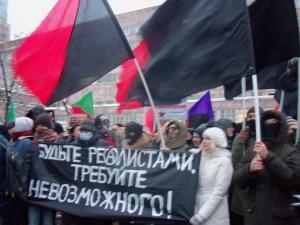
An open microphone assembly was held within the giant Moscow demonstrations
Almost all the speakers at a makeshift assembly were unanimous that the opposition status, consider themselves the ideologues of the protest movement, just want to get into power and do not intend to defend the interests of ordinary people. It is unlikely that peace, even thousands, meetings will lead to some radical changes. Defend the rights people can only do by fighting against the state and capital, and building around libertarian attitude.
When podium held by the free “opposition” oligarch Prokhorov, in black and red series he shouted, “Get in your Courchevel” and “The Power of millions, not the millionaires.” Anarchists and other participants in the meeting tried to block billionaire. Unfortunately, its passage further provided personal protection, but after Prokhorov flying snowballs.
After 16 hours, when some protesters began to disperse, and on the prospect of Sakharov became freer, and the column of anarchists and anti-fascists have joined together with her group of feminists, LGBT activists and individual representatives of the organized left-wing organizations has moved closer to the stage. The anarchists chanted “Freedom, equality, anarcho-communism,” “Higher, higher, black flag, the state chief enemy,” “Fascism shall not pass!”, “Our country – all of humanity!”(During a speech to the main podium speakers Nazi views), “All politics – crooks and thieves,” “Our candidate – self-government”, “Come on out, bring us a city,” “Down with fascism and capitalism,” “Path to Freedom – a revolution! “And other slogans.
After the meeting a column of anarchists, along with other protesters managed to arrange a procession from the expanded attributes and lit fireworks in the alley and Orlikova Kalanchevskaia street. Standing in a cordon police decided not to detain demonstrators.
About 18 hours, even at the metro station “Red Gate”, the ultra-right attacked a group of anarchists, who were returning from the rally. Police arrested along with neo-Nazis three anarchists, but they were soon released.
This month, federal judge Mar�a Servini asked Spain for information on Spanish military officials, as part of a new investigation based on a lawsuit filed in April 2010 by human rights lawyers in Argentina in the name of relatives of victims of the Franco dictatorship.
The judge requested the names of military officers involved in the Franco regime; lists of victims of forced disappearance and summary execution; lists of children who were stolen from their parents during the dictatorship; and the names of companies that allegedly benefited from the forced labour of political prisoners.
Anonymous hacks thousands of credit card numbers from security firm and cyphers money to charity.
Doing whatever it takes to bring some perceived justice back in the world…
Looks like the hacking group ‘Anonymous‘ has been back at it with its latest disclosure that it has stolen thousands of credit card numbers belonging to clients of US based security think tank Stratfor with as much a million dollars to date being donated to charity.
At present Anonymous is boasting that it has stolen Stratfor’s confidential client list, which includes outlets like Apple, the US Air Force and mined it for more than 4000 credit card numbers, passwords and home addresses.
To date ‘Anonymous’ has posted a small slice of the 200 gigabytes worth of sensitive client information, going so far as to go on twitter to taunt that more outlets have been earmarked in days to come.
Strike at the Heart of the Beast!
According to ‘Anonymous’ it was able to attain access to client credit card information because Stratfor failed to encrypt the codes, an embarrassing snafu for an outlet that’s in the business of security.
Hours after publishing what it claimed was Stratfor’s client list, Anonymous tweeted a link to encrypted files online with names, phone numbers, emails, addresses and credit card account details.
‘Not as many as you expected? Worry not, fellow pirates and robin hoods. These are just the ‘A’s,’ read a message posted online that encouraged readers to download a file of the hacked information.
What is particularly distressing to clients at present is the extent of information that ‘Anonymous’ has been able to steal and what some of the notes on various emails may have to say. Something that could prove to be very embarrassing as well as incriminatory given the sensitive information that an outlet like the US Airforce would be privy to.
This evening ‘Anonymous’ went online with images of receipts of charitable donations it already has begun to administer.
Hours after publishing what it claimed was Stratfor’s client list, Anonymous tweeted a link to encrypted files online with names, phone numbers, emails, addresses and credit card account details.
‘Not as many as you expected? Worry not, fellow pirates and robin hoods. These are just the ‘A’s,’ read a message posted online that encouraged readers to download a file of the hacked information.
One member of ‘anonymous’ went so far as to go on twitter using the handlebar, AnonymousAbu alleging that more than 90,000 credit cards from law enforcement, the intelligence community and journalists — ‘corporate/exec accounts of people like Fox’ News — had been hacked and used to make more than one million dollars worth of Christimas donations to entities that include for instance the Red Cross, CARE, Save the Children.Wishing everyone a “Merry LulzXMas” – a nod to its spin-off hacking group Lulz Security – Anonymous also posted a link on Twitter to a site containing the email, phone number and credit number of a US Homeland Security employee.
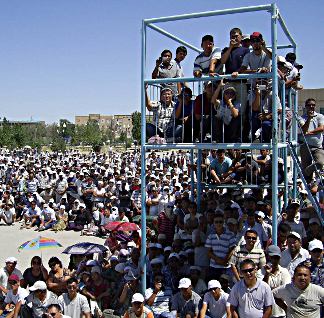
On December 16th (Kazakhstan’s Independence Day) more than 3,000 people met up for a demonstration at the main square of Zhanaozen, a town situated in the oil-rich Mangystau Province in the west of the country.
The people who took part in action were the ex-workers of local oil companies, fired after a bitter seven month strike. Their main demands were the payment of all outstanding salaries and improvement of work conditions.
As expected the oil workers and other town folk announced their intentions to hold a peaceful protest to the authorities of Kazakhstan. However, during the demo, a police Jeep was deliberately driven into the crowd of protesters and ‘peaceful’ went out of fashion from there on in. Angry people turned a police car upside down and set it on fire. A nearby police bus and a yurt (placed on the square “for the celebrations”) were
oil strikers camp Kazakhstan
also torched. Following this, the people, armed with sticks, pipes and molotov cocktails occupied the office of the local gas company and burned rooms on the ground floor of its office building. The local council building and a hotel were also burned. The oil workers surrounded the building and would not let the firemen get to the building. As an encore, they looted the houses of the rich in the exclusive, private area of town.
The state’s answer was to send army divisions, armoured transport and more police. The town’s population defended the strikers and, as a result of the attempt to bring it to ‘order’ more than ninety people (civilians and security) are said to have been killed, with eight hundred injured (these numbers are constantly growing).
Unsurprisingly, official media channels tell of much lower numbers. Many workers across the region have stopped work in support of the demonstrators. First oil workers of Mangystau Province started a sympathy strike, then workers of non-oil industries in the region also stopped their work in solidarity. The protests have become a general strike.
In what will probably become a 21st century standard ‘state-under-threat’ response, mobile phones in affected areas cannot be accessed, landlines do not work, Internet social networks and media are being blocked.
Of course, no mention has been made of punishing any police officers for firing on unarmed and peaceful people.The vast majority of the profits from the sale of the country’s resources are not shared with the nation’s poor, and the Kazakh government has a terrible human rights record. Time and time again members of the security forces, torture, beat, and mistreat detainees. The government continues to use arbitrary arrest and detention, and selectively prosecutes political opponents, often detaining them for long periods.
One might say that the spirit of the Arab spring has been taken up by Central Asians, but with the current low media interest (apart from a few newspapers here and there), there isn’t the same pressure on president Nazarbayev that there has been on Middle-Eastern leaders this past year (and they weren’t exactly exactly keen to fold up that pressure in any event).
However, Kazakhs don’t need to look as far away as the Arab world for inspiration. Another ex-Soviet Central Asian country, Kyrgystan, chucked out their despotic president Bakiyev in April 2010, following riots and demonstrations that led to Bakiyev’s ousting and the formation of a transitional government, headed by former philosophy lecturer Roza Otunbayeva. And what country did Bakiyev flee to? Kazakhstan.
No doubt president Nazarbaev has double checked his private jets are full of fuel and that his Swiss bank cashcard is still valid. Just in case.
Campaign Kazakhstan demonstrates in Berlin and Cologne
Campaign Kazakhstan activists, Germany
Berlin solidarity Kazakh oil strikers
Berlin
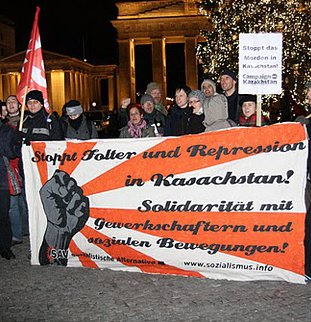
Yesterday, around 50 people protested in the centre of Berlin, criticising torture, repression and murder in Kazakhstan. Trade unionists including, metalworkers, teachers and health workers were joined by activists from the international “CampaignKazakhstan”, as well as members of the German LINKE (LEFT) party, SAV (CWI in Germany) and other left organisations, informing passers-by and tourists at Brandenburg gate of the events since last friday around the oil workers’ strike in western Kazakhstan.
The protesters shouted, “stop the slaughter in Kazakhstan!”





 The Free