Monsanto swindle destitutes millions in India….

Using its colossal market power, Monsanto craftily penetrated into the Indian markets.

Monsanto convinced the Indian government that its GM seeds would produce better crops. According to a report by Farm Wars, one former Managing Director of Monsanto claimed that Monsanto manipulated research data “to get commercial approvals for its products in India.”

Indian regulatory agencies, instead of verifying the data, simply remained compliant with the findings of what Monsanto presented. “They did not even have a test tube to validate the data and, at times, the data itself was faked,” the Farm Wars report says.

 Government regulations worked in favor of Monsanto to monopolize the Indian seed market. For example, “Prime Minsiter’s Office” in India pressured various state governments to sign MOUs with Monsanto to privatize the seed market.

Through these “vested interests” with the Indian government, Monsanto eventually has monopolized the GM seed market for more than a decade……….

The failure of Monsanto’s GM seeds was palpable. The farmers held onto their hopes for better crops after they had planted the “magic” seeds. Their crops never came. Throughout the villages in India the harvest from the GM seeds failed. The parasites destroyed the so-called “pest-proof” GM seeds.

Monsanto uses methods of manipulation and misinformation to reap their own benefits and profits at the cost of the farmers who rely on organic methods to grow their crops and animals, a tradition that existed in India for centuries.

By a contractual clause, the farmers could not save Monsanto’s GM seeds for reuse after the first season……….

With no harvest, the farmers could not pay back the lenders. Burdened with debts and humiliation, the farmers simply took their own lives, some by swallowing poisonous pesticides in front of their families. To date, an estimated 200,000 farmers have committed suicide all over India.

To add to the misery, wives inherited the debts along with the fear of losing their homes and lands. With no money coming in, they also had to pull their kids from the schools. The mass suicide among the Indian farmers is known as the “GM genocide.”

In its company website Monsanto declares that its pledge is “our commitment to how we do business.” And then there are the business philosophies with virtuous words like “integrity” and “transparency.”

Read Long full article HERE Globalresearch.caGlobal Research Articles by Iqbal Ahmed


More bio tech type stories I’d like to re blog   (from The Watchers with thanks)

  1. Organic farmers sue Monsanto over GMO seeds A landmark lawsuit filed on March 29 in US federal court seeks to invalidate Monsanto’s patents on genetically modified seeds and to prohibit the company from suing those whose crops become genetically contaminated. The Public Patent Foundation filed suit on behalf of 270,000 people from sixty organic and sustainable businesses and trade associations, including thousands of certified-organic farmers. In Organic Seed Growers and Trade Association, et al. v. Monsanto, et al. (U.S. District Court, Southern……
  2. Secret GM wheat experiments begin in Australia Australia’s first trial of genetically modified wheat and barley is under way near Narrabri, New South Wales in the south-eastern area of the country. The goal of the GM wheat is said to be more nutritious bread (http://www.smh.com.au/nsw/gm-wheat-…). How exactly the genes were altered to create this alleged more nutritious bread remains a secret. All that is known is that 14 different strains of wheat and barley will be grown. Some strains will allow researchers……
  3. Plant disease raises questions on modified crops Sudden death syndrome (SDS) of soybean was first discovered in 1971 in Arkansas and since then has been confirmed throughout most soybean-growing areas of the U.S. SDS is a fungal disease that also occurs in a disease complex with the soybean cyst nematode (SCN, Heterodera glycines). SDS is among the most devastating soil-borne diseases of soybean in the USA. When this disease occurs in the presence of SCN disease symptoms occur earlier and are more……
  4. Nikola Aleksic, Serbian ecology leader arrested for openly defying GMOs and chemtrails In October 2011, Nikola Aleksic, leader of Ecological Movement of Novi Sad in Serbia, was arrested and fined. Earlier on his way to a conference in Belgrade, an attempt was reportedly made on his life. And Monsanto has sued him with the threat of removing him and his family from their rented flat as “collateral.” Why all the fuss? Nikola made a spirited speech, recorded on video, challenging the Serbian president for allowing GMOs to……
  5. Did the USDA deregulate all new genetically modified crops? In press release titled “ USDA Responds to Regulation Requests Regarding Kentucky Bluegrass,” agency officials announced their decision not to regulate a “Roundup Ready” strain of Kentucky bluegrass—that is, a strain genetically engineered to withstand glyphosate, Monsanto’s widely used herbicide, which we know as Roundup. The maker of the novel grass seed, Scotts Miracle Gro, is now free to sell it far and wide. So you’ll no doubt be seeing Roundup Ready bluegrass blanketing lawns……
  6. BASF tries (again) to push ‘Frankenpotatoes’ on Europe Europeans have made it abundantly clear time and time again that they want nothing to do with genetically-modified organisms (GMOs). But chemical giant BASF refuses to take no for an answer, and is once again pushing for EU approval of a “Frankenpotato” known as Fortuna that, if approved, would represent the EU’s second new legalized GMO in more than a decade. Unlike most Americans, Europeans generally take a keen interest in the integrity of their……
  7. Biotech’s dirty tricks exposed in new documentary: ‘Scientists Under Attack’ “One question means one career.” This was the harsh warning of UC Berkeley Professor Ignacio Chapela for those daring to conduct independent research on genetically engineered foods and crops. “You ask one question, you get the answer and you might or might not be able to publish it; but that is the end of your career.” Both he and biologist Arpad Pusztai dared to asked questions and do the research. And then all hell broke……


Chevron/Texaco GUILTY of Amazon slaughter

Chevron found guilty in Ecuador… again By Mike G A court of appeals in Ecuador has upheld the ruling of a lower court, confirming what 30,000 Ecuadorians suffering from Chevron’s oil pollution in the Amazon and activists the world over have known for decades: Chevron is guilty. There is no question of Chevron’s responsibility for dumping some 18 billion gallons of toxic oil waste in the Ecuadorian Amazon. The only question, at this point, is: What ludicrous talking point will Chevron roll out this time to explain away its refusal to pay to clean up its mess?

. Evidence recently surfaced of the company’s secret labs used to hide dirty soil samples from Ecuadorian courts. Earlier this year, an appeals court in the US threw out the injunction barring enforcement of the $18 billion judgment against the company. That same week, diplomatic cables released by Wikileaks revealed that Chevron had been lobbying Ecuadorian officials to make the lawsuit go away, and just a couple weeks ago an attempt to buy its way out of liability for its pollution in the Amazon by funding Ecuador’s Yasuni-ITT Initiative blew up in the company’s face.

The real reason Chevron won’t take responsibility for its mess in Ecuador, of course, is unbridled greed and a complete disregard for human life. More than 1,400 Ecuadorians have died from Chevron’s oil pollution in the Amazon, but it’s all about money for the Big Oil behemoth. It’s certainly not that the company can’t afford to pay. Late last year, Chevron announced third quarter profits of $7.8 billion, bringing its haul in just the first three quarters of 2011 to $21.7 billion.-…………  Read full article HERE   with than  http://www.newint.org/blog/2012/01/05/chevron-guilty-

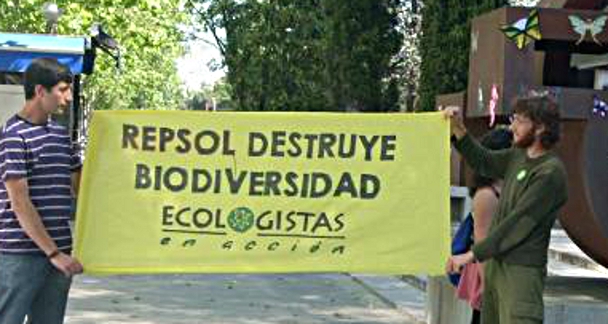
Repsol criminales FUERA de Ecuador YA!

Campaña para la retirada de la subvención a Repsol de los fondos de cooperación española

Contra que con fondos de cooperación al desarrollo se financien actividades que refuerzan la presencia de Repsol en la Amazonía Ecuatoriana

Campaña ciudadana para evitar la subvención, con dinero público, de actividades destinadas a la filantropía e imagen corporativa en el área afectada por el Bloque 16, en Ecuador. Los importantes pasivos ambientales e impactos sociales de la actividad hidrocarburífera obliga a esta compañía a realizar campañas en miras de apaciguar los reclamos y el descontento de la población.

La Agencia Española de Cooperación Internacional para el Desarrollo, AECID, ha concedido recientemente una subvención a la Fundación Repsol YPF del Ecuador por un monto total de 149.932 euros, para la ejecución de un proyecto en zona de influencia de la operación de Repsol YPF en la Amazonía ecuatoriana. (Resolución de 25 de noviembre, CAP 2º procedimiento, línea II.7) Las actividades de Repsol en América Latina y, específicamente, en Ecuador, han sido ampliamente denunciadas por la sociedad civil a ambos lados del Atlántico por daños ambientales, sociales y violaciones de los derechos humanos de las comunidades y pueblos afectados.

En Ecuador, Repsol opera el Bloque 16, ubicado sobre el territorio ancestral del pueblo waorani, afectando también a población kitchwa, gran parte del Parque Nacional Yasuní y el territorio intangible de los pueblos no contactados Tagaeri y Tagomenani. Repsol ejerce soberanía territorial sobre el Bloque 16, controlando la entrada y salida de personas, en clara violación de los derechos territoriales de los publos afectados. A pesar de la falta de información sobre la situación en el interior del Bloque, Repsol se ha visto obligada a reconocer el vertido de 14.000 barriles de crudo en 2008. Existen denuncias recurrentes sobre el aumento de enfermedades relacionadas con la actividad petrolera y daños hídricos y ambientales en la zona.

Se puede firmar la petición a través del formulario del siguiente enlace:

http://actuable.es/peticiones/pide-…

también se puede copiar y enviar el siguiene texto a : centro.informacion@aecid.es

DESTINATARIO: DIRECTOR DE LA AGENCIA ESPAÑOLA DE COOPERACIÓN INTERNACIONAL repsolmemata

scribo para mostrar mi preocupación por la reciente concesión de una subvención a la Fundación Repsol YPF en Ecuador. Repsol incurre en prácticas contrarias a los derechos humanos internacionalmente reconocidos, así como los principios recogidos en la política de la cooperación española, el Plan Director y estrategias sectoriales tales como la Estrategia de la Cooperación Española con los Pueblos Indígenas. Solicitamos que no se utilice el dinero público computado como Ayuda Oficial para el Desarrollo para financiar proyectos de empresas trasnacionales que, además de tener cuantiosos beneficios (más de 4.000 millones de euros en 2010), muestran poco respeto por las normas socio-ambientales y los derechos humanos internacionalmente reconocidos. Confío en que AECID cumplirá con los compromisos asumidos por España internacionalmente.  Atentamente,

Domingo 1ro de enero de 2012, por

http://repsolmata.ourproject.org/spip.php?article212

Save the Amazon, veto the new Forest Code

GREENPEACE INTERNATIONAL

    Dear friends,
The Amazon rainforest is facing its biggest threat ever. Damaging changes to Brazil’s Forest Code – the main laws protecting the rainforest – were just approved by Brazil’s Senate. These changes open up the Amazon to rampant deforestation and we now stand to lose more of this amazing ecosystem to destruction. Soon the only thing standing between the Amazon and the chainsaws will be Brazilian President Dilma Rousseff, who can veto these changes. We all have a stake in protecting this irreplacable resource.

You can urge President Dilma to protect the Amazon and veto the new Forest Code. clic HERE http://www.greenpeace.org/international/en/campaigns/forests/amazon

We are edging closer to an “ecological calamity” in the Amazon rainforest and a vote in the Brazilian Senate has pushed us closer to the brink. It voted to approve destructive changes to the laws governing forest protection – called the Forest Code – that would open up the Amazon rainforest to rampant destruction. But it is not too late. Brazilian President Dilma Rousseff will have the opportunity to veto the changes – you can ask her to protect the Amazon and veto the new Forest Code.

Losing the Amazon rainforest to further deforestation would be an unimaginable loss for our planet and life on it, and the approval of this new Forest Code in Brazil would bring us one step closer to this terrible reality.

Not only is the Amazon home to one out of every ten species on the planet and important to the livelihoods of local communities, but it also functions as a carbon storage system, which can help us avoid some of the worst consequences of climate change. If deforestation and degradation of the Amazon continues increasing at the current pace the damage could actually transform the Amazon into part of the problem instead of part of the solution. The emissions from Amazon destruction contribute to a feedback cycle that will not only make climate change worse, by increasing warming trends, but cause further damage to the remaining forest, as forest fires in the region would intensify. The new Forest Code would bring us closer to this vicious cycle. Some scientists are already discussing the potential of losing the Amazon completely – imagine a world with no Amazon rainforest.

It won’t happen, because we will all keep demanding real protection for the rainforest until we get it. We know that a future free from destruction is possible, and we’ll condemn any attempts to destroy that future for the short-term profit of a few – the new Forest Code is one such attempt.

This past year the agricultural lobby pushed hard inside Brazil to weaken forest protection, many of the people pushing for these changes have been fined themselves for illegal deforestation. The result is the new Forest Code – it reduces the size of areas under protection, pardons people who deforested illegally and weakens enforcement of protection laws.

The text that has now been approved by the Senate is really bad; after the vote, Greenpeace Amazon campaign director Paulo Adario reemphasized that it opens up the rainforest to further deforestation. He also pointed out that scientists and the public prosecutors office have already said that the new Forest Code is not good for the environment and will be challenged.

There is still time to turn this situation around. You can send President Dilma an email right now and make it clear that she has a duty to protect the Amazon rainforest and veto the new Forest Code. All of us, including President Dilma, have a stake in the survival of this amazing ecosystem.

We’d like to keep you updated on this situation as it develops, so please keep in touch and make sure you are following us on Facebook and Twitter.

Repsol se enriquece Matando

¡ Encontraron el Dorado!

Repsol se enriquece con los lotes y mercados cautivos de América Latina

Domingo 4 de diciembre de 2011, por repsolmemata

Las pasadas semanas Repsol sorprendió a los accionistas con la noticia del descubrimiento histórico de 927 millones de barriles equivalentes de petróleo en el yacimiento de Vaca Muerta, Neuquén, Argentina. La noticia coló y los inversores premiaron a la compañía con un aumento del 6% de la cotización bursátil a las pocas horas de su difusión. Aunque exagerada por su contenido (pues según los analistas, ni son reservas probadas, ni el shale oil es todavía petróleo ya que necesita de costosos procesos de refinación)[1] pareciera que la crisis mundial no afecta a la compañía petrolera, que sigue amasando altísimos beneficios. Pero si ellos ganan, quién pierde?

En el último lustro la estampa de Antoni Brufau, presidente de Repsol-YPF, abrazado a presidentes de diferentes países de América Latina se ha hecho familiar . No en vano, la compañía petrolera ha apostado millonarias inversiones en la exploración de nuevas áreas y el desarrollo de campos productivos que han engrosado unas reservas muy cotizadas en los mercados bursátiles. Otra estrategia ha sido formar sociedades mixtas con las empresas nacionales, para conseguir áreas prioritarias y superar las resistencias gubernamentales. De este modo, los países productores, que a la vez son consumidores, abren sus puertas a la compañía, entregando unos combustibles para que la compañía los exporte, o los venda al propio país con un gran margen de ganancias.

Mientras la compañía anuncia en las bolsas sus fabulosos hallazgos en zonas no tradicionales, los habitantes de estas regiones sufren los pasivos ambientales del avance de la frontera extractiva. Y los conflictos afloran con el petróleo.

Petróleo bajo el mar

En Brasil, Repsol materializó a finales del pasado año un acuerdo con la empresa china Sinopec para desarrollar conjuntamente los proyectos de exploración y producción que posee en las Cuencas de Santos, Campos y Espírito Santo, donde participa en 14 bloques, de los cuales opera siete.

En las últimas semanas, el consorcio Repsol Sinopec Brasil anunció descubrimientos de importantes reservas en varios pozos en la costa de Vitoria y Sao Paolo a profundidades entre 2 y 5 kilómetros. Estos hallazgos se añaden a otros mega-yacimientos que Repsol ya contabilizó en los pasados años y que le posicionaron en una de las empresas líderes en descubrimientos en aguas profundas.

Pero entre la detección de reservas ubicadas a kilómetros bajo la superficie y su posterior extracción, existen riesgos e impedimentos tecnológicos que – sirva el desastre del golfo de México de 2010 como precedente- conviene no subestimar.

En aguas colombianas, Repsol se propone realizar exploración y explotación petrolera en las Cayos del Norte, parte del archipiólago de San Andrés, Providencia y Santa Catalina. El proyecto ha levantado la oposición del pueblo indígena raizal y de organizaciones ambientalistas por poner en peligro los sistemas coralinos del conocido Mar de los Siete Colores.

Gas guaraní para la exportación

En Bolivia, Repsol se asoció a YPFB para formar la empresa PetroAndina SAM y conseguir nuevas áreas de exploración en la Amazonía.

Más al sur, en el Chaco, la compañía sigue perforando pozos exitosos en el interior de territorios indígenas. El Bloque Caipipendi, de 123.000 hectáreas que se superponen a los Territorios Comunitarios de Orígen Itika Guasu, Tentayapi, y al Parque Nacional Aguaragüe, ya se han puesto en marcha 5 pozos a profundidades de hasta 6.000 metros. En 2010 Cristina Fernandez y Evo Morales inauguraron un nuevo gasoducto de 40 kilómetros para unir este bloque con la red de gasoductos argentinos y asegurar mayores flujos de exportación hacia el mercado argentino, deficitario de este combustible – a pesar de que este país permite a las empresas exportar el gas a chile y otros países.

El pasado octubre, Repsol anunció la inversión, junto a su socia Pan American Energy de 1.400 millones de dólares para seguir perforando nuevos pozos con el horizonte de aumentar la producción de 3 a 14 millones de metros cúbicos diarios de gas en los próximos tres años. Con este repunte productivo “se garantizará los contratos de exportación a Argentina y por supuesto satisfacer el mercado interno”, el cual, valga decirlo, todavía es mínimo por no contar con una red de suministro domiciliario.

Amenazada por el bloque Caipipendi, la comunidad guaraní de Tentayape, declarada como Patrimonio Historico Cultural de los Guaranís en 2006, ha defendido a ultranza una posición de determinante rechazo a cualquier entrada de la compañía en su territorio. La empresa, a sabiendas de las reservas gasíferas que aguardan bajo el suelo de la comunidad, acorrala su territorio implantando cada vez más infraestructuras en la zona.

Amenazas a los pueblos amazónicos

Repsol opera en varios lotes en la Amazonía del Perú. Al norte, en el controvertido Lote 39, se discute la existencia o invención de pueblos en aislamiento voluntario. Mientras las organizaciones indígenas piden la creación de una reserva territorial que los proteja, Repsol niega su existencia en base a la colocación de trampas fotográficas. Mientrastanto, la francesa Perenco, ha obtenido la licencia para la construcción de un oleoducto en el vecino Lote 67, también en territorios de posible presencia de pueblos aislados.

Al sur del país, Repsol es socia del consorcio Camisea, que opera al interior de la Reserva Territorial Nahua Kugakapori Nantis. Pluspetrol, la operadora del Lote 88, ha iniciado hace unos meses cuestionados movimientos no previstos al interior de la reserva, contratando a comunarios del pueblo Nahua, en situación de contacto inicial, para actividades de vigía ante posibles encuentros con grupos aislados.

A parte, el descubrimiento de enormes bolsas de gas en el vecino Lote 57 ha empujado a Repsol a iniciar un ambicioso proyecto de industrialización de la selva. Para este año, peinará sus bosques con un proyecto de sísmica 3D que afectará 2.360 Km de la Reserva Comunitaria Machiguenga, así como su área de amortiguamiento y la del Parque Nacional Otuqui. También proyecta la contrucción de 22 pozos más que se añadirán al pozo ya perforado Kinteroni I y una conexión de gasoductos entre los pozos de los lotes 57, 56 y 88.[2]

En la región del Madre de Dios, el lote 76 operado por Repsol y Hunt, genera conflictos por la invasión con la Reserva Comunal Amarakaeri, pues se superpone a casi todo el territorio de la reserva y sin que se les haya efectuado la consulta previa a sus habitantes.

Repsol obtuvo un beneficio neto de 1.901 millones de euros en los nueve primeros meses de 2011, un 6,4% superior al año anterior. Buenas noticias para la bolsa, malas para los pueblos que cobijan el filón hidrocarburífero.

[1] Aleardo F. Laría , El misterio de Loma de la Lata, Diario Río Negro, Neuquen, 24/11/2011

[2] Agunos artículos sobre el tema: “ El desembarco de la modernidad, la sobmra de Repsol en Nuevo Mundo” http://servindi.org/actualidad/50232, “Repsol barrerá 5.000 km2 en reservas comunales” http://servindi.org/actualidad/48268, “La historia se repite para los pueblos aislados de la Reserva del Estado Nahua Kugakapori” http://www.kaosenlared.net/noticia/…

por  repsolmemata

Corrupt Brazil Senate votes for Amazon slaughter.

In what may go down as one of the worst environmental crimes of the 21st Century, the Brazilian Senate voted on Wednesday to retain most of the bad changes to the national Forest Code that had passed the House of Deputies earlier this year.

Brazil’s international commitments to mitigating climate change, maintaining biodiversity and it’s status before the upcoming RIO+20 global environmental meetings are now on collision course with the insatiable demand of its agri-business sector. In the coming months the issue will be laid squarely before President Dilma Rousseff who has thus far avoided comment.

re-posted from JustMeans    A revised version of Brazil’s Forest Code, a piece of legislation that regulates the use of forest coverage on private properties in Brazil, and whose draft was approved in Congress on Wednesday (23), has sent shockwaves through the sustainability community in the country and abroad.

An incensed debate has gripped the country over the last year, which culminated in yesterday’s vote. The new draft, which is designed to meet the requirements of the rural business, has been rushed through the House and the Senate and did not take into account expert opinion from scientists, who object to the new version of the law vehemently.

“The report continues to pardon those who deforested illegally and will promote more deforestation. What used to be an environmental crime now has become fantastic business”, said Mrcio Astrini, Greenpeace’s head of Amazon campaign.

Scientists have warned the new law will open way for the clearance of more than 175 million acres, or roughly the size of Germany, Italy and Austria combined, which would be come mostly pasture for livestock and soy monocultures to feed cattle, mostly.

This volume of deforestation would release more than 25 billion tons of CO2 into the atmosphere, or four times the goal for global reductions in greenhouse gas emissions under the Kyoto Protocol during 2008-12.
WWF, which has been campaigning against the revised legislation from the beginning of the debate, said the proposed changes severely contradict Brazil’s efforts to become an environmental and sustainability leader on the global stage.

“Brazil will be cutting itself off from a growing global market for responsibly sourced goods, in addition to forgoing the countless benefits provided by a healthy Amazon, such as clean air and water, stable weather patterns and various other environmental services”, it said.

“We are watching, just before Brazil hosts Rio + 20, a clear attempt to dismantle Brazil’s environmental legislation,” stated WWF-Brazil’s CEO Maria Cecilia Wey de Brito. “This is something unprecedented in our history.”

The bill will go back to the House before being sent to President Dilma Rousseff, who can still veto it. “In the next phase, she will have to keep her word to veto or break her campaign promises”, said Mr. Gasparini in reference to Ms. Rousseff’s promise to not pardon those who have deforested.

The current Forest Code was written in 1965 and requires landowners to keep a certain percentage of their land as untouched forest, from 20 percent in certain areas to 80 per cent in the Amazon. The new laws would give amnesty from heavy fines to landowners who cleared forest illegally between 1965 and July 2008.

Rules related to the clearing of hills would be relaxed and forest areas near rivers would have to be between 100 and 330 feet from the river bank, which conservationists say will are not enough.

A recent report compiled by Imazon and Proforest found that Brazil lags behind other BRIC countries in terms of legislation that protects forest coverage. Compared with China, Russia and India, Brazil loses the race towards sustainability by deforesting more than it reforests.

MORE INFO SEE HERE 

Belo Monte site OCCUPIED. Work still stopped..

Altamira, Brazil – Hundreds of indigenous leaders, fishermen and riverine people from the Xingu River basin have gathered to occupy the Belo Monte Dam construction site in a peaceful protest to stop its construction in Altamira, located in the state of Pará in the heart of the Brazilian Amazon. They Poor barrio of Altimira to […]

On sat 20th Aug a massive demo took place against the ongoing Amazon destruction for the Belo Monte dam. Also against the new Forest Law, now in the Senate, which ‘relaxes’ the already unenforced deforestation  code. Brazil had been a constructive leader in Climate talks, which came to nothing due to the greedy demands of […]

The greedy corrupt Brazilian politicians are voting to give free rein to their fascist landlord colleagues  and the McDonalds backed Ranching industry to  destroy the Amazon Rainforest. The politicians appeal to nationalist sentiment.. saying we have already destroyed our forests and they have every right. But 79% of Brazilians are AGAINST the new laws going […]

BRAZIL Politicians Out of Sync with Public Sentiment on the Environment By Mario Osava* Trans-Amazonian Highway outside Altamira in the northern Brazilian state of Pará. Credit:Mario Osava/IPS with thanks BRASILIA, Jun 29, 2011 (Tierramérica) – The environmental movement continues to gain credibility and support as scientific findings confirm its warnings and natural disasters become increasingly […]

Deforestation in the Brazilian Amazon from August 2009-May 2011.The analysis by Imazon suggests that the Forest Code debate may be a factor in rising deforestation. It found a 363 percent increase in forest degradation — logging and burning of forest that typically precedes deforestation — over the past 10 months, reaching 6,081 sq km. Most […]

”The surprise passing of the new Forest Law in the lower house of the Brazilian congress is due to a campaign by multinational  agribusiness and the big landlords who still own most of the country. The proposed amnesty for forest crimes has caused a 6 fold increase in deforestation already. The huge majority in favour […]

Dark Day for Brazil’s Amazon Jungle By Fabiana Frayssinet

foto. José and Maria. ‘They gunned them down and cut off their ears” An Amazon environmental activist and his wife were killed late on Monday and the crime is being investigated as a possible assassination to silence the outspoken forest defender, according to police. José Claudio Ribeiro da Silva, also known by his nickname of […]

URGENT AMAZON FOREST ALERT [UPDATE 20 May 2011: The Guardian UK reports, “Brazil forms ‘crisis cabinet’ following unexpected deforestation surge”.] Events are moving quickly in Brazil’s epic battle over a new national Forest Code. The struggle has has reached a critical stage full of both danger and opportunity. Please take action. EMERGENCY — BRAZIL’S NATIONAL […]

By Clarinha Glock* A solitary cow in a slash-and-burn clearing where there was once Amazon rainforest. C PORTO ALEGRE, Brazil, May 16, 2011 (Tierramérica) – The adoption of a new Forest Code in Brazil could threaten efforts to curb Amazon deforestation, which was reduced 70 percent between 2004 and 2010. The proposal to amend the […]

Belo Monte site OCCUPIED. Work still stopped..

Altamira, Brazil – Hundreds of indigenous leaders, fishermen and riverine people from the Xingu River basin have gathered to occupy the Belo Monte Dam construction site in a peaceful protest to stop its construction in Altamira, located in the state of Pará in the heart of the Brazilian Amazon. They

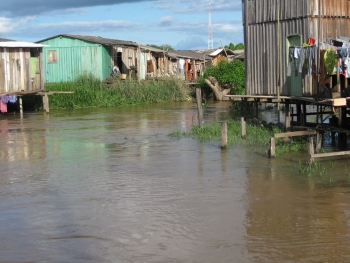
Poor barrio of Altimira to be permanently flooded by Belo Monte

have vowed to permanently occupy the site and are calling on allied organizations and movements to join them.

Work has been stopped while various legal cases are got rid of, with the politicians bought off by the ‘progress’ business and landlord nationalist lobby, while most people oppose the dam , as well as the amnesty for forest crimes and opening up of the Amazon with the new ‘Forest Code’.

Help support the peaceful protest: http://www.causes.com/campaigns/158177

Below: a report on the protest from Amazon Watch; and a declaration from the Xingu Alliance.

The Trans-Amazon Highway (BR-230) has been blocked around the Santo Antônio village, where it passes the proposed construction site. Groups are demanding the presence of a Brazilian government high-level official at the site to initiate a new round of negotiations that are transparent, inclusive and respectful of the rights of local people affected by the dam.

On Apr. 1, the Inter-American Commission on Human Rights IACHR recommended that the Brazilian government “immediately suspend the licensing process for the Belo Monte hydroelectric project” and “any material works” to protect the rights of local indigenous people.
This “abrupt change, without precedent in the democratic history of Brazil, indicates a breakdown of dialogue within the multilateral (Organisation of American States) system,” Caldas said at the news briefing.