Here in Spain things are hotting up, as more and more people lose their jobs.
The cuts forced by the State and Banks are cutting into essential services. (Health, education, Pensions..) and 1000s are evicted for defaulting on mortgages.
The demonstrations and occupations have become daily and hourly.
People recognize that the Capitalist System itself is at fault, and there is intense debate, especially from the Take The Streets (15-M) movement
which has decentralized into hundreds of local non hierarchical Assemblies and sub commissions.
There are many local initiatives setting off, including Mutual Aid Networks.
This Thursday will be a Day of Action as a lead up to the General Strike, and you can choos from over 50 mass demonstrations
due to take place around the country.
MOVILIZACIONES 29S. “La lucha está en la calle. Hacia la Huelga General”
Spain takes to the streets
Convocatorias unitarias de manifestaciones que tendrán lugar en todo el estado en la jornada de lucha del 29 de septiembre, con el lema de “La lucha está en la calle. Hacia la Huelga General”.
MOVILIZACIONES 29S. “La lucha está en la calle. Hacia la Huelga General”
Spain takes to the streets
Convocatorias unitarias de manifestaciones que tendrán lugar en todo el estado en la jornada de lucha del 29 de septiembre, con el lema de “La lucha está en la calle. Hacia la Huelga General”.
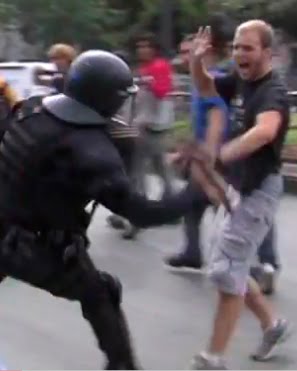
(English) The Take the Streets march from Spain to Brussels was viciously attacked by hysterical police in Paris when they held an Assembly with local activists in front of the Paris Stock Exchange. There were more than 50 arrests (finally released) and serious injuries. Despite all they camped in front of the Exchange and continued the long march.
…………….A les 18:30 hores les indignades i indignats van seure costat de l’edifici de France Press, davant de la Borsa de París, i sense deixar-se intimidar pel dispositiu policial que els envoltava, van començar l’assemblea que s’ha retransmès íntegrament per internet via streaming. Segons aquesta avançava, van anar arribant cada vegada més ciutadans, al mateix temps que s’anava formant un cordó policial. Davant l’arrest d’un d’ells per identificar (el motiu esgrimit per l’agent: “és una manifestació il·legal”), un grup de indignats va resistir pacíficament demanant la posada en llibertat del company. Els gendarmes van acabar detenint a un grup de més de 50 persones, que han anat sent alliberats al llarg de la nit. No obstant això, a les 2:30 hores encara es trobaven detingudes 11 persones. Finalment, els altres integrants de la Marxa van poder acampar davant de la Borsa de París……………
#OCCUPYWALLSTREET is a week old and roaring strong. We, the people, are finding our voice, realizing that, yes we can revive our democracy. It is beautiful. It is an achievement. And it has the potential to grow into something even more wild and wonderful over the next few weeks and months. This Saturday at noon at the people’s assembly in Liberty Plaza there will be a celebration of our incredible first week. Last Saturday, 5,000 people flocked nonviolently to Wall Street … this Saturday there will be 10,000. And then in the weeks that follow, we will swell to 50,000 … and maybe even to 100,000+ by mid-October. Wouldn’t that be something!
MALAGA, Spain, Sep 23, 2011 (IPS) – “I want to thank the 15-M. I will not forget them,” Algerian immigrant Sid Hamed Bouziane, whose deportation order was revoked after a group of activists from this burgeoning Spanish protest movement held an 11-day demonstration on his behalf, told IPS
The 15-M held protests to demand that the deportation be halted, and that the CIEs be closed “because they violate the most fundamental rights of human beings,” according to the members of the movement, who call themselves the “indignados” or “indignant” or “angry” ones.
“Managing to stop Bouziane’s sentencing to death was a success for our movement. No human being is illegal,” said Cosín. He also noted that the government cancelled the deportation order in August after the Algerian activist married his Spanish girlfriend, Candela Mayorgas, thus gaining the right to stay in Spain.
Four months after the original May 15 sit-in protest stretched into a full-fledged tent camp at Madrid’s Puerta del Sol square, giving rise to a growing wave of massive rallies and protests around Spain, the “Spanish revolution” – as it has been dubbed by the press – has been making bigger and bigger waves.
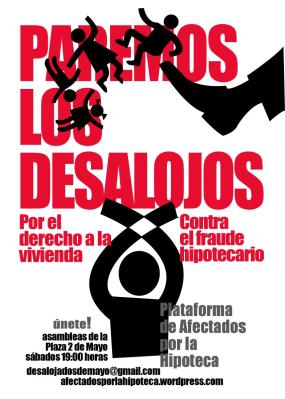
The movement has so far blocked more than 65 evictions, although an average of 175 evictions a day were carried out in Spain in the first quarter of 2011 as a result of the real estate bust. Due to the economic crisis, thousands of people have failed to keep up on their mortgage payments and have been forced out of their homes under a law “that shamefully protects banks and leaves citizens completely defenceless.
The 15-M set up camps outside the health centres, where they demonstrated alongside health professionals, neighbourhood associations and health consumers.
On Sunday Sep. 18, the “indignados” poured onto the streets of Spain’s largest cities to protest the reduction of budgets for public services, demanding the right to health care and quality education.
Chanting slogans like “divert military spending to schools and hospitals” and “less corruption, more education”, hundreds of people responded to the 15-M’s calls to march through the streets of Málaga behind a huge banner reading “free quality public health care and education for all”.
In Catalonia, hundreds of health clinics and wings of hospitals have been closed; in Castilla-La Mancha in central Spain hundreds of pharmacies went on strike to protest the non-payment of bills by the government health authority; and in Madrid, teachers protested cuts in education, a 15-M statement says.
A deep change of attitudes to Gays and Lesbians is slowly percolating through the Indian subcontinent. Now helped on by the new UN gay rights declaration.
In 2009, British colonial law dating back more than 150 years ago that held same-sex relationships as ‘unnatural’, was overturned by the Delhi High Court, responding to a clamour for change from gay rights activists and members of civil society.
“A level of dialogue around sexuality began after the Delhi High Court ruling,” Magdalene Jeyarathnam, founder-director of the Centre For Counselling in southern Chennai city, told IPS. “There has been a surge in the number of young people who have come out over the past couple of years.”
“I see this movement gaining power, strength and momentum with each passing day,” she added. Pawan Dhall, director of the Kolkata-based NGO ‘Solidarity and Action Against the HIV Infection in India’ which pioneered a sensitisation movement on gay rights in the late 1990s, said the country’s top campuses are in fact leading gay rights activism.
In Kolkata, a group called ‘Students against Campus Homophobia’ is active in the city’s Jadavpur University (JU), well known for its liberal ambience as well as academic excellence. JU already offers ‘Queer Studies’ as an optional subject at the post-graduate level in its English department.
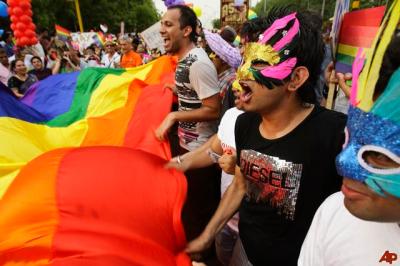
Kolkata also hosted the first Gay parade in India in 2003. The ‘Rainbow Walk’ is now an annual feature and other metros like New Delhi and Mumbai have followed.
Gay rights activism and awareness followed the AIDS awareness campaigns that were launched in the country in the 1990s and quickly caught the imagination of the country’s vibrant media.
“We have been fighting for a rights-based approach and inclusiveness from the 1990s. Today, it is heartening to see some change coming our way,” says Malobika, founder-member of ‘Sappho’, a forum for lesbians in Kolkata. She had to flee the town with her partner in the 90s under family pressure.
GENEVA – The United Nations endorsed the rights of gay, lesbian and transgender people for the first time ever Friday, passing a resolution hailed as historic by the U.S. and other backers and decried by African and Islamic countries.
The declaration was cautiously worded, expressing “grave concern” about abuses suffered by people because of their sexual orientation, and commissioning a global report on discrimination of gays. But activists called it a remarkable shift on an issue that has divided the global body for decades, and credited the Obama administration’s push for gay rights at home and abroad with helping win support for the resolution.
Gay rights percolating through Indian sub-continent
“This represents a historic moment to highlight the human rights abuses and violations that lesbian, gay, bisexual, and transgender people face around the world based solely on who they are and whom they love,” U.S. Secretary of State Hillary Rodham Clinton said in a statement.
Following tense negotiations, members of the Geneva-based U.N. Human Rights Council narrowly voted in favor of the declaration put forward by South Africa, with 23 votes in favor and 19 against.
Backers included the United States, the European Union, Brazil and other Latin American countries.
Those against included Russia, Saudi Arabia, Nigeria and Pakistan.
China, Burkina Faso and Zambia abstained, Kyrgyzstan didn’t vote
Entre cincuenta y setenta personas permanecen a las puertas de la Bolsa de Barcelona tras haber pasado allí la noche para protestar contra lo que denominan “golpe de Estado” de los mercados financieros, sumándose a una iniciativa mundial.
Tras participar en una manifestación mltitudinaria convocada en el centro de la ciudad en defensa de los servicios públicos, decidirán si siguen concentrados, explicó a Efe un portavoz de los concentrados.
A lo largo del día de hoy, los jóvenes organizaron diferentes actividades y charlas, relacionadas con la crisis económica, el sistema político y las posibles medidas que se pueden adoptar.
A media tarde partirán hacia la céntrica plaza de Cataluña para participar en una manifestación convocada por el movimiento 15-M de los “indignados” y otros colectivos en defensa de los servicios públicos y de la sanidad, y en contra de los recortes decididos por la administración.
 Here in Spain things are hotting up, as more and more people lose their jobs.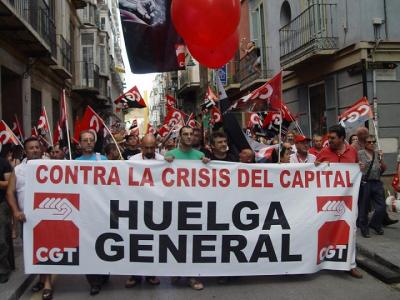


 The Free