No Life!? Study finds only 2 of 1,546 exoplanets not subject to atmosphere stripping from their stars’ magnetic fields

These were K2-3 d and Kepler-186 f, two Earth-sized exoplanets 144 and 579 light-years from Earth (respectively).

from thefreeonline on by Matt Williams at Universe Today (on Telegram: t.me/thefreeonline)

Earth’s magnetosphere is the region defined by our planet’s magnetic field. Image Credit: NASA

Planetary Habitability Depends on its distance from its Star’s Magnetic Field

The extrasolar planet census recently passed a major milestone, with 5500 confirmed candidates in 4,243 solar systems. With so many exoplanets available for study, astronomers have learned a great deal about the types of planets that exist in our galaxy and have been rethinking several preconceived notions.

These include the notion of “habitability” and whether Earth is the standard by which this should be measured – i.e., could there be “super habitable” exoplanets out there? – and the very concept of the circumsolar habitable zone (CHZ).

In a recent study, a team from Rice University extended the definition of a CHZ Habitable Zone of a planet to include its star’s magnetic field.

Traditionally, astronomers have defined habitable zones based on the type of star and the orbital distance where a planet would be warm enough to maintain liquid water on its surface. But in recent years, other factors have been considered, including the presence of planetary magnetic fields and whether they get enough ultraviolet light.

In a recent study, a team from Rice University extended the definition of a CHZ to include a star’s magnetic field.

Their findings could have devastating implications in the search for life on other planets (aka. astrobiology).

The paper describing their findings, “Exploring the Effects of Stellar Magnetism on the Potential Habitability of Exoplanets,” appeared on July 9th in The Astrophysical Journal.

Artist’s impression of exoplanets orbiting different types of stars. Credit: NASA/W. Stenzel

On Earth, the presence of an intrinsic magnetic field has been vital to the emergence and evolution of life as we know it. Without it, our atmosphere would have been stripped away long ago by energetic particles emanating from the Sun – which was the case with Mars. In addition to Earth’s atmosphere, our planet’s magnetic field ensures that a limited amount of solar radiation and cosmic rays reach the surface.

For this reason, astrobiologists consider a planetary magnetic field essential for determining whether or not an exoplanet is habitable.
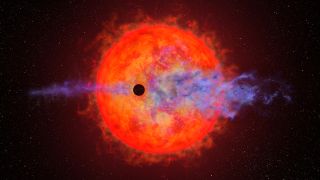
A fiery red dwarf star is seen in the background. In the foreground, a tiny black orb transits in front. Around the black orb is a purple hazy atmosphere that's blowing away on either side.

An illustration shows the atmosphere of a planet being blown away by its star, destroying the conditions needed for life. (Image credit: NASA, ESA, Joseph Olmsted (STScI))

Another factor is how the strength of a planet’s magnetic field and its interaction with its parent star’s magnetic field affect habitability.

Not only does an exoplanet require a strong field to shield it against stellar activity (solar flares, etc.), but it must also orbit far enough to avoid a direct magnetic connection with its star.

The magnetic field of a planet must be strong enough to shield it from the bombardment of charged particles coming from its star, yes, but it must also be far enough away from this stellar magnetic field to avoid direct contact and prevent a powerful event called “magnetic reconnection” from occurring.

The magnetic interactions between planets and their parent stars are known as “space weather.” For their study, the team examined 1,546 exoplanets to determine if they orbited inside or outside their host star’s Alfvén radius – the distance where stellar wind decouples from the star.

This consisted of characterizing the stars’ activity known using their Rossby number (Ro) – the ratio between a star’s rotational period to their convective turnover time.

Planets orbiting within this radius would directly interact magnetically with the star’s corona, leading to significant atmospheric stripping, ruling them out as viable candidates for habitability. This phenomenon has been observed with TRAPPIST-1 and its system of seven exoplanets.

After examining all the exoplanets in their study, they found that only two planets met all the conditions for potential habitability.

*Note that the 1546 planets in the study could only be chosen because their rotation details (Convective Turnover Time) are known – not due to their distance from Earth- So suitable planets for life may still be found comparatively nearby. There are an estimated 100 billion planets in the Milky Way Galaxy.

However many exoplanets more easily found are with red dwarf stars, which could mean that they must be close to their stars to be warm enough for life, but therefore likely inside the atmosphere stripping Alfvén radius?. * ..(Blogger)

These only 2 definitely suitable planets were K2-3 d and Kepler-186 f, two Earth-sized exoplanets 144 and 579 light-years from Earth (respectively).

At 13km/s, it would take about 12 million years to get to Kepler-186 f .

K2-3 d is a super Earth exoplanet that orbits an M-type star. Its mass is 2.2 Earths, it takes 44.6 days to complete one orbit of its star, and is 0.2014 AU from its star. Its discovery was announced in 2015.

Illustration of Kepler-186f, a recently-discovered, possibly Earthlike exoplanet that could be a host to life. Scientists could use this one or one like it to measure planetary entropy production as a prelude to exploration. (NASA Ames, SETI Institute, JPL-Caltech, T. Pyle)
Illustration of Kepler-186f, a possible Earth-like exoplanet that could be a host to life. Credit: NASA Ames, SETI Institute, JPL-Caltech, T. Pyle

Kepler-186f is inside the CHZ habitable Zone and outside its star’s Alfvén radius thus avoiding atmosphere stripping.

It is believed to be slightly larger than Earth and to have a similar composition to it. It is not known whether the planet has an atmosphere, but if it does, its position in its star system’s habitable zone means that it could potentially have oxygen and liquid water and thus be able to support life .

Both planets orbit within their stars’ CHZ, and lie outside their Alfvén radius, and have strong enough magnetic fields to protect them from stellar activity.

“While these conditions are necessary for a planet to host life, they do not guarantee it,” said Atkinson. “Our work highlights the importance of considering a wide range of factors when searching for habitable planets.”

These findings highlight the need for continuous observation when studying exoplanet systems and considering what factors have led to the emergence of life here on Earth. They are also indicative of current efforts among astronomers and astrobiologists to refine the definition of “Habitable Zone” and create a more nuanced understanding. In so doing, this research could help refine the search for extraterrestrial life by allowing scientists to further constrain where they should be looking.

Further Reading: Rice University, The Astrophysical Journal

The team’s research was published on July 9 in The Astrophysical Journal.

*********************************************

Newly Discovered Planet In Pisces Constellation By UK Scientists Claim It Can Support Human Life
by: True Activist Posted on July 25, 2024 https://trueactivist.com/newly-discovered-planet-in-pisces-constellation-by-uk-scientists-claim-it-can-support-human-life-t1/

***************************************************

Why is violence against women only getting worse? The answer doesn’t lie with Andrew Tate

By Gaby Hinsliff We are no closer to understanding why some men hate women so viciously – but we can transform how misogyny is policed Natalie Fleet was only 15 when she got pregnant by an older man. At the time, she says she didn’t really know how to describe what was happening; didn’t see […]

Why is violence against women only getting worse? The answer doesn’t lie with Andrew Tate

Why is violence against women only getting worse? The answer doesn’t lie with Andrew Tate

By Gaby Hinsliff We are no closer to understanding why some men hate women so viciously – but we can transform how misogyny is policed Natalie Fleet was only 15 when she got pregnant by an older man. At the time, she says she didn’t really know how to describe what was happening; didn’t see […]

Why is violence against women only getting worse? The answer doesn’t lie with Andrew Tate

Commemorating death of Nestor Makhno

Nestor Makhno died on July 25th, 1934. A committed anarchist communist all of his life, he suffered prison, where he contracted the TB that finally killed him, many wounds which left his body scarred in many places, and exile and poverty, yet he stuck to his ideas. “The freedom of any individual carries within it […]

Commemorating death of Nestor Makhno

Obituary: James C. Scott had a huge influence on SE Asian, agrarian, and anarchist studies

from thefreeonline James C. Scott (1936-2024) 25/7/24 by FreedomNews (on Telegram t.me/thefreeonline)

James C. Scott, Farmer and Scholar of Anarchism

A prolific scholar, he had a monumental influence on Southeast Asian, agrarian, and anarchist studies

Researcher and author James C. Scott passed away in his Connecticut home on July 19. He was 87 years old. His seminal works include The Moral Economy of the Peasant, Weapons of the Weak, Domination and the Arts of Resistance, Seeing Like a State, The Art of Not Being Governed, Two Cheers for Anarchism, and Against the Grain.

Seeing Like a State by James C. Scott – Audiobook

Scott grew up in New Jersey, receiving a Quaker education. The Quaker social gospel and week-long work camps at homeless shelters, prisons and the like made a deep impression on his worldview and politics. At Williams College he was studying Political Economy with a focus in Economics but fell in love in his senior year and was distracted from his studies.

When he went to defend his baccalaureate thesis his advisor rejected his work. Forced to find a new sponsor, he happened upon the door of economist William Hollinger, who was curious about the economic development of Burma (Myanmar).

He became an advisor to Scott, who after finishing his BA applied to the Graduate Program in Economics at Yale. Scott had an opportunity to visit North Africa that summer which conflicted with taking the calculus course, causing his transfer to the Political Science department.


Scott decided that in order to call himself a ‘peasantist’ he needed to actually engage in ethnographic fieldwork — a move his fellow political scientists thought was career suicide at worst, and a waste of time at best.

Continue reading “Obituary: James C. Scott had a huge influence on SE Asian, agrarian, and anarchist studies”

How to Change Everything – Rewriting the Fairy Tale of Capitalism – key Monbiot Interview /Trailer/ Book link-

from thefreeonline on 25th July 2024 George Monbiot, interviewed by The Ink( on Telegram:t.me/thefreeonline )

Ebook HERE… Invisible Doctrine – The Secret History of Neoliberalism

GM: Let’s start with capitalism. It’s often portrayed as if it were some kind of natural law, a basic property of human relations. It is nothing of the kind. Capitalism is a very particular form of economic organisation, which, following the work of the geographer Jason Moore, we date to the island of Madeira in roughly 1450.

(Trailer) THE INVISIBLE DOCTRINE: The Secret History of Neoliberalism (& how it came to control your life) -https://vimeo.com/828431285

This was arguably the first time and place in which land, labour and money were simultaneously commodified. The success of the Portuguese colonists, the first capitalists, set in train a particular mode of extreme and rapid exploitation, which led simultaneously to the explosion of colonial seizure and to the cascading collapse of ecosystems. We define capitalism as follows:

“Capitalism is an economic system founded on colonial looting. It operates on a constantly shifting and self-consuming frontier, on which both state and powerful private interests use their laws, backed by the threat of violence, to turn shared resources into exclusive property, and to transform natural wealth, labour and money into commodities that can be accumulated.”

FIND US ON: FACEBOOK FILM FREEWAY

Capitalism expanded with few constraints in its early centuries. Its advocates demanded that governments “laissez-nous faire”: leave us alone. But then it ran into a problem, a problem it has sought to solve ever since: democracy.

When most adults got the vote, they sought to use it to improve wages and labour conditions, demand a greater share of productivity gains, and make other outrageous requests, such as not poisoning the air and rivers, adulterating food or charging extortionate rents.

They even went so far as to demand the redistribution of wealth, effective public services and an economic safety net. Neoliberalism was hatched as a means of solving the problem of democracy.

Continue reading “How to Change Everything – Rewriting the Fairy Tale of Capitalism – key Monbiot Interview /Trailer/ Book link-“

‘Contamination Crisis’: US Pesticides Contain PFAS, Endangering Food and Water / by Edward Carver

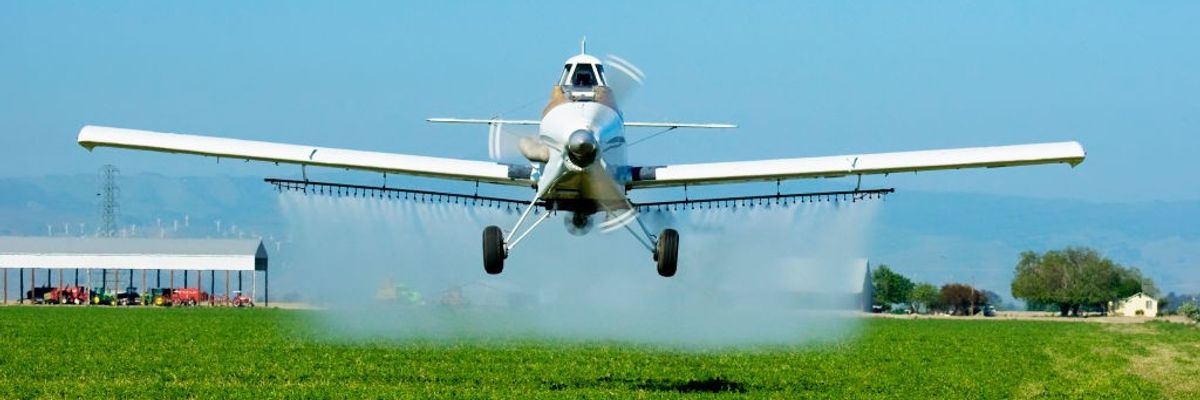
A crop duster flies low while spraying a field in California in 2023. (Photo: Bill and Brigitte Clough/Design Pics Editorial/Universal Images Group via Getty Images) “This is truly frightening news,” the author of a new study said. “Lacing pesticides with forever chemicals is likely burdening the next generation with more chronic diseases and impossible cleanup […]

‘Contamination Crisis’: US Pesticides Contain PFAS, Endangering Food and Water / by Edward Carver