Once the favored child of the establishment, Greta Thunberg has been dropped by the global elite.
A MintPress News study finds that coverage of Thunberg in The New York Times and Washington Post has dwindled from hundreds of articles per year to barely a handful, precisely as she widens her focus from the environment to the capitalist system that is causing climate breakdown, and the Israeli attack on Gaza, which the Swedish activist has labeled a “genocide.”
Not Your Puppet
Greta Thunberg was once a media darling. Organizing a climate strike at her local school when she was just fifteen, she shot to fame and was quickly embraced by the establishment.
In 2019, she was invited to the European Union Parliament and received a standing ovation from the politicians and diplomats in attendance.
She also spoke in front of the British government. Yet even as she told them that they were a pack of “liars” responsible for “one of the greatest failures of humankind,” the young Swede was applauded in a patronizing manner.
Then Environmental Secretary Michael Gove admitted being moved by her words, stating, “When I listened to you, I felt great admiration, but also responsibility and guilt. I am of your parents’ generation, and I recognize that we haven’t done nearly enough to address climate change and the broader environmental crisis that we helped to create.”
Her message of the urgent need to address the impending climate crisis was one that was palatable to authorities, who attempted to co-opt her with access and accolades.
In 2019, despite being only 16 years old, she won the Swedish Woman of the Year award and was named by Forbes magazine as one of the world’s 100 most powerful women.
Time magazine even awarded her its prestigious Person of the Year, for, in their words, “sounding the alarm about humanity’s predatory relationship with the only home we have,” “bringing to a fragmented world a voice that transcends backgrounds and borders,” and for “showing us all what it might look like when a new generation leads.”
While conservatives were hostile to her from the start, more liberal institutions showered her with attention and praise.
The New York Times, for example, described her as “a modern-day Cassandra for the age of climate change,” and noted that her work had “inspired huge children’s demonstrations” across the planet.
Yet Thunberg refused to be turned into a mascot for the elites, and the co-optation failed.
As a result, coverage of her in elite media outlets has plummeted to almost nothing, even as she continues to fight for global causes and risks her life trying to break the illegal blockade of Gaza……
“.. Did Epstein sell Israel the tapes of his pedophile island where the whole Western Elite flocked to party, including, says Musk, Donald Trump?. which would explain why they all ‘approve’ the Gaza Genocide “
Both Trump and Musk continue paying and supporting the Genocide of the indigenous Palestinians by the terrorist theocratic Israeli State
Trump-Musk Big Bro bust-up: Ignore the noise, focus on the signal… When the 2 most powerful andwealthy men on Earth swop criminal revelations, what does it say about their country?
Two very rich and very powerful and very big American egos have had a very public and very loud cat fight.
US President Donald Trump, arguably the single most powerful politician in the world, and his now former “buddy-in-chief” Elon Musk, certifiably the single richest oligarch on (for now) this planet, have “torched” (Wall Street Journal) their occasionally exuberant bromance of almost a year in a “stunning” (Bloomberg) and “spectacular” (New York Times) finale of fiery mutual recrimination.
Say what you will about oligarchic techno-capitalism, but it can be entertaining.
Using their own social media platforms, Musk and Trump have gone after each other with brutal reputational attacks, griping of the “You owe me!” – “No, you me!” variant, and high-value threats to do each other economic and political damage.
MEANWHILE.. on the streets:
On June 3, a crowd drove federal agents out of Minneapolis following an attempted raid. On June 4, people confronted ICE in Chicago and Grand Rapids. Today, there are clashes with ICE in Los Angeles.Trump has signed a memorandum deploying 2000 National Guard to Los Angeles—the next step in his power grab…. Stand up in solidarity. https://crimethinc.com/posters/the-border-is-everywhere
Musk claims that he is greatly concerned over America’s exploding and unsustainable national debt.
Since Trump’s Republican majority in the Senate is small, Musk’s open support for the bill’s vocal opponents there is a real political embarrassment for the White House at least, if not even a serious threat.
US sovereign debt, moreover, is a real and very serious problem with dire economic and geopolitical implications; and estimates put the costs of Trump’s bill at 3.3 trillion additional debt over the next ten years: Musk has a factual point.
Yet there also is the fact that Trump’s Big Beautiful Bill foresees cutting subsidies for buying Musk’s Tesla cars (among other EVs), amounting to an estimated loss of $1.2 billion for Tesla.
It can be complicated in that place between conservative ideology, pure and simple, and the unrelenting will to milk the public for yourself and your shareholders.
Musk also “revealed” – if that is the word – that Donald Trump features on the client list of the sinister financier, pedophile, mass sex criminal, and most likely intelligence-connected elite blackmailer Jeffrey Epstein, who conveniently committed suicide in a Manhattan jail in 2019.
To make it count, Musk, as if returning to his former Centrist political self, suggested impeaching Trump and founding a new party to contest the great blusterer’s grip on “the 80% in the middle.
Trump shot back by warning Musk that his “billions” in government contracts could melt away like the snows of yesteryear,
Which made Musk threaten to stop carrying US astronauts into orbit, that is, in effect – since the volatile oligarch is America’s de facto monopolist – shut down space for the US.
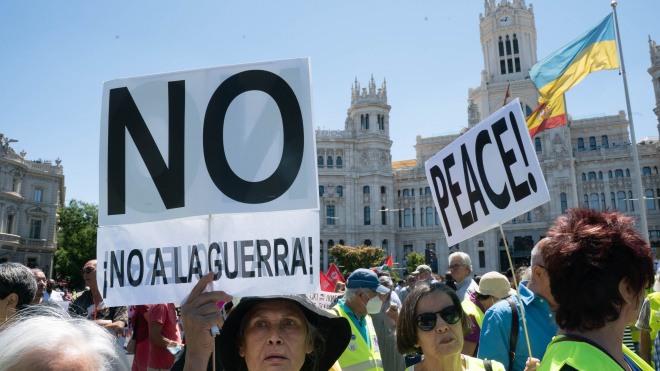
Por: Jorge Sánchez Miles de personas saldrán a las calles para denunciar la creciente militarización promovida por la Unión Europea y la OTAN, en el marco de una política de escalada bélica que desvía recursos públicos hacia el gasto militar.
En España, el gobierno del PSOE y Sumar ha anunciado un aumento repentino de 10.000 […]
“He’s really gone and done it this time. Now everyone can see what a disaster he is.” How many times have we heard this about Donald Trump? And how many times has it been proved wrong?
“From 2019 to 2023, inflation-adjusted household income fell, and the poverty rate rose.” GDP and social improvement are no longer connected.
Well, maybe this time he really has overstepped. After all, his clowning around with tariffs, sparking trade wars, then suddenly reversing his position, could provoke a global recession, perhaps even a depression.
\Surely his supporters will disown him? But I’m not banking on it, and this is why.
Already, Trump has waged war on everything that builds prosperity and wellbeing: democracy, healthy ecosystems, education, healthcare, science, the arts. Yet, amid the wreckage, and despite some slippage, his approval ratings still hold between 43 and 48%: far higher than those of many other leaders. Why? I believe part of the answer lies in a fundamental aspect of our humanity: the urge to destroy that from which you feel excluded.
This urge, I think, is crucial to understanding politics. Yet hardly anyone seems to recognise it. Hardly anyone, that is, except the far right, who see it all too well.
In the US, a high proportion of the population is excluded from many of the benefits I’ve listed. Science might lead to medical breakthroughs, but not, perhaps, for people who can’t afford health insurance. A university education might open doors, but only if you’re prepared to carry tens or hundreds of thousands of dollars of debt. Art and theatre and music improve our lives: good for those who can buy the tickets. So do national parks, but only if you can afford to visit them.
Democracy, we are told, allows people a voice in politics. But only, it seems, if they have a few million to give to a political party. As the political scientist Prof Martin Gilens notes in his book Affluence and Influence: “Under most circumstances, the preferences of the vast majority of Americans appear to have essentially no impact on which policies the government does or doesn’t adopt.” GDP growth was strong under Joe Biden, but as the economics professor Jason Furman points out: “From 2019 to 2023, inflation-adjusted household income fell, and the poverty rate rose.” GDP and social improvement are no longer connected.
All those good things? Sorry, they’re not for you. If you feel an urge to tear it all down, to burn the whole stinking, hypocritical, exclusive system to the ground, Trump is your man. Or so he claims. In reality his entire performance is both a distraction from and an accelerant of spiralling inequality. He can hardly lose: the more he exacerbates inequality, the more he triggers an urge for revenge against his scapegoats: immigrants, trans people, scientists, teachers, China.
But such killer clowns can’t pull this off by themselves. Their most effective recruiters are centrist parties paralysed in the face of economic power. In hock to rich funders, terrified of the billionaire media, for decades they have been unable even to name the problem, let alone address it. Hence the spectacular uselessness of the Democrats’ response to Trump. As the US journalist Hamilton Nolan remarks: “One party is out to kill, and the other is waiting for its leaders to die.”
In the UK, Labour, like the Democrats, has long assured itself that it doesn’t matter how wide economic disparities are, as long as the poorest are raised up. Now it has abandoned even that caveat: we can cut benefits, so long as GDP grows.
But it does matter. It matters very much. A vast array of evidence, brought together in 2009 in The Spirit Level by Richard Wilkinson and Kate Pickett and updated in 2024, shows that inequality exerts a massive influence on social, economic, environmental and political outcomes, regardless of people’s absolute positions.
If there is a such a thing as Starmerism, it collapses in the face of a paper published by the political scientists Leonardo Baccini and Thomas Sattler last year, which finds that austerity increases support for the radical right in economically vulnerable regions.
Austerity, they found, is the key variable: without it, less-educated people are no more likely to vote for rightwing demagogues than highly educated people are. In other words, Keir Starmer and Rachel Reeves are busily handing their core constituencies to Nigel Farage’s far right.
Of course, they deny they’re imposing austerity, using a technical definition that means nothing to those on the sharp end. Austerity is what the poor experience, while they must watch the rich and upper middle classes, under a Labour government, enjoy ever greater abundance.
Starmer and his minions suggest there’s nothing they can do: wealthy people are already taxed to the max. As private jets and helicopters cross the skies, anyone can see this is nonsense.
Of all the remarkable things I stumbled across while researching this column, the following is perhaps the most jaw-dropping. On the most recent (2022) figures, once benefits have been paid, the Gini coefficient for gross income in the UK scarcely differs from the Gini coefficient for post-tax income.
In other words, the gap between the rich and the poor is roughly the same after taxes are levied, suggesting that taxation has no further significant effect on income distribution. How could this possibly be true, when the rich pay higher rates of income tax?
It’s because the poor surrender a much higher proportion of their income in sales taxes, such as VAT. So much for no further options. So much for Labour “realism”.
The one thing that can stop the rise of the far right is the one thing mainstream parties are currently not prepared to deliver: greater equality. The rich should be taxed more, and the revenue used to improve the lives of the poor. However frantically centrist parties avoid the issue, there is no other way.
On Sunday morning at dawn, Palestinians from southern Gaza headed to the aid distribution point in Rafah run by the Gaza Humanitarian Fund (GHF), the U.S. contractor tasked with delivering aid to Palestinians instead of the UN.
Once thousands of aid-seekers arrived at the al-Alam area of Rafah’s Tal al-Sultan neighborhood, the Israeli army opened fire on the crowds, according to eyewitnesses who spoke to Mondoweiss.
As throngs of people waited outside the aid site in the early morning hours, waiting for the instructions of the American employees, eyewitnesses described an Israeli quadcopter drone hovering overhead and ordering them via loudspeaker to enter the fenced delivery site at 6:00 a.m.
After hundreds of people had entered, soldiers opened fire on the crowd, killing 75 people at the Rafah aid site and wounding a total of 400 others across aid distribution sites, Gaza’s Ministry of Health said in an updated statement on Monday.*
And by today, 3rd June, another 27 people have been murdered. The attacks come amid international criticism of the US-Israeli aid plan in Gaza, with Médecins Sans Frontières condemning it as “dehumanizing” and “ineffective,” arguing that the militarization of humanitarian aid under the US-Israeli Gaza Humanitarian Foundation is being used to justify continued military aggression and forced displacement of Palestinians.
In an earlier statement on Sunday, the Health Ministry said that fatalities arriving at Nasser Hospital “had sustained only one gunshot wound to the head or chest,” which the Ministry said “confirms the occupation’s intent to kill civilians.”
Director of Hospitals in Gaza, Muhammad Zaqout, said at a press conference in front of Nasser Hospital on Sunday in Khan Younis that the injured had arrived at the medical compound in animal-drawn carts or were carried on people’s shoulders due to the Israeli army’s prevention of ambulances from reaching the aid site.
As vociferously anti-colonial as Indonesia has been, it is nothing but colonial in its attitude toward Papua. Institutional racism, mistreatment of ethnic and religious minorities, media blackouts, internet shutdowns and policies that have long neglected the needs and interest of the local community have fueled a long-running insurgency that Jakarta has been unable to quell.
In #WestPapua, on illegally colonised and disputed land taken by violence from Melanesian Indigenous peoples last century by Indonesian forces, authorities label indigenous lands as “empty”. This is done in order to justify large-scale agricultural projects, displacing tribes like the #Malind and Khimaima peoples. These lands are vital sources of food and medicine, supporting traditional ways of life for several millennia. Communities and indigenous rights advocates call for halting exploitative #palmoil and #mining projects and honouring #LandRights#HumanRights#IndigenousRights#BoycottPalmOil
Representatives of Indigenous People from Merauke protested against the massive food estate project that affecting their territory in Jakarta, December 2024. Photo: Pusaka
The narrative of “empty land/unproductive forest” or “no forest/no trees” is often used by authorities to negate and delegitimize the existence of indigenous communities and the surrounding natural environment. Most recently, it was used by Hashim Djojohadikusumo, President Prabowo Subianto ’s younger brother, when addressing executives of the Indonesian Chamber of Commerce and Industry (Kadin) in December.
This narrative is painful for the people of Merauke in Papua, a site of the government’s food estate project. It reflects an attempt to roll out the red carpet for private corporations to develop monoculture plantations and massive food and energy industrial complexes, often obliterating the interests of indigenous peoples and local residents in the process with the state’s backing.
The status of national strategic project (PSN) was given unilaterally to these developments by former president Joko “Jokowi” Widodo in 2024. Yet, the idea of monetizing parts of Papua was first proposed in 2010, when president Susilo Bambang Yudhoyono established the Merauke Integrated Food and Energy Estate, which later failed.
Living with the local people engenders empathy for their daily fear of state authority creating a situation in which they do not belong, yet are too afraid to be involved. It is a process of ecological expropriation and extirpation of the lives of both indigenous and local communities in and around forest areas. The end results are the expansion of extractive industries, the seizing of power and control over resources that reap profits for a handful of people and do nothing for the interests of farmers or indigenous Papuans.
Expropriation is an action by government to take over the assets of individuals or organizations, in part or in whole, with or without compensation. Extirpation, on the other hand, is a unilateral act to eliminate or destroy something completely.
Press release: Stop food estate plans in Papua 18 November 2024Benar News….. Ten civil society organizations (CSOs) members of Civil Society Coalition Against Food Estate in Papua strongly reject President Jokowi’s plan to develop a food estate with an area of 2,052,551 ha.
At the time of writing, the land of Merauke’s villagers has been pegged as a new colony. Thousands of hectares of land, both forests and lowland swamps are being destroyed and drained, and then replaced with new industrial commodities.
Indonesians have experienced many failures in implementing the idea of so-called food estates since the Soeharto era, but the Prabowo administration does not seem to have learned anything. What past attempts have left behind are abandoned land and forests controlled by corporations, as well as complex and unresolved land and social conflicts.
One can pose many questions about the real motives when the food estate narrative can no longer mask the ugly reality. Where do the logs harvested from forests go? Who oversees their transport? What is the status of land rights? How was the land seized? What is the purpose of having a bold military presence in Merauke, where local Papuan resistance has diminished over the past two decades at least?
We need to consider the following facts.
The land in Merauke regency for the food estate project spanning more than 2 million ha that Hashim referred to is not empty land. It is customary land that belongs to the Malind, Maklew, Yei and Khimaima indigenous tribes, which have neither been recognized nor received their tenure rights from the state. More than 40,000 indigenous people, or around 80 percent of Merauke’s indigenous population, will be affected by the food estate project.
These tribes rely on the forest as their main source of livelihood. They go into the forest every day to harvest sago as their main food staple, hunt animals and harvest vegetables, even to look for medicinal plants. Now they are not free to enter and leave the forest due to hunting prohibition markers and security patrols.
The involvement of indigenous peoples in the project is minimal, represented only by a few formal institutions and certain individuals. Local administrations, at both the provincial and district/city levels, cooperate in implementing the project that was decided by the national government and ignores the rights of indigenous peoples. Local opposition to the project continues through demonstrations in Merauke and Jakarta.
Revealed: Government officials say permits for mega-plantation in Papua were falsified… Indonesian government have alleged that permits underpinning a multi-billion dollar plantation project in Papua were falsified. The land is being opened up by investors whose identity is hidden behind anonymously owned companies, as part of a plan to develop an oil palm plantation almost twice the size of London in the remote region. …29/10/2020
The Pusaka Bentala Rakyat foundation reviewed the development of the Merauke food estate and observed that the establishment of rice fields, sugarcane plantations and bioethanol production facilities converts and uses large forest areas by ignoring provisions on environmental and technical requirements, including strategic environmental studies.
A study by the Center of Economic and Law Studies (CELIOS) found that Indonesia could potentially double its emissions by simply running the mega food estate project in Merauke, undermining the country’s aim to achieve net-zero emissions. Meanwhile, Forest Watch Indonesia (FWI) revealed that in the past year, forest damage in South Papua increased more than twofold to 190,000 ha, or almost three times the size of Jakarta.
Regardless of the local people’s opposition, the project continues to move forward. The deployment of five battalions comprising 3,455 military personnel in South Papua is an indication of how much the government wants the project to go ahead. The involvement of the Indonesian Military (TNI) has the potential to threaten and eliminate the right to life of the Papuan people and worsen human rights violations, violence and arbitrariness, violating the Constitution, laws and regulations.
Merauke is part of the Trans-Fly Savanna and Grasslands ecoregion, an area rich in endemic freshwater biota that is located on the south coast of the island of New Guinea. It is the largest seasonal wetland area on New Guinea. South Papua has various ecosystems, including seasonal forests, swamplands and marine conservation areas. the World Wide Fund For Nature (WWF) describes this landscape as “the natural gem of Asia-Pacific”.
Indonesia’s massive sugar-bioethanol project in South Papua causes locals to fear exploitation Indonesia is going ahead with a project to convert millions of acres in Papua into a gigantic sugarcane plantation to produce bioethanol. But Indigenous communities and environmentalists worry that the project in South Papua’s Merauke regency will lead to land grabs, ecological damage, and the destruction of traditional livelihoods.
Swamps and savannas dominate most of the plains of Merauke, which has a type of soil deemed less fertile for growing food crops.
Musamus University has studied the suitability of the land in Merauke for rice or agroclimate and found that no area fulfills the high suitability criteria. However, more than 50 percent of the region, primarily the western and southern parts of Merauke regency, meets the medium suitability criteria. This means that the region’s capacity for intensive food crop production is still in question.
The writer is the executive director of the Pusaka Bentala Rakyat foundation, an NGO focusing on environmental justice and indigenous people’s rights.