As news of Noam Chomsky’s failing health makes the rounds, I share some learnings from my interactions with a trailblazing public intellectual whose moral compass has impacted the world
from thefreeonline on 21/6/24 by Beena Sarwar at Sapan News – The Free is now on Telegram: t.me/thefreeonline
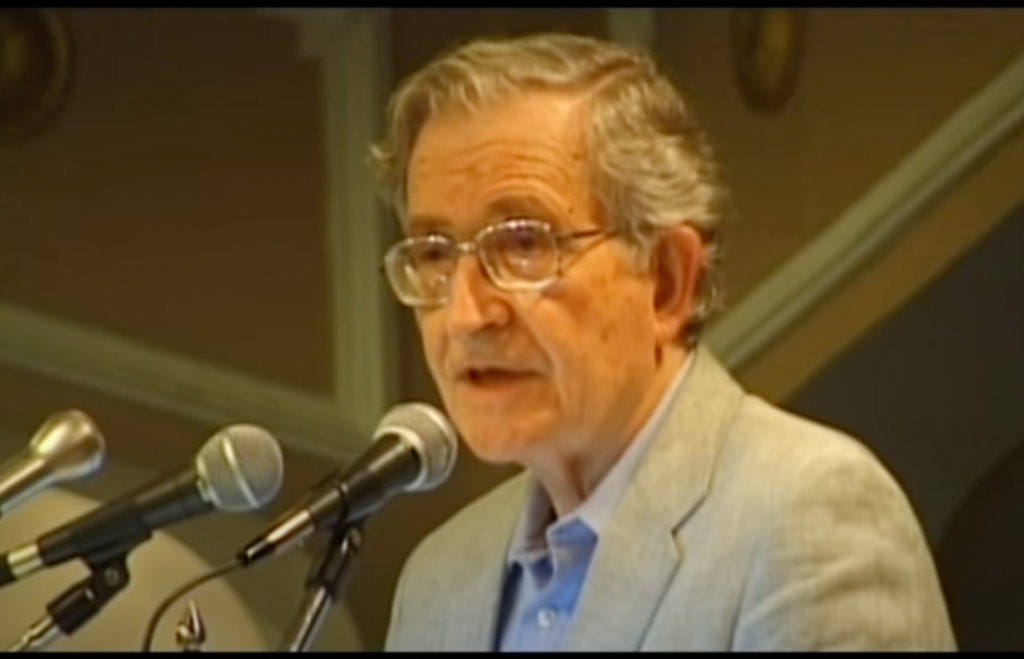
I once asked Noam Chomsky how he manages to remember so many facts and figures and hold audience attention.
He replied that he didn’t convey any new information, that his talks are based on materials already in the public domain, and that he simply joins the dots – providing context – and repeats the information consistently and in different ways.
His response was typical of his humility as well as his courtesy towards a much younger person to whom he owed nothing.
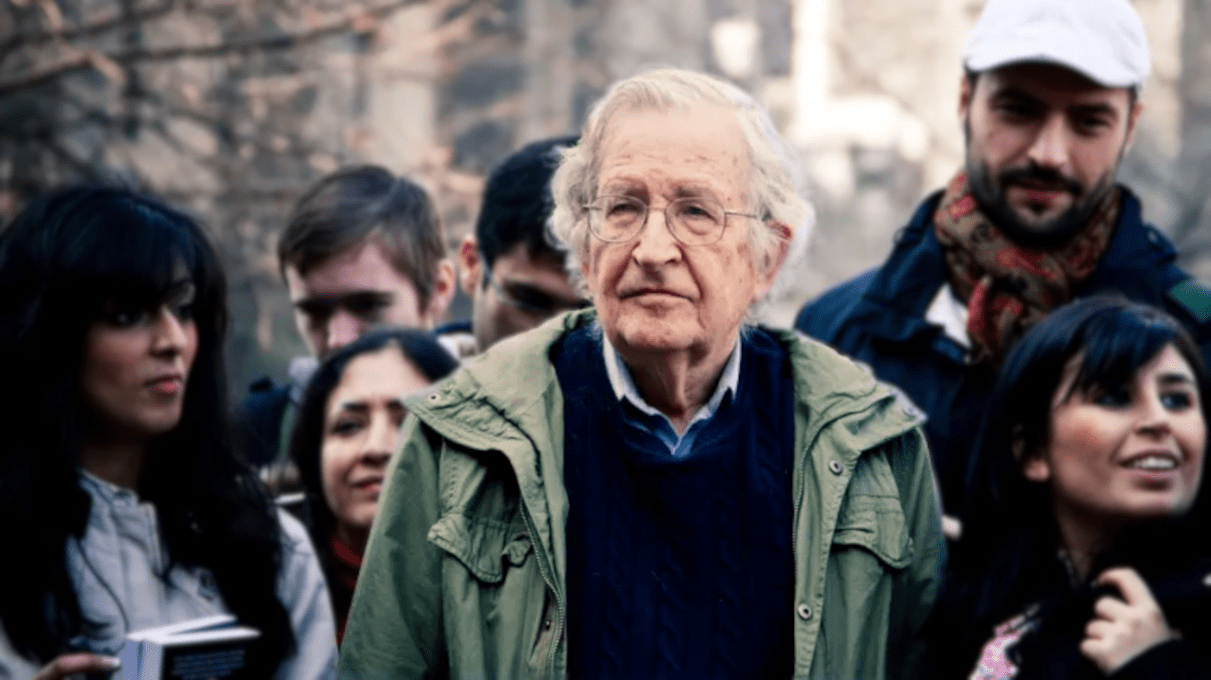
News of Chomsky’s ill health prompts Outpouring of Gratitude for ‘Lion of the Left’ Noam Chomsky is hospitalized in Brazil following a stroke
Chomsky teaches us that it is not necessary to be loud and sensationalist in order to be heard. This, together with the clear and courageous moral compass he has provided over decades, is a most valuable lesson.
The best way we can pay tribute to Noam Chomsky is by following his example: Stand firm, keep calm, keep speaking out, put information in context, and keep doing our work.
Noam Chomsky was already a legend when I first met him over two decades ago in December 2001 when he visited Pakistan for the inaugural Eqbal Ahmad Memorial lecture series.
Dr Eqbal Ahmad had been an anti-Vietnam War activist in the USA in the 1960s. He later taught at Hampshire College and was among Chomsky’s circle of friends, which included other intellectual giants and legendary figures like Howard Zinn and Edward Said.
A Conversation with NOAM CHOMSKY “Bullet dodged or merely delayed: Reflections on the future of democracy, nuclear threat and the looming environmental catastrophe in a post-Trumpian world,»
He had returned to Pakistan after the death of Gen. Ziaul Haq in 1988 and was prominent in the peace and anti-nuclear weapons movements in the region. He passed away in May 1999, on the first anniversary of India’s nuclear test, that Pakistan had followed.
Confronting empire
In November 2001, Chomsky did a lecture series in India. Another fellow-traveller, the well-known physics professor and activist Dr Pervez Hoodbhoy, piggy-backed on that to invite Chomsky to Pakistan for the Eqbal Ahmad Memorial lecture series. These events were organised months earlier, and Pervez was initially worried about whether there would be an audience.
Then the 11 September 2001 attacks in the USA took place. Chomsky cut through America’s outrage to point out that these attacks were historic not for their scale but because of where they took place, mainland America, which had not been attacked before.
Also, this was not the first, but “the second 9/11”. The earlier, “far more serious” 9/11 was the one in 1973, the violent coup against the elected government of Salvador Allende in Chile.
Many in America were uncomfortable with his thoughts but in progressive circles here and around the world, his popularity soared.
I had just returned to Pakistan from London after doing an MA in TV Documentary and wanted to document Chomsky’s visit to Pakistan for an international audience. Pervez agreed to let me record the series, and my Dutch friend Babette Niemel, then at VPRO Television in Holland, fought to get it approved for their ‘Seven Days’ video diary series.
Needing some B-roll, casual footage for the documentary, I had asked the organisers if I could follow Chomsky. They agreed to let me tag along to his room at the Avari Hotel in Lahore with cameraperson Mariam Pasha to escort him to the talk.
Noam Chomsky and his wife Carol had arrived in Pakistan to a celebrity welcome that discomfited them. Now, Chomsky politely conveyed that we were welcome to film his public events but that he and Carol were uncomfortable being followed by the camera.
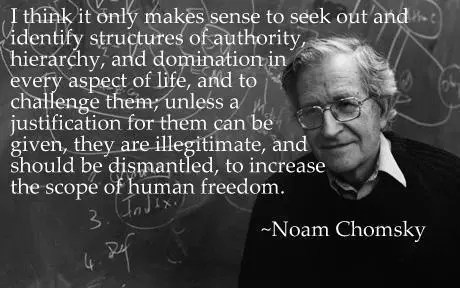
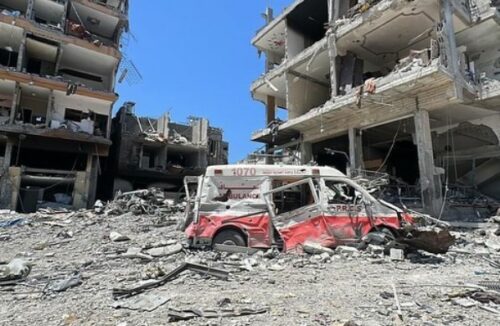
Noam Chomsky: My Visit to Gaza, the World’s Largest Open Air Prison… – Truthout– November 9, 2012– «A defenseless civilian population, trapped, was subjected to relentless attack by one of the world’s most advanced military systems, reliant on U.S. arms and protected by U.S. diplomacy».
We put our equipment away until he entered the venue where he was speaking. He walked through the packed hall to a standing ovation. A few days later, he addressed a larger audience at another packed venue, an indoor stadium in Islamabad.
Continue reading “What I’ve learned from Noam Chomsky-‘he paid the price for his support of the Palestinians’”