His whereabouts were unknown since July 2023 after being sentenced to eight years in prison for his participation in an explosive attack on the Il Bargello bookstore, linked to the fascist group CasaPound, in Florence.
🔥 He has currently been extradited and is in the Rebibbia prison (Rome) where he will be definitively transferred to Florence.
✊🏼 The non-criminalization of any method of struggle used is one of the key points of our organization.
Facing fascism is a duty of the working class, from the #PAB we send all support to him and his environment, we demand his freedom and encourage you to write to him to break the isolation to which they want to subject him.
El mandatario prometió no descansar hasta lograr el regreso de los migrantes “sanos y salvos a Venezuela”.
Como un “evento de agresión contra la migración latinoamericana y caribeña” y “el mayor acto de enemistad” contra los pueblos del continente calificó el presidente venezolano, Nicolás Maduro, la deportación de más de 200 venezolanos a El Salvador, […]
Under an authoritarian regime, we need different protocols for security than we do under capitalist democracy. And in an era of algorithmic policing and surveillance, aboveground and underground might no longer be enough.
Trump’s anti-trans executive orders: What they are and where they stand Mar 5, 2025LGBTQ+ rights attorneys are fighting back. Ten lawsuits have been taken up against the Trump administration’s anti-trans policies so far, and four have resulted in temporary restraining orders that pause enforcement.
As the Nazis marched into the Netherlands to occupy it in 1940, Jaap van Leeuwen started memorizing names. Just earlier that year, he’d started a magazine for gay men called Levensrecht (Right to Life), and he knew, as we know now, that queers are among the first targets for fascism.
So he memorized the names and addresses of every one of the 190 subscribers to the magazine and then burned the list. It’s good that he did—he spent seven months in captivity during the occupation and his home was scoured by the fascists.
He, like so many people living in Europe in the 1940s, led a double life during the occupation so that his resistance activities couldn’t be tracked. He and his friends, though, had a distinct advantage at this: they were used to living double lives—they were gay. They lived one life aboveground, one underground.
When the occupation ended, he wrote down those 190 names and the magazine resumed publication to those who had survived.
Under an authoritarian regime, we need different protocols for security than we do under capitalist democracy. And in an era of algorithmic policing and surveillance, aboveground and underground might no longer be enough. We might need something in between. We might need a version of ourselves that is not as secure as an underground life but is obscure to algorithmic tracking. Between the aboveground and the underground, we need a demiground.
We all know, on some level, what our digital footprints look like. They are reflected back to us as advertising, as recommended songs and videos, as the social media posts that are served up to us, catered to our interests.
In an era where corporations have a distinct set of interests from the state, there might not seem like much danger in volunteering our data to be scraped by companies like Google, Apple, Meta, Spotify, Amazon, and others.
For those of us in the United States at least, though, we are entering an era of outright fascism. Billionaires, representing the tech industries, are lining up behind Trump, more than happy to bend the knee to the state to protect their corporate interests. We are entering an era of automated policing, of algorithmic surveillance. It behooves us to behave accordingly.
For the purpose of this essay, we will distinguish between “secure” and “obscure.” Secure communication is intended to be entirely unreadable by adversaries. Obscure is simply meant to be harder to find and catalog. This is not a guide to a secure, underground life, but instead first notes towards an obscure, demiground life.
This security method proposes imagining our lives (at least our digital lives) divided into three categories. The A life, the B life, and the C life.
Your A life is your aboveground life, one that is easily traced and whose data is routinely fed into algorithmic tracking. This life leaves a huge digital footprint. Your C life is your underground life. It is meant to leave no footprint at all, and is the realm in which any actual crime you might want to commit (such as direct resistance to a fascist state) would take place.
Your B life is your demiground life, where, under an authoritarian regime, most of your socializing and online life ought to probably take place. Here, you will leave some footprints, but not ones that are easily categorized and sorted by machines.
A Life
Your A life (your Algorithm life) includes your lease, your mortgage, your car loans, and all your paperwork. It includes all publicly available social media, certainly including X, Facebook, Instagram, and TikTok (and includes your private accounts, since your data is not private to the companies that run the platforms). You A life includes financial transactions through credit cards or apps like Venmo and Cashapp (and not only transactions visible to the public). Your A life includes all of your rewards cards besides the punch cards at your local cafe. Your A life includes anything you send by unencrypted email, especially gmail. Your A life includes anything you type into google or anything you do in other tabs while you’re signed in to google (unless you use some sort of container to keep it isolated). Your A life builds a profile on you, one that is normally available to advertisers but is likely available to police and the state.
The brighter the light, the deeper the shadows. The purpose of your A life is to shine bright enough to obscures the rest of your activities. The state, reliant on automated profiles, might not notice the activity that is harder to scrape.
It’s useful to have an A life. If someone disappears entirely off of all platforms overnight, that could easily raise red flags to surveillance mechanisms.
For most people and for most purposes, the goal of your A life isn’t to appear squeaky clean and patriotic. Sure, people who are committed to a life of resistance might want to make their aboveground persona as palatable as possible, but in general there a value to having disagreement with the status quo be quite visible. Queers and other marginalized people disappearing from public life is what the fascists want, and I am not in the habit of encouraging people to give the fascists what they want.
C Life
Most people are unlikely to need a C life (your Crime life). Your C life includes everything that you hope is completely untraceable. This essay is not a guide to a C life, to the level of security necessary to act in criminal ways within a modern authoritarian state. At the very least it would require end-to-end encryption with disappearing messages and/or meeting in person without phones present, but there is far more to evading the modern state when it is actively searching for you. I have never done so and have no advice here.
B Life
I wasn’t able to come up with something cute that “B life” would stand for, unfortunately, but it is the primary subject of this essay. The purpose of the B life, the demiground, is to live as full and normal of a life as possible while controlling and limiting your digital footprint.
In order to populate the demiground, we need to make it as inviting as possible. It needs to be clear that not only is there political value in being obscure to the state, but that it is also a better and more fulfilling way to live.
Note that this essay is not a complete set of instructions of how to live in the demiground, simply a set of principles and a draft of first steps we might take.
Some ideas about how to participate in the demiground (B life):
Prioritize in-person communication and socializing
Message only by Signal: no digital communication is totally secure, but end to end encrypted communication can’t be fed into algorithms
Avoid social media: any online discussion that is not specifically encrypted should only happen on platforms that allow for anonymity, do not track what is written, and are not publicly visible.
Pay for everything in cash: anything purchased with a card or online account is an A life transaction.
Degoogle your life: While it might be necessary to maintain a gmail account for your A life (for work, for government paperwork, or other purposes), move all other email correspondence to non-google accounts, especially end-to-end solutions like Protonmail.
Use a secure browser: Firefox and Brave are built with security and privacy in mind. Brave is more single-mindedly privacy focused, but is built on google architecture. Use containers to isolate websites that attempt to track you.
Encrypt your hard drive and use only encrypted cloud storage
Distribute media in alternative ways: this essay, posted on Substack, is not part of demiground culture. Demiground culture is not posted on social media, but instead distributed through signal loops, encrypted email, and most especially in person. Magazines could be distributed through announcement-only signal groups or at in-person social events.
Signpost for the demiground in the aboveground: the goal of building a demiground culture is to help more people leave tracking behind. Participating in the aboveground in order to encourage people to join the demiground is worth doing.
There are other steps that may or may not be necessary or advisable, like moving to Linux from Windows or MacOS. Historically, companies like Google and Apple have actually been rather valuable from a security standpoint, as it has been in their best interests to protect their corporate clients from government overreach. It is hard to say exactly how secure they are and will remain in the modern era as tech companies cozy up to the state. And some of the specifics of how to interact with the demiground will change overtime as new tools are developed (like a system of digital payments that cannot so easily be traced).
There are people living in some version of the demiground now, of course. Direct action activists, sex workers, and criminals have developed tools and best practices for living semi-underground over the course of generations.
This is not an idea I have invented, but it is one that I think might need to be more widely adopted in counter to rising authoritarianism.
Fascism is no longer on the horizon, it is here. Part of keeping ourselves and our communities safe is making ourselves less transparent to the state without disappearing completely. And part of keeping ourselves and our communities safe is being ready to memorize and burn some lists of names.
And if we’re able to build stronger in-person ties in the process, all the better
1. Europe is weak and divided and few would waste their lives to confront Russia’s 5000 Nukes … 2.The 800 billion would have to go for inferior US Arms 3.Without US Satellite Net and Elon’s Starlink Europe would last 3 days.
What kind of “strategic autonomy” can a group of 27 countries with often divergent objectives that depend on a private satellite network and the nuclear cover of a “reluctant ally” have?
As everyone knows, Ursula von der Leyen launched her €800 billion “ReArm Europe” plan because “ something fundamental has changed.” Our European values—democracy, freedom, and the rule of law—are under threat. We see sovereignty being called into question, but so are ironclad commitments. Everything has become transactional. “The pace of change is accelerating, and the actions needed must be bold and decisive .”
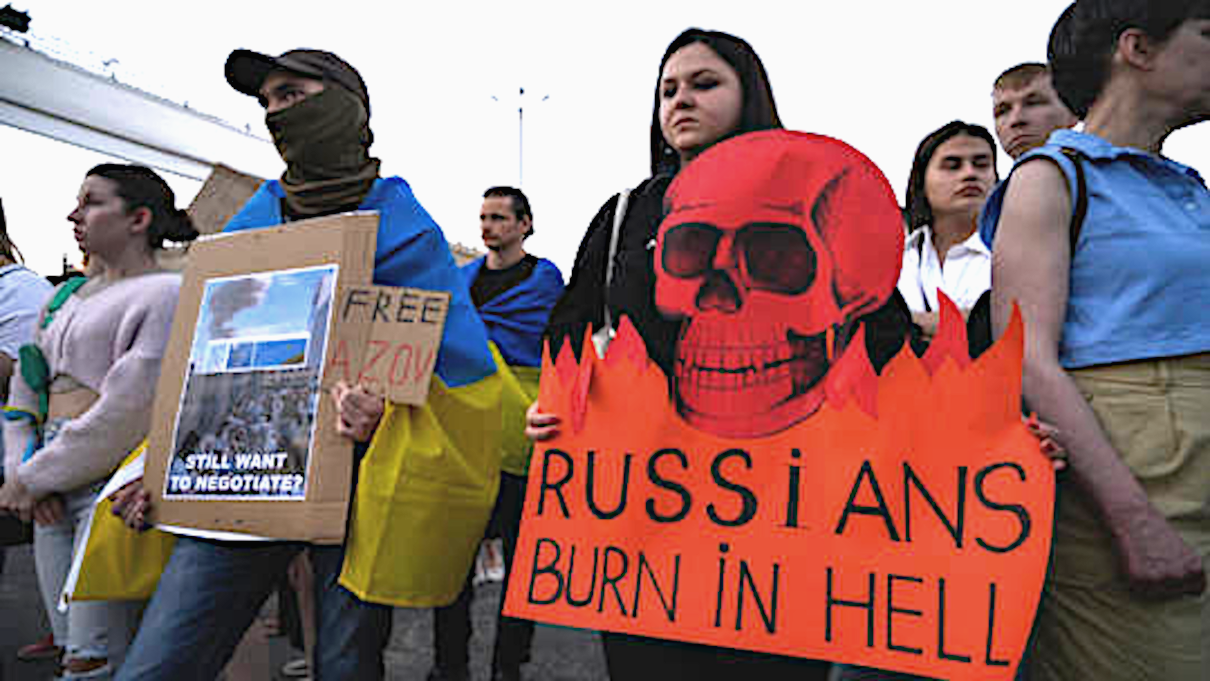
A demonstrator is holding a placard depicting a skull that reads ‘Russians burn in hell’ in Warsaw, Poland
Let’s also ignore for a moment the curious contradiction according to which one would want to rearm to “defend democracy” but, to do so, circumvents democratic institutions and proceeds “autocratically” (the “plan” will not be voted on by either the useless European Parliament or the 27 national parliaments). Translated: in whose name are we rearming ?
It’s also clear that these €800 billion are largely a three-card game, because in reality—with the exception of a portion consisting of new debt issued by both the European Union and individual nation states—a large part of them are transfers of funds intended for European “cohesion funds.” That is, the financial instruments created to ” reduce economic, social, and territorial disparities between EU Member States and regions ,” with the aim of ” promoting harmonious and sustainable development by strengthening economic, social, and territorial cohesion within the Union .”
In practice, Rearm Europe will authorize individual states to take these funds and, instead of spending them on building better infrastructure, wind or solar farms, modernizing water and sewage systems, or providing vocational training for the unemployed or young people, use them to buy weapons.
A vile game, but generally simple, like any low-budget hack.
The real problems, however, begin when you move from “finding the money” (it’s very easy to get into debt) to what to do.
‘The deranged European “elites” will fail, one way or the other. Their perception of reality is distorted by delusions, their resources – military and also intellectual – are far too small, and their aims make no sense. But the problem for the rest of us is that they may yet cause enormous damage on their way down the rubbish chute of history’.
Videos circulating on social media showed police beating and dragging protesters, including footage of an 87-year-old woman suffering a head injury as bystanders rushed to attack police and help her.
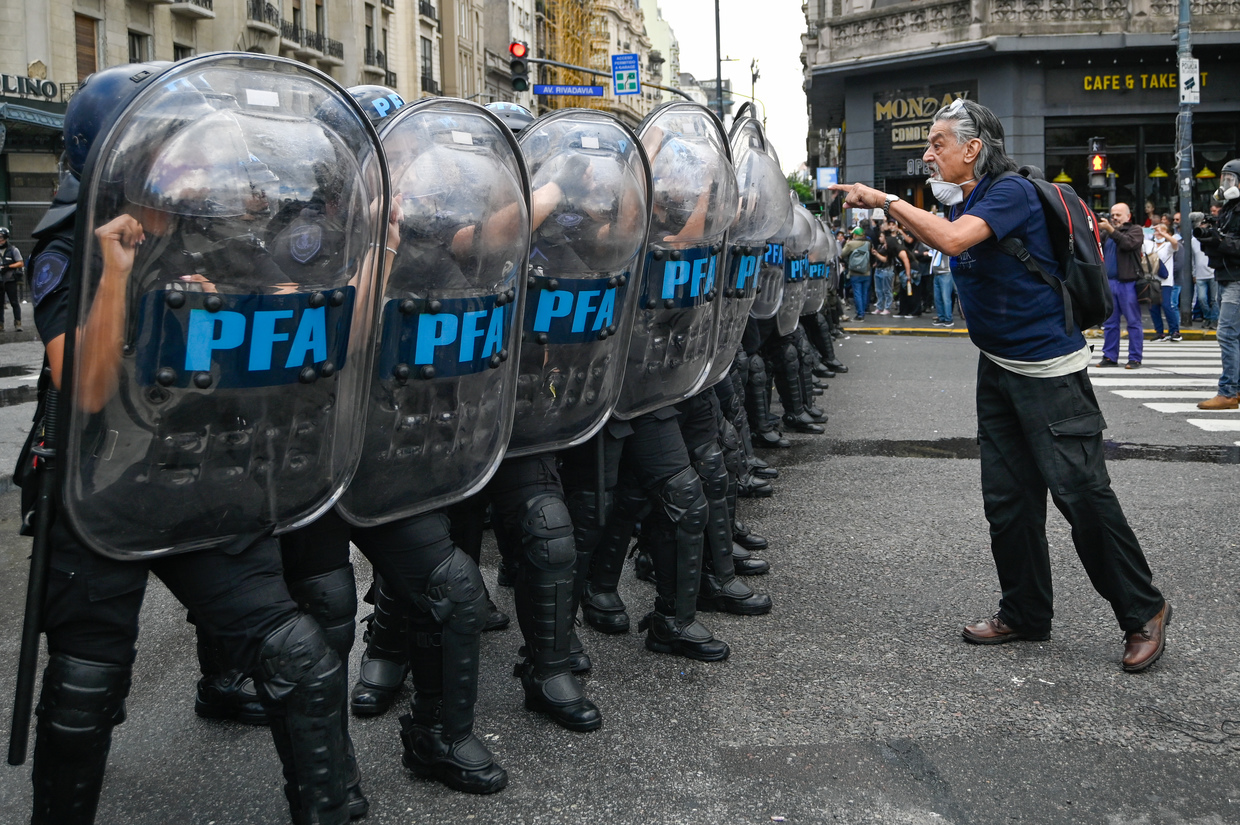
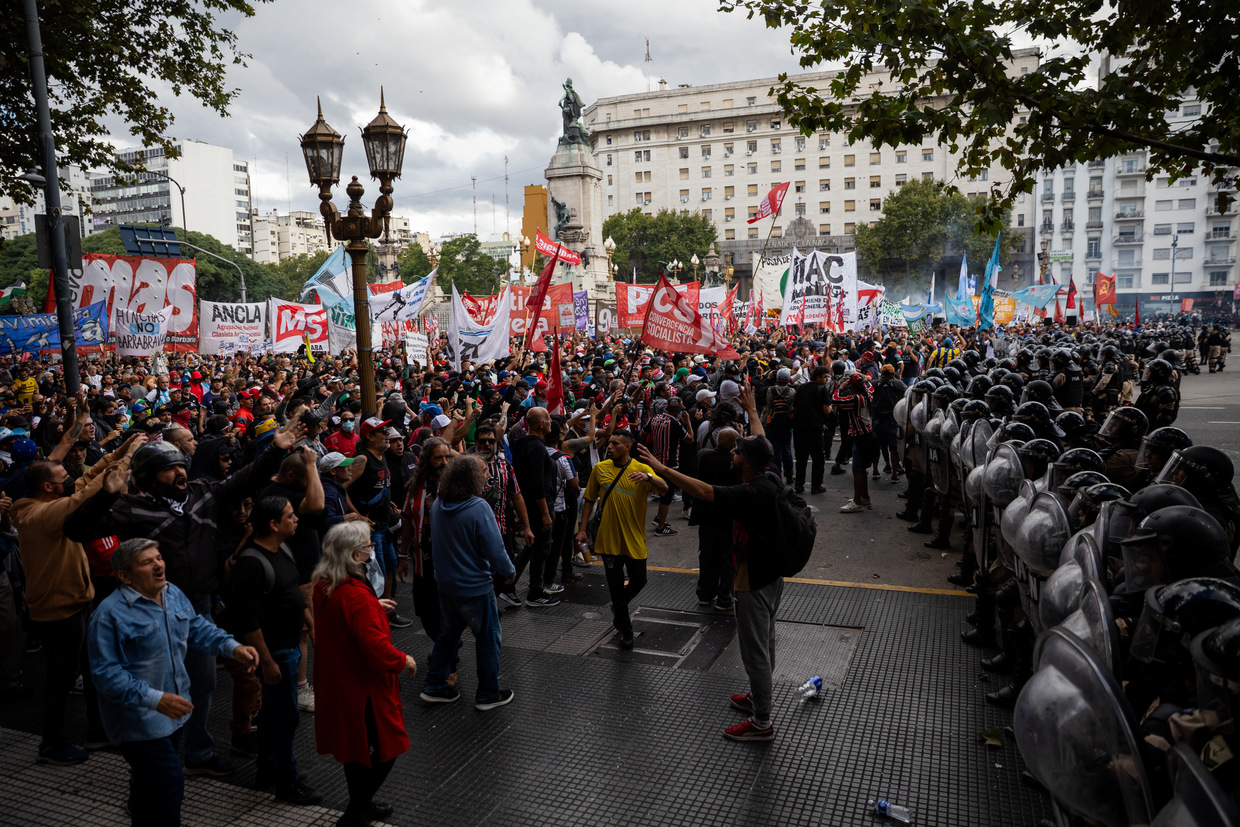
A protest outside Argentina’s Congress, where pensioners and football collectives came together to oppose President Javier Milei’s economic policies, erupted into chaos on Wednesday. Police brutalised old and young firing rubber bullets and tear gas at demonstrators, who hurled stones and torched dumpsters.
President Milei is accused of a massive robbery of tens of thousands in a Cyber swindle after promoting a new Coin in the name of the State before immense profits were withdrawn as it was it was rug pulled $LIBRA: Milei enfrenta investigaciones por presunta estafa – La FM
Retirees in Buenos Aires have staged regular weekly protests demanding higher pensions and citing worsening living conditions. While previous demonstrations saw minor clashes, including the use of tear gas against the elderly, Wednesday’s protest was the largest and most intense to date, according to observers.
Demonstrators and riot police clash during a protest against the government of Javier Milei on March 12, 2025 in Buenos Aires, Argentina. photo .. Tomas Cuesta / shared with thanks
What began as a peaceful demonstration reportedly spiraled into violent clashes, with police deploying water cannons, tear gas, and rubber bullets as protesters responded by throwing stones. A dense cloud of tear gas engulfed the congressional palace, according to local media. Amid the chaos, a police car was set ablaze, and dumpsters across the city were torched.
Some of the alleged football hooligans reportedly hurled sticks and cans at officers. With an estimated 800 officers deployed, the heavy police presence moved to suppress the demonstration.






























 The Free