Contact: steve@globaljusticeecology.org +1 (314) 210-1322 Sign on Letter Demands Justice for Forest Defender Killed by Police near Atlanta 2 May 2023–A sign on letter released on Earth Day (April 22) 2023 and closed on May Day (May 1) 2023 put out by Global Justice Ecology Project demands justice for Manuel Paez Teran, known as Tortuguita, who was killed by police in a hail…
By Eric Zuesse Source: The Duran Nobody can give a precise dollar-number to U.S. ‘Defense’ spending because the U.S. ‘Defense’ Department has never been able to pass an audit, and is by far the most corrupt of all federal Departments (and is the ONLY Department that has never passed an audit), and also because much of America’s military […]
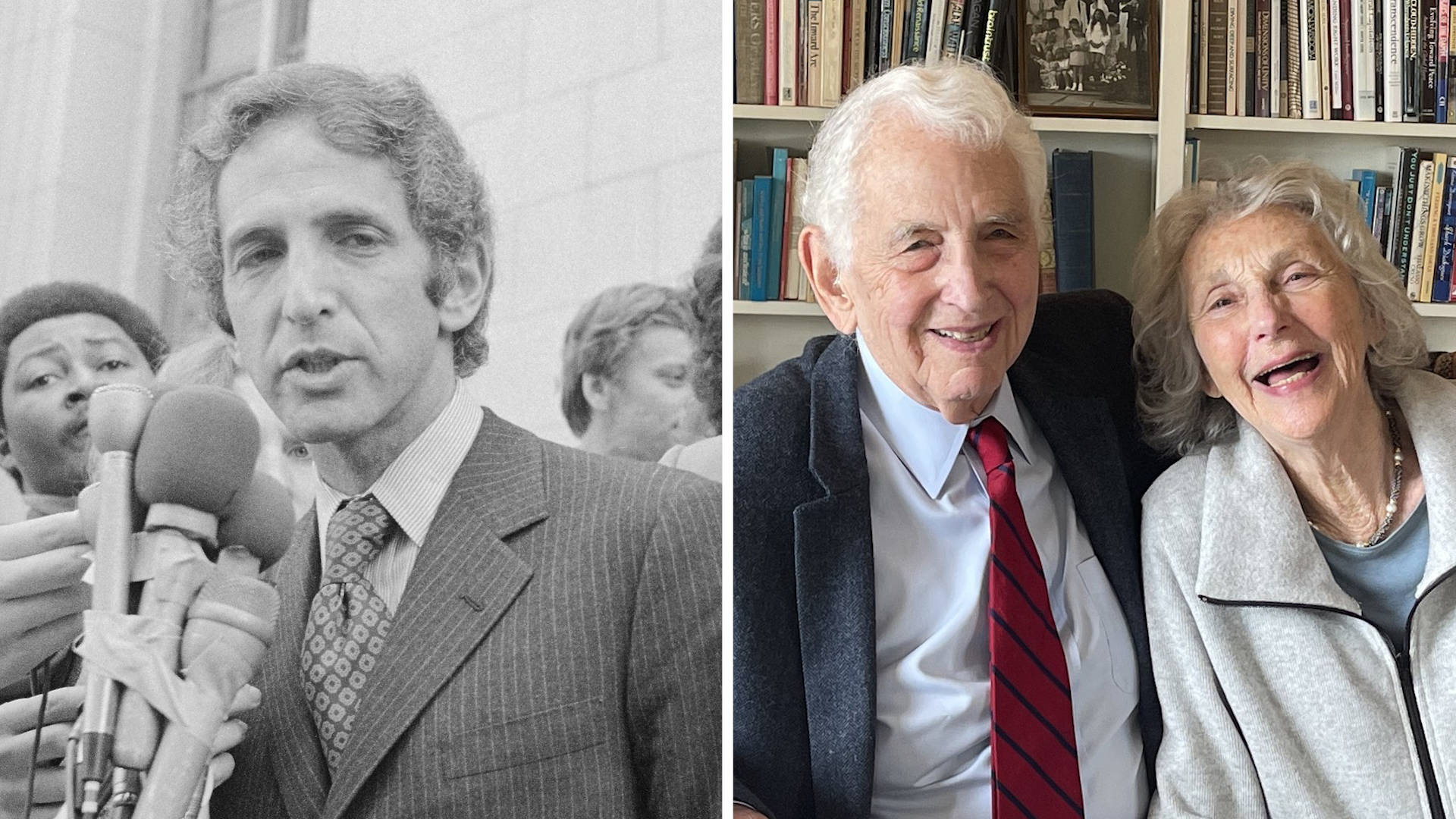
“I feel lucky and grateful that I’ve had a wonderful life … about having a few months more to enjoy life with my wife and family, and in which to continue to pursue the urgent goal of working with others to avert nuclear war in Ukraine or Taiwan (or anywhere else),”
As we continue our in-depth conversation with Daniel Ellsberg, the famed Pentagon Papers whistleblower talks about his lifelong antiwar activism and responds to the more recent leak of Pentagon documents about the war in Ukraine.
Ellsberg also reflects on the many people who inspired him and says others who look up to his example should know that the sacrifices for building a better world are worth it.
“It can work,” he says. Ellsberg, who was recently diagnosed with inoperable pancreatic cancer and given just months to live, spoke to Democracy Now! last week from his home in Berkeley, California.
Transcript.. This is a rush transcript. Copy may not be in its final form
AMY GOODMAN: This is Democracy Now!, democracynow.org. I’m Amy Goodman, as we continue our conversation with Pentagon Papers whistleblower Dan Ellsberg, who recently announced he’s been diagnosed with inoperable pancreatic cancer. This is another excerpt from the 2009 documentary The Most Dangerous Man in America: Daniel Ellsberg and the Pentagon Papers. The clip looks at how the Nixon White House responded to the Pentagon Papers leak. You’ll hear White House counsel John Dean; Egil Krogh, who went to prison for his part in Watergate; but first, President Nixon.
PRESIDENT RICHARD NIXON: Just because some guy is going to be a martyr, we can’t be in a position of allowing the fellow to get away with this kind of wholesale thievery, or otherwise it’s going to happen all over the government. I just say that we’ve got to keep our eye on the main ball. The main ball is Ellsberg. We’ve got to get this son of a bitch.
JOHN DEAN: The leak of the Pentagon Papers changed the Nixon White House. It really is what some of us have called the beginning of the dark period. I mean, it was rough and tumble before, but it got down and dirty. So it’s really a defining event for the Nixon presidency. And this is when Egil Krogh, Bud Krogh, was selected to head up the so-called Plumbers unit.
EGIL ”BUD” KROGH JR.: I was summoned to the Oval Office by the president. John Ehrlichman and I met with him. There was some suspicion that Dr. Ellsberg had access to the more recent war plans that had been developed by the Nixon administration, and would be able to release those documents. I came from that meeting feeling very strongly that I was dealing with a national security crisis, and I was to take any means necessary to respond to it.
AMY GOODMAN: Again, that’s a former Nixon official, Egil Krogh, an excerpt from The Most Dangerous Man in America: Daniel Ellsberg and the Pentagon Papers. Dan, I’m sure this is bringing you back, though you live it every day, them breaking into your psychiatrist’s office. Talk about what that meant to you, and if that was any worse than facing a hundred years in prison.
DANIEL ELLSBERG: I think it’s been misunderstood. Again, another aspect of the Pentagon Papers, it’s been misunderstood this whole time. It’s almost always described as an attempt to smear my reputation or to stigmatize me in some way. Now, I was already an American citizen facing 12 felony counts, a possible 115 years in prison. So they weren’t working with a new surface here entirely. I had been stigmatized quite a bit by that time. But that wasn’t the aim, actually, at all of their sending it in.
As Krogh indicated — and people miss this — what they were worried about was what else I knew — namely, what else I knew and could document that went beyond the Johnson administration into the Nixon administration. The Pentagon Papers themselves ended in 1968, before Nixon came in, so they didn’t incriminate him, except for his role in the ’50s supporting the French — and proposing nuclear weapons at that time, by the way. But he wasn’t mainly involved.
And so, when they came out, in fact, he was very calm about it, and properly so. “This will show,” as Kissinger said, “that it’s really the Democrats’ war, after all.” And they realized it didn’t constitute a real threat for them.
And then they realized that they had these terrific secrets that had to be kept secret from the American public because they were so criminal and dangerous — namely, that they were threatening North Vietnam with nuclear weapons, the same way that the criminal threats that are being made against Ukraine right now by Vladimir Putin.
Nixon was making those threats through the Russian ambassador, Dobrynin, and then directly at that time. And that had to be kept secret from the American people at that time, because the American democracy would not have stood for that. So they had to shut me up.
And the problem then was to find out whether I had documents that could document, prove, what I was saying, because people were very reluctant to believe that a president could lie to that degree or could be so criminal to that degree and reckless, unless they had documents to prove it, which I didn’t have and really never did convince the public on this point.
So I failed, in a way, in my name — my major project, which was to convince the public that a lying campaign, an imperial campaign against Vietnam, that had been carried on by four previous presidents, was being carried on by a fifth. I said it, but no one believed it.
They didn’t want to believe that the president was lying to them, just as they had allowed themselves to be misled by Truman, Eisenhower, Johnson, Kennedy, Kennedy and Johnson. So, that part did not succeed; however, they had reason to feel, and to fear, that I might turn up with documents that would demonstrate — which did exist.
(Natural News) Central banks are buying gold at a record pace in anticipation of fiat currency collapse. Meanwhile, the commercial banking sector is imploding. Just today, three more banks were halted on the stock exchange as their stock prices collapsed. Those three banks are PacWest Bankcorp, Western Alliance and Metropolitan Bank. More bank failures are […]
The Armenian Genocide was not a mistake. Holodomor was not a mistake. The Final Solution was not a mistake. The Great Leap Forward was not a mistake. The Killing Fields were not a mistake.
Name your genocide—it was not a mistake. That includes the Great Democide of the 2020s. To imply otherwise is to give Them the out they are seeking.
Few hours after martyrdom of Palstinian hunger striker Sheikh Khader Adnan in Israeli jail, political cartoonist Carlos Lattouf shared a cartoon of the Palestinian prisoner on his Twitter account, with a caption: “Rest in power.”
A timeline of major events in the life of Palestinian prisoner Khader Adnan, who died after an epic Hungerstrike in a racist apartheid Israeli Prison
Khader Adnan first went on hunger strike in 2012. [File: Majdi Mohammed/AP Photo]
Published On 2 May 20232 May 2023
Palestinian prisoner Khader Adnan, who was affiliated with the Palestinian Islamic Jihad group, has died in an Israeli prison after nearly three months on a hunger strike, Israeli prison officials said.
Reporting from Ramallah in the West Bank on Tuesday, Al Jazeera’s Nida Ibrahim said Adnan’s family had been warning that, after 80 days without food, his life was in danger.
INSERT: “Israel, has been severely weakened by an ongoing political crisis over a proposed judicial power grab by the Israeli government. Problems have also arisen with Israel’s approach to the status quo at the al-Aqsa Mosque in Jerusalem, a holy site where neighboring Jordan” maintains custodianship, and have caused major rows between Amman and Tel Aviv in recent months. .. Robert Inlakesh.
Adnan’s lawyer said Adnan’s condition had been deteriorating and they had asked Israeli authorities to hospitalise him.
A medic from the group Physicians for Human Rights Israel, who had visited the father of nine in prison this week, warned that he “faces imminent death” while calling for him to be “urgently transferred to a hospital”, the AFP news agency reported.
The Israel Prison Service said Adnan “refused to undergo medical tests and receive medical treatment” and “was found unconscious in his cell”.
Adnan, 45, began his strike shortly after being arrested on February 5.
Over the years, he has been repeatedly arrested by Israel and became a symbol of steadfastness in the face of Israel’s occupation when he began staging lengthy hunger strikes just more than a decade ago.
[Al Jazeera]
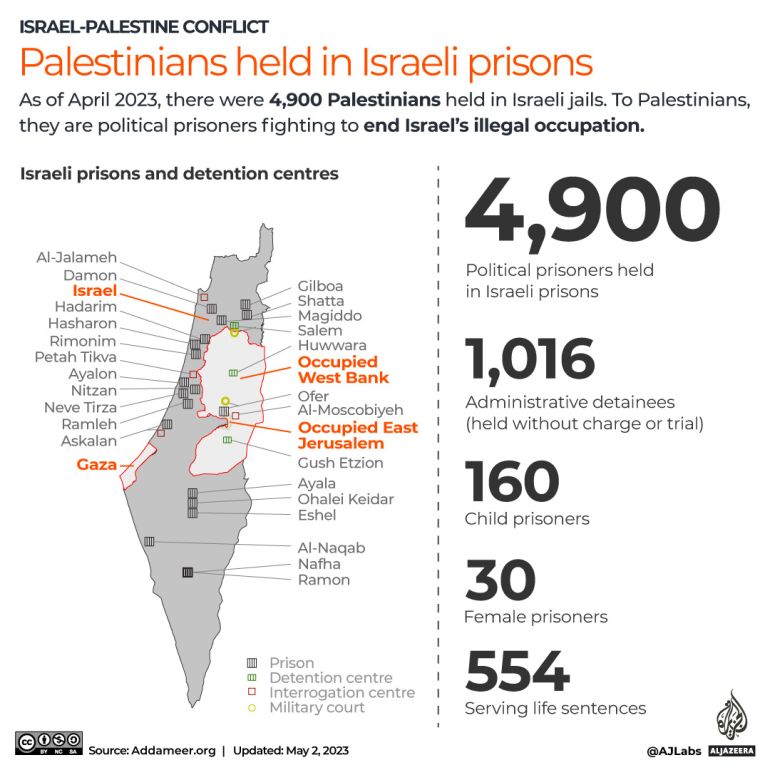
Adnan was arrested 12 times and spent about eight years in Israeli prisons, most of it under so-called “administrative detention”, in which Israel holds Palestinians on “secret evidence” for renewable six-month intervals without trial or charges
Here is a timeline of major events in Adnan’s life:
1999
Israel arrested Adnan for the first time in March 1999 and kept him in “administrative detention” for four months.
In November, the Palestinian Authority arrested Adnan for leading a student demonstration against then-French Prime Minister Lionel Jospin at Bir Zeit University. The arrest led to his first hunger strike, which lasted 10 days.
2002
Adnan was detained by Israeli security forces in 2002 and kept under “administrative detention” for a year. Six months after his release in 2003, he was arrested again and placed in solitary confinement.
2005
Adnan married Randa in 2005. Before the wedding, he sat her down and explained the perilous future that would lie ahead if she married him.
“He told me that his life was not normal, that he might be around for 15 days and then be gone again for a long time. But I always dreamed of marrying someone strong, someone who struggles in defence of his country,” she told Al Jazeera.
“I am proud of him whether he is under the ground or above it.”
Adnan was arrested in August and kept in detention for 15 months.
Video Duration 01 minutes 55 seconds 01:55Adnan death puts Israel’s administrative detention in spotlight
2008
Adnan became a father when his wife Randa gave birth to a girl, whom he named Maali after his sister. His second daughter Beesan was born two years later.
Adnan and Randa also had a boy, Abdel Rahman, and a set of triplets. At the time of his death, Adnan was the father of nine children.
2011
Israeli forces arrested Adnan on December 17 at their home in Arrabeh, near Jenin, in the occupied northern West Bank. His family were not given a reason for his arrest.
He went on a hunger strike on December 18.
Adnan’s family, his lawyer, and doctors who visited Adnan during his detention told Human Rights Watch that his health had deteriorated seriously and that Israeli authorities had shackled him to his hospital bed.